
Can I Transfer My CD Into an Annuity
As an Independent Annuity Broker, we compare rates across 100+ carriers and 1,000 different annuities— not just one company’s product offerings — to find the best fit for your goals.
Can I Transfer My CD Into an Annuity

Jason Stolz CLTC, CRPC, DIA, CAA
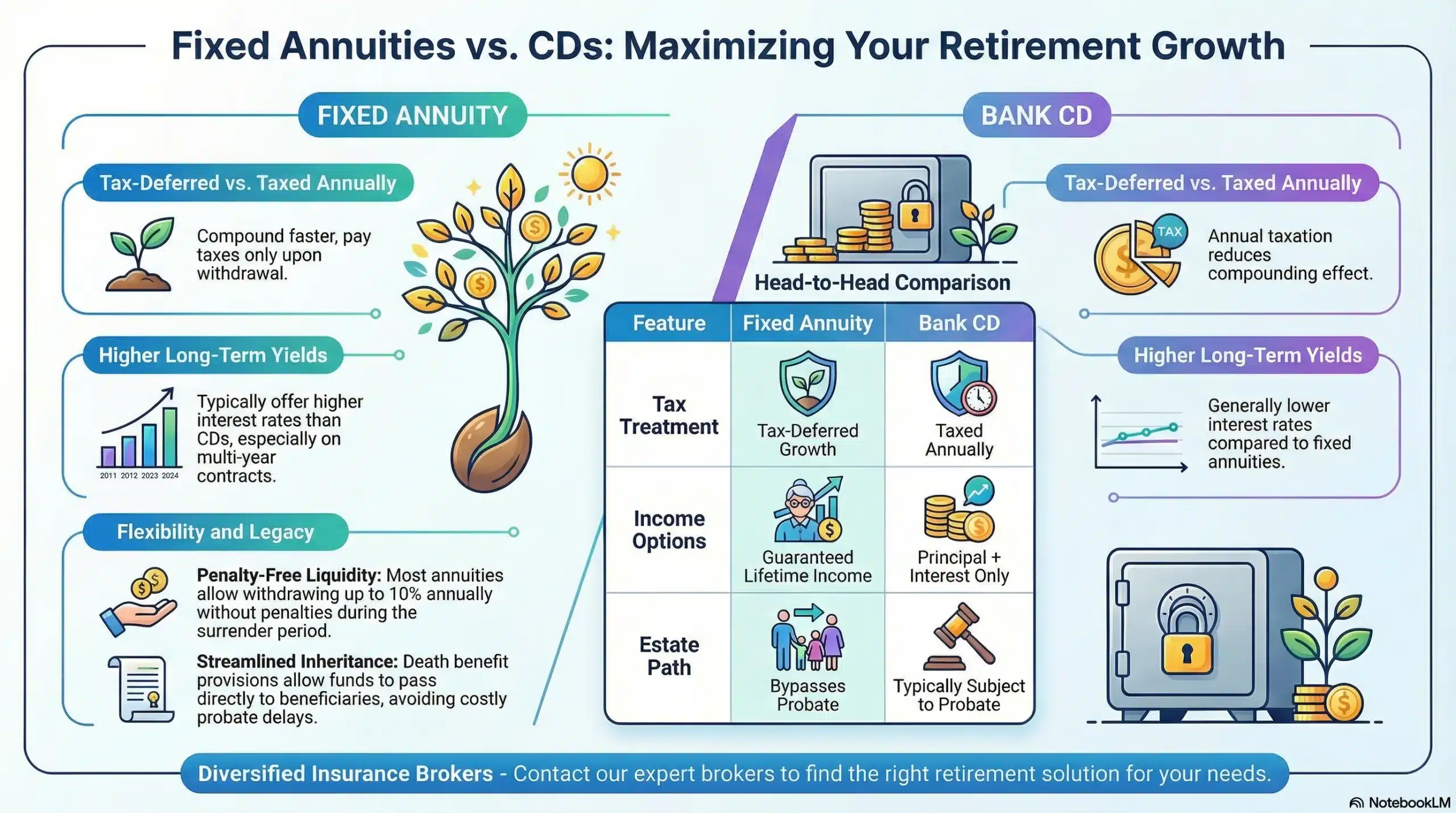
Yes — you can move CD money into an annuity. The mechanics are straightforward: the CD matures, the funds are withdrawn from the bank, and they are used to fund an annuity contract. Unlike a 401(k) rollover, which is a direct custodian-to-custodian transfer within the qualified retirement account system, a CD-to-annuity move for non-qualified funds is a straightforward two-step process: close or redeem the CD at maturity, then apply the proceeds to an annuity application. The key word is “maturity” — the cleanest and most cost-efficient moment to make this move is when the CD reaches the end of its term. Many banks automatically renew CDs into a new term within a short window after maturity, often 7 to 14 days, if no action is taken. A CD holder who has not compared options before that window closes may find themselves locked into another year or more at a rate they never actively chose. Our dedicated comparison resource, fixed annuities vs. CDs, covers the full structural comparison between these two principal-protected options, and our resource on how MYGAs compare to CDs addresses the specific product comparison most relevant for CD holders evaluating the move.
The case for moving CD money into a multi-year guaranteed annuity has been particularly compelling in the current rate environment. As of early 2026, top 5-year MYGA rates from A-rated carriers are approximately 5.50-5.70%, compared to approximately 4.15% for comparable 5-year bank CDs — a gap of roughly 1.35 to 1.55 percentage points. After accounting for the tax deferral advantage of annuity growth (non-qualified CD interest is taxed annually as it accrues; non-qualified annuity interest grows tax-deferred until withdrawn), the after-tax advantage of a MYGA over a comparable CD is wider still, particularly for investors in the 22% bracket or above. Fixed-rate deferred annuity sales — the category that includes MYGAs — topped $170 billion in 2025, driven substantially by CD holders and money market account holders seeking guaranteed rates with better tax efficiency. Our resource on understanding multi-year guaranteed annuities covers the full MYGA product structure, and our resource on why more retirees are choosing MYGAs covers the demographic and rate-environment factors driving that shift.
The decision is not universally right for every CD holder, and the right framing is not simply “the annuity rate is higher.” It is a question of whether the specific tradeoffs of an annuity — longer guaranteed term, less flexible early withdrawal provisions, state guaranty association protection rather than FDIC insurance, and tax-deferred rather than annually-taxed growth — align with the holder’s liquidity needs, time horizon, and tax situation. A CD held inside an IRA occupies a different planning context than a non-qualified bank CD because the tax deferral benefit of the annuity is redundant inside an already tax-deferred IRA. These distinctions matter for decision quality. Our resource on annuities for conservative investors covers how principal-protected annuity products fit within a conservative retirement savings framework, and our resource on are annuities a smart move when interest rates are high covers the rate-environment timing question specifically.
Ensure you are receiving the absolute top rates
Current Fixed Annuity Rates
Compare today’s best fixed annuity rates from top carriers.
Current Bonus Annuity Rates
See which annuities offer the highest upfront bonus today.
Request an Annuity Quote
Submit our annuity request form to get personalized rate options.
Lifetime Income Calculator
Use our calculator to see how much guaranteed income your CD proceeds can generate in an annuity.
CD vs. MYGA vs. Traditional Fixed Annuity — Side-by-Side Comparison
The table below compares the three most relevant options for a CD holder evaluating where to move money at maturity. All three provide principal protection. The differences are in rate potential, tax treatment, liquidity terms, and protection framework.
| Feature | Bank CD | Multi-Year Guaranteed Annuity (MYGA) | Traditional Fixed Annuity |
|---|---|---|---|
| Principal protection | Yes — full principal guaranteed by issuing bank | Yes — full principal guaranteed by issuing insurance carrier | Yes — full principal guaranteed by issuing insurance carrier |
| Rate comparison (5-year) | ~4.00-4.25% APY for top 5-year CDs | ~5.50-5.70% for top 5-year MYGAs from A-rated carriers — approximately 1.35-1.55% higher than CDs | Declared rate varies; may reset annually; rate environment at renewal applies |
| Tax treatment (non-qualified) | Interest taxed annually as ordinary income, even if left in the CD to compound | Interest grows tax-deferred; tax paid only when withdrawn — no annual tax drag on compounding | Same as MYGA — tax-deferred growth until withdrawal |
| Government-backed insurance | FDIC insured up to $250,000 per depositor per institution — federal government guarantee | Not FDIC insured — protected by state guaranty association (typically $100,000-$500,000 per annuitant per carrier depending on state) and carrier financial strength | Same as MYGA — state guaranty association protection |
| Early withdrawal penalty | Typically 90-180 days of interest forfeited — relatively modest; principal not at risk | Surrender charges: typically 7-9% in year 1, declining annually to 0% at maturity; 10% free withdrawal annually without charges | Similar surrender charge structure; varies by carrier and product design |
| At-maturity options | Receive principal + interest; bank typically auto-renews unless you act within 7-14 days | Renew, surrender for cash, annuitize for income, or 1035 exchange to another annuity tax-free — renewal notice 30-60 days before maturity | Similar options including annuitization and 1035 exchange; more flexibility in some carrier designs |
| Best fit | Short-term savings with full liquidity needs; amounts under $250,000 where FDIC protection is the top priority; shorter term requirements (3-12 months) | Funds not needed for 2-10 years; tax deferral is valuable (non-qualified); higher rate lock is the priority; straightforward “deposit and hold” approach preferred | Longer planning horizon; interest in potential for future rate adjustments; may include income rider option for eventual lifetime income |
The CD Maturity Window — When to Act and What Happens If You Miss It
Most bank CDs include a grace period at maturity — typically 7 to 14 days — during which the account holder can withdraw funds, close the CD, or redirect the money without incurring an early withdrawal penalty. Outside that window, the bank typically rolls the CD automatically into a new term at the prevailing rate offered that day. That automatic renewal is not necessarily unfavorable — the new rate may be competitive — but it removes the holder’s active decision point and may lock funds into a new term before any comparison shopping has occurred. Many CD holders who eventually move to annuities describe missing or ignoring multiple maturity windows before finally acting; each missed window represents another term locked at a bank rate rather than an annuity rate. The practical guidance is to calendar the CD maturity date several weeks in advance and use that window to compare MYGA and fixed annuity rates before the bank auto-renews. Our resource on best MYGA annuity rates and our resource on current fixed annuity rates provide current rate comparisons for this evaluation step.
What the Mechanics of a CD-to-Annuity Move Actually Look Like
For a non-qualified CD — a CD held outside an IRA or other tax-advantaged account — the mechanics of moving to an annuity are operationally simple. The CD matures and the funds are withdrawn from the bank. The proceeds, net of any taxes owed on final-period interest accrued and reportable for the year, are then applied to an annuity application. There is no IRS rollover rule, no 60-day window, and no direct transfer requirement — because you are moving between a bank deposit product and an insurance contract, not between two retirement accounts. Once the annuity is funded and issued, growth inside the annuity begins accumulating on a tax-deferred basis. Our resource on how annuities are taxed covers the full non-qualified annuity tax framework, and our resource on non-qualified annuity taxation covers the specifics of how gains are taxed when withdrawals eventually occur. One planning note: at the MYGA’s own maturity — not the CD’s, but when the annuity term ends — the holder has an option not available with CDs: a Section 1035 exchange, which allows the annuity to be exchanged into a new annuity contract on a tax-deferred basis, extending the tax deferral without triggering a taxable event. Our resource on annuity exclusion ratio covers the taxation mechanics for non-qualified annuity withdrawals when they do occur.
IRA CD to IRA Annuity — A Different Planning Context
When the CD is held inside an IRA — as many bank IRA accounts hold their assets in CD form — the move to an annuity takes on a different character. The transaction is structured as a direct IRA-to-IRA transfer from the bank to the insurance carrier: the IRA custodian (the bank) transfers funds directly to the annuity carrier, which receives them into a new IRA annuity. When handled correctly, no taxable event is triggered — the funds maintain their qualified IRA status inside the new annuity contract. The key mechanics are covered in our resources on how to transfer an IRA to an annuity and how to transfer a retirement account to an annuity. The planning context for an IRA CD is also different from a non-qualified CD in one important way: the tax deferral advantage of the annuity over the CD disappears inside an IRA, because the IRA is already tax-deferred regardless of the underlying holding. An IRA CD and an IRA MYGA both grow without annual taxation — the IRA wrapper provides that benefit. The remaining advantages of the IRA MYGA over the IRA CD are the potentially higher rate, the locked guaranteed term, the 1035 exchange option at maturity, and the ability to eventually annuitize for guaranteed lifetime income if that becomes a planning goal. For IRA CD holders with RMD concerns, the predictable maturity value of a MYGA simplifies RMD calculations at the relevant age. Our resource on what is a direct rollover covers the transfer mechanics in detail.
The Tax Difference That Widens the Rate Gap
The tax treatment difference between a non-qualified bank CD and a non-qualified annuity is one of the most underappreciated factors in the comparison, and it is particularly impactful for investors who are not spending the interest — those who are leaving it to compound. A non-qualified CD credits interest each year and the bank reports it on a Form 1099-INT. That interest is taxable as ordinary income in the year it is credited, whether or not the holder withdraws it. The CD holder who is in the 22% federal bracket and earns $2,500 in CD interest during the year owes approximately $550 in federal income tax on that interest even if the money stays in the CD. By contrast, interest credited inside a non-qualified annuity is not reported to the IRS as current income — it accrues inside the contract and is taxable only when distributed. The compound growth advantage of tax deferral increases with time horizon and tax bracket. For a holder in the 22% bracket with $200,000 in a 5-year CD vs. a 5-year MYGA at a 1.5 percentage point higher rate, the combined effect of the higher rate and tax deferral produces a meaningfully higher after-tax accumulation over the term. Our resource on how annuities are taxed in retirement covers how distributions are eventually taxed.
FDIC vs. State Guaranty — How Annuity Protection Works
One of the most consistent questions from CD holders considering annuities is about the protection structure. CDs at FDIC member institutions are insured up to $250,000 per depositor per ownership category per institution — a federal government-backed guarantee that has never failed to pay in the history of FDIC. Annuities are not FDIC insured because they are insurance products, not bank deposits. The protection mechanism for annuities is the state guaranty association system — every state has one, and each provides coverage up to specified limits (commonly $100,000 to $500,000 per annuitant per insolvent carrier, varying by state) when a licensed insurance company becomes insolvent. Our resources on are annuities FDIC insured, are annuities insured, and state guaranty association cover this protection framework. The practical guidance for holders with balances above the applicable state guaranty limit at any single carrier is to distribute across multiple carriers — the same strategy CD holders use to stay within FDIC limits across multiple banks. For balances at or below the applicable state limit at an AM Best A-rated carrier, the practical risk of carrier insolvency is historically minimal but should still be understood before purchase. Our resource on safe fixed annuity options and our resource on best fixed annuities for conservative investors cover the carrier selection framework.
Liquidity Comparison — CD Early Withdrawal Penalties vs. Annuity Surrender Charges
The liquidity comparison between CDs and annuities is the most important practical consideration before any CD-to-annuity move, and it almost always favors CDs for short-term or uncertain liquidity needs. A CD’s early withdrawal penalty — typically 90 to 180 days of interest forfeited, with principal always accessible — is relatively modest. An annuity’s surrender charge structure is more significant: most MYGAs impose charges of 7-9% in year one, declining annually until they reach zero at the end of the surrender period. A $100,000 MYGA with an 8% year-one surrender charge that is fully surrendered in year one returns approximately $92,000 — a real cost of approximately $8,000 that a CD holder who needed that money back would not have faced. The partial mitigation is the free withdrawal provision: most MYGAs allow 10% of the account value annually without triggering surrender charges, so a holder who needs a small portion of the funds can access up to $10,000 of a $100,000 contract without penalty each year. Our resource on annuity free withdrawal rules covers this provision, and our resource on annuity surrender charges explained covers the full surrender charge mechanics. The decision framework is straightforward: if there is any meaningful probability of needing more than 10% of the balance in a given year during the surrender period, keep those funds in a CD or other liquid instrument rather than an annuity.
The Laddering Strategy — Adapting CD Laddering to Annuity Laddering
Many experienced CD holders already use a laddering strategy — distributing funds across multiple CDs with different maturity dates to ensure regular access to a portion of the funds while keeping most of the balance at competitive rates. The same logic applies directly to annuity laddering, and the two strategies can be combined as funds roll from expiring CDs into annuities of different terms. A holder with $300,000 in CDs maturing in 2026, 2027, and 2028 might move the first maturity into a 3-year MYGA, the second into a 5-year MYGA, and the third into a fixed annuity with a lifetime income option — staggering the terms to maintain regular access to portions of the portfolio while locking in current rates across different time horizons. Our resources on laddering annuities and the power of laddering fixed annuities for retirement income cover the annuity laddering strategy in detail. Our resource on how to not run out of money in retirement covers the broader income sustainability framework that laddering supports, and our resource on when fixed annuities outperform market-based investments covers the sequence-of-returns context that makes guaranteed accumulation particularly valuable for retirees.
Talk With an Advisor Today
Choose how you’d like to connect—call or message us, then book a time that works for you.
Schedule here:
calendly.com/jason-dibcompanies/diversified-quotes
Licensed in all 50 states • Fiduciary, family-owned since 1980
FAQs: Can I Transfer My CD Into an Annuity?
Can I transfer my CD directly into an annuity without taxes?
For a non-qualified (non-IRA) CD, the move is not a tax-free “transfer” in the technical sense. The CD matures, you receive the proceeds (which may include interest reported on a 1099-INT), and you then fund the annuity with those after-tax proceeds. There is no IRS mechanism to move a bank CD into a non-qualified annuity on a tax-deferred basis. For an IRA CD, the move to an IRA annuity can be structured as a direct IRA-to-IRA transfer handled between the bank custodian and the insurance carrier, which is tax-neutral when done correctly as a direct trustee-to-trustee transfer. In that case, no taxable event occurs at the time of the transfer.
When is the best time to move CD money into an annuity?
The cleanest time is at CD maturity, during the bank’s grace period (typically 7-14 days after maturity). During that window, you can withdraw the full principal and accrued interest without an early withdrawal penalty. Moving before maturity triggers the bank’s early withdrawal penalty — usually 90-180 days of interest forfeited — which may or may not be worthwhile depending on the rate differential with the annuity. The practical recommendation is to calendar the maturity date several weeks in advance, compare current MYGA and fixed annuity rates against the bank’s renewal offer, and be ready to act during the grace period rather than letting the CD auto-renew into a rate you never actively evaluated.
Are annuities as safe as CDs?
Both provide principal protection, but through different mechanisms. CDs are FDIC insured up to $250,000 per depositor per FDIC institution — a federal government-backed guarantee. Annuities are not FDIC insured; they are protected by state guaranty associations (typically $100,000-$500,000 per annuitant per insolvent carrier, varying by state) and by the financial strength of the issuing insurance carrier. For balances at or below the applicable state guaranty limit at an AM Best A-rated carrier, the practical safety of the two products is comparable — but the protection mechanisms are different and the FDIC guarantee is technically stronger. For balances above $250,000, the relevant comparison is FDIC coverage across multiple banks versus state guaranty limits across multiple carriers.
Why do annuities pay higher rates than CDs?
Insurance companies issuing MYGAs and fixed annuities manage long-duration liabilities — they are designed to hold assets for extended periods and can invest accordingly. Banks issuing CDs must manage shorter-duration liquidity needs and balance sheet requirements tied to lending operations, which constrains the rates they can offer. Additionally, annuities are not FDIC insured, which means investors accept a somewhat different (though not necessarily inferior) protection structure in exchange for potentially higher yields. As of early 2026, top 5-year MYGA rates from A-rated carriers run approximately 1.35-1.55 percentage points above comparable 5-year CDs. The after-tax advantage is wider for non-qualified investors because CD interest is taxed annually while annuity interest compounds tax-deferred.
What are the downsides of moving CD money into an annuity?
The primary downside is reduced liquidity. A CD’s early withdrawal penalty (typically 90-180 days of interest) is modest. An annuity’s surrender charges (typically 7-9% in year one, declining annually) are meaningfully larger for significant early withdrawals. The 10% annual free withdrawal provision on most MYGAs partially mitigates this, but holders who may need more than 10% of their balance in a given year during the surrender period should not commit those funds to an annuity. Additional considerations: annuities are not FDIC insured; they require working with an insurance carrier rather than a bank; and for non-qualified funds, the gain will eventually be taxed as ordinary income rather than at capital gains rates. The annuity’s complexity (surrender schedules, carrier selection, future options at maturity) also requires more engagement than a simple CD renewal.
Does moving to an annuity make sense if my CD is inside an IRA?
It can — but the tax deferral advantage of the annuity over the CD disappears inside an IRA, because the IRA already provides tax deferral. The remaining advantages of an IRA MYGA over an IRA CD are: the potentially higher guaranteed rate locked for the full term; the predictable maturity value that simplifies RMD calculation; the 1035 exchange option at maturity (allowing tax-free rollover to a new annuity at the best available rate); and the option to eventually annuitize for guaranteed lifetime income. The transfer is executed as a direct IRA-to-IRA trustee transfer — no taxable event occurs at the time of the move. Rates inside an IRA are the same as for non-qualified MYGAs — there is no premium for qualified money.
About the Author:
Jason Stolz, CLTC, CRPC, DIA, CAA and Chief Underwriter at Diversified Insurance Brokers (NPN 20471358), is a senior insurance and retirement professional with more than 25 years of real-world experience helping individuals, families, and business owners protect their income, assets, and long-term financial stability. As a long-time partner of the nationally licensed independent agency Diversified Insurance Brokers, Jason provides trusted guidance across multiple specialties—including fixed and indexed annuities, long-term care planning, personal and business disability insurance, life insurance solutions, Group Health, Travel Medical and Evacuation Insurance, and short-term health coverage. Diversified Insurance Brokers maintains active contracts with over 100 highly rated insurance carriers, ensuring clients have access to a broad and competitive marketplace.
His practical, education-first approach has earned recognition in publications such as VoyageATL, and contributions from his agency featured in Kiplinger and GoBankingRates— highlighting his commitment to financial clarity and client-focused planning. Drawing on deep product knowledge and years of hands-on field experience, Jason helps clients evaluate carriers, compare strategies, and build retirement and protection plans that are both secure and cost-efficient. Visitors who want to explore current annuity rates and compare options across multiple insurers can also use this annuity quote and comparison tool.
Explore More Annuity Options: Browse our complete guide to Annuity Strategies & Retirement Income — covering tax strategies, retirement income planning, lifetime income & annuity comparisons from 100+ carriers.
Last Reviewed: June 26, 2026 |
Reviewed by: Jason Stolz, CLTC, CRPC, DIA, CAA
Chief Underwriter, Diversified Insurance Brokers, Inc. | NPN: 20471358 | Diversified Insurance Brokers, Inc. — Licensed in all 50 states
Fact Checked by: Tonia Pettitt, CMIP©
Medicare Specialist, Diversified Insurance Brokers, Inc. | NPN: 14374308 | Diversified Insurance Brokers, Inc. — Licensed in all 50 states
Did you find this content helpful? Leave us a Google review — it helps others find trustworthy guidance too.
Editorial Standards: Diversified Insurance Brokers maintains rigorous editorial standards to ensure accuracy, clarity, and independence in all content. Learn more about our editorial standards and commitment to transparency.
