
Disability Insurance for Flight Attendants
As an Independent Disability Insurance Broker, we have access to exclusive discounts and negotiated pricing most captive agents can’t offer — see the full breakdown near the end of this page.
Disability Insurance for Flight Attendants

Jason Stolz CLTC, CRPC, DIA, CAA
Disability insurance for flight attendants is an essential but frequently overlooked component of financial planning for one of aviation’s most physically demanding and psychologically taxing professions. Whether you fly domestic routes for a major carrier, work international long-haul routes spanning multiple time zones, operate regional routes on smaller aircraft, or work for a charter or private aviation operation — your income depends on your physical and psychological capacity to perform the specific duties of in-flight service and passenger safety, and a disabling condition that prevents you from meeting those demands eliminates all flight pay immediately.
Flight attendants face a disability risk profile that is more varied and more serious than most people outside the profession appreciate. Musculoskeletal injuries from luggage handling and cart operation account for a third of all reported flight attendant injuries and illnesses per OSHA data. Turbulence-related falls and injuries are a documented and recurring occupational hazard. Passenger assault incidents have increased substantially in recent years, producing everything from minor bruising to serious fractures and head trauma. Chemical exposure from cabin air contaminants and cleaning agents creates long-term respiratory risk. And the psychological burden of sustained emotional labor, irregular sleep schedules, and traumatic in-flight incident exposure creates mental health and PTSD risk that published research specifically associates with the flight attendant profession.
At Diversified Insurance Brokers, we help flight attendants structure disability insurance coverage that reflects the genuine occupational hazards of cabin crew work, the significant gaps in airline group and union disability plans, and the specific income complexity of flight attendant compensation — including base salary, trip pay, per diem, and other variable earnings components that group plans consistently exclude from benefit calculations.
Protect Your Flight Attendant Income
Compare disability insurance options designed for major airline flight attendants, regional cabin crew, charter aviation staff, and all in-flight service professionals.
What Flight Attendants Do and Why It Creates Meaningful Disability Risk
Disability insurance for flight attendants begins with a clear understanding of what the job actually involves — because the physical demands and environmental hazards of in-flight service work are substantially greater than the passenger-facing hospitality dimension of the role would suggest.
Flight attendants are primarily safety professionals. Their primary regulatory responsibility is the safe evacuation of aircraft and management of in-flight emergencies — duties that require physical capacity to operate emergency exits, deploy evacuation slides, assist incapacitated passengers, manage in-flight medical events, and perform the sustained physical tasks of emergency response in a confined, often turbulent environment. Alongside these safety responsibilities, flight attendants perform the service functions of in-flight hospitality — operating galley equipment, lifting and stowing passenger carry-on bags that routinely exceed 40 pounds, pushing and pulling heavy beverage and meal carts down narrow aisles across the full length of the aircraft, and sustaining the physical activity of cabin service across flights that can span twelve hours or more.
This combination of safety-critical physical function and sustained service labor in a unique and challenging physical environment creates an occupational disability risk profile that Diversified Insurance Brokers takes seriously. The same commitment to structuring aviation-appropriate disability coverage that we bring to pilots extends directly to flight attendants — our resource on disability insurance for pilots and aviation professionals provides parallel context for understanding how aviation occupation disability planning works across the full flight crew.
Musculoskeletal Injuries — The Most Prevalent Disability Risk for Flight Attendants
OSHA data on flight attendant occupational injury patterns consistently identifies musculoskeletal disorders — MSDs — as the most prevalent injury and illness category, accounting for approximately 33% of all reported flight attendant injuries and illnesses. The sources of this musculoskeletal burden are directly tied to the physical service demands of the cabin crew role.
Overhead bin luggage handling is the single most consistently cited source of flight attendant shoulder and back injuries. Flight attendants lift, shift, and stow passenger carry-on bags in overhead bins that require sustained overhead arm and shoulder work, often with bags that exceed 40 pounds — and they do this repeatedly across every boarding and deplaning sequence of every flight in their schedule. The sustained overhead shoulder loading of bin work produces rotator cuff injuries, shoulder impingement, and cervical spine conditions that develop gradually over years of cabin crew service and can eventually prevent a flight attendant from performing the physical demands of the role. A flight attendant who develops severe rotator cuff pathology from sustained bin work has sustained an occupational disability directly traceable to the physical demands of their specific profession — and own-occupation disability insurance is what protects that professional income.
Beverage and meal cart operation creates its own musculoskeletal exposure. Standard fully loaded aircraft beverage carts weigh between 150 and 250 pounds. Flight attendants push and maneuver these carts down narrow aisles across the length of the cabin, often on aircraft with slight floor angles from seating configuration, and must stop, stabilize, and control the cart during service across every row. The forces involved in pushing heavy loaded carts on uneven cabin floors, combined with sustained twisting and bending to serve passengers at different seat heights, create a lumbar and lower extremity loading pattern that contributes to the back injury rates documented across the flight attendant workforce. The sustained physical service labor that flight attendants perform in the confined cabin environment creates disability risks parallel to those facing other physically demanding service professionals, including restaurant workers and servers managing sustained physical service work disability risk.
Turbulence, Falls, and Acute Injury Risk in the Cabin
Slips, trips, and falls are documented as the second most common injury category for flight attendants, accounting for 16% of all reported flight attendant accidents per FAA data. The physical environment of an aircraft cabin creates specific and unavoidable fall hazard conditions that ground-based service workers do not face.
Unexpected turbulence is the most dangerous acute fall risk for flight attendants. During active cabin service — particularly beverage and meal distribution when flight attendants are standing in the aisle with heavy carts — unexpected moderate to severe turbulence can propel a flight attendant against the cabin ceiling, seat armrests, galley equipment, or the floor with forces capable of producing serious fractures, head trauma, and spinal injuries. Unlike workers in ground-based environments who can take protective action when they sense instability, flight attendants working in the aisle during turbulence often have no warning and no stable surface to brace against.
Galley floor surfaces, wet with spilled liquids from beverage service, create slip hazards on every flight. Narrow galley spaces with equipment extending into working areas create contact injury risk during service preparation and cleanup. Emergency exits and door mechanisms require significant physical force to operate, creating the risk of impact injury during emergency training exercises that flight attendants perform regularly throughout their careers. Each of these fall and acute injury scenarios can produce disabling conditions requiring extended recovery — and a flight attendant whose fracture or spinal injury requires three to six months of recovery faces the same immediate income interruption that any worker faces when a physical disability strikes, but with the specific complications of aviation employment’s income structure and group plan limitations. The acute injury risk facing flight attendants from turbulence and fall exposure in the cabin environment has parallels in other physically active service professions, including dancers and performance professionals managing acute physical injury risk in demanding work environments.
Passenger Assault — An Increasing Occupational Hazard for Flight Attendants
Physical assault by passengers has become a documented and growing occupational hazard for flight attendants over recent years. FAA incident data shows a substantial increase in unruly and assaultive passenger incidents, with thousands of incidents reported annually — including hundreds that involve physical assault against cabin crew. The injuries resulting from passenger assault range from minor bruising and lacerations to serious fractures, head trauma, and spinal injuries from physical contact, thrown objects, or wrestling incidents during attempts to restrain disruptive passengers.
A flight attendant who sustains a serious injury from a passenger assault — a fractured wrist from blocking a blow, a concussion from impact with a seat or overhead bin, a shoulder dislocation from physical restraint activity — faces exactly the same disability scenario as any other acute physical injury event. The injury prevents return to flying until medically cleared, creating an immediate income gap that disability insurance directly addresses. Unlike some workplace injury contexts where the employer’s workers’ compensation system provides reasonably adequate temporary disability income, airline workers’ compensation replaces only a portion of base salary and does not address the per diem, trip pay, and variable income components that constitute a meaningful part of flight attendant total compensation.
The psychological consequences of serious passenger assault incidents also warrant attention as a disability risk category. Flight attendants who experience or witness serious physical violence in the confined environment of an aircraft cabin may develop post-traumatic stress disorder symptoms that affect their ability to return to cabin crew work even after physical injuries have resolved. PTSD from in-flight traumatic events is specifically documented in published research on the flight attendant population — and its disability consequences can prevent return to the specific psychologically demanding environment of aircraft cabin service even when physical capacity is fully restored. The psychological disability risk from sustained exposure to traumatic events parallels that documented for other professionals in high-incident service roles, including emergency dispatchers managing PTSD and psychological disability risk from sustained trauma exposure.
Chemical and Environmental Exposure Risks for Flight Attendants
Flight attendants work in a unique environmental exposure context — pressurized aircraft cabins — that creates specific chemical and environmental health risks not faced by ground-based workers. Cabin air is supplied through engine bleed air systems that, during contamination events sometimes called “fume events” or “aerotoxic syndrome” incidents, can introduce engine oil vapors, hydraulic fluid compounds, and their thermal decomposition products into the cabin air supply. Research on cabin air contamination has identified organophosphate compounds — related to the nerve agent precursor class — as potential components of contaminated cabin air events, and multiple studies have documented neurological symptoms in flight crew members following cabin fume events.
Beyond in-flight cabin air, flight attendants work with cleaning chemicals, disinfectants, and sanitizing agents that are applied throughout the cabin during and between flights. Sustained daily exposure to these chemical agents in the enclosed cabin environment creates respiratory sensitization and skin exposure risks that, over a career of flight attendant service, can contribute to occupational asthma, chronic bronchitis, and dermatological conditions that affect continued cabin crew work. The chemical exposure health risk facing flight attendants from cabin environment contamination events and routine cleaning agent exposure creates a long-latency occupational disease dimension that disability insurance for flight attendants must address — covering not only acute injury scenarios but gradual occupational illness conditions that develop over career-long exposure.
Shift Work, Circadian Disruption, and Long-Term Health Consequences
Flight attendants work irregular schedules that are among the most chronobiologically disruptive of any profession — rotating days, nights, time zones, and rest periods across weekly schedules that vary with every bidding period. The sustained circadian rhythm disruption of long-haul international flying, red-eye domestic routes, and irregular reserve scheduling creates documented long-term health consequences for flight attendants including elevated cardiovascular disease risk, metabolic disruption, immune compromise, and increased rates of certain cancers associated with circadian disruption and night shift work.
Published research on flight attendant health — including studies published in the Journal of Occupational and Environmental Medicine — has documented that flight attendants as a population show elevated rates of certain health conditions compared to non-aviation service workers, and that long-term career exposure to the flight attendant occupational environment produces health outcomes that accumulate over a career of service. A flight attendant who develops a serious cardiovascular condition, an immune-related illness, or a cancer associated with their occupational exposure history faces a disabling health event that their airline group plan will address only partially — and that individual disability insurance addresses comprehensively by covering disability from any cause that prevents the flight attendant from performing their cabin crew duties. This long-term occupational health consequence from sustained environmental exposure parallels the documented career-long exposure outcomes facing other professions with sustained environmental health risk, including cruise ship workers managing sustained shipboard environmental exposure and health consequences.
The Gap in Airline Group Disability Plans for Flight Attendants
Most major airline flight attendants have access to employer-sponsored short-term and long-term disability coverage through their airline’s benefits program — sometimes supplemented by union-sponsored coverage. These plans provide a valuable baseline, but the limitations are significant and consistently underestimated by flight attendants who assume their disability coverage is more comprehensive than it actually is.
Airline group long-term disability plans typically replace 60% to 66.67% of base salary — with the critical limitation that “base salary” means exactly that, and no more. Flight attendants’ total compensation routinely includes per diem payments for time away from base, trip pay and hourly flight credit compensation, international override pay, language premium pay, and other variable compensation components that are entirely excluded from group plan benefit calculations. A flight attendant earning $65,000 in total annual compensation — $45,000 in base salary and $20,000 in per diem, trip pay, and override — who relies on the airline’s group long-term disability plan receives benefits calculated on the $45,000 base salary component only. The $20,000 in variable compensation that constitutes nearly a third of their total earnings is completely unprotected.
Group plans also terminate when employment ends — providing no income protection during airline furloughs, career transitions, or disability-related employment separations. Many airline group disability plans include own-occupation definitions that shift to any-occupation standards after two years of disability, potentially denying continued benefits to a flight attendant who remains physically unable to perform cabin crew duties but could technically perform ground-based work. Individual disability insurance supplements all of these gaps — covering total compensation rather than base salary only, maintaining own-occupation definitions for the life of the policy, and remaining in force through employer and airline changes. The income gap between total flight attendant compensation and group plan base salary coverage is the most important financial protection gap that individual disability insurance addresses. For flight attendants who are also exploring disability insurance as part of a broader financial protection picture, our resource on disability insurance for aviation and self-employed professionals managing income protection gaps provides parallel planning context.
Case Study: Flight Attendant Earning $72,000 Total Annual Compensation
Consider a flight attendant at a major carrier with $48,000 in base salary and $24,000 in per diem, trip pay, and international override, earning $72,000 in total annual compensation. Following a serious shoulder injury sustained during overhead bin assistance that requires surgical repair and seven months of recovery, the flight attendant cannot perform the physical demands of cabin crew service.
| Scenario | Group Plan Only | Group Plan + Individual DI |
|---|---|---|
| Monthly Benefit During Disability | ~$2,400 (60% of base salary only) | ~$2,400 group + $1,600–$2,000 individual supplement |
| Per Diem/Trip Pay Protected | $0 — entirely excluded from group plan | Supplement calibrated to total compensation including variable pay |
| 7-Month Total Income | ~$16,800 | ~$28,000–$30,800 |
| Financial Outcome | Significant income shortfall; financial pressure to return too soon | Recovery fully supported; return on medical timeline |
Overhead bin shoulder injuries are among the most commonly documented serious occupational injuries in the flight attendant workforce — they are predictable occupational outcomes of sustained bin work across a flying career. Disability insurance for flight attendants ensures this injury does not produce a financial crisis that pressures premature return to the physical demands of cabin service before surgical recovery is complete — which would risk re-injury and a worse long-term outcome for both health and career.
Mental Health and PTSD — The Psychological Disability Dimension
Research published in peer-reviewed occupational health journals specifically documents elevated rates of PTSD symptoms among flight attendants who have experienced traumatic events on the job — including in-flight emergencies, serious turbulence events, passenger assault incidents, and aircraft incidents. The confined environment of the aircraft cabin, the responsibility for passenger safety during emergencies, and the sustained emotional labor of managing both service delivery and safety functions across irregular schedules creates a psychological exposure profile that produces genuine mental health disability risk over a flight attendant career.
Many individual disability insurance policies provide coverage for mental health conditions including PTSD, major depression, and anxiety disorders when those conditions prevent performing occupational duties — but coverage terms vary significantly between carriers, with some limiting mental health benefit periods to 24 months. For flight attendants, where PTSD from in-flight traumatic events is specifically documented as a professional occupational risk, evaluating mental health coverage provisions carefully before purchasing any disability policy is an important planning step. The psychological disability risk from sustained high-stress occupational exposure parallels documented outcomes in other high-alert service professions, including event planners and high-pressure service professionals managing stress-related disability risk.
Key Policy Features for Flight Attendant Disability Insurance
Disability insurance for flight attendants should incorporate specific policy provisions that address the realities of aviation employment. The own-occupation definition is foundational — paying benefits when a condition prevents the flight attendant from performing the specific duties of cabin crew service regardless of whether they could theoretically perform ground-based work. A flight attendant whose shoulder injury prevents the sustained overhead bin work and cart handling that flying requires has a genuine occupational disability under an own-occupation policy, even if they could work in a non-physical ground role. Our comprehensive resource on own-occupation disability insurance explained covers this critical definition in full detail for aviation professionals.
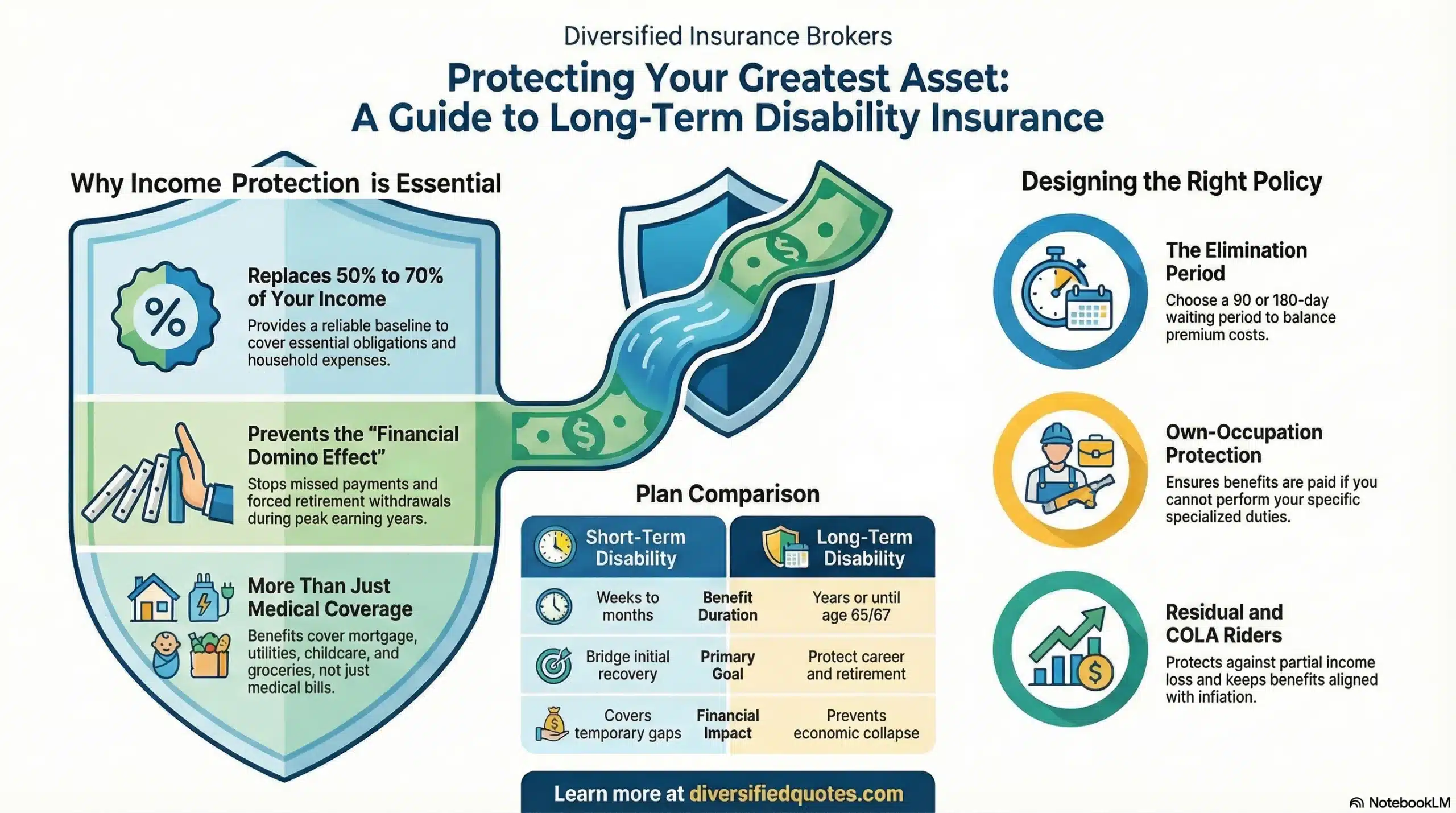
A residual disability rider is particularly important for flight attendants whose conditions may reduce flying capacity without eliminating it entirely. A flight attendant medically limited to shorter domestic routes, restricted from international long-haul flying, or cleared only for reduced monthly flight hours earns less than their normal total compensation without being totally disabled. Without a residual rider, a total-disability-only policy pays nothing during this partial capacity period. Our full resource on how residual disability insurance benefits work explains how this protection covers the income gap during partial return to flying. The cost-of-living adjustment rider preserves real benefit value during extended disability claims — our resource on disability income insurance with a COLA rider explains how this inflation protection functions for flight attendants facing extended shoulder, back, or mental health recovery timelines.
The elimination period should be calibrated to the flight attendant’s available financial reserves and their airline’s sick leave provisions. Flight attendants with meaningful airline sick bank balances and emergency savings can comfortably manage a 90-day elimination period. Those with limited sick time or financial reserves should evaluate shorter 30 or 60-day periods. Our full guide on how elimination periods work provides the complete framework. For flight attendants who want to understand how short-term disability bridges the initial gap before long-term benefits activate, our guide on how to buy short-term disability insurance provides additional context on the complete income protection picture.
Documenting Flight Attendant Income for Disability Insurance Underwriting
Income documentation for flight attendant disability insurance underwriting requires specific attention to the variable compensation components that constitute a meaningful portion of total flight attendant earnings. Disability insurance carriers base benefit amounts on verified earned income — typically using federal income tax returns — and the income figure that appears on a flight attendant’s W-2 may need to be supplemented with documentation that clarifies how per diem, trip pay, and other variable components are structured.
Per diem payments are particularly important to document correctly because their tax treatment varies — some are included in W-2 gross income while others are treated as non-taxable reimbursements. A flight attendant whose per diem is treated as non-taxable under IRS rules may find that their W-2 income significantly understates their actual compensation and financial need during a disability. Working with an independent broker who understands aviation compensation structures and how to present the full picture of flight attendant income to disability insurance underwriters is essential for securing a benefit amount that reflects total earning capacity rather than taxable W-2 income alone. The variable income documentation challenge facing flight attendants has parallels among other aviation and transportation professionals, including entertainment professionals managing variable income documentation for disability insurance underwriting.
Why Flight Attendants Need an Independent Disability Insurance Broker
Disability insurance for flight attendants involves aviation employment income complexity, mental health coverage evaluation, occupational classification assessment, and policy feature comparison that requires broker expertise to navigate effectively. An independent broker who understands aviation compensation structures, who can identify carriers most favorable for flight attendant occupational classifications, and who specifically evaluates mental health benefit provisions and per diem income documentation produces materially better coverage outcomes than enrollment in a union-offered plan or purchase through a general insurance agent unfamiliar with aviation employment.
At Diversified Insurance Brokers, we work with aviation professionals across the full flight crew — from pilots to flight attendants — and understand the income complexity, group plan limitations, and specific disability risks that characterize aviation employment. We evaluate options across multiple carriers, identify the strongest available policy definitions for flight attendant occupational duties, and structure coverage that reflects total compensation rather than base salary alone. Our dedicated resource on why independent disability insurance brokers matter explains the full value of this approach for aviation professionals. For flight attendants who want to understand the foundational financial case for individual coverage beyond their airline group plan, our resource on whether disability insurance is worth the investment provides the complete financial picture of what supplemental coverage protects.
Final Thoughts on Disability Insurance for Flight Attendants
Flight attendants serve as the primary safety professionals in every passenger aircraft cabin — responsible for passenger safety, in-flight emergencies, and the sustained physical demands of a service role that is far more physically taxing than its customer-facing hospitality dimension suggests. The musculoskeletal injuries from bin work and cart operation, the turbulence and fall risks of the cabin environment, the passenger assault exposure of recent years, the chemical and environmental health risks of the aircraft cabin, and the psychological toll of traumatic in-flight events all create genuine disability risk that deserves comprehensive income protection beyond what airline group plans provide.
Disability insurance for flight attendants — supplemental individual coverage that addresses the per diem and variable income gap, maintains own-occupation protection through career transitions, and covers mental health disabilities that airline group plans often handle inadequately — is the financial protection that ensures a cabin crew career-disrupting disability does not also become a household financial catastrophe. At Diversified Insurance Brokers, we are committed to helping every flight attendant secure that protection at the best available terms.
Related Pages
Talk With an Advisor Today
Choose how you’d like to connect—call or message us, then book a time that works for you.
Schedule here:
calendly.com/jason-dibcompanies/diversified-quotes
Licensed in all 50 states • Fiduciary, family-owned since 1980
Disability Insurance for Flight Attendants FAQs
Yes, flight attendants can obtain individual disability insurance, and the occupational classification for the profession is generally accessible through standard disability insurance carriers. Flight attendants are classified based on their specific duties — cabin crew service, safety responsibilities, and physical in-flight work — in a classification tier that reflects the occupational physical demands and injury risk profile of the role. The most important planning consideration for flight attendants is not whether coverage is available, but whether the benefit amount is structured to reflect total compensation including per diem, trip pay, and other variable earnings that airline group plans consistently exclude. Individual disability insurance supplements the airline group plan by covering the income components the group plan leaves unprotected, maintaining own-occupation definitions for the full benefit period, and providing portable coverage that follows the flight attendant through employer and airline changes throughout their career.
Musculoskeletal disorders — MSDs — are the most prevalent injury and illness category for flight attendants, accounting for approximately 33% of all reported injuries per OSHA data. Shoulder injuries from overhead bin luggage handling are the most consistently cited MSD source, followed by back injuries from cart pushing and passenger assistance, and cervical spine conditions from sustained service postures in narrow cabin spaces. Slips, trips, and falls account for 16% of all reported flight attendant accidents per FAA data, with turbulence-related falls representing the most serious acute injury risk. Passenger assault has become a documented and growing hazard category, producing injuries from minor bruising to serious fractures and head trauma. Chemical exposure from cabin air contamination events and cleaning agents creates respiratory and neurological health risks. PTSD and mental health conditions from traumatic in-flight events are specifically documented in published research on the flight attendant population. For parallel context on musculoskeletal disability risk in physically demanding service roles, see our resource on disability insurance for professionals with complex occupational risk profiles.
Airline group long-term disability plans typically replace 60% to 66.67% of base salary — with the critical limitation that “base salary” means exactly that, excluding all per diem, trip pay, international override, language premium, and other variable compensation components that constitute a meaningful portion of most flight attendants’ total annual earnings. A flight attendant earning $72,000 in total compensation — $48,000 base and $24,000 in variable components — whose airline group plan covers 60% of base salary receives approximately $2,400 per month in group disability benefits against a total compensation that would generate $6,000 per month if working. The variable income gap is entirely unprotected by the group plan. Group plans also terminate when employment ends, often shift from own-occupation to any-occupation definitions after two years, and may be taxable depending on how premiums were paid. Individual disability insurance addresses every one of these limitations — covering total compensation, maintaining own-occupation definitions permanently, and remaining in force through airline changes.
Own-occupation disability insurance pays benefits when a condition prevents a flight attendant from performing the specific duties of cabin crew service — overhead bin work, cart operation, passenger safety functions, in-flight service delivery — regardless of whether they could theoretically perform ground-based work. Any-occupation coverage only pays if the flight attendant cannot perform virtually any gainful employment. A flight attendant whose shoulder injury prevents the sustained overhead bin loading required for flying but who could technically perform a desk job at the airline would receive no any-occupation benefits, while an own-occupation policy would recognize the genuine inability to perform cabin crew duties and pay accordingly. This distinction is particularly important when airline group plans shift from own-occupation to any-occupation standards after two years — a transition that can deny continued benefits to a flight attendant who remains unable to fly but could theoretically work ground roles. Individual own-occupation coverage eliminates this risk by maintaining the stronger definition for the full benefit period. See our resource on disability insurance for professionals managing complex own-occupation definition considerations.
Many individual disability insurance policies provide coverage for mental health conditions including PTSD, major depression, and anxiety disorders when those conditions prevent performing occupational duties. For flight attendants, where PTSD from traumatic in-flight events — emergencies, serious turbulence, passenger assault incidents — is specifically documented in peer-reviewed occupational health research, mental health disability is a genuine and professional risk category rather than a remote hypothetical. Coverage terms vary significantly between carriers — some policies provide full benefits for mental health disabilities throughout the entire benefit period, while others limit mental health claims to 24 months even when the base policy would otherwise pay to age 65. For flight attendants whose career involves ongoing exposure to potentially traumatic in-flight events, evaluating the specific mental health benefit period provision of any disability policy before purchase is essential planning. At Diversified Insurance Brokers, we specifically evaluate mental health coverage terms when structuring disability insurance for aviation professionals.
Per diem payments create an important income documentation consideration in flight attendant disability insurance underwriting. Per diem can be treated differently for tax purposes — some is included in W-2 gross income, while some is treated as non-taxable expense reimbursement under IRS rules. When per diem is non-taxable, it may not appear on the W-2 income figure that disability insurance underwriters use for benefit calculation — potentially causing the benefit amount to be calibrated against a lower income figure than the flight attendant’s actual total compensation warrants. Working with an independent broker who understands aviation compensation structures and knows how to document and present total flight attendant compensation — including per diem, trip pay, override pay, and other variable components — is essential for securing a benefit amount that reflects genuine earning capacity and financial need during a disability. The variable income documentation challenge for flight attendants is among the most important practical planning considerations for getting the right benefit amount. For related context on how variable income documentation affects disability insurance, see our resource on disability insurance for professionals with complex variable income structures.
Residual disability coverage pays proportional benefits when a disabling condition reduces a flight attendant’s flying capacity and income without eliminating the ability to work entirely. A flight attendant medically restricted to shorter domestic routes due to a shoulder condition, cleared for only reduced monthly flight hours due to a back injury, or limited to certain aircraft types during recovery from a physical condition earns less than their normal total compensation without being totally disabled. Without a residual disability rider, a total-disability-only policy pays nothing during this partial capacity period. A residual rider supplements reduced flying income proportionally throughout the graduated return to full flying capacity, ensuring continuous financial support from the onset of disability through full return to unrestricted cabin crew service. For flight attendants whose most likely disabling conditions — shoulder and back injuries — often produce gradual functional limitations and graduated return timelines rather than binary on-off incapacity, this rider is essential for the policy to function as genuine income protection across the full recovery arc.
The elimination period should be calibrated to the flight attendant’s available sick bank balance at their airline, financial reserves, and how quickly income loss would create genuine financial hardship. Flight attendants with substantial airline sick time banked and meaningful emergency savings can often manage a 90-day elimination period — using sick time and savings to bridge the waiting period before long-term disability benefits begin. Flight attendants who have exhausted sick time from prior medical events, who have limited savings, or who are early in their career with a limited sick bank should evaluate shorter 30 or 60-day elimination periods. It is also worth noting that airline group short-term disability plans typically begin paying on day eight of disability — meaning there is usually at least a brief institutional bridge before individual long-term disability benefits would need to activate, which affects how much the elimination period selection matters for employed flight attendants with full group benefit programs. For the complete framework on elimination period selection, see our resource on elimination period planning for service professionals with variable institutional income support.
This is one of the most important advantages of individually owned disability insurance over airline group plan enrollment. An individually owned disability insurance policy belongs to you — not to your employer. When employment at an airline ends for any reason, including furlough, voluntary departure, or disability-related employment separation, your individual policy remains in force as long as premiums continue to be paid. The airline group plan, by contrast, terminates immediately when employment ends. For flight attendants whose careers may include multiple airline employers, furlough periods, leaves of absence, or voluntary transitions between carriers, the portability of individual disability insurance is a fundamental financial planning advantage. Furlough periods — when no airline income is being earned and group plan coverage has lapsed — are precisely the periods when a disabling condition arising from prior occupational wear and injury history is most financially catastrophic without an individual policy in place to provide income replacement. Securing individual disability insurance while actively employed and healthy ensures coverage is in place regardless of airline employment fluctuations.
The best time is as early as possible in a flight attendant career — ideally in the first years of active flying before occupational health conditions from bin work, cart operation, turbulence exposure, or other cabin crew physical demands have accumulated in the medical record. Disability insurance premiums are based in part on age and health status at the time of application, and younger flight attendants in excellent health secure the most comprehensive coverage at the most favorable rates. Shoulder conditions from bin work, back conditions from cart and passenger handling, and psychological health findings from traumatic incident exposure can all produce exclusion riders or restricted terms if documented at the time of application. Applying before these occupational health consequences develop ensures comprehensive coverage is in place when they eventually emerge — as they predictably do over a flight attendant career. The non-cancelable and guaranteed renewable provision locks in that early-career health rating for the life of the policy, regardless of what health developments occur in subsequent flying years.
An independent broker brings aviation compensation documentation expertise, carrier access across the full marketplace, and the ability to compare policy definitions, mental health coverage provisions, per diem income documentation approaches, and premium structures across multiple carriers simultaneously. For flight attendants whose income includes per diem, trip pay, and other variable components requiring specific handling in underwriting, the difference between a broker who understands aviation compensation and one who does not can be a meaningful difference in the benefit amount secured. A captive agent or union plan enrollment process presents only one company’s approach. At Diversified Insurance Brokers, we evaluate the full competitive marketplace for every flight attendant we work with — identifying the carriers most favorable for cabin crew occupational classifications, ensuring mental health coverage provisions are adequate for the aviation occupational context, and structuring benefit amounts that reflect total flight attendant compensation rather than base salary alone. Our resource on why independent disability insurance brokers matter explains this value for aviation professionals in full detail.
Browse Disability Insurance for Transportation, Maritime & Hazardous Occupations
About the Author:
Jason Stolz, CLTC, CRPC, DIA, CAA and Chief Underwriter at Diversified Insurance Brokers (NPN 20471358), is a senior insurance and retirement professional with more than 25 years of real-world experience helping individuals, families, and business owners protect their income, assets, and long-term financial stability. As a long-time partner of the nationally licensed independent agency Diversified Insurance Brokers, Jason provides trusted guidance across multiple specialties—including fixed and indexed annuities, long-term care planning, personal and business disability insurance, life insurance solutions, Group Health, Travel Medical and Evacuation Insurance, and short-term health coverage. Diversified Insurance Brokers maintains active contracts with over 100 highly rated insurance carriers, ensuring clients have access to a broad and competitive marketplace.
His practical, education-first approach has earned recognition in publications such as VoyageATL, and contributions from his agency featured in Kiplinger and GoBankingRates— highlighting his commitment to financial clarity and client-focused planning. Drawing on deep product knowledge and years of hands-on field experience, Jason helps clients evaluate carriers, compare strategies, and build retirement and protection plans that are both secure and cost-efficient. Visitors who want to explore current annuity rates and compare options across multiple insurers can also use this annuity quote and comparison tool.
Explore All Disability Insurance Options: Browse our complete Disability Insurance guide — covering occupations, high risk jobs, medical professionals, self-employed, and planning strategies from 100+ carriers.
Last Reviewed: June 7, 2026 |
Reviewed by: Jason Stolz, CLTC, CRPC, DIA, CAA
Chief Underwriter, Diversified Insurance Brokers, Inc. | NPN: 20471358 | Diversified Insurance Brokers, Inc. — Licensed in all 50 states
Fact Checked by: Tonia Pettitt, CMIP©
Medicare Specialist, Diversified Insurance Brokers, Inc. | NPN: 14374308 | Diversified Insurance Brokers, Inc. — Licensed in all 50 states
Did you find this content helpful? Leave us a Google review — it helps others find trustworthy guidance too.
Editorial Standards: Diversified Insurance Brokers maintains rigorous editorial standards to ensure accuracy, clarity, and independence in all content. Learn more about our editorial standards and commitment to transparency.
