
F&G Prosperity Elite – Bonus Income and Long-Term Retirement Confidence
F&G Prosperity Elite – Bonus Income and Long-Term Retirement Confidence
At Diversified Insurance Brokers, we specialize in building retirement income strategies designed to last a lifetime — not just perform well in good markets. The F&G Prosperity Elite Fixed Indexed Annuity, issued by Fidelity & Guaranty Life Insurance Company, is engineered for individuals who want meaningful market-linked growth, contractual income guarantees, and health-based income protection features built into one comprehensive design. In an environment where retirees are increasingly concerned about longevity risk, inflation pressure, and stock market volatility, Prosperity Elite addresses all three: principal protection through a 0% floor, multiple index crediting strategies for upside participation, an Enhanced Guaranteed Minimum Withdrawal Benefit (EGMWB) rider with powerful roll-up mechanics, and impairment-based income multipliers that can significantly increase payouts if health circumstances change. Reviewing today’s current fixed annuity rates and current bonus annuity rates provides useful context when comparing declared-rate guarantees versus indexed growth structures like Prosperity Elite.

The Mandatory Package Choice: Enhancement vs. Protection
Prosperity Elite is not a standard FIA with optional riders bolted on. Every buyer must choose one of two packages at the time of application — and that choice fundamentally defines what the contract does for you. The Enhancement Package includes a vesting premium bonus applied to the account value and a Guaranteed Minimum Death Benefit Rider (GMDB) — this version is focused on legacy and wealth transfer, structured for buyers whose primary objective is passing maximum value to beneficiaries. The Protection Package includes a vesting premium bonus, the Enhanced Guaranteed Minimum Withdrawal Benefit Rider (EGMWB), and an Enhanced Guaranteed Minimum Death Benefit Rider (EGMDB) — this version is structured for buyers whose primary objective is guaranteed lifetime income with health-contingent multipliers. Both packages carry a charge. The EGMWB rider in the Protection Package costs 0.35% of the income base annually. This page covers the Protection Package — the version most relevant for retirement income planning.
Understanding the distinction between the two value bases inside the Protection Package is essential before evaluating the numbers. There are two parallel values maintained by the contract: (1) the accumulation value (also called account value) — the actual contract balance that earns index credits, is subject to surrender charges, and is used for death benefit and liquidity calculations; and (2) the income base — a separate calculation base used exclusively by the EGMWB rider to determine the dollar amount of guaranteed lifetime income payments. These two values grow differently and serve different purposes. A premium bonus credited to the income base does not increase the accumulation value. The 18% income base bonus in year 1 affects only the income calculation, not the amount you could surrender or leave to heirs.
Ensure you are receiving the absolute top rates
Current Fixed Annuity Rates
Compare today’s best fixed annuity rates from top carriers.
Current Bonus Annuity Rates
See which annuities offer the highest upfront bonus today.
Request an Annuity Quote
Submit our annuity request form to get personalized rate options.
Prosperity Elite: Key Product Specifications
| Feature | Details |
|---|---|
| Carrier and Financial Strength | Fidelity & Guaranty Life Insurance Company, Des Moines, Iowa. Founded 1959. Subsidiary of Fidelity National Financial, Inc. (FNF), Fortune 500 (#313). AM Best: A (Excellent). $47.6B+ total assets. NAIC complaint index: 0.10 (below 1.00 national average). J.D. Power 2023: #1 overall customer satisfaction; 2024: #7. Available in most states outside New York; state availability varies significantly by term and package type — confirm availability in your state before applying. |
| Product Structure and Package Election | Flexible premium deferred FIA. Terms: 7, 10, or 14 years (14-year not available in many states). Minimum premium: $10,000. Additional premiums: minimum $2,000 per payment, maximum $1,000,000 cumulative. Mandatory package election at issue — either Enhancement Package (GMDB rider, legacy focus) or Protection Package (EGMWB + EGMDB riders, income focus). This page covers the Protection Package. Issue age 71+ receives death benefit in installments over 10 years rather than lump sum. |
| EGMWB Rider: Income Base Mechanics | Income base only — not account value. Income base starts with initial premium multiplied by the EGMWB rider rate, producing the 18% income base bonus in year 1. Income base then grows at 10% simple annual roll-up for up to 10 years, or until income payments begin, whichever comes first. Critical disclosure: F&G reserves the right to change the roll-up rate upon restart — it is not contractually fixed at 10% permanently. The minimum guaranteed roll-up rate is 3%. Rider charge: 0.35% of income base annually. Lifetime income withdrawal percentage is a function of age at activation — beginning at 3.3% of income base at age 50, increasing with each year income is deferred. For a full explanation of how roll-up mechanics determine income outcomes, see our guide on income annuity roll-up rates. |
| Impairment Multiplier | If qualifying conditions are met, lifetime income payments increase 2X (1.5X for joint contracts). Qualification requirements: EGMWB rider in force at least 3 years (5 years in Hawaii and Illinois); annuitant unable to perform at least 2 of 6 ADLs, certified by licensed physician; annuitant requires care of a licensed caregiver; impairment began at least 1 year after contract issue and expected to be permanent; annuitant is age 60 or older and a U.S. resident; account value must be greater than zero. Subject to state availability. Not a long-term care insurance policy. |
| Liquidity, Waivers, and Account Value Bonus | Free withdrawals: 10% of vested account value beginning in year 2 (noncumulative). All year-1 withdrawals subject to surrender charges and MVA. RMDs waive surrender charges and MVA. Included waivers (no additional charge): Nursing Home Rider (not available in MA or SD), Terminal Illness Rider, Home Health Care Rider (not available in FL). Account value premium bonus: a separate vesting bonus applied to the accumulation value that vests over the surrender period — this is distinct from the 18% income base bonus. For a broader overview of annuity withdrawal rules, see our guide on annuity free withdrawal provisions. |
| Death Benefit and Index Crediting | EGMDB death benefit paid as the greatest of: (a) account value including total vesting bonus even if not fully vested; (b) minimum guaranteed surrender value; or (c) initial premium plus vesting bonus on initial premium growing at 5% simple interest for 10 years or until age 85 (older owner if joint), whichever first. Index options include S&P 500, Barclays Trailblazer Index, GS Global Factor Index, and Gold Commodity Index — each with 0% floor and annual reset. Multiple crediting methods per index: point-to-point with cap, point-to-point with participation rate, performance trigger rate (flat positive return triggers declared rate). For a full breakdown of how crediting methods work, see our guide on how fixed indexed annuities work. |
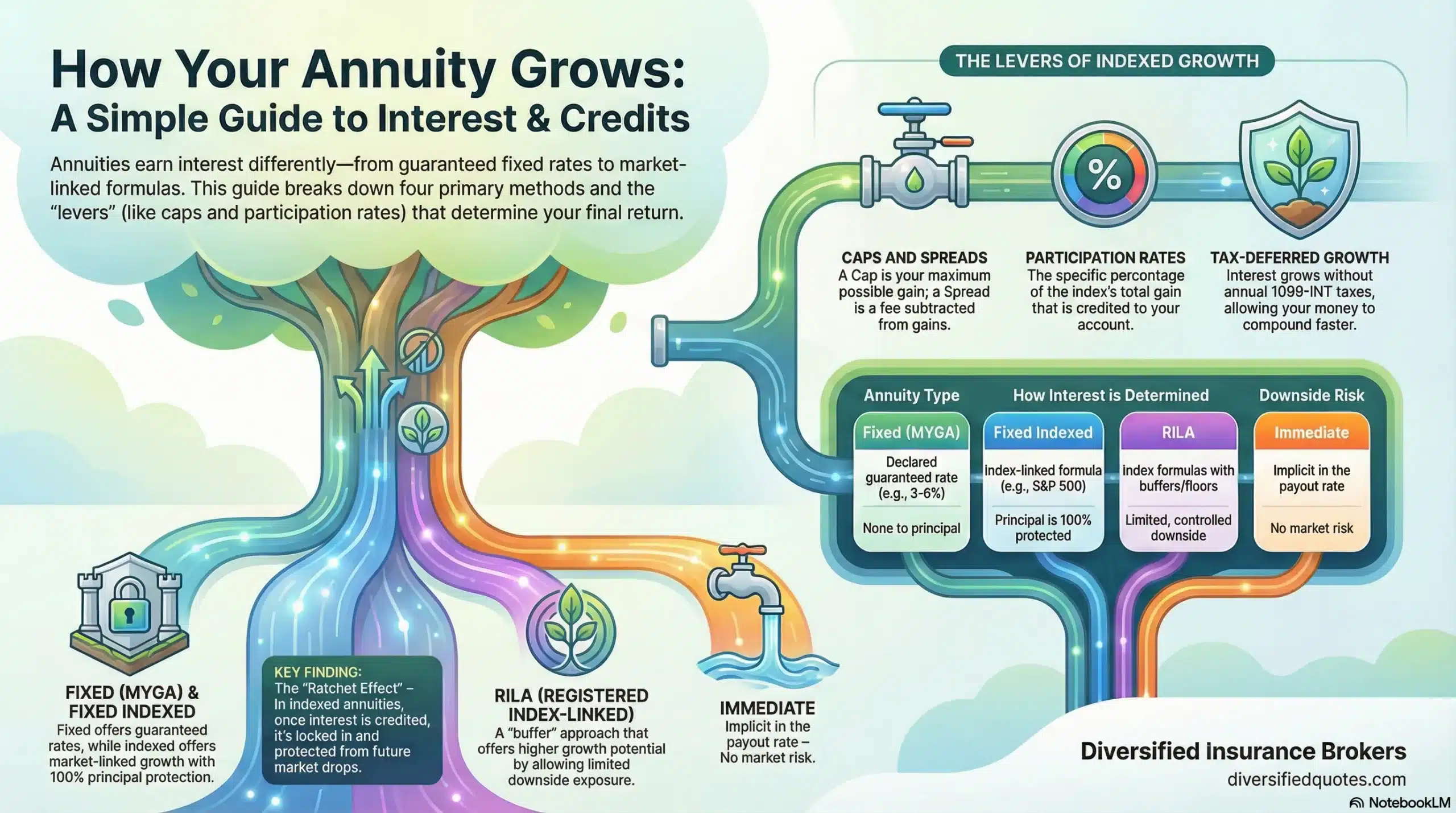
Unlike traditional fixed annuities that credit a set interest rate, Prosperity Elite credits interest based on the performance of selected market indexes — while protecting your principal from downside loss. Gains, once credited, are locked in annually under reset structures. This is particularly valuable during the critical five to ten years before retirement, when protecting accumulated wealth becomes more important than chasing pure upside. Prosperity Elite includes access to multiple index options such as the S&P 500, Barclays Trailblazer Index, GS Global Factor Index, and Gold Commodity Index — allowing diversification within the contract itself. Because growth is tax-deferred, your earnings compound without annual taxation until withdrawals begin, making this structure particularly attractive for income-oriented FIA buyers and IRA rollovers alike.
The EGMWB Roll-Up: What 10% Simple Growth Actually Produces
The income mechanics of the Protection Package deserve precise explanation rather than headline treatment. The EGMWB rider starts the income base at 118% of the first-year premium (the 18% income base bonus). The income base then grows at 10% simple annual roll-up — meaning it adds 10% of the original income base each year, not 10% of the prior year’s income base. Simple growth adds a fixed dollar amount each year; compound growth would produce more over time. On a $100,000 premium: income base at year 1 = $118,000. Adding $11,800 (10% of $118,000) per year simple: year 5 = $177,000; year 10 = $236,000 (the maximum roll-up period is 10 years). Lifetime income at activation depends on the payout percentage for the annuitant’s age — starting at 3.3% at age 50 and increasing with each year income is deferred. Deferring to age 70 with a 10-year roll-up in force could produce substantially higher guaranteed income than activating at 55. Our resource on how activation age affects annuity income provides the comparative framework across different start ages.
One rider provision that merits explicit attention: F&G reserves the right to change the roll-up rate upon a restart (a restart occurs when you voluntarily pause and resume income payments). The minimum guaranteed roll-up rate is 3% — not 10%. The 10% roll-up is the current contractual rate and is locked in during the initial accumulation period before income begins, but if you restart income later, the roll-up rate that applies to a new accumulation period after the restart could be lower than 10%. This is a material contract term for buyers who plan to start and stop income distributions. Our resource on roll-up rates vs. payout rates explains how these two mechanics combine to determine actual lifetime income output.
The Impairment Multiplier: Income Protection Without a Separate LTC Policy
One of the most unique aspects of Prosperity Elite is the Impairment Multiplier embedded in the EGMWB rider at no additional charge. If qualifying conditions are met, annual income payments double (or increase 1.5X for joint contracts). This creates a built-in health income enhancement without requiring a separate long-term care policy. However, it is not a substitute for comprehensive long-term care insurance, and buyers evaluating this feature should understand the qualifying conditions clearly before relying on it for care planning. The Impairment Multiplier requires: (1) the EGMWB rider has been in force for at least 3 years — 5 years in Hawaii and Illinois; (2) the annuitant is unable to perform at least 2 of the 6 standard activities of daily living, certified by a licensed physician; (3) the annuitant requires the care of a licensed caregiver; (4) the impairment began at least 1 year after the contract issue date and is expected to be permanent; (5) the annuitant is age 60 or older and a U.S. resident; and (6) the account value is greater than zero. The feature is subject to state availability. The “permanent” impairment requirement distinguishes this from a temporary disability or recovery scenario. For a comparative analysis of this type of feature versus standalone long-term care coverage, our income rider evaluation framework provides context for fitting the Impairment Multiplier into a broader care protection plan.
See how Prosperity Elite can increase your guaranteed lifetime income.
Request Your Custom Annuity Quote
F&G, Fidelity National Financial, and the A-Rated Carrier Context
Fidelity & Guaranty Life Insurance Company is a subsidiary of Fidelity National Financial, Inc. (FNF) — a Fortune 500 company primarily known as one of the largest title insurance providers in the United States. FNF acquired F&G in 2020, providing institutional capital backing and a large corporate parent. F&G holds an AM Best A (Excellent) rating, placing it squarely in the A tier — not A+ (which Integrity Life and North American hold) and not A- (which Delaware Life and Aspida hold), but A — a strong financial strength grade that most financial advisors accept without reservation for long-term commitments. The NAIC complaint index of 0.10 is well below the national average of 1.00, and J.D. Power ranked F&G first overall in individual annuity customer satisfaction in 2023. Its ranking shifted to seventh in 2024, which remains among the industry’s stronger performers. These operational metrics reflect a carrier that delivers well on policyholder experience alongside the financial strength guarantee. Understanding how state guaranty association coverage works alongside carrier ratings is relevant for any annuity commitment — our resource on state guaranty associations explains the coverage structure that applies to all licensed carriers regardless of AM Best rating.
Prosperity Elite can be structured using qualified funds (IRA, 401(k), 403(b)) or non-qualified assets. A properly executed Roth IRA rollover to an annuity avoids immediate taxation and may simplify income planning. As retirees approach required minimum distribution age, coordination between income riders and RMD rules becomes increasingly important — our overview of RMD changes under SECURE 2.0 explains how annuity income may satisfy RMD obligations depending on contract elections. Because Prosperity Elite’s rider income may satisfy RMD obligations, aligning contract elections with tax strategy is a key part of the advisory process at the point of application. Within the F&G lineup, sibling products include the F&G Safe Income Advantage for buyers wanting built-in income without a mandatory package election, and the F&G Performance Pro for buyers who want a simpler GWLB structure at a lower rider cost. Our broader annuity education hub outlines the full landscape of product types and how income-rider FIAs fit within a layered retirement strategy.
Fidelity & Guaranty Insurance Company is known for competitive indexed annuity designs and strong rider engineering. However, selecting the right annuity is never about one product alone — it is about fit. At Diversified Insurance Brokers, we compare more than 75 top-rated carriers to ensure each recommendation aligns with your age, liquidity needs, income timeline, tax status, and legacy objectives. Prosperity Elite is particularly well-suited for clients who want strong roll-up mechanics, enhanced income multipliers, and flexible index allocation options within one contract. If your goal is to create dependable income that can adjust to changing health conditions while preserving principal protection, this product deserves consideration alongside the full range of top income FIAs and pension rollover options available in the current market.
Position your retirement savings with growth potential and health-based income protection.
Start Your Personalized Prosperity Elite Analysis
Lifetime Income Calculator
Use our calculator to see how much guaranteed income your annuity can provide.
Financial Protection Essentials
Compare insurance rates, retirement tools, and business protection strategies that help strengthen long-term financial planning.
Talk to an Advisor or Request Your Annuity Quote
Ready to explore this annuity in more detail—or compare it with other carriers to see if even higher rates are available? With guaranteed income, principal protection, and long-term growth potential on the line, making the right choice is essential. The experienced advisors at Diversified Insurance Brokers will guide you through the options and design a strategy tailored to your retirement goals.
Schedule here:
calendly.com/jason-dibcompanies/diversified-quotes
Licensed in all 50 states • Fiduciary, family-owned since 1980
What is the difference between the Enhancement Package and the Protection Package — and can I switch after issue?
The package election is permanent at contract issue — you cannot switch after the annuity is issued. The Enhancement Package provides a vesting premium bonus and the Guaranteed Minimum Death Benefit Rider (GMDB), without the EGMWB income rider. This version is appropriate for buyers whose primary goal is maximizing wealth transfer to beneficiaries with index-linked growth potential. The Protection Package provides the same vesting premium bonus plus the EGMWB (lifetime income) and Enhanced GMDB riders. Both packages carry a rider charge — the EGMWB charge in the Protection Package is 0.35% of the income base annually. Given the permanence of this election, buyers should decide before application which objective is primary: legacy and death benefit maximization (Enhancement Package) or guaranteed lifetime income with the Impairment Multiplier (Protection Package). A formal illustration comparing the accumulation value, income base trajectory, and projected lifetime income under both packages at your specific premium amount, age, and intended income start date is the most direct tool for making this decision. Our resource on annuitization vs. income rider decisions provides foundational context for evaluating which structure fits your retirement income objective.
The 10% roll-up says F&G can lower it — what does that mean in practice?
During the initial accumulation period — from contract issue until the first Guaranteed Withdrawal Payment begins — the roll-up rate is the declared rate at contract issue and applies for the full pre-income period up to 10 years. F&G’s right to change the roll-up rate is exercised upon a “restart” — a restart occurs when a policyholder who has been receiving income payments voluntarily stops taking payments and re-enters an accumulation period. If you restart, the roll-up rate applied to the new accumulation period is whatever F&G declares at that time, with a contractual floor of 3%. For buyers who intend a straightforward strategy — accumulate for a defined number of years, begin income, and never restart — the roll-up rate change provision is essentially non-applicable. The 10% is the declared rate that applies to the initial accumulation through income start. For buyers who anticipate pausing and restarting income distributions due to circumstances change, the restart provision and its potential 10% to 3% roll-up reduction is a meaningful planning risk. Buyers in the latter category should model the income impact at the minimum guaranteed 3% roll-up rather than assuming a restart produces the same 10% growth trajectory. Our resource on income rider fees and contract provisions covers restart mechanics across different carrier designs.
How does the joint contract Impairment Multiplier work differently from the single-life version?
For a joint contract (two annuitants), the Impairment Multiplier increases income payments by 1.5X rather than 2X when the qualifying conditions are met. The qualifying conditions are otherwise the same — the impaired individual must be the annuitant, unable to perform 2 of 6 ADLs, certified by a licensed physician, requiring a licensed caregiver, with impairment beginning at least 1 year post-issue, expected to be permanent, age 60+, and a U.S. resident. In practical terms: if a couple’s joint contract is producing $30,000 per year in guaranteed lifetime income, and the primary annuitant qualifies for the Impairment Multiplier, payments increase to $45,000 annually (1.5X) rather than $60,000 (which would apply to a single-life contract under the 2X provision). The 1.5X joint provision still represents a meaningful income increase for care funding — but married couples evaluating this feature should model both the joint 1.5X and single-life 2X scenarios. Some couples choose to structure separate single-life contracts rather than a joint contract specifically to preserve the 2X multiplier for each individual. Our resource on joint life annuity income for married couples covers the structural trade-offs between joint and single-life contract designs.
How does the Prosperity Elite 7 differ from the Prosperity Elite 10 and 14?
The three Prosperity Elite versions share the same EGMWB rider structure, income base mechanics, and Impairment Multiplier. What differs is the surrender charge period: 7, 10, and 14 years respectively. The 14-year version is not available in a significant number of states and is generally more restrictive in its availability. The longer surrender periods typically come with higher cap rates and participation rates — the carrier takes on a longer-duration liability in exchange for offering better credited interest. This creates a genuine product selection decision: buyers with shorter time horizons or liquidity concerns may prefer the 7-year term with somewhat lower crediting parameters but a faster exit window. Buyers who are confident they will hold through 10+ years and want to maximize indexed growth alongside the income rider should consider the 10-year or 14-year versions. The 10-year version is the most widely available and the most commonly illustrated. Our resource on annuity income rider costs across different products provides context for evaluating the 0.35% EGMWB charge against the income rider value produced at different ages and surrender periods.
How does Prosperity Elite compare to other F&G income FIAs — Safe Income Advantage and Performance Pro?
F&G offers multiple FIAs with income riders, and Prosperity Elite occupies the bonus-and-income segment of the lineup. The F&G Safe Income Advantage has a built-in income feature at no separate rider charge (the product is structured around the income guarantee without a named rider fee), making its cost structure different from Prosperity Elite’s 0.35% annual charge. The F&G Performance Pro uses a mandatory Guaranteed Withdrawal for Life Benefit (GWLB) rider at 0.10% of the income base — notably lower than Prosperity Elite’s 0.35% — and also includes an impairment multiplier (2X single, 1.5X joint), but requires no income for the first 10 years to unlock the multiplier. Prosperity Elite’s defining advantage over Performance Pro is the 18% income base bonus and 10% simple roll-up, which produce a larger income base faster for buyers who want to begin income in fewer than 10 years. Performance Pro’s advantage is the lower 0.10% rider cost, which accumulates significantly less fee drag over a 10- to 14-year holding period. The right choice between the three depends on income start timeline, sensitivity to rider cost, and whether the income base bonus is the primary driver.
About the Author:
Jason Stolz, CLTC, CRPC, DIA, CAA and Chief Underwriter at Diversified Insurance Brokers (NPN 20471358), is a senior insurance and retirement professional with more than 25 years of real-world experience helping individuals, families, and business owners protect their income, assets, and long-term financial stability. As a long-time partner of the nationally licensed independent agency Diversified Insurance Brokers, Jason provides trusted guidance across multiple specialties—including fixed and indexed annuities, long-term care planning, personal and business disability insurance, life insurance solutions, Group Health, Travel Medical and Evacuation Insurance, and short-term health coverage. Diversified Insurance Brokers maintains active contracts with over 100 highly rated insurance carriers, ensuring clients have access to a broad and competitive marketplace.
His practical, education-first approach has earned recognition in publications such as VoyageATL, and contributions from his agency featured in Kiplinger and GoBankingRates— highlighting his commitment to financial clarity and client-focused planning. Drawing on deep product knowledge and years of hands-on field experience, Jason helps clients evaluate carriers, compare strategies, and build retirement and protection plans that are both secure and cost-efficient. Visitors who want to explore current annuity rates and compare options across multiple insurers can also use this annuity quote and comparison tool.
Explore More: Browse our complete Lifetime Income Planning guide — covering retirement income strategies, account transfers & annuity income solutions from 100+ carriers.
Last Reviewed: June 24, 2026 |
Reviewed by: Jason Stolz, CLTC, CRPC, DIA, CAA
Chief Underwriter, Diversified Insurance Brokers, Inc. | NPN: 20471358 | Diversified Insurance Brokers, Inc. — Licensed in all 50 states
Fact Checked by: Tonia Pettitt, CMIP©
Medicare Specialist, Diversified Insurance Brokers, Inc. | NPN: 14374308 | Diversified Insurance Brokers, Inc. — Licensed in all 50 states
Did you find this content helpful? Leave us a Google review — it helps others find trustworthy guidance too.
Editorial Standards: Diversified Insurance Brokers maintains rigorous editorial standards to ensure accuracy, clarity, and independence in all content. Learn more about our editorial standards and commitment to transparency.
