
Life Insurance for Cushing’s Syndrome
Life Insurance for Cushing’s Syndrome

Jason Stolz CLTC, CRPC, DIA, CAA
Two people can both carry a “Cushing’s syndrome” diagnosis on their chart and represent entirely different underwriting risk. One has a small pituitary tumor, surgically removed years ago, with life expectancy that research shows can mirror the general population. The other has an adrenal or ectopic source that was never fully controlled. Same diagnosis on paper. Genuinely different files. The single most important thing to understand before applying for life insurance with this history is that the source of the excess cortisol, and how completely it was treated, matters far more than the diagnosis label itself.
This isn’t a niche distinction that only matters in rare cases. Cushing’s syndrome covers a genuinely wide range of situations — a patient on long-term prednisone for an autoimmune condition, a patient who had a small pituitary tumor removed a decade ago, and a patient still working through active treatment for an adrenal tumor can all technically carry the same diagnosis code, while representing three entirely different conversations with an underwriter. Understanding which situation actually applies to you, and documenting it clearly, is what determines whether this page’s outcome is a straightforward approval or a drawn-out back-and-forth.
Jason Stolz, CLTC, CRPC, DIA, CAA, is Chief Underwriter at Diversified Insurance Brokers and has worked Cushing’s syndrome cases enough to know exactly which records separate a strong file from a difficult one. As an independent broker working across dozens of carriers, our office knows how to present a treated Cushing’s case in a way that gives underwriters the specific evidence they need, rather than leaving them to assume the worst from a diagnosis code alone.
Navigating life insurance with a Cushing’s syndrome history and want an honest, specific read on your options? Let’s talk.
Talk to a Life Insurance Specialist
| Your Situation | What It Typically Means | What Helps Right Now |
|---|---|---|
| Pituitary or benign adrenal adenoma, surgically treated, confirmed remission | Research shows survival can closely mirror the general population — often the strongest category | Surgical pathology report, post-op cortisol testing, and current remission status |
| Exogenous cause (long-term steroid medication) | Underlying condition requiring the steroids is often the primary underwriting question, not the Cushing’s label itself | Documentation of the underlying condition and current steroid dose or tapering status |
| Recently completed treatment, still in the tapering phase | Genuinely early — this 1-2 year window carries its own recognized risks, including elevated clot risk | Endocrinologist follow-up confirming tapering is proceeding without complication |
| Long-term remission (5+ years), documented comorbidity control | Generally favorable, though some studies show modestly elevated long-term cardiovascular risk even after cure | Recent cardiovascular risk factor labs (blood pressure, glucose, lipids) |
| Ectopic source or adrenocortical carcinoma | A genuinely more complex case — these causes carry the highest mortality risk among Cushing’s etiologies | Complete oncology and endocrinology records; guaranteed issue remains available now |
| Recurrence after initial surgical treatment | Recurrence itself is a recognized risk factor, independent of the original case’s severity | Full records of both the original and recurrent treatment course |
Outcomes above reflect general, well-documented underwriting patterns and are not a quote or a guarantee; actual results depend on the complete file and the specific carrier.
See Real-Term Rates Side by Side
Life Insurance Quoter
Why the Source of the Cortisol Matters More Than the Diagnosis
Cushing’s syndrome describes the effects of prolonged excess cortisol exposure, but it isn’t one single disease with one single cause. The excess cortisol can come from outside the body, through long-term corticosteroid medication prescribed for another condition, or from inside the body, where a tumor drives cortisol production directly. Endogenous cases break down further: a pituitary tumor causing excess ACTH is specifically called Cushing’s disease, a benign or malignant adrenal tumor can produce cortisol directly, and rarer ectopic tumors elsewhere in the body can also drive ACTH production.
Endocrinologists also classify endogenous cases along a second axis worth understanding, since it shows up throughout the medical records an underwriter will review: whether the excess cortisol is ACTH-dependent or ACTH-independent. Cushing’s disease and ectopic ACTH-producing tumors are both ACTH-dependent, meaning the pituitary or another tissue is driving the adrenal glands to overproduce cortisol by pumping out excess ACTH. Adrenal adenomas and adrenal carcinomas are ACTH-independent, meaning the adrenal gland itself is producing excess cortisol regardless of what the pituitary is signaling. This distinction directly determines which imaging and lab tests were used to confirm the diagnosis, and it’s a normal, expected part of a complete endocrinology workup, not an unusual detail specific to a difficult case.
Endogenous Cushing’s syndrome is genuinely rare on its own, with published incidence estimates in the range of two to four cases per million people per year. This distinction is exactly what drives the underwriting conversation, and it’s well supported by outcome research. Patients whose Cushing’s syndrome came from a pituitary adenoma or a benign adrenal adenoma, and who were successfully treated, generally show survival outcomes that closely track the general population. Ectopic Cushing’s syndrome and cases caused by adrenocortical carcinoma carry meaningfully higher mortality risk than the other categories. Two applicants with the identical diagnosis label can represent genuinely different risk profiles depending entirely on which of these categories their case actually falls into, which is exactly why a bare diagnosis code, without the underlying pathology and imaging behind it, tells an underwriter almost nothing useful on its own.
Exogenous Cushing’s: The Real Question Is Usually the Underlying Condition
A significant share of Cushing’s syndrome cases come from long-term steroid medication, prescribed for conditions like severe asthma, autoimmune disease, or after an organ transplant. In fact, exogenous glucocorticoid use is recognized as the single most common cause of Cushing’s syndrome overall, more common than every endogenous cause combined, simply because corticosteroid medications are prescribed so widely across so many conditions. This is worth stating plainly, because it reframes how common this diagnosis actually is: most people carrying a Cushing’s syndrome label got there through a prescribed medication, not through a tumor.
In these cases, the Cushing’s syndrome itself is often secondary to the real underwriting question: what’s the underlying condition requiring steroid treatment, how well is it controlled, and what does the current steroid dose look like. A case built on well-managed rheumatoid arthritis with a low, stable steroid dose is a different file than one built on a condition that’s still poorly controlled. There’s also a genuine medical reason steroid tapering has to be handled carefully rather than simply stopped: prolonged steroid use suppresses the body’s own hypothalamic-pituitary-adrenal axis, the internal system responsible for producing cortisol naturally. Stopping a long-term steroid abruptly can leave the body without enough cortisol from any source, a real medical emergency called adrenal insufficiency, or in its acute form, adrenal crisis. This is exactly why exogenous Cushing’s cases are tapered gradually under medical supervision rather than discontinued outright, and it’s exactly why documentation of that tapering process, not just a statement that steroids were “stopped,” is genuinely useful supporting evidence.
Documentation of both pieces, the underlying condition and the steroid regimen itself, gives an underwriter the complete picture rather than an incomplete one built around the Cushing’s label alone.
How Cushing’s Syndrome Is Actually Diagnosed and Confirmed
Understanding how a Cushing’s diagnosis actually gets confirmed clinically helps explain exactly what documentation an underwriter is looking for, since the confirmatory tests themselves become the strongest evidence in your file. Diagnosis typically starts with one or more screening tests designed to demonstrate that cortisol levels are genuinely elevated and aren’t following the normal daily pattern a healthy person’s cortisol follows. A 24-hour urinary free cortisol test measures total cortisol output across a full day. A late-night salivary cortisol test checks whether cortisol, which should be at its lowest point late at night in a healthy person, is instead still elevated. A low-dose dexamethasone suppression test checks whether a dose of synthetic steroid, which should suppress the body’s own cortisol production in a healthy person, fails to do so.
Once elevated cortisol is confirmed, a blood ACTH level helps distinguish whether the case is ACTH-dependent or ACTH-independent, which then determines what kind of imaging comes next: MRI of the pituitary gland for suspected Cushing’s disease, CT imaging of the adrenal glands for suspected adrenal causes, and a broader search, sometimes including chest imaging, when an ectopic ACTH source is suspected. This full sequence of tests, not just the final diagnosis, is what a complete endocrinology record actually contains, and it’s precisely the kind of documentation that turns a bare diagnosis label into a case an underwriter can evaluate with genuine confidence.
The Three Phases After Treatment, and Why Timing Matters
Endocrinology research on post-treatment Cushing’s recognizes three distinct phases, and understanding them helps explain why timing genuinely affects an underwriting outcome. Immediately after successful surgery, the focus is confirming remission and managing the abrupt drop in cortisol, since removing the source of excess cortisol, whether that’s a pituitary tumor, an adrenal tumor, or an ectopic source, means the body suddenly has to rely on whatever cortisol-producing tissue remains, which is often suppressed and slow to recover.
Over the following one to two years, patients typically go through a glucocorticoid tapering phase, during which they’re placed on replacement hydrocortisone and gradually weaned off it as their own hypothalamic-pituitary-adrenal axis recovers its normal function. This recovery period doesn’t follow a fixed timeline — for some patients, normal cortisol production returns within months, while for others it can take considerably longer, and a treating endocrinologist typically confirms recovery through repeat cortisol testing rather than simply estimating based on time elapsed. This tapering window carries its own recognized risks, including a real, documented spike in blood clot risk that in some research is actually higher in the year immediately following successful treatment than during the active disease itself, alongside the ongoing risk of adrenal insufficiency if the taper moves faster than the body’s own recovery.
Beyond that window, long-term management shifts to annual surveillance for recurrence and monitoring of cardiovascular risk factors that may persist even after cortisol levels have fully normalized. This means a case just a few months past surgery and a case five or more years into confirmed remission are genuinely different files, even with an identical original diagnosis. The tapering-phase window specifically deserves careful, honest documentation rather than being glossed over as simply “recovering,” since an underwriter reviewing a case still inside this window is looking at fundamentally incomplete information about where the case will ultimately land.
Have your surgical and endocrinology records and want to know what they’d mean for your application? Let’s look at the specifics.
Get a Confidential Case Review
Bone Health: A Real, Measurable, and Genuinely Reversible Comorbidity
Osteoporosis is one of the best-documented complications of Cushing’s syndrome, and it deserves its own dedicated discussion because it’s both common and, encouragingly, largely reversible with successful treatment. Prolonged cortisol excess directly interferes with bone formation while accelerating bone breakdown, and this holds true regardless of whether the excess cortisol came from an endogenous tumor or from exogenous steroid medication. Published research has found osteoporosis present in roughly 36% and fragility fractures in roughly 13% of patients with active Cushing’s syndrome, and other cohorts have reported fracture rates ranging as high as 19% to 50% depending on the population studied. Vertebral compression fractures are the most frequently reported fracture type, and in some cases, a fragility fracture is what actually leads to the original diagnosis, particularly in younger patients whose fracture would otherwise be unexpected.
Here’s the genuinely encouraging part of this picture: research following patients over time has found that bone density measurably improves after Cushing’s syndrome goes into remission, with the prevalence of osteoporosis declining consistently on follow-up scans once cortisol levels normalize. This is a meaningfully different pattern than some of the cardiovascular effects discussed elsewhere on this page, which can persist even after biochemical cure. Bone health genuinely tends to move in the right direction once the underlying cortisol excess is resolved, which is exactly why a follow-up DEXA bone density scan showing improvement, or at minimum stability, since treatment is such valuable supporting evidence for a life insurance application.
Does Remission Actually Mean the Risk Is Gone?
Mostly, but not entirely, and it’s worth being honest about the nuance here rather than overselling a clean recovery. Some long-term studies have found that patients in remission from Cushing’s disease continue to show modestly elevated overall mortality compared to the general population, even more than a decade after successful treatment, driven primarily by circulatory disease. Other research following patients over twenty years found that remission restored life expectancy essentially to normal, regardless of which treatment approach achieved it, provided ongoing comorbidities were actively managed. The honest summary sitting between these findings is this: successful treatment dramatically improves the outlook, but cardiovascular risk factors that developed during active disease don’t necessarily disappear the moment cortisol levels normalize, and how well those residual risk factors are subsequently managed matters as much as the remission itself.
This is exactly why current blood pressure, glucose, and cholesterol readings are genuinely relevant supporting evidence for a Cushing’s case, even years after successful treatment — they demonstrate whether the comorbidities that came with active disease have actually resolved, or whether they’re being actively managed if they haven’t. A file that shows normal blood pressure, normal glucose tolerance, and a stable weight several years after treatment tells a very different story than a file where these same markers remain abnormal despite biochemical cure, even though both files might describe someone in confirmed cortisol remission.
It’s also worth understanding that the degree of cardiovascular risk that develops during active disease appears to be connected to how long the condition went undiagnosed and how severe the hypercortisolism was before treatment. This is one more reason the length of time between symptom onset and actual diagnosis, when that information is available in a patient’s history, can be a genuinely useful data point rather than an incidental detail.
Recurrence: A Real Consideration for Surgically Treated Cases
For Cushing’s disease treated with pituitary surgery, published cure rates for smaller tumors run roughly 65% to 90% with initial surgery, and recurrence rates afterward have been reported as high as 20%. Recurrence isn’t just “the same case again” from an underwriting standpoint — it’s treated as its own independent signal, since it suggests the original treatment may not have fully addressed the source, and it typically prompts a more thorough evaluation the second time around, sometimes including a second surgery, radiation therapy directed at the pituitary, or medication to control cortisol production directly when a second surgery isn’t advisable.
Because recurrence can happen years after an initial successful surgery, the long-term surveillance protocol matters as much as the original treatment record. Most endocrinologists recommend ongoing annual cortisol testing for years after apparent remission, specifically because recurrence doesn’t always announce itself with obvious symptoms right away. A case involving recurrence generally benefits from complete documentation of both the original and follow-up treatment, along with clear evidence of current remission status, and ideally, some explanation from the treating endocrinologist about why the recurrence happened and what, if anything, was done differently the second time to address it.
Building the Strongest Possible File
A handful of specific records make a disproportionate difference in how a Cushing’s syndrome case gets evaluated. First, clear documentation of the cause: surgical pathology confirming a pituitary or adrenal adenoma, or complete records of the underlying condition if the cause was exogenous steroid use. Second, confirmation of current remission or control status, including the specific confirmatory test results, urinary free cortisol, salivary cortisol, or dexamethasone suppression testing, rather than just a physician’s summary statement that the patient is “doing well.” Third, current cardiovascular risk factor labs, since these remain relevant even well past successful treatment. Fourth, a recent DEXA bone density scan if one has been performed, particularly useful if it shows improvement or stability compared to a scan taken during active disease. Fifth, an endocrinologist’s follow-up note confirming ongoing surveillance and stability, including how frequently follow-up testing is occurring.
Together, these give an underwriter a genuinely complete picture rather than asking them to assume either the best or the worst from a diagnosis code alone. It’s worth taking the time to request these specific records directly from a treating endocrinologist’s office before applying, rather than assuming a general medical records request will surface everything relevant — endocrinology records in particular can be scattered across a surgical record, a separate endocrinology clinic record, and lab results held by a third-party lab, and pulling all three together into one organized file before an application is submitted genuinely speeds up the entire underwriting process.
Realistic Rate Class Expectations
For a well-documented case involving a pituitary or benign adrenal adenoma, successfully treated with confirmed long-term remission and controlled cardiovascular risk factors, standard rates or a modest table rating are a realistic outcome at many carriers. A case still within the first year or two of the tapering phase, or one involving an ectopic source or carcinoma, is more likely to see a table rating or a request for additional records, and it’s worth understanding that a request for more information is a different outcome than a decline.
Exogenous cases tend to be evaluated primarily on the underlying condition rather than the Cushing’s diagnosis itself, which means the rate class outcome often mirrors whatever outcome the underlying autoimmune, respiratory, or transplant-related condition would receive on its own, once the steroid dose and any Cushing’s-related complications are factored in. A recurrence, particularly a recent one, generally resets the clock in terms of how much stable follow-up time an underwriter wants to see before offering the most favorable terms. Our broader overview of how rate classes work and what actually drives your premium cover this system in more depth.
Coverage Available While You Build That History
If your diagnosis or treatment is recent and the follow-up record hasn’t had time to establish itself yet, you don’t need to go without protection in the meantime. Simplified underwriting and guaranteed issue coverage remain available immediately regardless of where your case currently stands, and many clients use exactly this kind of coverage as a bridge while a fully underwritten application is pursued once more follow-up data exists. This is particularly relevant for anyone still inside the one-to-two-year tapering window described earlier, where a fully underwritten carrier may reasonably want more time before making a final decision.
If You’ve Already Been Rated or Declined Elsewhere
Carriers vary meaningfully in how carefully they distinguish a treated pituitary adenoma from a more complex ectopic or carcinoma-driven case, and a decline or unfavorable rating from one company is genuinely not the final word. Some carriers’ underwriting guidelines still treat every Cushing’s syndrome diagnosis as a single category, without meaningfully differentiating between a decade-old, fully resolved pituitary case and an active, uncontrolled adrenal carcinoma case, simply because both share the same diagnosis code on paper. Our second-opinion review exists specifically for cases like this, where the right records presented clearly to a carrier that reads them carefully can produce a meaningfully different outcome than the first quote suggested.
How We Help
We know which specific records actually change the outcome on a Cushing’s syndrome case, and we know how to present a treated case so an underwriter sees the complete picture rather than filling gaps with assumptions. Before you apply anywhere, we’ll help you gather the documentation that makes your specific case strongest and match you with carriers genuinely positioned to evaluate it fairly.
Our guidance on choosing the right policy and how much coverage you need reflects the same principle behind every case we take on: your diagnosis is one input among several, not the final word on what’s available to you. If you’d like to understand why working with an independent broker matters for a case like this specifically, that’s worth a direct conversation.
Ready to find out what your specific file would look like to an underwriter?
Get Your Life Insurance Review
Financial Protection Essentials
Explore policy types, retirement distribution strategies, and beneficiary planning.
Talk With an Advisor Today
Choose how you’d like to connect—call or message us, then book a time that works for you.
Schedule here:
calendly.com/jason-dibcompanies/diversified-quotes
Licensed in all 50 states • Fiduciary, family-owned since 1980
Can I get life insurance with a history of Cushing’s syndrome?
Yes, and the outcome depends heavily on the cause and treatment history, not the diagnosis alone. Research shows patients whose Cushing’s came from a pituitary or benign adrenal adenoma, successfully treated, can have survival outcomes that closely mirror the general population. A well-documented case with confirmed remission is frequently placeable at standard or near-standard rates.
Does the cause of Cushing’s syndrome actually change how it’s underwritten?
Significantly. Pituitary adenomas and benign adrenal adenomas, once treated, are generally associated with favorable long-term outcomes. Ectopic Cushing’s syndrome and cases caused by adrenocortical carcinoma carry meaningfully higher mortality risk. Exogenous cases, caused by long-term steroid medication, are often evaluated based primarily on the underlying condition requiring the steroids rather than the Cushing’s diagnosis itself.
Why does the timing after treatment matter so much?
Because the first one to two years after successful surgery involve a recognized glucocorticoid tapering phase, during which the body’s own cortisol production recovers. This window carries real, documented risks, including a spike in blood clot risk that some research shows is actually higher immediately after treatment than during active disease. A case well past this window, with confirmed long-term remission, is a genuinely different file than one still in the early tapering phase.
Does achieving remission mean the health risks from Cushing’s syndrome are gone?
Mostly, but not always completely. Some long-term studies have found modestly elevated overall mortality in remission, more than a decade after treatment, driven primarily by circulatory disease. Other research found life expectancy essentially normalized after successful treatment, provided ongoing comorbidities were actively managed. Current blood pressure, glucose, and cholesterol readings remain genuinely relevant supporting evidence even years after successful treatment.
What are the cure and recurrence rates for surgically treated Cushing’s disease?
Published cure rates for pituitary microadenomas treated with transsphenoidal surgery run roughly 65% to 90%, with recurrence afterward reported as high as 20%. Recurrence is treated as its own independent underwriting signal, separate from the severity of the original case, which is why complete documentation of both the original and any follow-up treatment matters.
What records should I gather before applying with a Cushing’s syndrome history?
Four pieces of documentation make a disproportionate difference: surgical pathology or records confirming the specific cause, current cortisol testing confirming remission or control status, recent cardiovascular risk factor labs, and an endocrinologist’s follow-up note confirming ongoing surveillance and stability.
If my Cushing’s syndrome is from long-term steroid medication, what does an underwriter actually focus on?
Primarily the underlying condition requiring the steroids, not the Cushing’s syndrome diagnosis itself. How well that underlying condition is controlled, and the current steroid dose, are generally more relevant to the underwriting outcome than the fact that Cushing’s syndrome developed as a secondary effect of that treatment.
I was declined or rated poorly elsewhere. What are my options?
A decline from one company is genuinely not the final word. Carriers vary meaningfully in how carefully they distinguish a treated pituitary adenoma from a more complex ectopic or carcinoma-driven case. Presenting the same file, with the cause and treatment history clearly documented, to a carrier that reads it carefully can produce a materially different outcome.
About the Author:
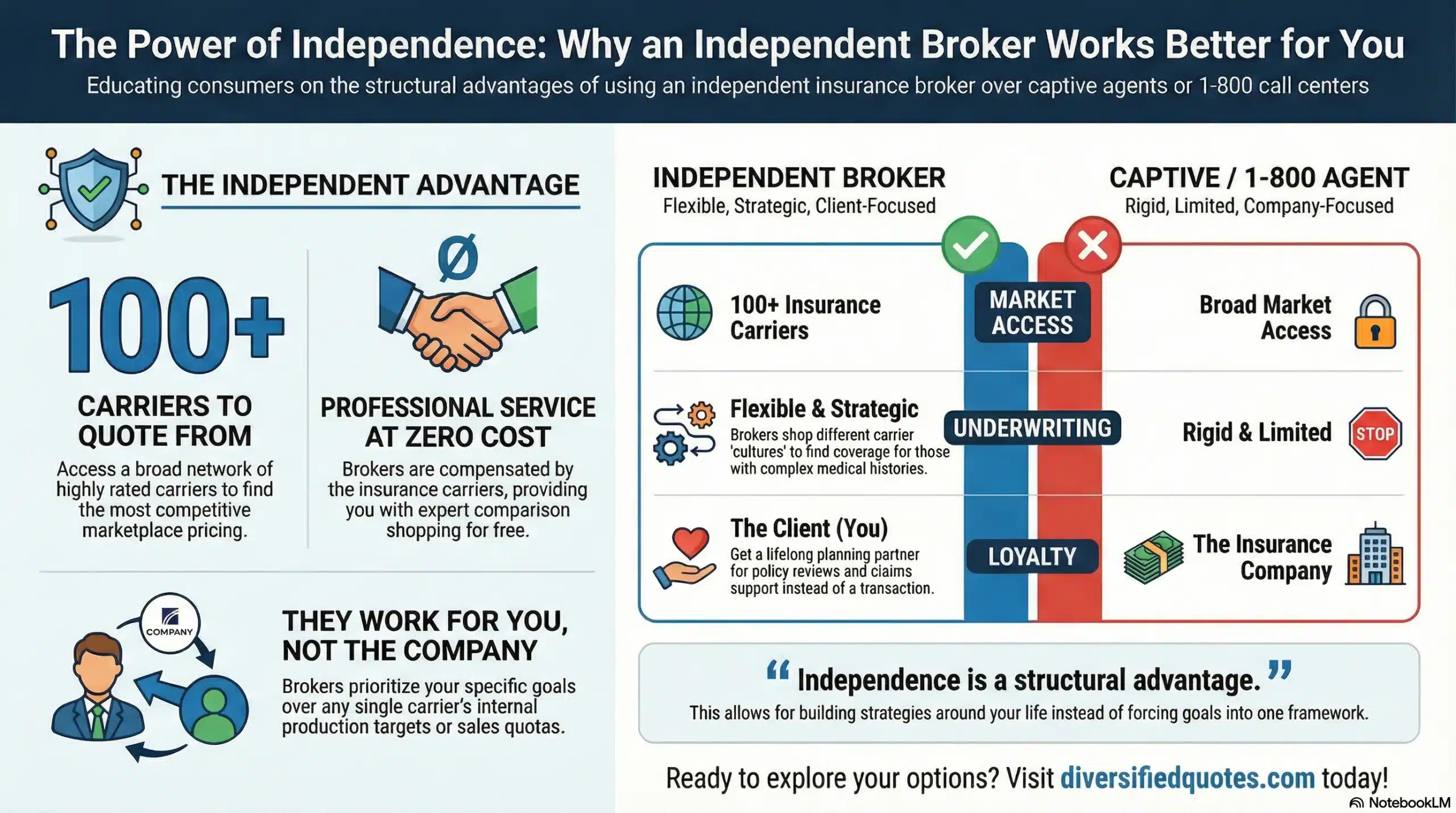
Jason Stolz, CLTC, CRPC, DIA, CAA and Chief Underwriter at Diversified Insurance Brokers (NPN 20471358), is a senior insurance and retirement professional with more than 25 years of real-world experience helping individuals, families, and business owners protect their income, assets, and long-term financial stability. As a long-time partner of the nationally licensed independent agency Diversified Insurance Brokers, Jason provides trusted guidance across multiple specialties—including fixed and indexed annuities, long-term care planning, personal and business disability insurance, life insurance solutions, Group Health, Travel Medical and Evacuation Insurance, and short-term health coverage. Diversified Insurance Brokers maintains active contracts with over 100 highly rated insurance carriers, ensuring clients have access to a broad and competitive marketplace.
His practical, education-first approach has earned recognition in publications such as VoyageATL, and contributions from his agency featured in Kiplinger and GoBankingRates— highlighting his commitment to financial clarity and client-focused planning. Drawing on deep product knowledge and years of hands-on field experience, Jason helps clients evaluate carriers, compare strategies, and build retirement and protection plans that are both secure and cost-efficient. Visitors who want to explore current annuity rates and compare options across multiple insurers can also use this annuity quote and comparison tool.
Explore More Life Insurance Options: Browse our complete guide to Life Insurance for Chronic, Autoimmune & Neurological Conditions — covering arthritis, lupus, MS, Crohn's, epilepsy, and Parkinson's from 100+ carriers.
Last Reviewed: September 16, 2026 |
Reviewed by: Jason Stolz, CLTC, CRPC, DIA, CAA
Chief Underwriter, Diversified Insurance Brokers, Inc. | NPN: 20471358 | Diversified Insurance Brokers, Inc. — Licensed in all 50 states
Fact Checked by: Tonia Pettitt, CMIP©
Medicare Specialist, Diversified Insurance Brokers, Inc. | NPN: 14374308 | Diversified Insurance Brokers, Inc. — Licensed in all 50 states
Did you find this content helpful? Leave us a Google review — it helps others find trustworthy guidance too.
Editorial Standards: Diversified Insurance Brokers maintains rigorous editorial standards to ensure accuracy, clarity, and independence in all content. Learn more about our editorial standards and commitment to transparency.
