
Disability Insurance for Hunting and Safari Guides
Disability Insurance for Hunting and Safari Guides

Jason Stolz CLTC, CRPC, DIA, CAA
Disability insurance for hunting and safari guides is essential income protection for outdoor professionals who work in one of the most genuinely hazardous occupational environments in the world — leading clients through remote wilderness terrain, tracking and managing dangerous game, operating in locations where emergency medical response may be hours or days away, and accepting personal responsibility for the safety of paying guests in conditions that produce documented wildlife attack, firearm, terrain, and environmental injury risk across every active guiding season. Whether you work as a licensed hunting guide in North America leading deer, elk, bear, or mountain lion hunts, operate as a professional hunter in Africa guiding dangerous game safaris for lion, buffalo, elephant, leopard, or hippo, work as a photographic safari guide in sub-Saharan Africa or Southern Asia, lead wilderness hunting expeditions in remote backcountry terrain, or guide clients on specialized bird, waterfowl, or upland hunting operations — your income depends entirely on your physical capacity to perform demanding outdoor work in environments whose documented hazard profile places the profession in the extreme end of the occupational risk spectrum.
The income protection planning challenge for hunting and safari guides is compounded by the professional structure of the industry. Industry job descriptions for professional hunters in Africa are explicit that the position comes with no medical insurance, no dental insurance, no life insurance, and no retirement benefits — reflecting the reality that most guiding professionals worldwide work as self-employed freelancers, independent contractors, or seasonal employees without any of the institutional safety nets that employed workers in other industries receive as baseline benefits. When a disabling injury or illness prevents guiding work, the income stops immediately and completely. There is no employer sick pay, no group disability plan, and no workers’ compensation for most self-employed guides.
At Diversified Insurance Brokers, we help hunting guides, safari guides, professional hunters, outfitters, and wilderness guiding professionals structure disability insurance coverage that reflects the genuine hazard profile of their work, the seasonal and variable income structure of the guiding profession, and the policy features that provide the most meaningful financial protection when injury or illness eliminates the ability to guide in the field.
Protect Your Guiding Income
Compare disability insurance options designed for hunting guides, safari guides, professional hunters, and wilderness guiding professionals.
Request Disability Insurance OptionsThe Documented Hazard Profile of Hunting and Safari Guiding
Hunting guides and safari guides face an occupational hazard profile that spans wildlife attack, firearms incidents, remote terrain physical injury, vehicle accidents, environmental exposure, and the sustained physical demands of backcountry guiding work across seasons that may run from several months to nearly year-round. Understanding this multi-dimensional hazard profile is essential for structuring disability insurance coverage that responds to the conditions most likely to produce career-disrupting injuries in the guiding profession.
Wildlife attacks represent the most distinctively occupational hazard of hunting and safari guiding — the risk category that is specific to this profession in ways that have no parallel in most other outdoor occupations. For professional hunters in Africa guiding dangerous game, the four primary dangerous species — elephant, lion, buffalo, and leopard — each carry documented attack and fatality risk even for experienced and properly equipped professional hunters. Elephant attacks account for the largest share of documented wildlife fatality incidents, with wounded buffalo and charging leopard historically documented as the most dangerous recovery scenarios for professional hunters on follow-up situations. For North American hunting guides, bear attacks — from black bear, grizzly, and brown bear — represent the most documented wildlife attack risk, with published research from Alaska specifically documenting hospitalization rates from bear attacks on hunters and hunting guides in the field.
The remote location dimension amplifies the severity of every injury category. A hunting guide injured by a charging dangerous animal, a firearms accident, a fall in steep backcountry terrain, or a vehicle accident on remote access roads faces a medical response timeline measured in hours rather than minutes — and the quality of initial medical management in the field before evacuation to a proper facility directly affects both immediate outcomes and long-term functional recovery. An injury that would be manageable with immediate trauma care becomes potentially life-altering when the nearest hospital is a helicopter flight or a day’s drive away. The remote wilderness location disability risk for hunting and safari guides parallels that facing other extreme remote outdoor professionals, including big game hunting guides managing the specific disability risks of remote dangerous game guiding operations.
Dangerous Game — The Two-Tier Risk Structure of Professional Hunting
Within the professional hunting guide population, a meaningful risk distinction exists between guides working with plains game or non-dangerous game species and those holding dangerous game licenses to guide elephant, buffalo, lion, leopard, hippo, and rhinoceros hunts. The dangerous game license distinction reflects the genuine and documented additional hazard of working with species whose predatory or defensive behaviors create acute lethal attack risk that plains game does not — and this distinction affects both occupational classification and the policy terms most relevant for different guiding specializations.
Professional hunters guiding dangerous game on follow-ups — approaching wounded lion, buffalo, or leopard in dense cover — accept proximity to animals whose attack capability and response speed can produce catastrophic injuries in fractions of a second. The professional hunter’s role in these situations is to protect both the client and themselves while recovering the animal, placing them in documented high-lethality confrontation scenarios as a regular professional function rather than an incidental risk. For these dangerous game specialists, disability insurance planning must account for the acute catastrophic injury risk category at the extreme end of the hunting guide hazard spectrum — paralleling the extreme occupational hazard profile of other professionals in documented high-lethality risk contexts, including professional divers managing catastrophic acute injury risk in extreme underwater operational environments.
Firearms-Related Injuries — The Most Prevalent Guiding Hazard
While wildlife attacks capture the imagination, firearms-related injuries are statistically the most frequently occurring serious injury category in hunting guide operations — reflecting the reality that guided hunts involve multiple individuals carrying loaded firearms in active pursuit scenarios where the guide is often in proximity to the client’s shooting position and downrange of the animal being pursued. Published hunting accident statistics document that fewer than 100 hunters die annually from firearms accidents in the United States, but non-fatal firearms injuries occur at substantially higher rates — and hunting guides who spend entire seasons escorting clients with rifles and shotguns accumulate far more at-risk exposure hours than recreational hunters who hunt a few days per year.
The firearms injury risk for hunting guides is specific and distinct from general firearms handling risk because it involves sustained proximity to clients whose marksmanship and firearms safety discipline vary considerably across the guide’s client roster. A professional deer guide in Texas who leads dozens of hunter-days per season, a waterfowl guide working tight blind positions with multiple shotgun-armed clients, and a dangerous game professional hunter positioned within the shot radius of a client taking dangerous game all face firearms injury risk from others that recreational hunters with complete control over their own muzzle direction do not. The firearms-adjacent occupational injury risk for hunting guides parallels the documented hazard profile of other professionals in sustained proximity to firearms and explosive events, including explosives handlers and other extreme hazard professionals managing injury risk from sustained proximity to high-energy events.
Terrain, Environmental, and Physical Demand Disability Risks
Beyond wildlife attacks and firearms incidents, hunting guides face the full spectrum of outdoor terrain and environmental disability risks that accumulate over careers of sustained remote wilderness work. Falls in steep mountain terrain, creek crossings, and backcountry access routes are among the most frequently occurring non-wildlife serious injuries in hunting guide operations — producing ankle fractures, knee injuries, back trauma, and head injuries whose recovery timelines measure in months and whose permanent consequences can end guiding careers. North American mountain elk and sheep guides who pack into remote high-altitude wilderness basins navigate terrain that produces the same fall and terrain injury risk that affects other extreme outdoor professionals working at elevation.
Vehicle accidents on remote hunting access roads — forest service roads, ranch two-tracks, and wilderness access routes that traverse the same dangerous terrain conditions that make the hunting areas valuable — produce serious orthopedic and spinal injuries for hunting guides who drive extensively between camps, access points, and hunting areas throughout their seasons. Dehydration, heat exhaustion, and hypothermia in extreme temperature hunting environments create occupational illness disability risk for guides working in the full range of North American and African climatic conditions. And the sustained physical demands of hunting guide work — packing heavy equipment and game in mountain terrain, sustained walking and tracking across varied wilderness environments, climbing, and the physical exertion that backcountry guiding demands — create the cumulative musculoskeletal loading that produces progressive career-wear disability over long guiding careers. The terrain, environmental, and sustained physical demand disability risk profile of hunting guides parallels that documented for other sustained extreme outdoor professionals, including forest and park rangers managing the multi-dimensional physical injury and environmental hazard disability risk of sustained remote outdoor professional work.
The Seasonal and Freelance Income Structure of Guiding
The overwhelming majority of hunting guides and safari guides work in seasonal, freelance, or independent contractor arrangements that generate no employer benefits of any kind. Industry descriptions of professional hunter employment are explicit on this point — no medical insurance, no dental insurance, no life insurance, no retirement benefits. The professional hunter or hunting guide earns their income through guiding days, daily rates, and client tips during a defined hunting season, and that income stops the moment the season ends or the moment disability prevents participation in the field.
For North American hunting guides, income is typically concentrated in one or two specific seasonal windows — deer and elk season in the fall, waterfowl season in the winter, spring turkey, or whatever species the guide specializes in — with income outside these windows from off-season preparation, scouting, and supplemental activities. A disability that strikes during a guide’s primary season produces income loss that cannot be recovered in subsequent off-season months. For African professional hunters, the hunting season typically runs from April through November with most of the year’s income concentrated in these active guiding months.
This seasonal income concentration means that the financial consequences of a disability during the active season are disproportionately large relative to the duration of the disability itself. A hunting guide who sustains a serious injury in October — prime deer season — and misses the final six weeks of the season loses not just six weeks of income but potentially the majority of the entire year’s professional earnings. Individual disability insurance that activates during the season provides income replacement that reflects this seasonal reality. The seasonal income and freelance structure of hunting guide income parallels that facing other seasonal outdoor professional operators, including commercial fishermen managing the acute seasonal income concentration and disability insurance planning challenges of fishing-season-dependent earnings and agricultural aviation professionals managing seasonal professional income documentation for disability insurance purposes.
Income Documentation for Hunting and Safari Guides
The income documentation for hunting guide disability insurance follows the same self-employment framework applicable to all seasonal freelance professionals — Schedule C for guides operating as self-employed business operators, W-2 for employed outfitter staff, and multi-year income averaging for guides whose booked days and total earnings vary significantly between seasons. Tip income, which can represent a substantial portion of a professional hunter’s total compensation above their daily guiding rate, requires careful documentation to be included in insurable income calculations — and guides who have not historically tracked and documented tip income in their tax reporting may find that the benefit amount available understates their genuine professional earning capacity.
For outfitter-owners who combine guiding income with business revenue from their outfitting operation — hunt bookings, outfitter fees, equipment rentals, and other revenue streams — the total insurable income picture is more complex and requires separating the earned professional guiding income from business revenue streams that may not constitute earned income for disability insurance purposes. The income documentation complexity for outfitter-owners parallels that facing other self-employed outdoor business operators, including independent contractors and self-employed outdoor business operators managing earned income documentation for disability insurance underwriting.
Case Study: North American Big Game Hunting Guide Earning $72,000 Per Year
Consider a self-employed elk and deer hunting guide in the Rocky Mountain West with 14 years of guiding experience, earning $72,000 annually from a combination of guide fees and client tips during a fall season running from late August through late November. In October — the peak of elk season with his most valuable bookings of the year — this guide sustains a serious knee injury when a client’s horse rolls on him during a mountain pack-in, requiring surgical reconstruction and five months of rehabilitation during which sustained backcountry guiding is medically prohibited.
| Scenario | Without Disability Insurance | With Disability Insurance |
|---|---|---|
| Monthly Income During Recovery | $0 — no employer, no sick pay, no group plan, no workers’ comp | $3,000–$3,600 individual benefit |
| Peak Season Income Lost | Final 6 weeks of elk season — majority of annual earnings — lost entirely | Disability benefit provides income replacement through the remaining season and rehabilitation period |
| 5-Month Total Income | $0 | $15,000–$18,000 |
| Next Season Readiness | Financial pressure may force premature return before knee is genuinely healed — risk of permanent damage | Recovery on medical timeline; return to backcountry guiding only when knee is genuinely ready |
Horse-related injuries during mountain pack-in operations are a documented and recurring serious injury mechanism for Rocky Mountain hunting guides who use pack strings to access remote wilderness basins — and the knee and orthopedic injuries they produce are specifically career-threatening for guides whose work requires sustained hiking, climbing, and physical backcountry navigation. Disability insurance for hunting and safari guides ensures that a peak-season injury does not become both a physical and financial catastrophe for a professional who has built a guiding business over more than a decade of work.
Key Policy Features for Hunting and Safari Guide Disability Insurance
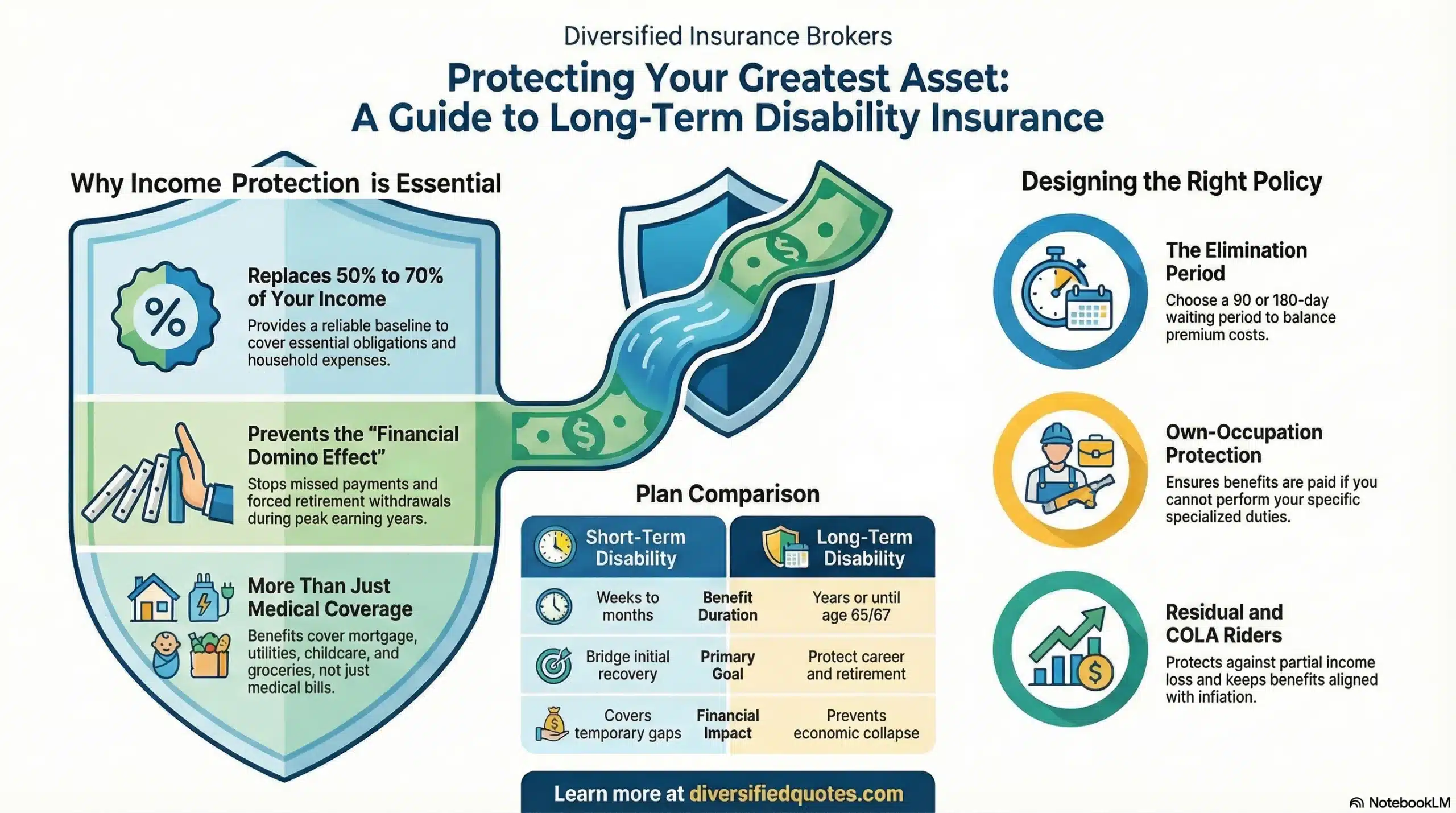
Disability insurance for hunting and safari guides should incorporate specific policy provisions that address the extreme hazard profile, the seasonal income structure, and the remote location disability risk of professional guiding work. The own-occupation definition is foundational — ensuring that a hunting guide who cannot perform the sustained physical outdoor work, terrain navigation, and client management demands of active guiding receives disability benefits regardless of theoretical capacity for less physically demanding or less hazardous work. Our comprehensive resource on own-occupation disability insurance explained covers how this definition protects hunting guide income from the conditions most likely to prevent continued active field guiding.
A residual disability rider is important for guides whose injuries may reduce field capacity without eliminating it entirely — a guide who can manage some lighter operations but cannot handle the full physical demands of backcountry guiding earns reduced income without being totally disabled. Our resource on how residual disability insurance benefits work explains how partial disability coverage supports guides through graduated return-to-field capacity. The elimination period should account for seasonal income concentration — a guide who sustains a mid-season injury with no other income source needs faster benefit access than a guide with off-season supplemental income — our guide on how disability insurance elimination periods work provides the complete framework. A cost-of-living adjustment rider preserves real benefit value across extended disability periods — our resource on disability income insurance with a COLA rider explains this protection. Our guide on how to buy short-term disability insurance covers the complete short-term income protection picture for seasonal professionals.
Occupational Classification and Specialty Market Access
Professional hunting guides — particularly those working with dangerous game in Africa or guiding hunts in remote wilderness terrain — face occupational classification challenges that place them among the more difficult applications in the individual disability insurance marketplace. The documented wildlife attack risk, firearms proximity hazard, remote location severity amplification, and physical terrain demands of guiding work at the extreme end produce classifications that some standard retail carriers decline or underwrite only with significant restrictions. Dangerous game guides specifically may find that their occupational profile requires specialty market placement with carriers experienced in extreme outdoor hazard classifications.
North American hunting guides whose work involves less extreme hazard profiles — bird hunting, deer hunting, non-dangerous game operations without remote wilderness pack-in requirements — typically receive more accessible classifications that provide meaningful coverage at competitive premium rates. Photographic safari guides whose work does not involve firearms or active dangerous game hunting management typically receive more favorable classifications than hunting guides in equivalent wildlife environments. The specialty market access considerations for extreme hunting guide classifications parallel those facing other high-hazard outdoor professionals who require experienced broker guidance to access meaningful coverage, including boat captains and remote maritime professionals managing specialty market disability insurance placement for extreme offshore occupational risk and race car drivers and other extreme sport professionals requiring specialty market access for high-profile hazardous occupation disability coverage.
Why Hunting and Safari Guides Need an Independent Disability Insurance Broker
Disability insurance for hunting and safari guides requires specialty market carrier access for dangerous game and extreme wilderness guiding profiles, knowledge of how to document seasonal freelance guiding income most accurately for benefit calculation, experience with the occupational classification distinctions between guiding specializations, and the ability to identify which carriers most favorably accommodate the hunting guide occupational risk profile at each hazard tier. A standard retail application is not optimized for professional hunting guide income structures or hazard classifications, and a general agent unfamiliar with outdoor professional disability insurance will not access the carriers or policy terms that genuine professional guiding income protection requires.
At Diversified Insurance Brokers, we work with hunting guides, safari guides, professional hunters, outfitters, and wilderness guiding professionals across all specializations to structure disability insurance that accurately reflects the specific hazard level of their guiding work, documents their seasonal professional income accurately, and accesses the carriers whose underwriting is most favorable for each guide’s specific professional profile. Our dedicated resource on why independent disability insurance brokers matter explains the full value of this approach. The guide on disability insurance for agricultural and remote outdoor workers provides additional context on income documentation and coverage approaches for seasonal self-employed outdoor professionals.
Final Thoughts on Disability Insurance for Hunting and Safari Guides
Hunting guides and safari guides provide professional services that require years of accumulated field knowledge, species expertise, terrain familiarity, client management skill, and the physical fitness and outdoor capability that demanding wilderness environments require. The income those skills generate is seasonal, variable, and entirely dependent on the guide’s continued physical capacity to perform demanding outdoor work in environments where the hazards are real, documented, and occupationally specific. Without individual disability insurance, a single disabling event during a peak guiding season can eliminate a year’s professional income without any institutional bridge of any kind.
Disability insurance for hunting and safari guides — structured around an accurate occupational classification for the specific guiding specialization, calibrated to documented seasonal professional income, built with an own-occupation definition that protects active field guiding capacity specifically, and placed through carriers whose underwriting favorably accommodates the guiding profession’s hazard profile — provides the income security that allows a professional whose career has been built through years of field work to recover from a disabling injury on a medical timeline rather than a financial one.
Related Pages
Talk With an Advisor Today
Choose how you’d like to connect—call or message us, then book a time that works for you.
Schedule here:
calendly.com/jason-dibcompanies/diversified-quotes
Licensed in all 50 states • Fiduciary, family-owned since 1980
Disability Insurance for Hunting and Safari Guides FAQs
Yes — hunting guides and safari guides can obtain individual disability insurance, though the application process requires specialty market expertise and experienced independent broker guidance for guides working at the higher-hazard end of the occupational spectrum. The availability and terms of coverage vary significantly based on the specific type of guiding involved. North American hunting guides working with non-dangerous game species in accessible terrain typically access coverage with more favorable terms. Professional hunters guiding dangerous game in Africa, guides leading remote wilderness pack-in operations, and other extreme wilderness guiding professionals may require specialty market placement with carriers whose underwriting guidelines accommodate extreme outdoor hazard occupational profiles. For all hunting and safari guides, the income documentation process for seasonal freelance guiding income requires specific handling — multi-year averaging of Schedule C or documented guiding income, appropriate inclusion of tip income, and accurate documentation of the seasonal income pattern. For context on disability insurance for other extreme remote outdoor professionals, see our page on disability insurance for game wardens and other extreme outdoor law enforcement and wildlife professionals.
The disability risk profile for hunting and safari guides spans several distinct injury categories that reflect the specific hazards of professional guiding work. Wildlife attacks — from dangerous game in Africa or bear attacks in North America — represent the most distinctively occupational acute injury risk, with elephant attacks documented as the most common wildlife-related fatality in African safari contexts and grizzly bear attacks producing documented hospitalization events for Alaskan hunting guides. Firearms-related injuries from sustained proximity to clients carrying loaded firearms during active hunting scenarios represent statistically the most frequently occurring serious injury category across guiding operations broadly. Falls in steep mountain terrain, creek crossings, and backcountry access routes produce serious orthopedic and spinal injuries for backcountry hunting guides. Horse and pack animal injuries during pack-in mountain operations produce significant knee, back, and orthopedic injuries. Vehicle accidents on remote access roads produce spinal and orthopedic trauma. And the cumulative musculoskeletal loading of sustained backcountry physical guiding work produces progressive career-wear conditions — knee osteoarthritis, lumbar disc disease, shoulder conditions — that eventually limit active guiding capacity for long-career professionals.
Seasonal income concentration creates a specific and important disability insurance planning consideration for hunting guides whose professional earnings are compressed into defined seasonal windows — fall deer and elk seasons, waterfowl season, spring turkey, or the April through November African hunting season for professional hunters. A disability that strikes during the active season produces income loss disproportionately large relative to its duration, because the lost guiding days represent the majority of the year’s earning potential rather than a proportional fraction of it. For disability insurance purposes, most carriers use a multi-year average of documented professional guiding income — typically from two to three recent tax years — to establish a representative earning capacity for benefit calculation purposes. This averaging approach produces a more accurate and representative benefit amount for guides with variable seasonal bookings than a single year’s income would reflect. Tip income, which can represent a substantial share of a professional hunter’s or hunting guide’s total compensation above their daily guide rate, should be included in income documentation when properly documented — making accurate financial record-keeping an important planning consideration for guides seeking benefit amounts that reflect their genuine professional earning capacity.
Own-occupation disability insurance pays benefits when a disabling condition prevents a hunting guide from performing the specific physical and professional demands of their guiding work — sustained backcountry terrain navigation, physical pack-in operations, client management in the field, firearms safety supervision, wildlife management and tracking, and all the other specific physical and professional demands of active guiding — regardless of whether they could theoretically perform other less physically demanding or less hazardous work. Any-occupation coverage only pays if the guide cannot perform virtually any gainful employment. A mountain elk guide whose serious knee injury prevents the sustained climbing and terrain navigation that backcountry guiding requires but who could theoretically work a sedentary retail job receives no any-occupation benefits, while an own-occupation policy recognizes the genuine inability to continue active guiding and pays accordingly. For hunting guides who have invested years developing the terrain knowledge, species expertise, client relationships, and physical capability that their professional value depends on, the own-occupation definition is the only coverage provision that genuinely protects that professional guiding income from the physical injury and illness conditions most likely to affect a working guide in the field. For context on own-occupation coverage for extreme outdoor professionals, see our page on disability insurance for extreme outdoor professionals requiring own-occupation protection for physically demanding field work.
Yes — the occupational classification and available coverage terms differ meaningfully between professional hunters guiding dangerous game and hunting guides working with non-dangerous game species. Dangerous game professional hunters — those licensed to guide elephant, buffalo, lion, leopard, hippo, and rhinoceros hunts in Africa — face occupational hazard exposure at the extreme end of the wildlife guide risk spectrum, where the acute attack risk from wounded or charged dangerous animals creates documented fatality and serious injury potential as a regular professional function. This hazard profile places dangerous game professional hunting in a classification tier that some standard retail disability carriers decline entirely and that requires specialty market placement for meaningful coverage. Non-dangerous game hunting guides — North American deer, elk, bird, and waterfowl guides, and photographic safari guides who do not manage firearms-involved dangerous game encounters — receive classifications that reflect their actual hazard profile, which while elevated above most occupations remains accessible through a broader range of carriers at more competitive premium rates. The distinction matters significantly for premium rates, available benefit periods, and own-occupation definition access across the two populations.
Workers’ compensation does not automatically cover self-employed sole proprietor hunting guides in most states — it covers employees of a business, not the business owner themselves. Some states allow self-employed workers to elect workers’ compensation coverage for themselves at additional cost, but even where elected, workers’ compensation provides only partial wage replacement for work-related injury events and excludes illness, off-duty injuries, and non-work-related disabling conditions entirely. For the majority of self-employed freelance hunting guides and professional hunters who have not elected workers’ compensation for themselves, individual disability insurance is the only available income protection — covering disability from any cause regardless of origin, for the full benefit period, without the work-relatedness restrictions that workers’ compensation imposes. The absence of workers’ compensation protection for self-employed guides makes individual disability insurance not supplemental but the entirety of their occupational income protection, making the absence of any individual coverage a complete absence of financial protection against income loss from disability. For context on workers’ compensation limitations for extreme outdoor professionals, see our page on disability insurance for self-employed extreme hazard professionals managing the complete absence of workers’ compensation protection.
Elimination period selection for hunting and safari guides must account for the complete absence of any employer income bridge and the seasonal concentration of guiding income that makes mid-season disability particularly financially acute. With no employer sick pay, no group disability plan, and no workers’ compensation for most self-employed guides, income stops completely on the first day of disability with no institutional support of any kind. A 30-day elimination period provides the fastest benefit access for guides with limited savings reserves. A 90-day elimination period is appropriate only if the guide has three months of living expenses genuinely available in liquid savings without creating financial hardship. The seasonal timing of a disability is also relevant — a guide who is injured in the off-season with no current season income at stake has more flexibility in elimination period selection than one injured at the height of their peak booking season, where the urgency of income replacement is most acute. Guides who carry outfitter business fixed costs — vehicle loans, equipment costs, license fees, marketing expenses — during disability periods may need a shorter elimination period to address both personal income and business carrying costs throughout the waiting period before benefits activate.
The best time is as early as possible in a guiding career — ideally when first establishing professional guiding operations, before any injury history, musculoskeletal conditions from sustained backcountry physical demands, or occupational health consequences from guiding work have accumulated in the medical record. Disability insurance premiums are based in part on age and health status at the time of application, and younger guides in excellent health secure the most comprehensive coverage at the most favorable rates. Any prior injury history from guiding — knee injuries, back conditions, animal contact injuries, firearms incidents — can result in exclusion riders or restricted policy terms if documented at application. The non-cancelable and guaranteed renewable provision locks in the early-career health rating for the policy’s entire duration, regardless of what occupational health developments occur during subsequent years of guiding activity. Applying before the cumulative physical demands of sustained backcountry guiding work have produced the orthopedic and musculoskeletal conditions that inevitably develop over long guiding careers is the most reliable way to ensure comprehensive coverage for the conditions most likely to eventually limit active field guiding capacity. For context on early application timing for extreme outdoor professionals, see our page on disability insurance for outdoor physical professionals managing early career coverage decisions.
An independent broker with extreme outdoor and high-hazard occupational disability insurance expertise is essential for hunting and safari guides because this profession spans multiple hazard tiers — from accessible non-dangerous game North American hunting guides to dangerous game African professional hunters — and the carrier most appropriate for each tier differs substantially. Different carriers within the specialty and standard disability insurance markets approach guiding occupational classifications, extreme outdoor hazard profiles, and seasonal freelance income documentation with different guidelines that produce meaningfully different classification outcomes, premium rates, and available policy features. A standard retail application process or a single-carrier agent cannot navigate these differences effectively. At Diversified Insurance Brokers, we evaluate the full competitive marketplace for every hunting and safari guide we work with — identifying whether standard market or specialty market placement is most appropriate, presenting seasonal guiding income documentation most accurately for benefit calculation, and structuring coverage with the own-occupation definitions, residual disability riders, and appropriate benefit periods that the specific guiding specialization’s disability risk profile requires.
About the Author:
Jason Stolz, CLTC, CRPC, DIA, CAA and Chief Underwriter at Diversified Insurance Brokers (NPN 20471358), is a senior insurance and retirement professional with more than 25 years of real-world experience helping individuals, families, and business owners protect their income, assets, and long-term financial stability. As a long-time partner of the nationally licensed independent agency Diversified Insurance Brokers, Jason provides trusted guidance across multiple specialties—including fixed and indexed annuities, long-term care planning, personal and business disability insurance, life insurance solutions, Group Health, Travel Medical and Evacuation Insurance, and short-term health coverage. Diversified Insurance Brokers maintains active contracts with over 100 highly rated insurance carriers, ensuring clients have access to a broad and competitive marketplace.
His practical, education-first approach has earned recognition in publications such as VoyageATL, and contributions from his agency featured in Kiplinger and GoBankingRates— highlighting his commitment to financial clarity and client-focused planning. Drawing on deep product knowledge and years of hands-on field experience, Jason helps clients evaluate carriers, compare strategies, and build retirement and protection plans that are both secure and cost-efficient. Visitors who want to explore current annuity rates and compare options across multiple insurers can also use this annuity quote and comparison tool.
Explore More Disability Insurance Options: Browse our complete guide to Disability Insurance for Agriculture, Natural Resources & Outdoor Industries — covering farmers, ranchers, fishermen, foresters, miners, oil & gas workers & outdoor industries from 100+ carriers.
Last Reviewed: June 8, 2026 |
Reviewed by: Jason Stolz, CLTC, CRPC, DIA, CAA
Chief Underwriter, Diversified Insurance Brokers, Inc. | NPN: 20471358 | Diversified Insurance Brokers, Inc. — Licensed in all 50 states
Fact Checked by: Tonia Pettitt, CMIP©
Medicare Specialist, Diversified Insurance Brokers, Inc. | NPN: 14374308 | Diversified Insurance Brokers, Inc. — Licensed in all 50 states
Did you find this content helpful? Leave us a Google review — it helps others find trustworthy guidance too.
Editorial Standards: Diversified Insurance Brokers maintains rigorous editorial standards to ensure accuracy, clarity, and independence in all content. Learn more about our editorial standards and commitment to transparency.
