
F&G 1-2-3 Fixed Indexed Annuity – Income Flexibility, Market Growth, and Lifetime Protection
As an Independent Annuity Broker, we compare rates across 100+ carriers and 1,000 different annuities— not just one company’s product offerings — to find the best fit for your goals.
F&G 1-2-3 Fixed Indexed Annuity – Income Flexibility, Market Growth, and Lifetime Protection
At Diversified Insurance Brokers, we specialize in helping retirees and pre-retirees cut through the noise of the annuity marketplace to find strategies that truly align with long-term income goals. The F&G 1-2-3 Fixed Indexed Annuity — issued by Fidelity & Guaranty Life Insurance Company — is a limited flexible premium deferred fixed indexed annuity designed around one planning insight: most retirees do not know exactly when they will need income to begin, and a contract that forces that decision at purchase creates unnecessary friction. The “1-2-3” structure gives buyers one contract with two income path choices made at issue and three core benefits — guaranteed lifetime income, index-linked growth potential, and a legacy option for beneficiaries. F&G carries an AM Best A- (Excellent) rating, a NAIC Complaint Index of 0.10 (far below the 1.00 industry average), and ranked 1st overall in J.D. Power customer satisfaction in 2023. Eliminating sequence of returns risk from a portion of the retirement portfolio — while preserving optionality over when income begins — is the core planning use case. Not available in California or New York.

Ensure you are receiving the absolute top rates
Current Fixed Annuity Rates
Compare today’s best fixed annuity rates from top carriers.
Current Bonus Annuity Rates
See which annuities offer the highest upfront bonus today.
Request an Annuity Quote
Submit our annuity request form to get personalized rate options.
Lifetime Income Calculator
Use our calculator to see how much guaranteed income your annuity can provide.
F&G 1-2-3: Key Product Features at a Glance
| Product Feature | Details |
|---|---|
| Issuing Carrier | Fidelity & Guaranty Life Insurance Company (F&G). Des Moines, Iowa. AM Best: A- (Excellent) — confirmed from official AM Best press release and SEC filings. S&P: A-. Fitch: A-. Moody’s: A3. NAIC Complaint Index: 0.10 — far below the 1.00 industry average. J.D. Power: 1st overall 2023, 7th in 2024. FNF Fortune 500 parent. $50+ billion in assets. Not available in California or New York. Not FDIC insured. All guarantees backed by claims-paying ability of F&G. |
| Product Structure | Limited flexible premium deferred fixed indexed annuity. At issue, the buyer selects one of two income paths — Anytime Income or Future Income — which determines the income rider structure and growth mechanics for the contract’s life. Path selection is made once at issue. Minimum age at income start: 50. Minimum premium: confirm at application. Qualified and non-qualified funding accepted. MVA applies on excess withdrawals; does not apply in AK, AL, CT, IL, MN, MO, MS, OR, and certain other states — confirm at application. |
| Path 1: Anytime Income | For buyers who may need income at any point — or who are already in retirement. Built-in GLWB rider with no income wait period — income may begin any time after issue (minimum age 50). Income base grows with an interest credit multiplier before income begins. Once income is elected, a different participation factor applies to the income base. Income base bonus multiplier: 35% in the consumer brochure example. Guaranteed lifetime withdrawal payments continue for life — even if account value depletes — as long as no Excess Withdrawals are taken (excess withdrawals reduce guaranteed withdrawal amounts and may terminate the contract). Income base cannot be surrendered or withdrawn. |
| Path 2: Future Income | For buyers who can defer income at least 10 years — legacy-priority clients. Income wait period: 10 years (income may begin only after the wait period has elapsed and the annuitant is at least age 50). Enhanced income base bonus multiplier: 50% (higher than the 35% in the Anytime path) — rewards the 10-year deferral commitment with a larger base for lifetime income calculations. During the wait period, account value continues to accumulate. Better income payout factors at income start in exchange for the wait period commitment. Installment Death Benefit: beneficiaries may elect installment payments from the income base over at least 5 years, maximizing the death benefit, or elect a lump-sum payout instead. |
| GLWB Rider — Included at No Separate Charge | The income rider is built into the product at issue — not added for a separate annual fee as in many competing FIAs. Understanding how income rider fees work at competing products places this in context: built-in riders at no separate charge typically involve a trade-off in cap rates or participation rates vs. fee-based rider structures. Confirm current crediting terms relative to F&G FIAs without income riders before application. Income payments stop increasing once the account value reaches zero. Excess withdrawals reduce the Guaranteed Withdrawal Payment amount; in some cases, to zero, terminating the contract. |
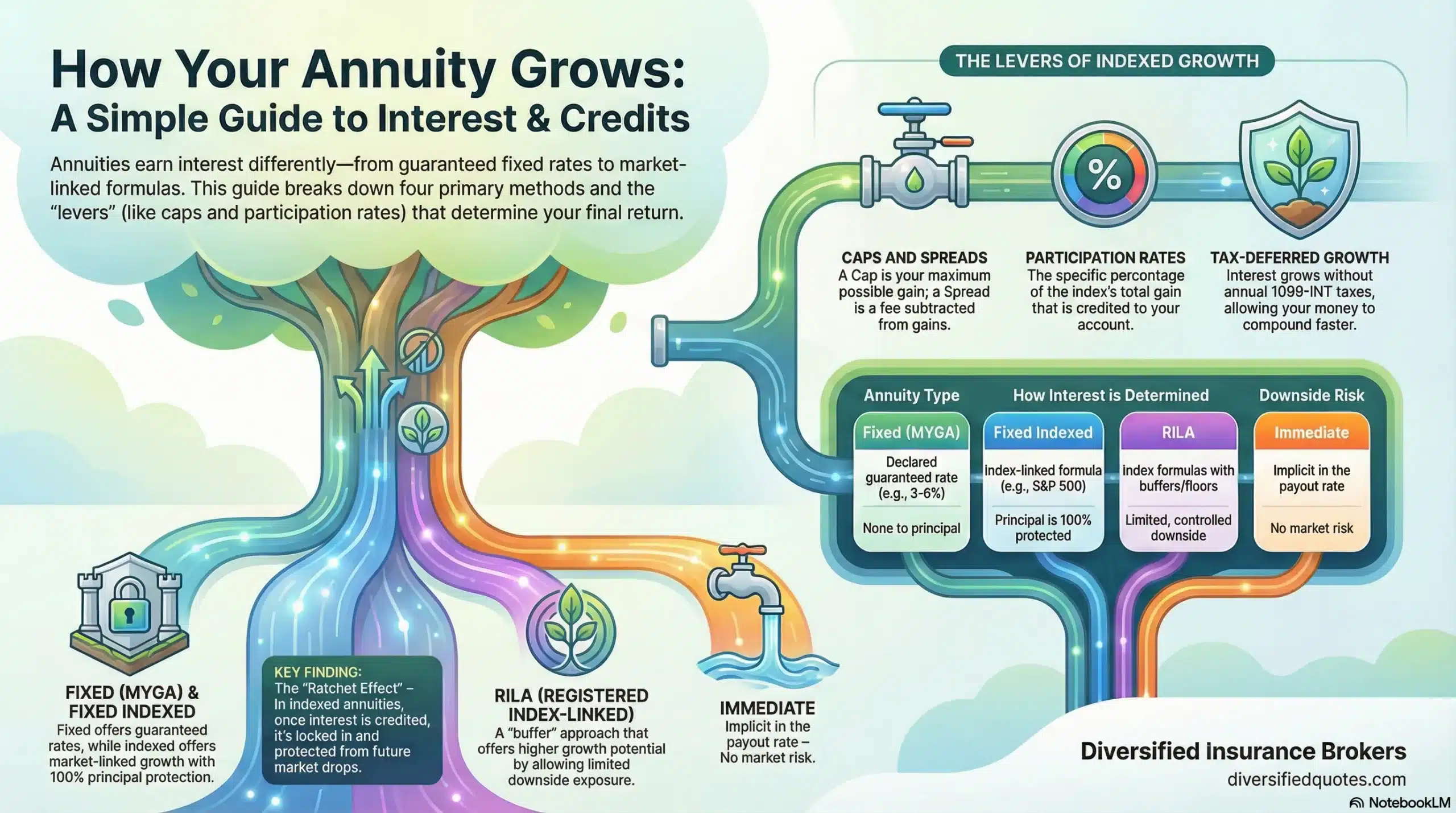
| Index Crediting and Growth | Index interest is credited based on performance of selected indices — including S&P 500 and other options — subject to cap rates, participation rates, or spreads. Fixed interest option also available. Zero floor: if the selected index has a negative year, credited interest for that term is zero — principal is protected from market-driven loss. Gains are locked in at the end of each crediting period. Income base growth mechanics differ between Anytime and Future Income paths — confirm current crediting terms, interest credit multipliers, and participation factors at application. Indexed interest options available from S&P and other providers. Crediting terms may change at renewal. |
| Free Withdrawal Provision | Year 1: 10% of initial premium. Year 2+: 10% of beginning-of-year account value. Health event waivers: (1) Terminal Illness Rider — full withdrawal without surrender charge/MVA if life expectancy 12 months or less. (2) Impairment Rider — if unable to physically care for self without assistance (six activities of daily living definition). (3) Nursing Home Rider (confirmed on Anytime Income version — confirm availability on Future Income path at application). RMDs: penalty-free. Excess Withdrawals above free amount are subject to surrender charges and MVA — and on an active GLWB, excess withdrawals reduce the Guaranteed Withdrawal Payment amount. |
| Surrender Charges and MVA | Surrender charge period and schedule: confirm at application — may vary by state. MVA applies on excess withdrawals during the surrender period based on interest rate changes since issue; generally decreases surrender value if rates rise, increases if rates fall. MVA does not apply in AK, AL, CT, IL, MN, MO, MS, OR and certain other states — confirm at application. Surrender charges waived on annuitization. Both reach zero at end of surrender period. |
| Death Benefit and Legacy | Account value paid as lump-sum death benefit to named beneficiaries. Alternatively, beneficiaries may elect installment payments from the income base over at least 5 years — the Installment Death Benefit limit is the greater of 125% of the cash surrender value or total premium credited at 10% interest per year (not to exceed 250% of total premium less withdrawals). Reviewing annuity beneficiary death benefits covers distribution options and tax treatment for heirs. Bypass probate in most cases with proper beneficiary designation. |
| Tax Treatment | Index-linked interest accumulates tax-deferred — no annual 1099 during accumulation. Non-qualified: LIFO — earnings distributed first, taxed as ordinary income; cost basis returned tax-free. Reviewing non-qualified annuity mechanics covers after-tax premium taxation. Qualified accounts: full distributions taxed as ordinary income. Withdrawals before age 59½ subject to 10% IRS early withdrawal penalty. Tax deferral provides no additional benefit inside a qualified account beyond what the IRA already provides. Not FDIC insured. |
Anytime Income vs. Future Income: Choosing the Right Path at Issue
The income path decision is the most consequential choice in the F&G 1-2-3 application process — and it must be made correctly at issue because the path determines the income base mechanics, bonus multipliers, and payout structure for the life of the contract. The Anytime Income path is designed for buyers who are in or near retirement and want the ability to activate guaranteed lifetime withdrawals at any time with no waiting period. The income base grows with a 35% bonus multiplier (illustrated in the consumer brochure) and an interest credit multiplier before income begins — providing a meaningful income foundation even if income is activated relatively soon after issue. The Future Income path is designed for buyers who can commit to a minimum 10-year deferral before activating income. In exchange for that commitment, the income base bonus multiplier increases to 50% — a larger base applied to the income calculation at the point of activation. The 10-year deferral also allows the account value and income base to accumulate longer before income begins, potentially producing higher guaranteed withdrawal amounts. The correct path choice depends on one question: when is income actually likely to begin? If the buyer has a high probability of needing income within 1–7 years, Anytime Income is the correct path — the income start flexibility is the primary value, and the 35% multiplier supports a reasonable income base. If the buyer has a high probability of being able to defer income for 10 or more years, Future Income is the correct path — the 50% multiplier and longer accumulation period produce a materially higher income outcome. If the answer is genuinely uncertain — “somewhere between 5 and 15 years” — the Anytime Income path’s flexibility value outweighs the Future Income path’s higher multiplier, because locking into a 10-year wait period when income may be needed in year 6 carries meaningful cost. Reviewing whether to annuitize or use an income rider and comparing the F&G 1-2-3 against the best fixed indexed annuities for income at the same deferral horizon confirms whether the 1-2-3’s path structure produces competitive income vs. alternatives.
Index Crediting, Liquidity, Tax Strategy, and the F&G Product Family
The F&G 1-2-3’s index growth potential follows standard FIA mechanics: interest is credited based on index performance subject to caps, participation rates, or spreads — with a zero floor protecting against market-driven loss. The income base and account value are separate quantities: the account value is what can be surrendered or withdrawn; the income base is what determines the guaranteed withdrawal calculation and cannot be surrendered or withdrawn directly. When the account value depletes through withdrawals or market conditions, guaranteed withdrawals from the income base continue for life on the active GLWB — provided no Excess Withdrawals are taken, which would reduce the guaranteed payment amount. This is the longevity hedge the F&G 1-2-3 provides that a traditional investment portfolio cannot replicate. The fixed annuities vs. indexed structure comparison — reviewing fixed vs. fixed indexed annuities — clarifies the trade-off between the 1-2-3’s index-linked upside potential and the predictability of a declared-rate MYGA for the same capital. For IRA rollover buyers: reviewing how to transfer an IRA to an annuity covers correct execution. For 457(b) plan assets: reviewing 457(b) rollovers to annuities addresses the specific rules for that account type. For non-qualified funds, reviewing how annuities are taxed — including the LIFO treatment on non-qualified withdrawals and reviewing non-qualified annuity mechanics — ensures the tax strategy integrates correctly with Social Security timing and required minimum distributions. Coordinating guaranteed income activation from the 1-2-3 with Social Security claiming — reviewing how Social Security and annuities work together — reduces bracket surprises at income start. Within the F&G product family, the F&G Safe Income Advantage is the income-focused alternative with health benefit multipliers (up to 2x payments if impairment qualifications are met), and the F&G Performance Pro provides premium bonuses alongside income rider structure. The F&G Prosperity Elite adds upfront bonus alongside accumulation and income features. Comparing these alongside the 1-2-3 — using income projection illustrations at your specific premium, age, and deferral horizon — is the prerequisite analysis for selecting the correct F&G product for income planning objectives. For buyers building retirement income without a pension, reviewing pension alternatives places the F&G 1-2-3 in the full guaranteed income context.
Related Pages
Explore additional F&G products and income annuity planning resources.
Financial Protection Essentials
Explore life insurance strategies for seniors, global travel medical protection resources, and financial planning tools that help manage risk and long-term coverage needs.
Talk to an Advisor or Request Your Annuity Quote
Ready to explore this annuity in more detail—or compare it with other carriers to see if even higher rates are available? With guaranteed income, principal protection, and long-term growth potential on the line, making the right choice is essential. The experienced advisors at Diversified Insurance Brokers will guide you through the options and design a strategy tailored to your retirement goals.
Schedule here:
calendly.com/jason-dibcompanies/diversified-quotes
Licensed in all 50 states • Fiduciary, family-owned since 1980
FAQs: F&G 1-2-3 Fixed Indexed Annuity
What is the difference between the Anytime Income and Future Income paths — and how do I choose?
The path choice at issue is the single most important decision in the F&G 1-2-3 application. Both paths include the same three core benefits — lifetime income, growth potential, and legacy — but they differ in when income can begin, the income base bonus multiplier, and the payout structure. Anytime Income: no wait period, income may begin any time after issue (minimum age 50), income base bonus multiplier of 35% (illustrated). Designed for buyers who may need income relatively soon or want maximum flexibility over activation timing. Future Income: 10-year wait period before income can begin, income base bonus multiplier of 50% (illustrated). Designed for buyers who can commit to a full 10-year deferral in exchange for a larger income base and better payout factors at activation. The path choice rule: if income is likely needed within 1–9 years, choose Anytime Income — the flexibility value outweighs the Future Income path’s higher multiplier. If income is genuinely not needed for 10 or more years and the buyer can make that commitment at issue, Future Income produces materially higher guaranteed withdrawal amounts. If uncertain, Anytime Income is the safer structural choice because the 10-year wait period on Future Income creates real cost if income is needed before the wait period ends. Comparing projected lifetime income from both paths at your specific age, premium, and realistic income start timeline — side by side in an illustration — is the definitive basis for the decision.
The income rider is built in — is there a cost, and how does it compare to fee-based riders?
The F&G 1-2-3 includes its GLWB income rider built into the product structure without a separately disclosed annual rider fee (unlike many competing FIAs that charge 0.75%–1.25% of the benefit base annually). However, “built-in at no separate fee” does not mean free — the income rider cost is embedded in the product’s crediting terms. Carriers that include income riders without separate fees typically offer lower cap rates, lower participation rates, or a lower spread than accumulation-only FIAs from the same carrier family — the rider cost is recovered through the crediting margin rather than an explicit annual charge. The correct comparison: take the F&G 1-2-3’s current cap and participation rates on the Anytime Income or Future Income path, compare them against the F&G AccumulatorPlus or Flex Accumulator (accumulation-focused FIAs without built-in income riders from the same carrier), and quantify the difference in accumulation value over the same period. That difference is the effective annual cost of the built-in income rider. Whether that cost is justified depends on whether you actually intend to use the guaranteed income — if you do, the built-in rider at F&G’s no-separate-fee structure may be cost-competitive with or better than fee-based alternatives. If you don’t intend to use the income guarantee, an accumulation-focused FIA without an income rider provides better growth potential for the same premium.
What happens if I take an Excess Withdrawal after the guaranteed income is active?
This is the most important operational risk in the F&G 1-2-3 once the GLWB is active. Any withdrawal above the annual Guaranteed Withdrawal Payment amount is an Excess Withdrawal. Excess Withdrawals reduce the Guaranteed Withdrawal Payment amount — and in some cases, to zero, terminating the contract and eliminating all future guaranteed income payments. This means that once income is activated, the F&G 1-2-3 requires disciplined withdrawal management: take only the guaranteed withdrawal amount each year, no more. If you anticipate needing more than the guaranteed withdrawal amount in any given year — for a large unplanned expense, medical cost, or liquidity need — plan to address that need from a separate liquid account outside the annuity rather than from an excess withdrawal inside the 1-2-3. The free withdrawal provision (10% of premium in Year 1; 10% of beginning-of-year account value thereafter) operates alongside the GLWB structure — but excess withdrawals that would trigger a surrender charge also interact with the income rider. The health event waivers (terminal illness, impairment, nursing home) may provide additional access under qualifying scenarios without triggering the excess withdrawal consequence — confirm qualification requirements at application. This operational dynamic — protecting the guaranteed income by never exceeding the annual guaranteed withdrawal amount — is the single most important behavioral rule for F&G 1-2-3 policyholders once income is activated.
How does the F&G 1-2-3 compare to the F&G Safe Income Advantage and F&G Performance Pro?
The three F&G income-focused FIAs serve meaningfully different buyer profiles. The F&G Safe Income Advantage includes health benefit multipliers — up to 2x the guaranteed withdrawal payment (1.5x on joint contracts) if qualifying impairment conditions are met. This makes it specifically valuable for buyers with long-term care planning concerns or family health history that increases the probability of a qualifying impairment event. If doubling the guaranteed withdrawal amount in a care scenario is an important planning objective, Safe Income Advantage addresses that need more directly than the 1-2-3. The F&G Performance Pro provides upfront premium bonuses (up to 17% depending on age and state) alongside income rider structure — making it the right choice when maximizing starting account value is the priority alongside income planning. The bonus creates a larger starting base for both accumulation and income calculations. The F&G 1-2-3 is most appropriate when the primary planning objective is flexible income timing — the ability to activate income at any time (Anytime Income) or to commit to a 10-year enhanced deferral (Future Income) — without a premium bonus and without the health multiplier feature. The selection rule: if impairment benefit doubling is a planning priority, Safe Income Advantage. If upfront balance maximization alongside income planning is the priority, Performance Pro. If income timing flexibility is the priority, F&G 1-2-3. Obtain comparative illustrations across all three at your specific premium and age before choosing.
How does the installment death benefit work — and is it better than the lump sum for beneficiaries?
The F&G 1-2-3’s installment death benefit option gives beneficiaries a choice that most FIA death benefits don’t provide: instead of receiving the account value as a lump sum, beneficiaries may elect installment payments from the income base over at least 5 years. The installment death benefit limit is calculated as the greater of 125% of the cash surrender value or total premium credited at 10% interest per year, not exceeding 250% of total premium less withdrawals. In practical terms: if the income base has grown substantially through the interest credit multiplier and deferral — particularly under the Future Income path with the 50% bonus multiplier — the income base available for installment payments may be significantly larger than the account value at death. Beneficiaries who elect the installment option may receive more total dollars from the income base than they would receive from the lump-sum account value. The trade-off: installment payments spread over at least 5 years create a structured distribution obligation rather than immediate lump-sum access. The correct choice for beneficiaries depends on their immediate liquidity needs, tax bracket management objectives, and whether the income base value exceeds the account value by enough to justify the installment structure over the lump sum. Reviewing income-focused FIAs confirms whether the F&G 1-2-3’s installment death benefit provides a legacy advantage that competing products do not match.
About the Author:
Jason Stolz, CLTC, CRPC, DIA, CAA and Chief Underwriter at Diversified Insurance Brokers (NPN 20471358), is a senior insurance and retirement professional with more than 25 years of real-world experience helping individuals, families, and business owners protect their income, assets, and long-term financial stability. As a long-time partner of the nationally licensed independent agency Diversified Insurance Brokers, Jason provides trusted guidance across multiple specialties—including fixed and indexed annuities, long-term care planning, personal and business disability insurance, life insurance solutions, Group Health, Travel Medical and Evacuation Insurance, and short-term health coverage. Diversified Insurance Brokers maintains active contracts with over 100 highly rated insurance carriers, ensuring clients have access to a broad and competitive marketplace.
His practical, education-first approach has earned recognition in publications such as VoyageATL, and contributions from his agency featured in Kiplinger and GoBankingRates— highlighting his commitment to financial clarity and client-focused planning. Drawing on deep product knowledge and years of hands-on field experience, Jason helps clients evaluate carriers, compare strategies, and build retirement and protection plans that are both secure and cost-efficient. Visitors who want to explore current annuity rates and compare options across multiple insurers can also use this annuity quote and comparison tool.
Browse More Resources: Return to our complete Fixed Indexed Annuity Products & Education guide — covering FIA products and education from top carriers.
Last Reviewed: June 23, 2026 |
Reviewed by: Jason Stolz, CLTC, CRPC, DIA, CAA
Chief Underwriter, Diversified Insurance Brokers, Inc. | NPN: 20471358 | Diversified Insurance Brokers, Inc. — Licensed in all 50 states
Fact Checked by: Tonia Pettitt, CMIP©
Medicare Specialist, Diversified Insurance Brokers, Inc. | NPN: 14374308 | Diversified Insurance Brokers, Inc. — Licensed in all 50 states
Did you find this content helpful? Leave us a Google review — it helps others find trustworthy guidance too.
Editorial Standards: Diversified Insurance Brokers maintains rigorous editorial standards to ensure accuracy, clarity, and independence in all content. Learn more about our editorial standards and commitment to transparency.
