
National Life Group Income Driver 10 Fixed Indexed Annuity – Guaranteed Lifetime Income with Principal Protection
As an Independent Annuity Broker, we compare rates across 100+ carriers and 1,000 different annuities— not just one company’s product offerings — to find the best fit for your goals.
National Life Group Income Driver 10 Fixed Indexed Annuity – Guaranteed Lifetime Income with Principal Protection
At Diversified Insurance Brokers, we help clients access and understand top retirement products from over 75 carriers. The Income Driver 10 Fixed Indexed Annuity, issued by National Life Group, is designed for individuals who want growth potential without market losses and the ability to create predictable, guaranteed lifetime income. In today’s retirement environment — where pensions are rare and market volatility can disrupt carefully built portfolios — many pre-retirees and retirees are searching for ways to protect principal while still positioning assets for reasonable long-term growth. The Income Driver 10 addresses that concern directly by combining indexed interest strategies with structured income rider options that can provide withdrawals for life, even if the account value is reduced over time due to income distributions. For clients who are evaluating whether an annuity fits into their overall strategy, it is helpful to first understand how a fixed indexed annuity works, how interest is credited, how income riders function, and how surrender schedules interact with liquidity needs. Unlike variable investments, this annuity does not place your premium directly in the market.

Ensure you are receiving the absolute top rates
Current Fixed Annuity Rates
Compare today’s best fixed annuity rates from top carriers.
Current Bonus Annuity Rates
See which annuities offer the highest upfront bonus today.
Request an Annuity Quote
Submit our annuity request form to get personalized rate options.
Lifetime Income Calculator
Use our calculator to see how much guaranteed income your annuity can provide.
Income Driver 10: Key Product Specifications
| Feature | Details |
|---|---|
| Carrier and Financial Strength | Issued by Life Insurance Company of the Southwest (LSW), Addison, TX — a subsidiary of National Life Group (NLV Financial Corporation). In New York, issued by National Life Insurance Company (Montpelier, VT). Parent: mutual holding company — no outside shareholders, no private equity ownership. Founded 1848. AM Best: A+ (Superior) — applies to both LSW and National Life Insurance Company. $56.4B in total assets. $3.4B in annuity sales in 2024 (record year). NAIC complaint index below 1.00 national average. 2024 reinsurance note: LSW completed a $4.9B reinsurance transaction with 26North Re (a PE-backed reinsurer), ceding a seasoned block of MYGA and FIA policies. NLG retains a minority stake in 26North Re. This does not affect policyholder guarantees but is worth understanding before purchase. LSW not licensed in New York — NY buyers should confirm which entity issues their contract. |
| Contract Structure and Premium | Single premium deferred indexed annuity. 10-year surrender schedule. Minimum premium: $100,000. Qualified and non-qualified funding accepted: Traditional IRA rollover, Roth IRA, 401(k), 403(b), 457(b), pension transfer, and non-qualified lump sum. Free withdrawals: 10% of contract value annually after the first contract year. RMDs accommodated. Withdrawals that exceed rider guidelines can reduce the income base and future guaranteed income amounts — coordinate excess withdrawals carefully with the GLIR provisions. MVA may apply to excess surrenders during the surrender period. |
| Guaranteed Lifetime Income Rider (GLIR) — Critical Distinctions | The GLIR is the central income feature. Two design options are generally available: (1) Benefit Calculation Base (BCB) with roll-up — the BCB builds with an income base bonus plus a fixed roll-up rate (approximately 5% per NLG materials, subject to confirmation at application), providing predictable income growth regardless of index performance. (2) Accumulation Value plus activation bonus — income is based on the contract’s actual accumulation value at the time of activation, plus an activation bonus, which may produce higher income than the BCB option in strong index years but less certainty during flat periods. The BCB and income calculation base are not values available for surrender — they exist solely to calculate lifetime withdrawal amounts. Guaranteed withdrawals continue for life even if the accumulation value depletes to zero. The source page references a “no-fee rider option” — this claim was not confirmed in independent research; most NLG GLIR products carry an annual fee of approximately 1%. Confirm the exact rider fee and rider structure at application. For a full explanation of GLWB mechanics across carriers, see our guide on how GLWBs work. |
| Index Crediting and Floor | Interest is credited based on performance of selected external indices — including broad benchmarks such as the S&P 500 plus additional strategy options (Barclays and other indices available on NLG FIA products). Crediting methods include participation rates and cap rates depending on the selected strategy. 0% floor on all indexed strategies — negative index performance does not reduce the accumulation value. Gains are locked in annually at each reset. Caps, spreads, and participation rates are declared by LSW and may change at renewal within contractual limits. See our guide on how annuities earn interest and the index annuity crediting methods overview for a full explanation of how these mechanisms determine credited interest. |
| Waivers, Death Benefit, and Availability | Some NLG FIA products include nursing home, terminal illness, and emergency access waivers at no additional charge — confirm which waivers apply specifically to the Income Driver 10 at application. Death benefit provisions generally provide beneficiaries the greater of account value or minimum guaranteed value, subject to contract terms — on select NLG designs, the GLIR death benefit provides beneficiaries the Benefit Calculation Base (income base), which may substantially exceed the accumulation value. See our guide on annuity beneficiary death benefits for context. Not available in New York through LSW — NY buyers are issued through National Life Insurance Company with potentially different rates. Confirm state-specific availability and product terms before applying. For clients comparing this product to other NLG FIA designs, the sibling Zenith Income 10 is available on our site for side-by-side context. |
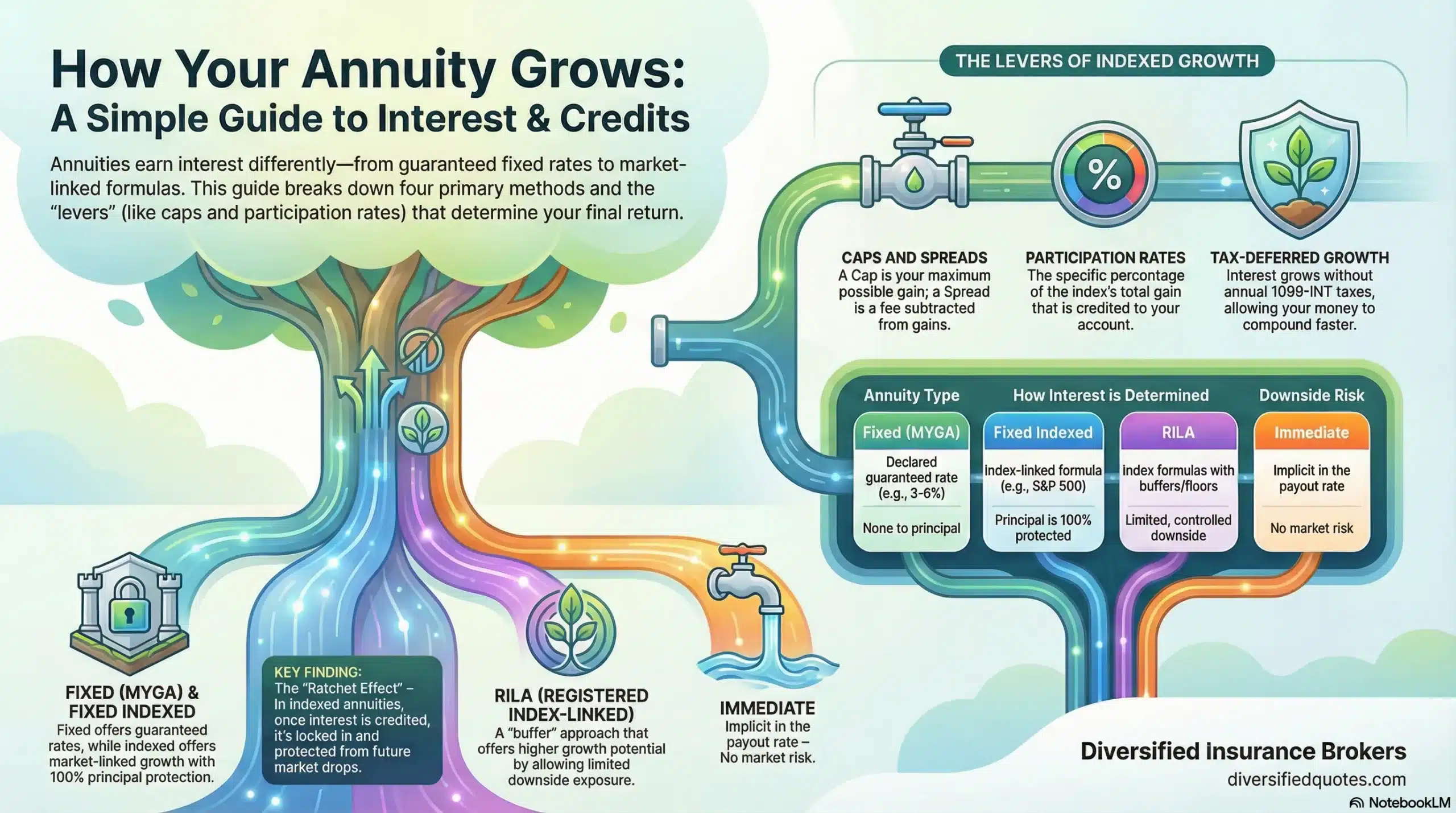
Instead, interest is linked to the performance of selected index strategies — subject to caps, spreads, or participation rates — while protecting principal from negative market years. That means if the index posts a loss, your credited interest for that period is 0%, not negative. This zero floor structure is one of the primary reasons conservative investors consider FIAs as part of a retirement income allocation. When evaluating the Income Driver 10, it is also important to understand how indexed crediting differs from direct investing; reviewing how annuities earn interest and the various index annuity crediting methods can clarify expectations before comparing illustrations.
The GLIR’s Two Design Paths: BCB Roll-Up vs. Activation Bonus
The most important decision a buyer of the Income Driver 10 makes — after deciding to purchase the product at all — is which GLIR design to elect. The Benefit Calculation Base (BCB) option gives income planning its clearest foundation: the BCB grows at a declared roll-up rate regardless of how the index performs in any given year. Whether the S&P 500 is up 18% or down 12%, the BCB continues accumulating at the stated roll-up, and that BCB is the value used to calculate your lifetime withdrawal amount. The predictability of the BCB option makes it particularly valuable for buyers who are deferring income for 5 to 10 years and want to project their future income with reasonable certainty before they need it. The alternative — the accumulation value plus activation bonus structure — links the income calculation directly to how the contract actually performs in the market. In strong index years, this can produce a larger income base at activation than the BCB route would. In flat or modestly negative years, the BCB route may produce more. Neither is universally superior. The correct choice depends on your projected income start date, your expectation for index performance during the deferral period, and how much income certainty matters relative to income potential. Requesting illustrations under both options at your specific age, premium, and projected income start date is the only way to make this comparison with real numbers. Our resource on what an income rider is explains how these structures work across different carrier designs for broader context.
The Income Driver 10 is structured with a 10-year surrender schedule, making it most appropriate for funds that can remain positioned for long-term retirement planning rather than short-term liquidity. After the first contract year, it allows penalty-free withdrawals of up to 10% annually, aligning with common annuity free withdrawal rules. However, withdrawals beyond rider guidelines can affect future guaranteed income calculations, so coordination is critical. The rider generally establishes two distinct values: the account value (your actual accumulation value) and an income base used strictly to calculate lifetime withdrawals. It is important to understand that the income base is not available for surrender — it is a calculation tool only. That distinction prevents unrealistic expectations when reviewing illustrations. Clients who want deeper clarity on income structuring should review fixed indexed annuities with income riders to compare design variations across carriers.
National Life Group: A+ Carrier with a Mutual Holding Structure
National Life Group’s AM Best A+ (Superior) rating is held by both Life Insurance Company of the Southwest and National Life Insurance Company — the two entities through which Income Driver 10 contracts are issued depending on the buyer’s state of residence. The A+ rating is the second-highest AM Best category, placing National Life Group in the company of North American, Midland National, and Integrity Life. The mutual holding company structure is a meaningful differentiator from PE-backed carriers and publicly traded holding companies: there are no outside shareholders, no quarterly earnings pressure from equity markets, and no PE fund timeline driving capital allocation decisions. Policyholder interests are structurally aligned with the company’s long-term claims-paying obligations. The 2024 reinsurance transaction with 26North Re — in which LSW ceded a $4.9 billion block of seasoned MYGA and FIA policies to a PE-backed reinsurer — is worth understanding before purchase. This is an increasingly common industry practice (similar structures exist at several large carriers), and NLG retains a minority stake in 26North Re. The transaction does not affect the contractual guarantees on in-force or new policies, but sophisticated buyers who care about the counterparty chain backing their policy should understand that a portion of NLG’s FIA and MYGA block is now reinsured by an alternative asset manager-backed entity. Reviewing the full financial background of National Life Group provides the context to evaluate these factors alongside the product features.
Growth inside the Income Driver 10 is linked to index performance — including the S&P 500 and additional strategy options. Because crediting is formula-driven rather than directly invested, performance depends on caps, spreads, and participation rates declared by the carrier. Those terms can change at renewal within contractual limits, which is why carrier strength and renewal history matter. When comparing annuities, it is also beneficial to examine key retirement considerations such as income start age, Social Security timing, required minimum distributions (if qualified funds are used), and tax coordination. Because annuities grow tax-deferred, they can provide compounding efficiency for non-qualified funds, but distributions are taxed as ordinary income on gains. For investors coordinating RMDs after SECURE 2.0, planning the income rider activation alongside updated RMD ages and amounts is essential. For investors concerned about risk alignment, evaluating your profile with an investment risk analysis can clarify whether indexed growth with principal protection aligns with your tolerance and time horizon. Protecting retirement accumulation from sequence-of-returns risk is one of the core reasons pre-retirees shift assets into FIA structures during the five to ten years before income begins.
Coordinating the Income Driver 10 with Social Security, RMDs, and Portfolio Income
The Income Driver 10 is most powerful when its income activation is coordinated deliberately with other retirement income sources rather than activated arbitrarily. The two most common coordination strategies are Social Security delay and RMD timing. For buyers between ages 62 and 70, delaying Social Security claiming while drawing from the Income Driver 10’s guaranteed withdrawal provision can improve lifetime Social Security income by 6% to 8% per year of delay, while the annuity income floor covers essential expenses during the delay period. This strategy works because the Income Driver 10’s guaranteed income is not inflation-adjusted — meaning the real value of the annuity income erodes slowly over time — while delayed Social Security benefits are inflation-indexed and provide progressively higher coverage. Structuring the annuity to cover fixed essential expenses (housing, utilities, insurance) while Social Security covers the remaining income floor and investment portfolios cover discretionary growth creates a layered retirement income architecture that is more resilient than relying on any single source. For buyers in RMD territory, the income rider must be coordinated with annual RMD obligations for qualified funds. Withdrawals taken as RMDs may count toward the 10% annual free withdrawal provision, but amounts that exceed rider guidelines can reduce the income base. Confirm with a licensed professional how your specific RMD amount interacts with the GLIR provisions before activating the rider or taking distributions. Our resource on RMD rules after SECURE 2.0 covers the updated distribution age and calculation framework. For clients funding the Income Driver 10 with a qualified rollover, our guide on how to transfer a 401(k) to an annuity covers the mechanics, and our overview of IRA rollovers to annuities addresses the tax-qualified transfer process.
The Income Driver 10 may also include death benefit provisions that provide beneficiaries the greater of account value or minimum guaranteed value, subject to contract terms. On select NLG designs, the GLIR death benefit provides beneficiaries the Benefit Calculation Base rather than the accumulation value — which can represent a meaningful legacy enhancement if the income base has grown substantially beyond the accumulation value during the deferral period. For clients prioritizing legacy planning, understanding annuity beneficiary death benefits ensures realistic expectations about how assets transfer. This annuity is not built for aggressive market speculation — it is built for structured accumulation and predictable distribution. If your objective is to create an income floor that covers essential retirement expenses so that other investments can remain growth-oriented, the Income Driver 10 may serve as a foundational component alongside other lifetime income strategies. Because income riders are highly sensitive to age at activation, deferral duration, and premium size, running multiple timeline illustrations is essential. At Diversified Insurance Brokers, we model real-world distribution scenarios to determine how income aligns with projected expenses, Social Security coordination, and longevity assumptions — not simply headline percentages from a brochure. For individuals within 5 to 10 years of retirement who want clarity and protection without surrendering long-term income potential, the Income Driver 10 can be a strong candidate when structured correctly and compared thoroughly across carriers.
Related Pages
Explore additional education, rate comparisons, and income planning resources.
Financial Protection Essentials
Compare annuity benefits, disability coverage strategies, group health planning, and retirement income solutions to build a more secure financial plan.
Talk to an Advisor or Request Your Annuity Quote
Ready to explore this annuity in more detail—or compare it with other carriers to see if even higher rates are available? With guaranteed income, principal protection, and long-term growth potential on the line, making the right choice is essential. The experienced advisors at Diversified Insurance Brokers will guide you through the options and design a strategy tailored to your retirement goals.
Schedule here:
calendly.com/jason-dibcompanies/diversified-quotes
Licensed in all 50 states • Fiduciary, family-owned since 1980
What is the difference between the income base and the account value on the Income Driver 10?
The Income Driver 10 maintains two separate values that serve completely different purposes. The accumulation value — also called the account value — is the real dollar amount inside your contract. It grows through index-linked credits, is reduced by withdrawals and rider charges, and is the value you would receive upon full surrender (minus applicable surrender charges). The income base, sometimes called the Benefit Calculation Base (BCB), is a separate calculation used only to determine your guaranteed lifetime withdrawal amount. It is not available for surrender or lump-sum withdrawal. The income base may grow through a declared roll-up rate or receive a bonus at income activation, potentially reaching a value substantially higher than the accumulation value after years of deferral. The practical significance: when you see an illustrated “income base” of $350,000 on a $200,000 premium after 10 years, that does not mean you can access $350,000. It means your guaranteed annual income withdrawal will be calculated as a percentage of $350,000. This distinction is the single most common source of confusion when reviewing income FIA illustrations, and our resource on how income riders work explains it across multiple carrier designs.
What is the 26North Re reinsurance transaction and does it affect my contract?
In 2024, Life Insurance Company of the Southwest completed a $4.9 billion reinsurance transaction with 26North Re, a private equity-backed reinsurer, transferring a seasoned block of MYGA and FIA policies. National Life Group retains a minority ownership stake in 26North Re. Reinsurance is a standard industry risk management practice — LSW remains the primary obligor on your contract and is responsible for honoring all guaranteed benefits. The reinsurance arrangement means LSW has transferred some of the financial risk of that block to 26North Re, which manages it through an alternative investment strategy. Your contractual guarantees are not affected. LSW’s AM Best A+ rating reflects its overall financial strength including its reinsurance arrangements, and Texas insurance regulators oversee LSW’s solvency regardless of how reinsurance is structured. State guaranty associations provide an additional backstop — typically $250,000 per covered contract — independent of any reinsurance arrangement. Similar structures exist at other large carriers including several A-rated leaders in the FIA market.
Why does the Income Driver 10 have a $100,000 minimum premium?
The $100,000 minimum reflects the Income Driver 10’s positioning as a single premium deferred annuity designed for buyers consolidating meaningful retirement assets — not a starter account. At that premium threshold, the lifetime income calculations become compelling: a guaranteed income base of $150,000 to $200,000 after deferral produces annual income amounts that can meaningfully supplement or replace other income sources. Below $100,000, the projected income amounts are often too small to justify the 10-year surrender commitment. For buyers consolidating multiple qualified accounts — a 401(k) rollover, an IRA transfer, and a maturing CD — reaching the $100,000 threshold is typically straightforward through combined trustee-to-trustee transfers. Our guides on 401(k) to annuity rollovers and IRA to annuity transfers cover the mechanics. For buyers with less than $100,000 available, NLG offers flexible premium products that accept contributions as low as $5,000, though with different structures and rider configurations than the Income Driver 10.
How does the Income Driver 10 compare to the NLG Zenith Income 10?
Both are National Life Group FIAs with a 10-year surrender schedule and Guaranteed Lifetime Income Rider options issued through Life Insurance Company of the Southwest. The Zenith Income 10 features two GLIR design paths — the Max Bonus option, which provides a stronger upfront boost to the income base for buyers planning to defer income for several years, and the Split Bonus option, which balances enhancements between the income base and the accumulation value for buyers who want greater liquidity flexibility alongside income guarantees. The Income Driver 10 similarly offers a Benefit Calculation Base roll-up structure and an accumulation value plus activation bonus structure. The practical distinction between these products for any specific buyer comes down to the current declared roll-up rates, bonus percentages, rider fees, and how each illustrates at your specific age, deposit amount, and planned income start date. Neither product is universally superior — the better choice is the one that produces higher confirmed lifetime income at your situation based on current illustrated rates. Side-by-side illustrations comparing both products at your inputs are the only reliable comparison tool. Our resource on how GLWBs work across carriers provides the framework for evaluating these rider structures objectively.
National Life Group is a mutual holding company — why does that matter for annuity buyers?
National Life Group operates under NLV Financial Corporation, a mutual holding company structure — meaning there are no outside shareholders, no publicly traded equity, and no private equity ownership. This is a meaningful structural distinction from the majority of the FIA market, where PE-backed carriers (funding lifetime income guarantees through alternative credit strategies) and publicly traded holding companies (subject to quarterly earnings pressure) dominate sales volumes. In a mutual holding company, the organizational incentives are aligned toward long-term policyholder claims-paying rather than investor returns or share price. Decisions about capital allocation, reserve adequacy, and product pricing are made with long-term policyholders as the primary stakeholder rather than an external capital partner with a defined investment timeline. For buyers committing to a 10-year surrender schedule with a guaranteed income rider, the organizational alignment of incentives is a meaningful factor alongside the AM Best A+ rating. National Life Group’s 175+ year operating history and $56.4 billion in total assets reflect an institution built on exactly this kind of long-term structural discipline — which is why it has remained a top carrier in the employer-sponsored FIA market where plan sponsors conduct rigorous due diligence before selecting carriers.
About the Author:
Jason Stolz, CLTC, CRPC, DIA, CAA and Chief Underwriter at Diversified Insurance Brokers (NPN 20471358), is a senior insurance and retirement professional with more than 25 years of real-world experience helping individuals, families, and business owners protect their income, assets, and long-term financial stability. As a long-time partner of the nationally licensed independent agency Diversified Insurance Brokers, Jason provides trusted guidance across multiple specialties—including fixed and indexed annuities, long-term care planning, personal and business disability insurance, life insurance solutions, Group Health, Travel Medical and Evacuation Insurance, and short-term health coverage. Diversified Insurance Brokers maintains active contracts with over 100 highly rated insurance carriers, ensuring clients have access to a broad and competitive marketplace.
His practical, education-first approach has earned recognition in publications such as VoyageATL, and contributions from his agency featured in Kiplinger and GoBankingRates— highlighting his commitment to financial clarity and client-focused planning. Drawing on deep product knowledge and years of hands-on field experience, Jason helps clients evaluate carriers, compare strategies, and build retirement and protection plans that are both secure and cost-efficient. Visitors who want to explore current annuity rates and compare options across multiple insurers can also use this annuity quote and comparison tool.
Explore More Lifetime Income Options: Browse our complete guide to Lifetime Income Annuities & Products — covering best annuities for lifetime income, GLWB riders, joint income annuities & top carrier products from 100+ carriers.
Explore More Annuity Options: Browse our complete guide to Best Fixed Indexed Annuity Products — covering individual fixed indexed annuity product reviews from top-rated carriers from 100+ carriers.
Last Reviewed: August 23, 2026 |
Reviewed by: Jason Stolz, CLTC, CRPC, DIA, CAA
Chief Underwriter, Diversified Insurance Brokers, Inc. | NPN: 20471358 | Diversified Insurance Brokers, Inc. — Licensed in all 50 states
Fact Checked by: Tonia Pettitt, CMIP©
Medicare Specialist, Diversified Insurance Brokers, Inc. | NPN: 14374308 | Diversified Insurance Brokers, Inc. — Licensed in all 50 states
Did you find this content helpful? Leave us a Google review — it helps others find trustworthy guidance too.
Editorial Standards: Diversified Insurance Brokers maintains rigorous editorial standards to ensure accuracy, clarity, and independence in all content. Learn more about our editorial standards and commitment to transparency.
