
North American NAC Control X Fixed Indexed Annuity – Growth, Control, and Guaranteed Protection
North American NAC Control.X Fixed Indexed Annuity – Growth, Control, and Guaranteed Protection
At Diversified Insurance Brokers, we work with more than 75 top-rated insurance carriers to help clients nationwide secure safe, smart retirement strategies. The NAC Control.X Fixed Indexed Annuity, issued by North American Company for Life and Health Insurance (AM Best: A+ Superior, affirmed August 2025 — maintained continuously since at least 2006 as part of Sammons Financial Group), was built for individuals who want the power of market-linked growth without putting their retirement principal at risk due to market downturns. For the right investor profile, Control.X can serve long-term accumulation, tax-deferred growth, and retirement income planning — especially for people who want flexibility without giving up protection.

Jason Stolz CLTC, CRPC, DIA, CAA
Fixed indexed annuities are often misunderstood because they don’t behave like traditional investments. They aren’t designed for day-to-day trading, and they aren’t meant to follow the stock market tick for tick. Instead, a fixed indexed annuity uses a defined interest crediting method tied to an index, while keeping your account protected from negative market years. If you want a full breakdown of how this works in plain English, our resource on how a fixed indexed annuity works covers the mechanics. Our resource on fixed indexed annuity myths debunked addresses the most common misconceptions that cause buyers to either over-expect or under-value FIA products before they understand the structure.
Ensure you are receiving the absolute top rates
Current Fixed Annuity Rates
Compare today’s best fixed annuity rates from top carriers.
Current Bonus Annuity Rates
See which annuities offer the highest upfront bonus today.
Request an Annuity Quote
Submit our annuity request form to get personalized rate options.
Lifetime Income Calculator
Use our calculator to see how much guaranteed income your annuity can provide.
NAC Control.X vs. the Conservative Retirement Allocation Landscape
| Dimension | NAC Control.X FIA | Fixed Rate Annuity (MYGA) | Direct Market Exposure |
|---|---|---|---|
| Downside Protection | Full — 0% floor on all indexed crediting strategies. Account value cannot decline due to index performance regardless of severity or duration of decline. Previously credited gains locked in annually and permanently protected. | Full — principal and declared interest guaranteed contractually for the full term. No market exposure of any kind. Simpler than FIA but no upside participation beyond the declared rate. | None — full market participation in both directions. A severe bear market is fully realized. The absence of any floor makes early retirement drawdowns the primary risk for investors within 5–10 years of retirement. |
| Crediting Menu Depth | Multiple — annual point-to-point, trigger strategies, participation-rate structures. Customization allows buyers to match crediting method to risk comfort level, time horizon, and interest rate environment. Strategies can typically be reallocated at each annual renewal. | Single — declared rate applied uniformly for the full term. No strategy selection required. Maximum simplicity; rate is known from day one and does not depend on any market performance. | Full index participation — no cap, no participation rate. Returns and losses fully realized. No crediting menu; the account tracks the market directly without any contractual modification. |
| Tax Treatment | Full tax deferral — no annual 1099 on credited interest. Gains taxable as ordinary income at distribution; basis returned tax-free for non-qualified contracts. Full credited rate compounds without annual tax reduction. | Full tax deferral — same compounding advantage. Both FIA and MYGA structures defer taxation identically; the crediting mechanism (indexed vs. declared) is the only material difference between the two. | Taxable annually in non-qualified accounts — dividends and realized gains generate a 1099 each year. Tax drag reduces effective compound return relative to tax-deferred alternatives at the same nominal rate over multi-year holding periods. |
| Income Rider Availability | Optional income riders available — can create guaranteed lifetime withdrawal streams without requiring annuitization. Owner retains access to account value within contract limits; income base and account value are separate calculations. | Some MYGA carriers offer income riders; more commonly, MYGA accumulation is repositioned into a separate income annuity at maturity. Less integrated income planning than an FIA with a built-in optional rider. | No contractual income guarantees — systematic withdrawal from a market portfolio can deplete the account if returns are negative and withdrawals continue. No guaranteed lifetime income mechanism of any kind. |
| Carrier Strength | North American: AM Best A+ (Superior), S&P A+ (Strong), Fitch A+ Stable — triple-A+ sweep across all three major agencies, maintained since at least 2006. Part of Sammons Financial Group, one of the largest privately held financial services organizations in the U.S. | Varies by carrier — MYGA marketplace spans B++ through A+ rated carriers. North American also offers competitive MYGAs, meaning the A+ carrier strength is available in both the FIA and MYGA product types from the same issuing entity. | Brokerage account — SIPC protects against brokerage failure (up to $500K); no protection against investment losses. The comparison framework for carrier strength is not applicable to direct market investments. |
Why Consider the NAC Control.X Fixed Indexed Annuity?
Control.X stands out because it combines a modern index strategy menu with a retirement-friendly structure. When someone is considering an annuity for retirement, they typically fall into one of three categories: the conservative saver who wants protection above all else; the retiree who wants income certainty and wants to reduce reliance on market performance; or the planner who wants a balance of growth opportunity and safety while keeping liquidity options available. Control.X tends to fit best in that third category — but depending on how it is configured, it can also serve many conservative retirement plans. The reason a product like Control.X gets attention is simple: many retirees and pre-retirees want an alternative to “all market risk” or “all cash and CDs.” A fixed indexed annuity can play an important role in a broader retirement plan, especially when paired with a strategy for guaranteed income and long-term liquidity.
Growth Without Market Losses — The Core FIA Mechanics
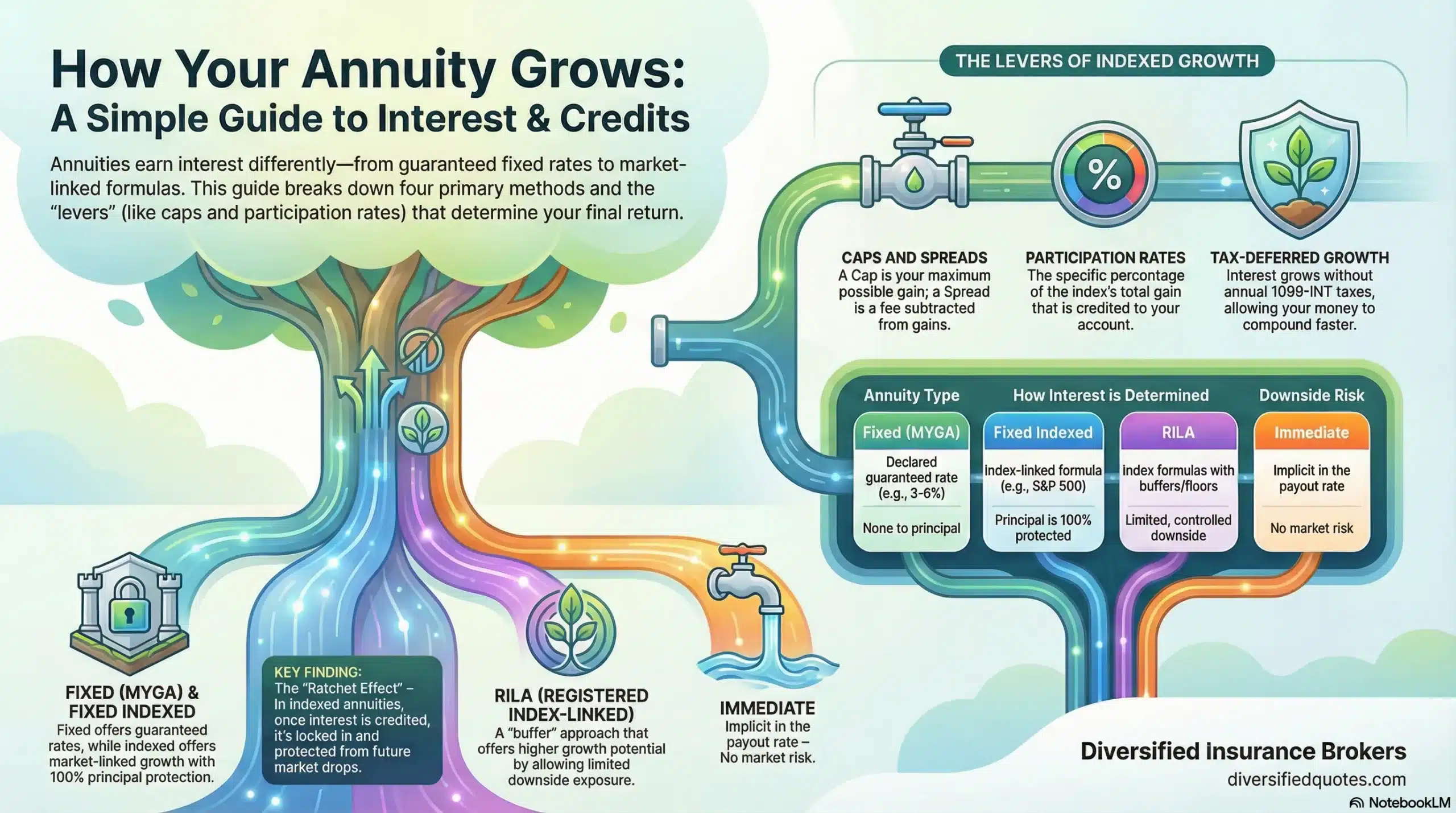
The core promise behind Control.X is that credited interest is linked to index performance, but principal is not directly invested in the market. In a year when the index is down, the contract doesn’t lose money due to that negative return. Instead, the strategy credits a floor of zero and the account value stays intact — while the annual reset restarts the index measurement from the current level, meaning the index does not need to recover to its prior high before the contract can again earn positive credits. Over a multi-year holding period, this structure creates a stair-step accumulation pattern: positive years add locked-in gains; negative years hold the balance steady and reset the measurement point; recovery years immediately produce credits. The timing of market returns matters enormously in retirement, and a large loss early while withdrawals are occurring can be devastating even if the market eventually recovers. Control.X’s contractual floor eliminates that timing risk for the allocated assets.
Multiple Index Crediting Strategies and Customization
Control.X offers multiple indexing strategy choices, giving buyers the ability to tailor how credited interest is calculated over time. Some investors want a straightforward annual point-to-point design. Others want trigger strategies that credit a stated rate when the index ends above a defined level — simpler to conceptualize and easy to understand at renewal. Some want participation-rate structures that credit a defined percentage of index gains without a strict cap ceiling. What matters is not the name of the index but the method: how returns are measured, when interest is credited, and what limits apply. When reviewing index strategies, the practical questions matter most: What happens in a flat year? What happens in a strong year? What happens in a down year? And critically — what happens if the insurance company changes caps or participation rates at renewal? Understanding those mechanics is how you select a strategy you can commit to over the full contract period. For a complete overview of what’s competitively available across the full FIA marketplace right now, reviewing current annuity rates provides the comparison context that keeps the Control.X evaluation honest.
Liquidity, Income Riders, and the IRA Annuity Context
Liquidity is one of the biggest mistakes people make when choosing an annuity. Most FIAs, including Control.X, allow penalty-free withdrawals of up to 10% annually after the first year — giving access without breaking the contract structure. That matters when life happens: unexpected repairs, family emergencies, healthcare needs, or strategic tax planning. If liquidity structure is an important evaluation factor, reviewing annuity free withdrawal rules across carriers clarifies how access provisions work and what to anticipate before any commitment is made.
Many clients exploring Control.X aren’t just looking for accumulation — they’re looking for income they can depend on. Optional income riders can create guaranteed lifetime withdrawal streams without annuitizing the contract, meaning the owner retains access to the account value within contract limits while building a guaranteed withdrawal framework. This is a critical distinction: modern FIAs allow the owner to keep the money, keep the ability to withdraw within contract limits, and structure income while maintaining control. If lifetime guaranteed income is the primary objective, our resource on lifetime income annuity strategies covers the full income planning evaluation framework.
For buyers using qualified funds — IRA, 401(k) rollovers, or other eligible accounts — the Control.X FIA can be structured as a qualified annuity. If you’re rolling IRA funds into an annuity for principal-protected accumulation or integrated income planning, our resource on what is an IRA annuity covers the tax treatment, RMD coordination, beneficiary considerations, and qualified vs. non-qualified nuances that affect how the contract should be structured for maximum long-term efficiency. North American’s A+ (Superior) AM Best rating — maintained across all three major agencies — provides one of the strongest carrier financial strength foundations available in the FIA marketplace for both qualified and non-qualified buyers committing retirement assets for a multi-year accumulation period.
Ready to compare the NAC Control.X against today’s full FIA marketplace?
Request Your Personalized Annuity Comparison
Financial Protection Essentials
Explore annuity interest examples, disability income protection for key professions, and insurance planning strategies across multiple coverage types.
Talk to an Advisor or Request Your Annuity Quote
Ready to explore this annuity in more detail—or compare it with other carriers to see if even higher rates are available? With guaranteed income, principal protection, and long-term growth potential on the line, making the right choice is essential. The experienced advisors at Diversified Insurance Brokers will guide you through the options and design a strategy tailored to your retirement goals.
Schedule here:
calendly.com/jason-dibcompanies/diversified-quotes
Licensed in all 50 states • Fiduciary, family-owned since 1980
What does “customization” actually mean in the NAC Control.X — and how do I choose among index strategies?
The NAC Control.X’s customization refers primarily to the multiple indexed crediting strategies the buyer can select from at contract inception and reallocate among at each annual renewal. The practical implication is that a buyer who chooses an annual point-to-point S&P 500 strategy at issue can switch to a trigger strategy at the next renewal if market conditions or personal preference have changed — without surrendering the contract or incurring any cost. This annual renewal flexibility is one of the most underappreciated features of the FIA structure: the strategy commitment is one year at a time, not locked for the full surrender period. The three most common strategy types in Control.X are annual point-to-point (compares index value at contract anniversary; credits the gain up to the cap, or zero if negative); trigger strategies (credit a fixed stated rate if the index ends positive at the measurement date, regardless of how much it gained — simpler to understand, independent of the magnitude of the gain); and participation-rate strategies (credit a defined percentage of the index gain without a strict cap ceiling, typically on the S&P 500 or a volatility-controlled proprietary index). Understanding how each crediting method performs across different market environments — specifically how trigger strategies outperform point-to-point in flat-to-modest positive years while underperforming in strongly positive years, and how participation-rate strategies behave without a ceiling — is the analytical foundation for selecting the approach that matches your realistic return expectations. In our advisory process, we illustrate each strategy across three scenarios: a strong equity year, a flat year, and a negative year — so the choice is grounded in realistic expectations rather than the best-case illustration alone.
How does North American’s A+ AM Best rating affect the safety of the Control.X guarantees?
North American Company for Life and Health Insurance’s AM Best A+ (Superior) rating — affirmed August 2025, maintained across all three major rating agencies (AM Best A+, S&P A+, Fitch A+) as part of Sammons Financial Group — is the direct financial backing for every contractual guarantee in the NAC Control.X FIA. The 0% floor, the annual interest lock-in, the free withdrawal provision, and any optional income rider guarantees are not backed by a government program or market mechanism — they are contractual obligations backed solely by North American’s financial strength. The A+ designation is the second-highest of 15 AM Best rating categories, indicating Superior ability to meet ongoing insurance obligations. North American has maintained A+ across at least 20 years of continuous operation, including through the 2008-2009 financial crisis and the 2020 market disruption — providing evidence that the rating reflects durable structural strength rather than a cyclical peak. The triple-A+ consistency across AM Best, S&P, and Fitch places North American in a very small group of annuity carriers with this level of multi-agency financial strength rating convergence. For buyers evaluating whether the Control.X’s crediting terms justify the commitment — or comparing it against products from carriers rated A- or B++ — the carrier strength dimension means that the 0% floor and income rider guarantees in the Control.X rest on a notably more durable financial foundation than most competitively-priced FIA alternatives in the marketplace. Our resource on RILA structures — which are typically issued by large carriers also rated A or A+ — provides context for how the Control.X’s carrier strength compares in the broader indexed annuity category when buyers are evaluating the full range of principal-protection versus buffer-based structures.
How do Control.X income riders work — and how does guaranteed income from an FIA differ from annuitization?
The most common misconception about FIA income is that creating guaranteed lifetime income requires annuitizing the contract — permanently surrendering the account value to the insurance company in exchange for income payments. Modern FIA income riders, including those available on the NAC Control.X, are structured differently. An income rider establishes a separate income base (often called a benefit base or guaranteed withdrawal base) that grows separately from the account value — typically at a guaranteed roll-up rate during the deferral period. When income activates, the rider pays a defined percentage of the income base as an annual guaranteed withdrawal for life — even if the account value depletes to zero due to ongoing distributions. Crucially, the owner retains access to the account value within the contract’s free withdrawal provisions throughout the process, and any remaining account value at death passes to named beneficiaries. This structure creates “income without surrender” — guaranteed lifetime cash flow while maintaining control, ownership, and beneficiary rights. Understanding how annuities pay lifetime income — specifically the distinction between a GLWB income rider that preserves account value access and true annuitization that does not — is one of the most important conceptual clarifications before any income planning decision is made. The income rider evaluation framework: at the same age, deferral period, and premium amount, compare the projected annual guaranteed income from Control.X’s rider against competing income FIAs across the full marketplace — because income rider payout percentages and roll-up rates vary significantly across carriers and product generations, and the best income rider for the Control.X’s specific crediting structure may or may not be the most competitive in the current market.
How does tax deferral in Control.X compare to holding the equivalent assets in a taxable account?
Understanding how annuity gains are taxed — and more importantly, how the deferral advantage compounds over time — is one of the most practically significant comparisons for buyers repositioning non-qualified assets into Control.X. For a non-qualified contract funded with after-tax dollars: the full credited rate compounds each year without a tax payment reducing the compounding base. A buyer in the 32% federal bracket with a credited rate of 6% inside the annuity compounds at the full 6% annually. An equivalent taxable account earning 6% retains approximately 4.1% after annual federal and state taxation (depending on state tax rate), and that 4.1% is the base from which next year’s compounding begins — not 6%. Over a 10-year accumulation period, this differential compounds to a materially larger accumulated value inside the annuity versus the taxable account at the same nominal rate. The second planning advantage is income timing: unlike a CD or bond that forces annual 1099 recognition, the annuity allows the owner to choose when gains are recognized as ordinary income — coordinating distribution timing with lower-income years, Roth conversion windows, or Medicare IRMAA thresholds. For qualified IRA or 401(k) rollover funding: the marginal tax deferral advantage is less significant since the qualified wrapper already defers — but Control.X’s principal protection, indexed growth potential, and optional income rider features still provide value independent of the additional tax deferral benefit.
How does Control.X compare to North American’s other FIA products — and when might one product be preferred over another?
North American Company for Life and Health Insurance offers multiple fixed indexed annuity products with different structural emphases — including the BenefitSolutions 10 FIA, which is designed with specific built-in benefits for retirement and care needs. The comparison between Control.X and BenefitSolutions 10 — or any other North American FIA product — depends on the buyer’s primary objective. Control.X is positioned as a customizable accumulation vehicle with a broad crediting strategy menu and income rider optionality. BenefitSolutions 10 is specifically engineered with built-in care and income benefit features that are part of the core product rather than optional add-ons. A buyer whose primary planning objective is pure accumulation flexibility with maximum crediting strategy customization may find Control.X’s design more aligned — while a buyer who wants the security of built-in care benefits or a specific income structure integrated into the contract architecture may find BenefitSolutions 10 more appropriate. This carrier-to-carrier comparison within the same product family (evaluating two North American FIAs against each other) is part of our advisory process. We also compare both products against alternatives from competing A+ and A carriers to ensure the recommendation is the best available product for the specific buyer — not the best available within a single carrier’s product menu. Using a simple vs compound interest framework to illustrate how credited interest compounding inside each product’s specific structure produces different accumulation outcomes across the same holding period is one of the most practically useful illustrations in a side-by-side product comparison process.
About the Author:
Jason Stolz, CLTC, CRPC, DIA, CAA and Chief Underwriter at Diversified Insurance Brokers (NPN 20471358), is a senior insurance and retirement professional with more than 25 years of real-world experience helping individuals, families, and business owners protect their income, assets, and long-term financial stability. As a long-time partner of the nationally licensed independent agency Diversified Insurance Brokers, Jason provides trusted guidance across multiple specialties—including fixed and indexed annuities, long-term care planning, personal and business disability insurance, life insurance solutions, Group Health, Travel Medical and Evacuation Insurance, and short-term health coverage. Diversified Insurance Brokers maintains active contracts with over 100 highly rated insurance carriers, ensuring clients have access to a broad and competitive marketplace.
His practical, education-first approach has earned recognition in publications such as VoyageATL, and contributions from his agency featured in Kiplinger and GoBankingRates— highlighting his commitment to financial clarity and client-focused planning. Drawing on deep product knowledge and years of hands-on field experience, Jason helps clients evaluate carriers, compare strategies, and build retirement and protection plans that are both secure and cost-efficient. Visitors who want to explore current annuity rates and compare options across multiple insurers can also use this annuity quote and comparison tool.
Browse More Resources: Return to our complete Fixed Indexed Annuity Products & Education guide — covering FIA products and education from top carriers.
Last Reviewed: June 26, 2026 |
Reviewed by: Jason Stolz, CLTC, CRPC, DIA, CAA
Chief Underwriter, Diversified Insurance Brokers, Inc. | NPN: 20471358 | Diversified Insurance Brokers, Inc. — Licensed in all 50 states
Fact Checked by: Tonia Pettitt, CMIP©
Medicare Specialist, Diversified Insurance Brokers, Inc. | NPN: 14374308 | Diversified Insurance Brokers, Inc. — Licensed in all 50 states
Did you find this content helpful? Leave us a Google review — it helps others find trustworthy guidance too.
Editorial Standards: Diversified Insurance Brokers maintains rigorous editorial standards to ensure accuracy, clarity, and independence in all content. Learn more about our editorial standards and commitment to transparency.
