
GBU Future Flex Fixed Indexed Annuity – Flexible Growth, Protected Principal
As an Independent Annuity Broker, we compare rates across 100+ carriers and 1,000 different annuities— not just one company’s product offerings — to find the best fit for your goals.
GBU Future Flex Fixed Indexed Annuity – Flexible Growth, Protected Principal
At Diversified Insurance Brokers, we help clients structure retirement strategies that combine growth potential, principal protection, and long-term flexibility. The Future Flex Fixed Indexed Annuity from GBU Life Insurance Company (AM Best: A- Excellent, stable outlook, affirmed August 2025) is designed for individuals who want indexed growth opportunities without exposing their retirement savings to direct market risk. In today’s volatile environment, many retirees and pre-retirees are looking for alternatives that offer more stability than equities but more upside potential than traditional fixed products. A fixed indexed annuity like Future Flex fills that gap by crediting interest based on external index performance while contractually guaranteeing that your principal will never decline due to negative market returns.

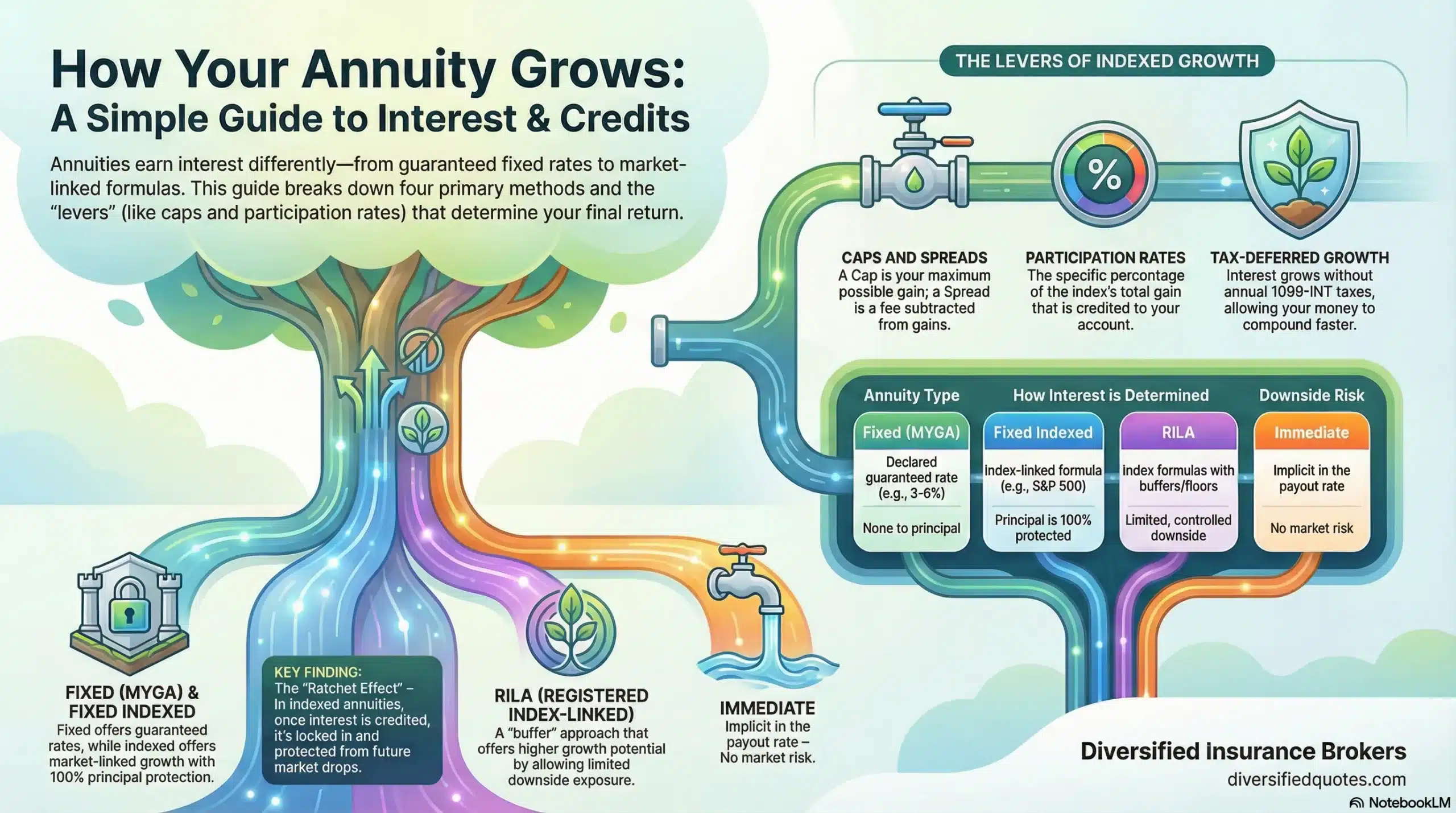
Understanding how this structure works is critical. Unlike variable annuities, which fluctuate with market performance, FIAs shield your base account value from downturns. When the market performs well, you participate in a portion of that growth according to the selected crediting strategy. When the market declines, your credited interest for that term is simply zero — not negative. Over time, this reset structure can provide meaningful compounding without the psychological and financial damage of large market drawdowns. For a deeper look at the protective framework that defines these products, reviewing how indexed annuity principal protection works clarifies the contractual mechanics. For those comparing indexed designs, understanding RILAs provides useful context — RILAs incorporate buffers and partial downside exposure, while FIAs like Future Flex maintain full principal protection from index loss.
Ensure you are receiving the absolute top rates
Current Fixed Annuity Rates
Compare today’s best fixed annuity rates from top carriers.
Current Bonus Annuity Rates
See which annuities offer the highest upfront bonus today.
Request an Annuity Quote
Submit our annuity request form to get personalized rate options.
Lifetime Income Calculator
Use our calculator to see how much guaranteed income your annuity can provide.
GBU Future Flex vs. Competing Conservative Growth Options
| Dimension | GBU Future Flex FIA | MYGA (Fixed Rate Annuity) | CDs / Taxable Bonds |
|---|---|---|---|
| Principal Protection | Full contractual — 0% floor on indexed accounts. Account value cannot decline due to index performance. Gains locked in annually and cannot be reversed by future negative index years. | Full — principal and declared interest guaranteed contractually for the full term. No index exposure. Maximum certainty at a declared rate known from day one. | CD: FDIC-insured up to $250K — full principal protection. Taxable bond: mark-to-market losses possible if rates rise. Neither provides the upside participation of an FIA with the same protection floor. |
| Growth Mechanism | Index-linked — annual point-to-point, monthly averaging, and other crediting strategies. In strong market years, may credit significantly above what a CD or MYGA provides. Negative years credit zero. Annual reset restarts measurement from current level. | Declared fixed rate — known and locked for the full term. No upside participation above the stated rate; no downside exposure. Highest rate predictability of any annuity structure. | CD: declared rate locked for term; reinvested at prevailing rates at maturity. Taxable bond: interest rate risk on price; coupon fixed. Neither provides indexed upside participation or tax deferral. |
| Tax Treatment | Full tax deferral — no annual 1099 on credited interest. Gains taxable as ordinary income at distribution; basis returned tax-free for non-qualified contracts. Credited rate compounds without annual tax reduction. | Full tax deferral — same compounding advantage as the FIA. For buyers in higher brackets, the net after-tax return advantage over a taxable CD earning the same nominal rate is significant over multi-year holding periods. | Fully taxable annually — CD interest and bond coupons generate a 1099 each year regardless of whether income is withdrawn. Tax drag reduces effective compound return. No tax deferral advantage in either bank product. |
| Flexibility | Term length variety — Future Flex offers multiple term options to align with anticipated liquidity needs. Annual penalty-free withdrawals (typically up to 10% after year one) provide measured access without disrupting long-term accumulation. | Term-specific — rate locked for the full MYGA term. Similar 10% annual free withdrawal provisions on most MYGA contracts. Full penalty-free access at maturity for reinvestment or income conversion. | CD: penalty for early withdrawal before maturity. Taxable bond: fully liquid at market price, which may be below purchase price if rates rose. No income planning features or guaranteed lifetime income options. |
| Best Suited For | Conservative investors who want S&P 500-linked upside with a guaranteed zero floor, tax deferral, and term flexibility; pre-retirees who experienced volatility and want a smoother accumulation trajectory without sacrificing index growth potential. | Buyers who value absolute rate certainty above index-linked potential; those who want to know the exact maturity value at purchase without tracking crediting strategy performance or renewal rate adjustments. | Buyers who need maximum liquidity and FDIC insurance for shorter-term reserves; those who cannot commit to even a minimal surrender schedule. Not appropriate as a primary retirement accumulation vehicle at significant amounts. |
Future Flex Structure — Crediting Flexibility, Income Planning, and Liquidity
The Future Flex FIA allows contract owners to choose from multiple indexed crediting strategies. These may include annual point-to-point methods, monthly averaging approaches, or other structured index options depending on availability. This flexibility allows the strategy to align with your time horizon and risk comfort level. Understanding how index annuity crediting methods work across cap strategies, participation rates, and annual reset mechanics — and how each performs differently in bull, flat, and bear market environments — provides the analytical foundation for selecting the most appropriate crediting approach within the Future Flex contract. The term length variety is another distinguishing feature: unlike many FIA products that offer only a single surrender period, Future Flex allows alignment of the surrender schedule with anticipated liquidity needs and retirement timeline.
Even if accumulation is the immediate goal, planning ahead for lifetime income is prudent. Understanding how annuity income is calculated — including how income riders, payout percentages, deferral periods, and age factors influence future retirement cash flow — helps clarify how the Future Flex accumulation phase connects to the income conversion decision. Many clients begin with growth as their priority and later transition toward income stability as retirement approaches. FIAs can be structured to convert into guaranteed income streams, creating a private pension alternative. Tax deferral further enhances the accumulation advantage: interest credited within the annuity compounds without annual taxation, allowing uninterrupted growth until withdrawals begin. When structured alongside other income sources such as coordinated Social Security income, annuity income can help smooth taxable distributions and reduce the risk of withdrawing too aggressively during market downturns.
For clients transitioning funds from an existing employer plan, proper rollover execution maintains tax qualification. Guidance on transferring a deferred compensation plan to an annuity covers the specific rollover mechanics and tax treatment considerations. GBU Life Insurance Company is a fraternal benefit society with an insurance history tracing to 1910 and a consistent A- AM Best rating, affirmed August 2025 with stable outlook. At Diversified Insurance Brokers, we compare Future Flex against alternative FIA designs across 75+ carriers to evaluate crediting methods, caps, participation rates, surrender structures, and financial strength ratings before any recommendation — because the right annuity is the one that best aligns with your specific objectives, not the one in front of us.
Ready to evaluate the Future Flex alongside today’s full FIA marketplace?
Request Your Personalized Annuity Comparison
Financial Protection Essentials
Explore annuity interest examples, disability income protection for key professions, and insurance planning strategies across multiple coverage types.
Talk to an Advisor or Request Your Annuity Quote
Ready to explore this annuity in more detail—or compare it with other carriers to see if even higher rates are available? With guaranteed income, principal protection, and long-term growth potential on the line, making the right choice is essential. The experienced advisors at Diversified Insurance Brokers will guide you through the options and design a strategy tailored to your retirement goals.
Schedule here:
calendly.com/jason-dibcompanies/diversified-quotes
Licensed in all 50 states • Fiduciary, family-owned since 1980
What does “term flexibility” actually mean in the Future Flex FIA — and how should I choose a term length?
The “Future Flex” name specifically references the product’s multiple surrender term options — a design that gives buyers the ability to align the contract’s commitment horizon with their individual retirement timeline rather than accepting a one-size-fits-all structure. Most FIA products are offered in a single surrender period (5, 7, or 10 years depending on the carrier’s product lineup) or in a narrow range of 2-3 options. The Future Flex provides broader term flexibility, which becomes valuable when the buyer’s retirement date, income activation timeline, or anticipated liquidity needs create a specific planning window. The term selection framework involves three questions: first, when do you need the accumulated value to be fully accessible without penalty — the contract’s maturity date should align with or precede that timeline; second, how does the shorter versus longer term’s crediting parameters compare — longer surrender periods typically allow the carrier to offer higher initial cap rates or participation rates because the extended commitment provides a larger options budget from the fixed-income portfolio; and third, what happens to the allocation at the chosen maturity date — whether it rolls into a new FIA, converts to an income vehicle, or is repositioned elsewhere should be known at purchase rather than decided reactively at maturity. Understanding how FIA contracts function at the contract level — specifically how the surrender schedule, annual free provision, and crediting term interact — provides the foundational knowledge needed to evaluate Future Flex term options against one another and against competing products at equivalent terms. For buyers who want to maintain rolling liquidity access across multiple contracts simultaneously, exploring a laddering approach alongside Future Flex may address the flexibility objective more completely than any single contract’s term flexibility alone.
How does the annual reset in the Future Flex FIA protect accumulation across multiple market cycles?
The annual reset is one of the most consequential mechanics in any FIA — including Future Flex — and it operates in two directions simultaneously. In the upward direction: at the end of each crediting year in which the index has a positive return, the interest credited (subject to the cap, participation rate, or spread) is added to the account value and permanently locked in. Once credited, those gains become part of the new base from which next year’s credit calculation begins — they cannot be taken back by future negative index years. In the downward direction: when the index declines during a crediting period, the account is credited zero rather than a loss, and the starting index value resets to the current (lower) index level for the next crediting period. This means the index does not need to return to its prior peak before the contract can again earn positive credits — each year begins fresh from wherever the index currently stands. The practical compounding consequence over a multi-year holding period is that the Future Flex accumulation trajectory tends to be more durable than direct market investment: positive years add locked-in gains, negative years hold the balance steady and reset the measurement point, and recovery years immediately produce credits from the new lower starting level without requiring the index to claw back to a prior high. Understanding how the cap rate limits the annual credit amount in each positive year — and how the cap interacts with the reset to determine the effective credited return over a full market cycle — is essential for realistic projection of Future Flex’s accumulation across best-case, moderate-case, and minimum-cap scenarios.
How does tax deferral inside the Future Flex FIA interact with Social Security and Medicare planning?
The tax deferral inside the Future Flex FIA creates specific planning interactions with Social Security and Medicare that make the income timing control advantage particularly valuable for retirees managing multiple income sources simultaneously. Understanding how annuity distributions are taxed in this context is the starting point. For non-qualified Future Flex contracts funded with after-tax dollars, partial withdrawals are subject to LIFO treatment — gains are distributed first and taxed as ordinary income before the tax-free return of basis begins. This means that strategic control over how much is withdrawn from the Future Flex in any given year directly controls how much ordinary income is recognized from the contract in that year — which in turn affects the Social Security benefit taxation calculation and the Medicare IRMAA (Income-Related Monthly Adjustment Amount) premium determination. Social Security benefits become taxable when combined income (adjusted gross income plus half of Social Security plus municipal bond interest) exceeds $25,000 for single filers or $32,000 for joint filers, with up to 85% of benefits taxable above $34,000 or $44,000 respectively. The ability to limit Future Flex distributions in a high-income year — or to take distributions in a lower-income year before Medicare enrollment or during a Roth conversion window — provides a tax planning lever that taxable savings vehicles cannot replicate because the 1099 is not issued until withdrawal. For retirees whose combined income is near the Medicare IRMAA threshold that triggers premium surcharges (currently structured in multiple tiers above a baseline), the ability to defer Future Flex gains rather than being forced to recognize them annually can prevent crossing into a higher IRMAA bracket in any given year.
Is the Future Flex FIA appropriate for a 401(k) rollover or IRA transfer?
Yes — the Future Flex FIA can be purchased as a qualified annuity funded by a direct IRA rollover or a 401(k) rollover, and this is one of the most common funding sources for FIA purchases in the retirement market. The direct rollover from a former employer 401(k) or from an existing IRA moves funds directly from the prior custodian to GBU Life without triggering a taxable distribution — as long as the rollover is handled as a direct trustee-to-trustee transfer rather than a 60-day indirect rollover. For buyers rolling over an existing annuity contract into the Future Flex — using a 1035 exchange rather than a direct qualified plan rollover — the analysis requires confirming that any remaining surrender charges on the prior contract are justified by the improvement in Future Flex’s crediting terms over the same holding period. The accumulated value and cost basis transfer in a 1035 exchange without triggering current taxation. The most important consideration for any IRA rollover into the Future Flex is RMD coordination: IRA-qualified annuities must still satisfy Required Minimum Distributions beginning at the required beginning date, and the annual 10% free withdrawal provision should be large enough to accommodate the RMD amount from this specific contract — or the RMD should be aggregated across multiple IRAs so that the annuity’s RMD is satisfied from another account while the annuity’s free withdrawal provision remains intact. Our resource on annuity beneficiary and death benefit provisions is also relevant for rollover buyers — particularly for IRA-qualified contracts where the death benefit rules (including the 10-year rule for most non-spouse beneficiaries under SECURE 2.0) affect the legacy planning considerations for the accumulated annuity value. Understanding how the Future Flex’s specific death benefit provisions interact with IRA beneficiary rules is part of the full due diligence conversation before a large rollover commitment.
How does GBU Life’s A- AM Best rating affect the guarantees inside the Future Flex FIA?
GBU Life Insurance Company’s AM Best A- (Excellent) rating, affirmed August 2025 with a stable outlook, is the direct backing for every contractual guarantee in the Future Flex FIA. The 0% floor — the guarantee that the account value will never decline due to index performance — is not backed by a government program or market mechanism; it is backed solely by GBU Life’s contractual obligation and its financial strength to honor that obligation across the full surrender period and beyond. The annual interest lock-in, the free withdrawal provisions, and any optional income rider guarantees all rest on the same foundation. The A- designation — the fourth-highest AM Best rating category out of 16 — indicates that AM Best has evaluated GBU Life’s balance sheet strength, operating performance, and business profile and determined the company has Excellent ability to meet its ongoing insurance obligations. GBU Life is a fraternal benefit society with an insurance history dating to 1910, maintaining the A- rating since 2017 when it was upgraded from B++, and holding over $4.7 billion in assets with a $314 million surplus. Compared to the B++ tier where a disclosure recommendation applies at Diversified Insurance Brokers, the A- represents a materially stronger financial stability assessment. For buyers comparing Future Flex against products from B++ carriers offering potentially higher promotional cap rates, the A- carrier strength versus B++ carrier strength comparison is an explicit trade-off to evaluate — not a secondary consideration. Our resource on structuring pension alternatives using annuities covers how to weigh carrier financial strength for large lump sum rollovers where the concentration of a significant retirement asset with a single carrier makes the rating evaluation particularly consequential.
About the Author:
Jason Stolz, CLTC, CRPC, DIA, CAA and Chief Underwriter at Diversified Insurance Brokers (NPN 20471358), is a senior insurance and retirement professional with more than 25 years of real-world experience helping individuals, families, and business owners protect their income, assets, and long-term financial stability. As a long-time partner of the nationally licensed independent agency Diversified Insurance Brokers, Jason provides trusted guidance across multiple specialties—including fixed and indexed annuities, long-term care planning, personal and business disability insurance, life insurance solutions, Group Health, Travel Medical and Evacuation Insurance, and short-term health coverage. Diversified Insurance Brokers maintains active contracts with over 100 highly rated insurance carriers, ensuring clients have access to a broad and competitive marketplace.
His practical, education-first approach has earned recognition in publications such as VoyageATL, and contributions from his agency featured in Kiplinger and GoBankingRates— highlighting his commitment to financial clarity and client-focused planning. Drawing on deep product knowledge and years of hands-on field experience, Jason helps clients evaluate carriers, compare strategies, and build retirement and protection plans that are both secure and cost-efficient. Visitors who want to explore current annuity rates and compare options across multiple insurers can also use this annuity quote and comparison tool.
Browse More Resources: Return to our complete Fixed Indexed Annuity Products & Education guide — covering FIA products and education from top carriers.
Last Reviewed: June 26, 2026 |
Reviewed by: Jason Stolz, CLTC, CRPC, DIA, CAA
Chief Underwriter, Diversified Insurance Brokers, Inc. | NPN: 20471358 | Diversified Insurance Brokers, Inc. — Licensed in all 50 states
Fact Checked by: Tonia Pettitt, CMIP©
Medicare Specialist, Diversified Insurance Brokers, Inc. | NPN: 14374308 | Diversified Insurance Brokers, Inc. — Licensed in all 50 states
Did you find this content helpful? Leave us a Google review — it helps others find trustworthy guidance too.
Editorial Standards: Diversified Insurance Brokers maintains rigorous editorial standards to ensure accuracy, clarity, and independence in all content. Learn more about our editorial standards and commitment to transparency.
