
NWL Impact 10 – Bonus Growth, Flexible Income, and Strong Protection
NWL Impact 10 – Bonus Growth, Flexible Income, and Strong Protection
At Diversified Insurance Brokers, we help clients design retirement strategies that combine protection, disciplined growth, and dependable lifetime income. The NWL Impact 10 Fixed Indexed Annuity, issued by National Western Life Insurance Company, is structured for long-term planners who want market participation without market losses. National Western Life holds an AM Best A- (Excellent) rating and has operated since 1956 — one of the longer-tenured carriers in this review series, now a wholly owned subsidiary of National Western Life Group, Inc. The Impact 10 is specifically built for individuals who want downside protection, a meaningful premium bonus, flexible income options, and strong contractual guarantees. One feature that sets it apart from every other FIA in this series: policy loans of up to 60% of account value are available starting just two months after issue, giving the contract genuine liquidity depth beyond the standard free withdrawal provision.

Ensure you are receiving the absolute top rates
Current Fixed Annuity Rates
Compare today’s best fixed annuity rates from top carriers.
Current Bonus Annuity Rates
See which annuities offer the highest upfront bonus today.
Request an Annuity Quote
Submit our annuity request form to get personalized rate options.
NWL Impact 10: Key Product Specifications
| Feature | Details |
|---|---|
| Carrier and Financial Strength | National Western Life Insurance Company, Austin, Texas. Founded 1956. Wholly owned subsidiary of National Western Life Group, Inc. (publicly traded parent, acquired October 2015). AM Best: A- (Excellent). Conservative, traditional carrier with long operating history and no PE backing. Flexible premium deferred FIA — additional premiums accepted over time. Not available in all states; confirm state availability at application. |
| Premium Bonus and Vesting | Premium bonus applied to first-year contributions. Source page states 7% — NWL product brochure footnotes reference a 5% bonus on the Income Outlook Plus 5 NH rider specifically. Confirm the current bonus percentage applicable to your specific rider election at application. Bonus is subject to a 10-year vesting schedule for annuitization and surrender purposes. Critical distinction: the bonus is fully vested immediately for Guaranteed Lifetime Withdrawals and the death benefit — even before the 10-year surrender period ends. This means the bonus enhances your income calculation and death benefit from day one, even though it vests more slowly for full surrender purposes. |
| Liquidity: Free Withdrawals and Policy Loans | Free withdrawals: 10% of the sum of Account Value plus Vested Bonus Value annually, after the 1st policy year. The vested bonus is included in the free withdrawal base — a structural advantage over bonus products where the vesting schedule reduces the accessible amount. RMDs: free in all policy years. Systematic interest withdrawal: available after 1st policy year. Policy loans: up to 60% of account value available after two months from issue (availability and terms vary by state) — a feature not available on any other FIA in this comparison series. See our overview of annuity free withdrawal provisions for broader context. |
| Income Rider Options | Two optional withdrawal benefit riders available (not available in all states): (1) NWL Income Outlook Plus 5 NH Withdrawal Benefit Rider — includes its own 5% bonus applied to the income base, subject to vesting for annuitization/surrender but fully vested for GLWs and death benefit; roll-up rate guaranteed for first 10 years unless restart is elected. (2) Income Outlook NH Withdrawal Benefit Rider — simpler income structure without the additional 5% rider bonus. Both provide lifetime withdrawal guarantees; single or joint income options available. Rider availability and terms vary by state. For a full breakdown of how income riders work, see our guide on what is an income rider. |
| Index Crediting and Floor | Multiple index crediting strategies available including S&P 500-linked options (annual point-to-point, monthly average with participation rate), fixed interest account, and additional index options depending on state and current product version. All indexed strategies carry a 0% floor — negative index performance does not reduce account value. Gains are locked in annually at each reset. Understanding how participation rates, caps, and spreads determine credited interest is covered in our guide on how fixed indexed annuities work. |
| Death Benefit, Annuitization, and Waivers | Death benefit: Account Value plus Bonus Value (including unvested bonus) if annuitant dies before the annuity date. Spousal continuation available. Full contract value annuitization available after the 10th policy year for a minimum of 5 years. Waivers included at no charge: terminal illness, qualified medical confinement (nursing home). RMD distributions are free of withdrawal charge in all policy years. For qualified accounts, coordinate income rider elections with RMD obligations using our resource on RMD rules after SECURE 2.0. |
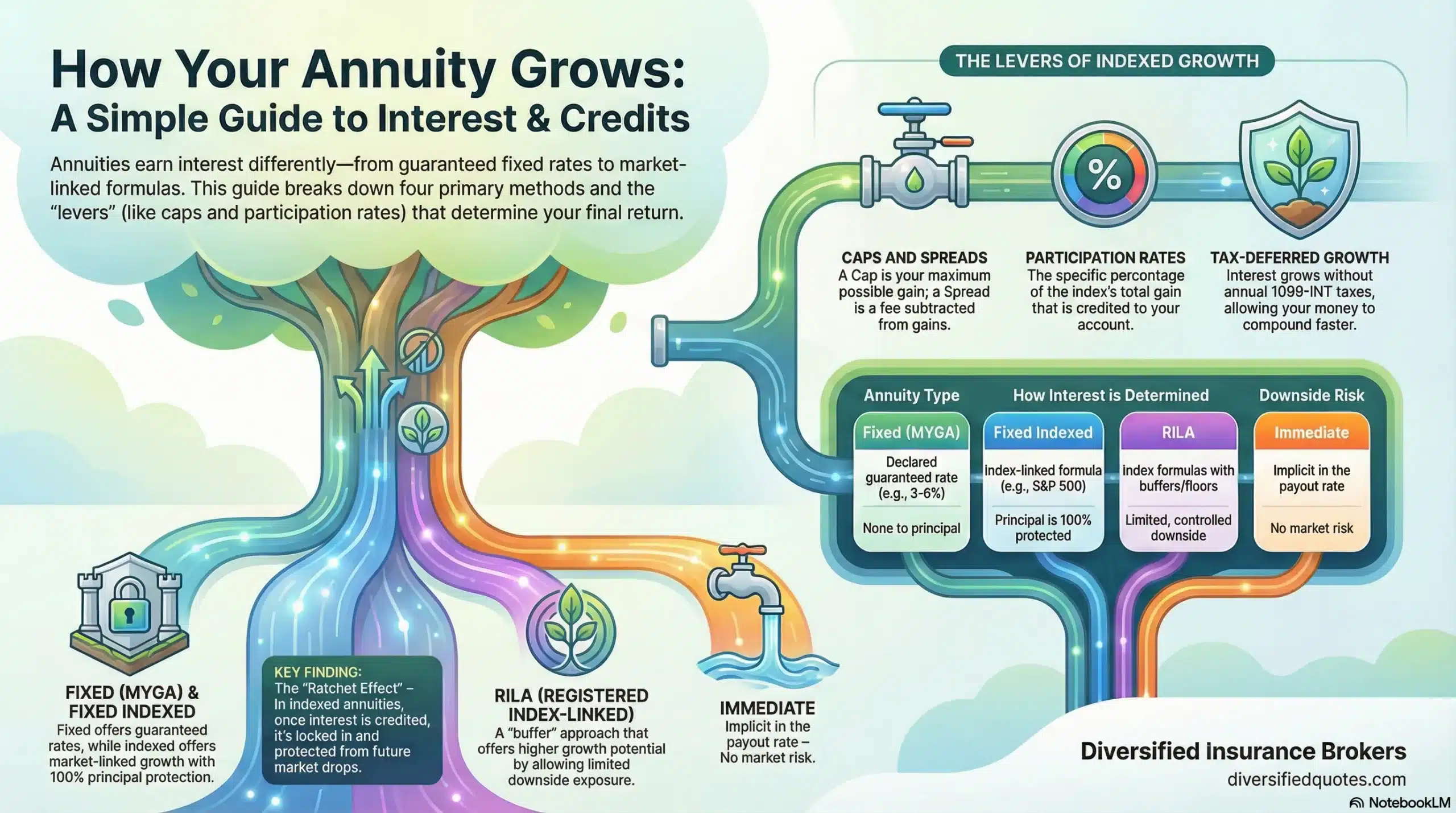
Unlike traditional fixed annuities that offer a declared interest rate, or variable annuities that fluctuate directly with subaccounts, the Impact 10 credits interest based on external index performance while protecting your principal with a 0% floor. That means even in years when the linked index declines, your account does not lose value due to market downturns. For many retirees and pre-retirees, this structure creates a valuable balance between growth opportunity and capital preservation. Some clients prioritize maximum declared guarantees; others prefer index-linked upside potential. The Impact 10 serves the latter — without sacrificing protection. For clients new to indexed mechanics, our guide on how a fixed indexed annuity works explains how caps, participation rates, and floors interact to determine credited interest.
The Policy Loan Provision: Genuine Liquidity Most FIAs Don’t Offer
The most structurally distinctive feature of the Impact 10 — and one absent from every other FIA in this review series — is the policy loan provision. Starting just two months after contract issue, owners can borrow up to 60% of their account value, with availability and specific terms varying by state. Policy loans are not withdrawals: the borrowed amount remains within the contract structure, continues to earn indexed credits (at a potentially reduced rate depending on the carrier’s loan crediting method), and does not trigger surrender charges or MVA. The loan accrues interest at the policy loan rate, and repayment restores the contract to its full position. For owners who face an unexpected large expense during the surrender period — a medical event, a real estate transaction, a business need — the policy loan provides access to substantial capital without triggering the penalty structure that would apply to an excess withdrawal. This is a meaningful structural advantage that buyers who anticipate any possibility of mid-term capital need should evaluate closely before choosing between the Impact 10 and a no-loan FIA at potentially higher caps. The liquidity calculus is not purely about the free withdrawal provision; the policy loan expands the total accessible capital during the surrender period well beyond the 10% annual free amount.
The Bonus Vesting Structure: Two Different Timelines for Two Different Purposes
One of the defining features of the NWL Impact 10 is its premium bonus, applied to first-year contributions. While bonuses should never be viewed in isolation, the Impact 10’s structure has a specific characteristic that differentiates it from simpler bonus products: the bonus operates on two different vesting timelines depending on how you access it. For annuitization and full surrender, the bonus vests over a 10-year schedule — meaning full surrender in year 3 would not deliver the full bonus value. For Guaranteed Lifetime Withdrawals under an income rider, and for the death benefit, the bonus is fully vested from day one. This distinction is material for buyers whose primary use case is income: the full bonus benefit is available immediately for income calculation and for legacy purposes, even while the accumulation-side vesting is still in progress. Buyers whose primary use case is lump-sum accumulation followed by full surrender at maturity should model the vesting schedule at their expected exit date to confirm the net effective bonus at surrender. The interaction between bonus vesting and income rider mechanics is explained in our resource on how annuity income riders work.
Growth inside the Impact 10 is driven by multiple crediting strategies. Clients have access to S&P 500-linked options, fixed interest allocations, and additional index strategies depending on state approval and current product pricing. Because indexed annuities use caps, spreads, or participation rates rather than direct market investment, understanding how these components interact is essential. The key principle: your principal is not directly invested in the market, but interest credits are calculated using index performance formulas. In negative index years, your account is protected by the contractual 0% floor. In positive years, you receive interest subject to the product’s defined crediting method. Protecting accumulation from sequence-of-returns risk is one of the primary reasons retirees shift assets into FIA structures during the final years before retirement.
The Impact 10 provides 10% penalty-free withdrawals annually starting in year two — calculated on Account Value plus Vested Bonus Value, giving the vested bonus immediate liquidity value. Waivers for terminal illness, qualified medical confinement, and RMDs add further adaptability. For qualified accounts, coordinating income rider elections with distribution requirements is critical; our resource on RMD changes after SECURE 2.0 explains how annuities interact with updated withdrawal ages and planning strategies.
Income through the Impact 10 is accessed either via annuitization (after year 10, minimum 5-year payout) or through the optional withdrawal benefit riders. Riders allow lifetime withdrawals that continue even if the account value declines to zero. For married couples, joint income options continue payments as long as either spouse is living. Spousal continuation allows a surviving spouse to assume full contract benefits. When evaluating income options, comparing projected withdrawal percentages, bonus impact, and roll-up features across alternative designs ensures you are making an evidence-based choice rather than a marketing-driven one — our broader resource on top income FIAs by rider structure provides a comparative framework.
The Impact 10 can be funded through direct transfers or rollovers from qualified accounts. Our guide on rolling a 403(b) into an annuity outlines the steps to avoid taxable events, and our overview of TSP rollovers to annuities covers federal employee accounts. For investors modeling how much retirement income an IRA balance can sustain, our resource on how long an IRA lasts in retirement provides a useful baseline comparison for evaluating whether shifting a portion to a protected income structure like the Impact 10 improves the overall outcome. Some clients allocate a portion of retirement assets to indexed annuities for protected growth while maintaining other funds in equities or traditional fixed instruments — the Impact 10 serves as a middle ground between pure fixed guarantees and direct market exposure. Our main annuities overview covers how fixed, indexed, and income categories complement each other in a layered retirement strategy.
Secure protected growth with income flexibility tailored to you.
Start Your Personalized Impact 10 Analysis
Lifetime Income Calculator
Use our calculator to see how much guaranteed income your annuity can provide.
Financial Protection Essentials
Explore disability income protection, life insurance policy rules, annuity structures, and the benefits of working with independent insurance brokers.
Talk to an Advisor or Request Your Annuity Quote
Ready to explore this annuity in more detail—or compare it with other carriers to see if even higher rates are available? With guaranteed income, principal protection, and long-term growth potential on the line, making the right choice is essential. The experienced advisors at Diversified Insurance Brokers will guide you through the options and design a strategy tailored to your retirement goals.
Schedule here:
calendly.com/jason-dibcompanies/diversified-quotes
Licensed in all 50 states • Fiduciary, family-owned since 1980
How does an annuity policy loan differ from a free withdrawal — and why does it matter?
A policy loan and a withdrawal are structurally different transactions with different financial consequences. A free withdrawal removes funds permanently from the contract — the withdrawn amount no longer earns credits, and the account value is reduced by the full withdrawal amount. An excess withdrawal above the 10% annual free amount triggers surrender charges and potentially MVA. A policy loan, by contrast, keeps the borrowed funds within the contract’s accounting structure. The “loaned” amount is still technically part of the contract — it earns a credited interest rate (typically at the loan crediting rate, which may be lower than the full indexed rate), while the outstanding loan balance accrues interest at the policy loan rate. The net effect is that the policyholder has cash in hand and the contract continues to earn (at a potentially lower rate) on the full notional value. This can be advantageous when the policy loan rate is lower than what borrowing the same amount externally would cost. Policy loans do reduce the death benefit and the cash surrender value by the outstanding loan balance plus accrued interest, so they must be managed carefully. Availability and specific loan terms vary by state on the Impact 10 — confirm the loan crediting rate and the loan interest rate that would apply in your state before treating the policy loan provision as a central part of your liquidity plan.
The source says 7% bonus but the NWL brochure references 5% — which is correct?
Both figures may be accurate in different contexts, and the discrepancy requires clarification at application. The NWL product brochure footnotes specifically reference a 5% bonus on the Income Outlook Plus 5 NH Withdrawal Benefit Rider — that 5% is tied to the income rider election and is fully vested for GLWs and death benefit. There may be a separate account value bonus (which the source page describes as 7%) that applies to the base contract or a different version of the product. NWL has updated Impact 10 rates and bonuses over time, and the current bonus applicable to your specific rider election and state may differ from both figures. The definitive answer requires a current illustration from NWL showing the exact bonus percentage for your premium amount, state of residence, and rider choice. Do not commit to the Impact 10 based on a specific bonus percentage without confirming it on the current illustration and the issued contract. The bonus vesting structure — fully vested for GLWs and death benefit, 10-year vesting for surrender — is the more important planning consideration than the specific headline percentage.
What is the difference between the Income Outlook Plus 5 NH rider and the Income Outlook NH rider?
The primary structural difference is the additional 5% income base bonus embedded in the Income Outlook Plus 5 NH rider. The “Plus 5” version adds a 5% bonus to the income base (the value used to calculate guaranteed lifetime withdrawal amounts), subject to vesting for annuitization and surrender but fully vested for GLW and death benefit purposes. The roll-up rate under the Plus 5 version is guaranteed for the first 10 years unless a restart is elected. The Income Outlook NH rider is a simpler lifetime income structure without the additional income base bonus — it still provides guaranteed lifetime withdrawals, single or joint income options, and spousal continuation, but without the Plus 5 enhancement to the income base starting value. For buyers focused on maximizing projected income at a specific future start date, the Plus 5 version’s income base enhancement will generally produce a higher starting income payout. The trade-off is that the Plus 5 rider may carry different costs or crediting parameters than the standard Income Outlook NH. Request illustrations for both rider elections at your premium amount and intended income start age to determine which produces the better net lifetime income outcome. Our resource on how sequence risk affects retirement income strategies provides context for why the income base starting value matters so much for long-term income projection.
National Western Life is a publicly traded company — does that matter compared to the mutuals and PE-backed carriers in this series?
National Western Life Group, Inc. — the holding company that owns National Western Life Insurance Company — is publicly traded. This distinguishes NWL from the mutual carriers (where policyholders are nominal owners), the PE-backed carriers (Apollo/Athene, Ares/Aspida, Axar/Revol One), and the privately held Sammons carriers (North American, Midland National). A publicly traded parent means financial statements are publicly available and subject to SEC reporting requirements — buyers can review the parent company’s annual reports, balance sheet, and investment portfolio disclosures independently. This transparency is a meaningful due diligence advantage over privately held carriers. The trade-off is that publicly traded insurance holding companies face quarterly earnings pressure from equity markets, which can in theory influence capital allocation decisions. NWL’s insurance subsidiary (National Western Life Insurance Company) is regulated at the state level regardless of the parent’s public status, and the AM Best A- rating reflects the insurance subsidiary’s financial strength, not the holding company’s stock price. For buyers who value public financial transparency in carrier evaluation, NWL’s public parent structure makes independent research more accessible than for carriers without SEC reporting obligations.
The bonus is fully vested for the death benefit — what does that mean practically?
If the annuitant dies before the annuity date, the death benefit equals the Account Value plus the full Bonus Value — meaning the entire bonus is included in the death benefit regardless of how many years of the 10-year vesting schedule have elapsed. If you purchase the contract in year 1 and pass away in year 3, your beneficiaries receive the full account value plus the complete bonus amount, not just the 30% that would have vested for surrender purposes by that point. This creates an asymmetric benefit: the bonus that is inaccessible for surrender during the early vesting years is still fully available to your estate through the death benefit. For buyers with significant legacy objectives who want the bonus to serve double duty — enhancing income if they live and maximizing death benefit if they don’t — this vesting structure is genuinely favorable. The same principle applies to Guaranteed Lifetime Withdrawals: the full bonus is immediately available for income calculation, so the income stream reflects the complete bonus from the first year of income activation regardless of the surrender vesting position. Our broader resource on how income riders use the benefit base explains how bonus vesting interacts with lifetime withdrawal calculations across different product designs.
About the Author:
Jason Stolz, CLTC, CRPC, DIA, CAA and Chief Underwriter at Diversified Insurance Brokers (NPN 20471358), is a senior insurance and retirement professional with more than 25 years of real-world experience helping individuals, families, and business owners protect their income, assets, and long-term financial stability. As a long-time partner of the nationally licensed independent agency Diversified Insurance Brokers, Jason provides trusted guidance across multiple specialties—including fixed and indexed annuities, long-term care planning, personal and business disability insurance, life insurance solutions, Group Health, Travel Medical and Evacuation Insurance, and short-term health coverage. Diversified Insurance Brokers maintains active contracts with over 100 highly rated insurance carriers, ensuring clients have access to a broad and competitive marketplace.
His practical, education-first approach has earned recognition in publications such as VoyageATL, and contributions from his agency featured in Kiplinger and GoBankingRates— highlighting his commitment to financial clarity and client-focused planning. Drawing on deep product knowledge and years of hands-on field experience, Jason helps clients evaluate carriers, compare strategies, and build retirement and protection plans that are both secure and cost-efficient. Visitors who want to explore current annuity rates and compare options across multiple insurers can also use this annuity quote and comparison tool.
Explore More: Browse our complete Lifetime Income Planning guide — covering retirement income strategies, account transfers & annuity income solutions from 100+ carriers.
Last Reviewed: June 24, 2026 |
Reviewed by: Jason Stolz, CLTC, CRPC, DIA, CAA
Chief Underwriter, Diversified Insurance Brokers, Inc. | NPN: 20471358 | Diversified Insurance Brokers, Inc. — Licensed in all 50 states
Fact Checked by: Tonia Pettitt, CMIP©
Medicare Specialist, Diversified Insurance Brokers, Inc. | NPN: 14374308 | Diversified Insurance Brokers, Inc. — Licensed in all 50 states
Did you find this content helpful? Leave us a Google review — it helps others find trustworthy guidance too.
Editorial Standards: Diversified Insurance Brokers maintains rigorous editorial standards to ensure accuracy, clarity, and independence in all content. Learn more about our editorial standards and commitment to transparency.
