
The Standard Keystone Index 10 Fixed Indexed Annuity – Safe Accumulation with Market Potential
The Standard Keystone Index 10 Fixed Indexed Annuity – Safe Accumulation with Market Potential
At Diversified Insurance Brokers, we specialize in designing annuity strategies that bring together protection, disciplined growth, and long-term retirement income stability. The Keystone Index 10 Fixed Indexed Annuity from Standard Insurance Company (The Standard) — AM Best A (Excellent), affirmed November 2025, one of only eight life and health insurers to hold A or higher continuously since 1928; S&P A+ Strong; Meiji Yasuda parent with $312 billion in assets — represents a compelling balance of contractual guarantees and growth opportunity for individuals who want market-linked upside without placing principal at risk. The Keystone Index 10 is built precisely for that purpose: structured accumulation with a 3.00% minimum guaranteed interest rate, a Guaranteed Minimum Annuity Value, and defined indexed crediting strategies.

Product Availability Notice: Standard Insurance Company announced an agreement in May 2026 to transfer its individual annuity business — including the Keystone Index 10 — to Pacific Guardian Life Insurance Company (also owned by Meiji Yasuda Life Insurance Company of Japan), with closing expected in early 2027 pending regulatory approval. For existing policyholders, all contractual guarantees transfer within the same Meiji Yasuda corporate family. For prospective buyers, verify current Keystone Index 10 availability and confirm the issuing entity before purchase. Pacific Guardian Life holds its own AM Best A (Excellent) rating. All product details require confirmation with a current illustration and contract document.
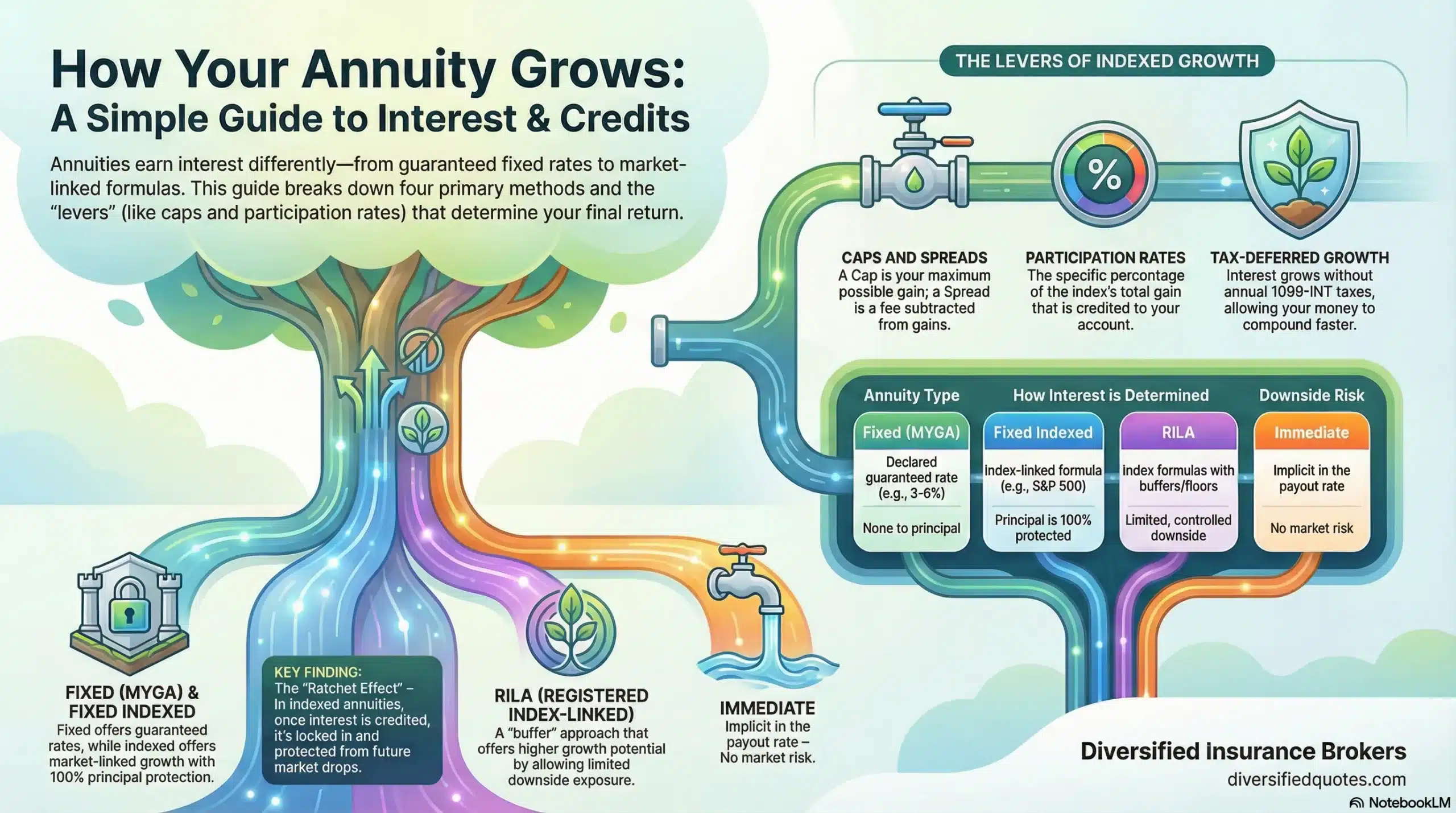
This annuity offers multiple crediting approaches designed to align with varying risk comfort levels and growth objectives. Policyholders may select from S&P 500-linked strategies featuring cap rates or participation rate structures, or allocate funds to a fixed interest strategy that provides guaranteed steady accumulation. Regardless of strategy selection, the contract includes a minimum guaranteed interest rate of 3.00%, establishing a foundational layer of long-term value. For investors exploring how indexed annuities compare to traditional fixed contracts, reviewing how a fixed indexed annuity works can clarify how caps, spreads, and participation rates influence performance while preserving principal through a 0% floor. Unlike variable annuities, indexed annuities do not directly invest in the stock market; instead, they credit interest based on index performance within defined limits, shielding the contract from negative market years.
Ensure you are receiving the absolute top rates
Current Fixed Annuity Rates
Compare today’s best fixed annuity rates from top carriers.
Current Bonus Annuity Rates
See which annuities offer the highest upfront bonus today.
Request an Annuity Quote
Submit our annuity request form to get personalized rate options.
Lifetime Income Calculator
Use our calculator to see how much guaranteed income your annuity can provide.
Keystone Index 10 vs. the Conservative Retirement Accumulation Field
| Dimension | Keystone Index 10 FIA | MYGA (Fixed Rate Annuity) | Variable Annuity |
|---|---|---|---|
| Principal Protection | Full — 0% floor on indexed accounts plus a 3.00% minimum guaranteed interest rate and GMAV backstop. Even in the worst sustained flat or negative market environment, the contract earns at least the 3% minimum annually. | Full — principal and declared interest guaranteed contractually for the full term. No index exposure. Declared rate known from day one; the most straightforward protection structure with no crediting complexity or renewal uncertainty. | None — subaccounts are directly market-invested. A severe bear market is fully realized. M&E fees, fund expenses, and rider charges reduce net return annually regardless of market direction — no floor protects account value. |
| Growth Mechanism | Index-linked — S&P 500 cap strategies, S&P 500 participation rate strategies, and fixed interest allocation available within the same contract. Annual reset locks in gains; each year begins fresh from the current index level. | Declared fixed rate — locked for the full guarantee period with no strategy selection required. Maximum simplicity and rate certainty; no upside beyond the stated rate regardless of market performance during the term. | Full market participation through subaccount investments — no cap, no floor. Full upside in bull markets; full downside in bear markets. Returns reflect underlying fund performance net of layered annual fees. |
| Guaranteed Minimum Floor | 3.00% minimum guaranteed interest rate — a structural guarantee above the 0% floor that credits at least 3% annually even in zero-index-credit years. Supplemented by the GMAV, ensuring long-term structural value independent of index cycles. | The declared rate itself serves as the minimum and maximum — for a MYGA, the full stated rate is guaranteed for every year of the term. Higher year-one certainty than the FIA’s 3% floor; lower upside potential in positive market environments. | No guaranteed minimum on subaccounts — GLWB income riders may guarantee income levels independent of account value, but account value itself has no floor and reflects full market performance net of the layered fee structure. |
| Tax Treatment | Full tax deferral — no annual 1099 on credited interest including the 3% guaranteed minimum. Gains taxable as ordinary income at distribution; LIFO rules apply to non-qualified partial withdrawals; basis returned tax-free. | Full tax deferral — same compounding advantage as the FIA. Both structures provide identical deferral treatment; the crediting mechanism is the only material structural difference between the two from a tax treatment standpoint. | Full tax deferral — but M&E charges, fund expense ratios, and rider fees assessed annually reduce the effective compound return, partially offsetting the tax deferral advantage versus the FIA’s more cost-efficient structure. |
| Carrier Strength | The Standard: AM Best A (Excellent), affirmed November 2025; one of only 8 life and health insurers with uninterrupted A or higher from AM Best since 1928; S&P A+; Meiji Yasuda parent. Product transitioning to Pacific Guardian Life (same Meiji Yasuda family, AM Best A) — see notice above. | Varies — MYGA marketplace spans B++ through A++ rated carriers. A-level MYGA alternatives from competing carriers allow buyers to access declared-rate certainty alongside equivalent or stronger carrier strength if that combination is preferred. | Typically A or A+ rated major issuers. The carrier strength question for VAs is less differentiated than for FIAs because the market risk is borne by the policyholder rather than the carrier, making the issuer’s rating less central to protection. |
GMAV, Principal Protection, and the 3% Guaranteed Minimum — How They Work Together
One of the distinguishing strengths of the Keystone Index 10 is its Guaranteed Minimum Annuity Value (GMAV), which ensures that the contract maintains long-term structural value regardless of index volatility. For retirees concerned about sequence-of-returns risk — particularly in the early years of retirement — this guarantee can provide meaningful peace of mind alongside the 3% minimum interest rate. The annuity also allows penalty-free withdrawals up to 10% annually beginning in year one, providing liquidity without undermining the broader accumulation objective. Understanding how annuity free withdrawal rules work across carrier products ensures the 10% provision is properly sized relative to anticipated liquidity needs before commitment. Health-related waivers for terminal illness and nursing home confinement add further flexibility, ensuring unforeseen life events do not force difficult financial decisions under surrender penalty pressure.
RMD Coordination, Income Integration, and Tax Planning
For clients funding retirement accounts, understanding distribution rules is equally important. The Keystone Index 10 can be structured within qualified accounts such as IRAs, and required minimum distributions can be accommodated under contract provisions. If you are approaching RMD age, reviewing RMD updates under SECURE 2.0 ensures your annuity strategy aligns with evolving federal guidelines — specifically the extended RMD ages, the excise tax structure for non-compliance, and how the Keystone Index 10’s 10% annual free provision interacts with the qualified account RMD requirement. Strategic coordination between accumulation vehicles and distribution requirements prevents unnecessary penalties and enhances long-term planning efficiency.
Income flexibility is another consideration for many investors. While the Keystone Index 10 focuses on protected growth, it can integrate with income planning strategies depending on long-term objectives. Understanding how annuity income riders work — specifically how guaranteed withdrawal benefit bases are established, how roll-up rates function during deferral, and how payout percentages translate into actual annual guaranteed income — clarifies how the Keystone Index 10’s accumulation phase connects to income activation. Many clients begin with growth as the priority and later transition toward lifetime income annuity strategies as retirement approaches. Combining accumulation and income planning within a broader retirement framework often produces greater stability than relying solely on portfolio withdrawals subject to market conditions.
When comparing annuities across carriers, evaluating surrender schedules, liquidity features, crediting methods, and financial strength ratings is essential. Diversified Insurance Brokers works with more than 75 top-rated carriers to provide side-by-side comparisons tailored to your timeline, tax situation, and income objectives. Some investors prioritize bonus structures — reviewing current bonus annuity rates — while others focus strictly on fixed guarantees through current fixed annuity rates. The Keystone Index 10 may be ideal for individuals who want measured growth potential with strong contractual backstops, a 3% guaranteed floor, and an A-rated carrier with nearly a century of uninterrupted financial strength. Tax deferral further enhances the long-term compounding effect — earnings inside the annuity accumulate without annual taxation, with the 3% minimum guaranteed interest compounding on the full accumulated base each year without any annual tax reduction. For non-qualified funds, taxation occurs only upon withdrawal, typically on a LIFO basis, making the coordination with Social Security income and tax bracket management a meaningful planning dimension.
Looking to protect your retirement savings while capturing market-linked growth?
Request Your Personalized Keystone Index 10 Quote Today
Financial Protection Essentials
Compare insurance rates, retirement tools, and business protection strategies that help strengthen long-term financial planning.
Talk to an Advisor or Request Your Annuity Quote
Ready to explore this annuity in more detail—or compare it with other carriers to see if even higher rates are available? With guaranteed income, principal protection, and long-term growth potential on the line, making the right choice is essential. The experienced advisors at Diversified Insurance Brokers will guide you through the options and design a strategy tailored to your retirement goals.
Schedule here:
calendly.com/jason-dibcompanies/diversified-quotes
Licensed in all 50 states • Fiduciary, family-owned since 1980
What exactly is the Guaranteed Minimum Annuity Value (GMAV) and how does it protect the Keystone Index 10 over time?
The Guaranteed Minimum Annuity Value (GMAV) is a structural guarantee that establishes a minimum floor for the Keystone Index 10’s long-term accumulated value — operating separately from and in addition to the year-to-year 0% floor on indexed crediting. The 0% floor prevents the account value from declining due to negative index performance in any single crediting year. The GMAV provides a longer-horizon guarantee: ensuring that even across an extended multi-year period where indexed strategies consistently produce zero credits (which would occur in a sustained flat or negative market), the contract value still meets a defined minimum annuity value. The GMAV is supported by the 3.00% minimum guaranteed interest rate — meaning the worst-case annual credit in the Keystone Index 10 is not zero, but 3%. Over a 10-year period of consistently zero indexed credits, the 3% minimum compounding annually produces a meaningfully higher accumulated value than a pure 0% floor FIA that credits nothing across the same period. Understanding how the free withdrawal provision interacts with the GMAV — specifically whether withdrawals reduce the GMAV base and how the 10% annual provision is calculated against the current contract value versus the GMAV floor — is part of the due diligence conversation before committing funds to a 10-year structure. The two-layer protection design (annual 0% floor + 3% GMAV minimum interest) provides contractual certainty that most FIA designs without an explicit minimum credited rate cannot match. The combination allows conservative buyers to model a worst-case accumulation trajectory based on the 3% minimum floor, while the upside remains linked to index performance that may credit meaningfully above 3% in positive market years.
How does the 3% minimum guaranteed rate change the comparison between the Keystone Index 10 and a competing MYGA?
The correct framework for comparing the Keystone Index 10 against a MYGA at equivalent carrier strength levels requires evaluating three scenarios: the bear market scenario (index strategies produce zero annually), the moderate market scenario (index strategies credit 4%–7% in most years), and the bull market scenario (index strategies credit at or above the cap in most years). In the bear market scenario, the Keystone Index 10 credits its 3.00% guaranteed minimum — making the comparison equivalent to a MYGA declared rate of 3%. If a competing 10-year MYGA from an A-rated carrier declares 5.00%, the MYGA outperforms the Keystone Index 10 in the bear market scenario. In the moderate market scenario, the Keystone Index 10 credits above 3% in positive index years while the MYGA stays at 5.00%. Depending on cap rates and the specific index performance, the average effective annual credit over the full 10 years may be above or below 5.00%. In the bull market scenario, the Keystone Index 10 consistently credits at or near the cap, and if the cap is above 5.00%, the FIA produces better accumulation than the MYGA. Understanding how annuity cap rates are set and adjusted at renewal — and whether the minimum guaranteed cap specified in the Keystone contract protects against severe renewal rate reductions — is the most important crediting variable for the 10-year comparison. For buyers who want the maximum accumulation certainty and can identify a 10-year MYGA from an equivalent A-rated carrier offering a declared rate significantly above 3%, the MYGA may produce better worst-case outcomes. For buyers who believe a moderate-to-strong market environment is likely across the 10-year period and want the indexed upside while maintaining the 3% floor as downside protection, the Keystone Index 10 is the appropriate structure. Our resource on fixed annuities vs fixed indexed annuities covers this framework in full comparative detail.
How does the Keystone Index 10 coordinate with RMDs under SECURE 2.0 for IRA-qualified buyers?
For buyers funding the Keystone Index 10 with IRA or 401(k) rollover assets, RMD coordination is a critical pre-purchase planning step that should be completed before any commitment is made. The Keystone Index 10 can hold IRA-qualified assets, and qualified annuities must satisfy Required Minimum Distributions beginning at the required beginning date — age 73 for most buyers under SECURE 2.0 rules. The annual 10% free withdrawal provision in the Keystone Index 10 is calculated against the current account value, and the question at issue is whether that 10% amount covers the RMD that will be required from this specific IRA contract beginning at the required starting date. If the RMD percentage from the IRS Uniform Lifetime Table exceeds 10% of the account value in any given year, a surrender charge on the excess would apply — unless the RMD is aggregated across multiple IRA accounts so that the Keystone’s RMD portion is satisfied from a different IRA account that is not subject to a surrender charge. Reviewing RMD rules under SECURE 2.0 — specifically the new RMD age, the 25% excise tax for missed RMDs (reduced from 50%), and the modified correction provisions — ensures the Keystone Index 10 is integrated into the qualified account distribution plan correctly. For buyers who hold other IRA assets outside the Keystone, the IRA aggregation rule allows all traditional IRA RMDs to be satisfied from any one or combination of IRA accounts — meaning the Keystone’s RMD can be paid from a separate IRA while the annuity’s free provision remains intact for the annuity contract itself. Confirming this strategy with both the RMD calculation and the annuity’s free withdrawal terms before purchase prevents forced surrender charge payments later.
How does The Standard’s A rating history and Meiji Yasuda ownership affect the carrier evaluation for the Keystone Index 10?
Standard Insurance Company’s carrier credentials for the Keystone Index 10 are among the most distinctive available in the FIA marketplace — not merely because of the current AM Best A (Excellent) rating, but because of the uninterrupted continuity of that rating. The Standard is one of only eight life and health insurers in the United States to have maintained AM Best A or higher continuously since 1928 — the first year AM Best began assigning ratings. That 95+ year track record encompasses the Great Depression, World War II, stagflation, multiple recessions, the 2008-2009 financial crisis, the 2020 pandemic disruption, and subsequent interest rate cycles. The rating has never fallen below A across nearly a century that forced financial institutions of all types to restructure, weaken, or fail. For the Keystone Index 10 buyer, this history is directly relevant: the contractual guarantees — the 0% floor, the 3% minimum guaranteed interest, the GMAV protection — are backed by an institution whose financial strength has demonstrably endured across every economic environment of the modern era. The Meiji Yasuda Life Insurance Company ownership (since 2016, acquisition price approximately $5 billion) provides additional capital backing from one of the world’s largest insurance organizations, with $312 billion in assets and the largest share of group insurance in the Japanese market. The pending transition of The Standard’s individual annuity block to Pacific Guardian Life (also Meiji Yasuda-owned, also AM Best A Excellent) keeps this institutional backing within the same corporate family. Understanding the full depth of this Standard Insurance Company carrier profile — including the financial history, operating performance metrics, and Meiji Yasuda relationship — is part of thorough due diligence before any 10-year commitment of retirement assets.
How does the Keystone Index 10 fit within a broader retirement income strategy alongside Social Security and other income sources?
The Keystone Index 10’s 10-year accumulation horizon and 3% minimum guaranteed floor make it well-suited as the conservative accumulation vehicle within a layered retirement income architecture — particularly alongside a Social Security delay strategy. For a buyer who is 62, plans to delay Social Security to age 72 to maximize the guaranteed lifetime benefit, and needs the retirement plan to bridge that decade, the Keystone Index 10 provides: protected accumulation during the full Social Security delay period with a 3% minimum floor that ensures the conservative allocation grows meaningfully even in sustained flat market conditions; the 10% annual free withdrawal provision that can fund supplemental bridge income without disrupting the contract; and the option to connect to a lifetime income annuity strategy at the Keystone’s maturity at year 10 — exactly when the buyer’s Social Security income begins. Our resource on how Social Security and annuities work together covers the full income coordination framework, including whether the annuity income should serve as a bridge during the delay period or as a permanent supplement to Social Security after activation. For pension recipients evaluating whether to take a lump sum and position it within an FIA, the Keystone Index 10’s 3% floor provides an accumulation guarantee that makes the lump sum self-management strategy more predictable than a pure indexed accumulation approach would suggest — our resource on pension lump sum alternatives using annuities covers that specific comparison in detail.
About the Author:
Jason Stolz, CLTC, CRPC, DIA, CAA and Chief Underwriter at Diversified Insurance Brokers (NPN 20471358), is a senior insurance and retirement professional with more than 25 years of real-world experience helping individuals, families, and business owners protect their income, assets, and long-term financial stability. As a long-time partner of the nationally licensed independent agency Diversified Insurance Brokers, Jason provides trusted guidance across multiple specialties—including fixed and indexed annuities, long-term care planning, personal and business disability insurance, life insurance solutions, Group Health, Travel Medical and Evacuation Insurance, and short-term health coverage. Diversified Insurance Brokers maintains active contracts with over 100 highly rated insurance carriers, ensuring clients have access to a broad and competitive marketplace.
His practical, education-first approach has earned recognition in publications such as VoyageATL, and contributions from his agency featured in Kiplinger and GoBankingRates— highlighting his commitment to financial clarity and client-focused planning. Drawing on deep product knowledge and years of hands-on field experience, Jason helps clients evaluate carriers, compare strategies, and build retirement and protection plans that are both secure and cost-efficient. Visitors who want to explore current annuity rates and compare options across multiple insurers can also use this annuity quote and comparison tool.
Browse More Resources: Return to our complete Fixed Indexed Annuity Products & Education guide — covering FIA products and education from top carriers.
Last Reviewed: June 26, 2026 |
Reviewed by: Jason Stolz, CLTC, CRPC, DIA, CAA
Chief Underwriter, Diversified Insurance Brokers, Inc. | NPN: 20471358 | Diversified Insurance Brokers, Inc. — Licensed in all 50 states
Fact Checked by: Tonia Pettitt, CMIP©
Medicare Specialist, Diversified Insurance Brokers, Inc. | NPN: 14374308 | Diversified Insurance Brokers, Inc. — Licensed in all 50 states
Did you find this content helpful? Leave us a Google review — it helps others find trustworthy guidance too.
Editorial Standards: Diversified Insurance Brokers maintains rigorous editorial standards to ensure accuracy, clarity, and independence in all content. Learn more about our editorial standards and commitment to transparency.
