
American Life Fixed Index Annuity – Growth Potential With Principal Protection
American Life Fixed Index Annuity – Growth Potential With Principal Protection
The American Life Fixed Index Annuity is designed for people who want a retirement growth path that participates in market-style upside while keeping principal protection at the center of the plan. At Diversified Insurance Brokers, we help individuals compare annuity strategies that support long-term accumulation, tax deferral, and future income planning — without exposing retirement savings to direct market losses. This annuity is issued by American Life & Security Corp., a Lincoln, Nebraska carrier built around a focused product lineup. It offers multiple fixed indexed annuity crediting choices and contract flexibility, while protecting the base premium from market loss. For buyers who understand the B++ carrier rating context disclosed above, the American Life FIA’s distinctive index menu — including first-mover access to ESG-linked and volatility-controlled indices — gives it a unique positioning in the FIA market.

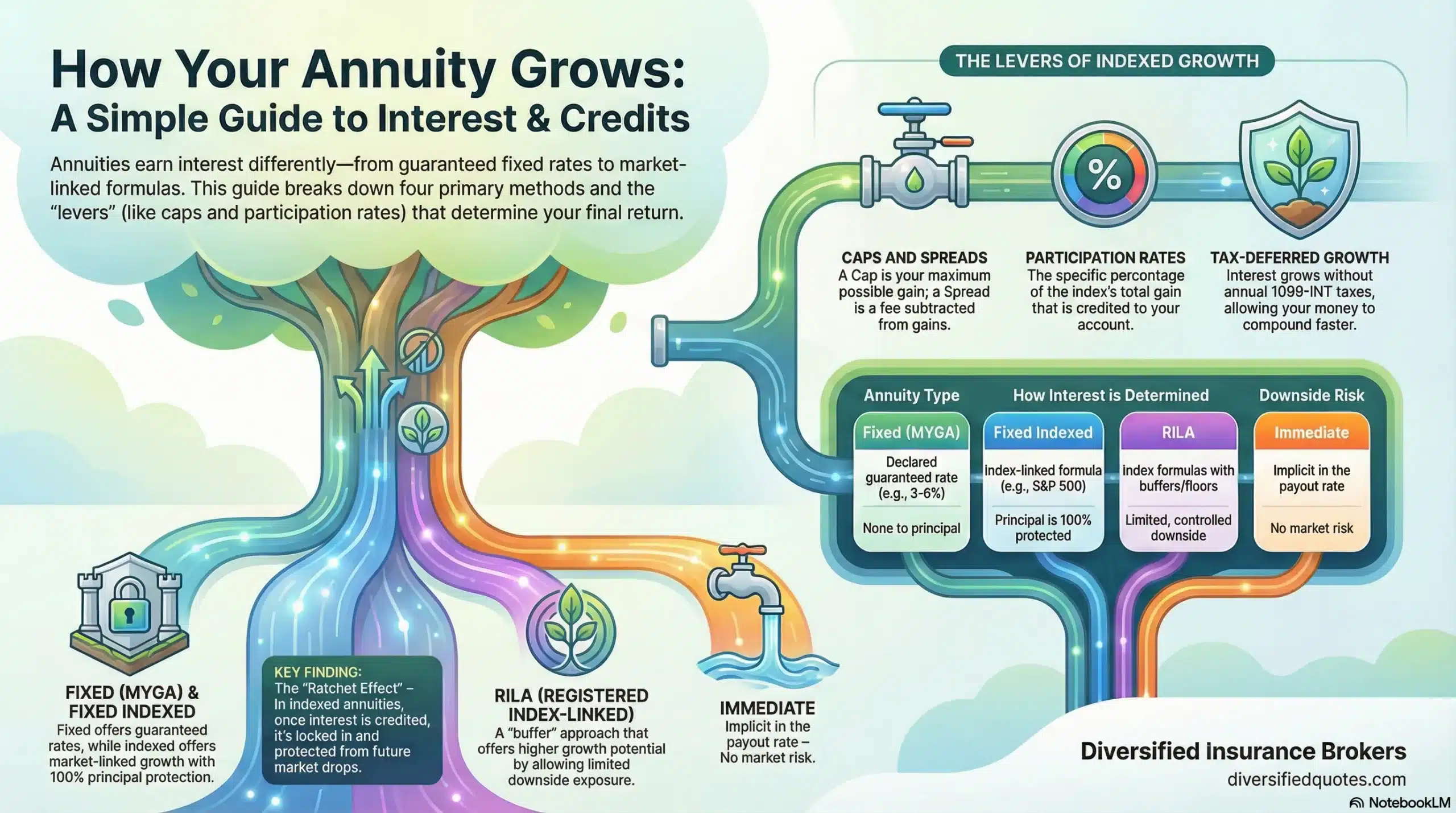
Many people like the idea of market participation until they live through a year where markets drop fast and emotions take over. Retirement planning differs from accumulation planning because the consequences of a sharp drawdown can be more severe when you are near retirement or already distributing assets. That’s the core problem sequence of returns risk creates — and it’s the problem FIAs are structurally designed to address. An FIA is not a stock investment. It is an insurance contract with crediting methods linked to an index. When the index performs well, the contract can credit interest subject to caps, participation rates, or spreads. When the index performs poorly, the contract protects your principal — credited interest for that period is zero, not negative. That zero floor is the defining feature buyers are actually purchasing.
Ensure you are receiving the absolute top rates
Current Fixed Annuity Rates
Compare today’s best fixed annuity rates from top carriers.
Current Bonus Annuity Rates
See which annuities offer the highest upfront bonus today.
Request an Annuity Quote
Submit our annuity request form to get personalized rate options.
Lifetime Income Calculator
Use our calculator to see how much guaranteed income your annuity can provide.
American Life FIA: Key Product Features at a Glance
| Product Feature | Details |
|---|---|
| Issuing Carrier | American Life & Security Corp. Lincoln, Nebraska. AM Best: B++ (Good), positive outlook — below the A-tier carrier benchmark. Not available in all states; confirm state availability at application. Absent from J.D. Power 2024 and 2025 annuity satisfaction studies. Not FDIC insured. All guarantees backed solely by claims-paying ability of American Life & Security Corp. |
| Product Type | Single-premium deferred fixed indexed annuity. Contract form ICC19-FIA 001. Multiple index crediting strategies available. Zero floor — credited interest is never negative due to index performance. Tax-deferred growth. MVA may apply on excess withdrawals. No optional riders listed as standard — confirm available riders at application. Not available in all states. |
| Index Crediting Options | Five index strategies plus a fixed interest rate account. Allocations can be combined in any proportion and may be changed on the contract anniversary. (1) S&P 500® ESG Index — broad U.S. market exposure with ESG screening criteria. (2) Goldman Sachs Xenith Index — rules-based, volatility-controlled strategy designed for smoother return profiles. (3) Janus SG Guidance Index: Value Lock — volatility-managed, systematic allocation approach developed with Société Générale. (4) S&P 500® Index — standard broad-market benchmark with no index-level embedded fee deductions. (5) S&P MARC 5% Excess Return Index — multi-asset, risk-controlled strategy targeting 5% annualized volatility. Fixed interest account also available. Zero floor applies to all index strategies — principal cannot decline due to index performance. |
| Crediting Methods and Rates | Each index strategy is subject to a crediting method — typically participation rates, caps, or spread rates — that determine the credited interest based on index performance. Crediting rates are declared at issue for each strategy term and may change at renewal within contractual minimums. Volatility-controlled indices (Goldman Sachs Xenith, Janus SG Guidance, S&P MARC 5%) typically support higher participation rates because the index methodology manages daily risk exposure — but embedded index costs may reduce net credited interest relative to the headline participation rate. Request current crediting terms for each strategy at application. |
| Free Withdrawal Provision | Up to 10% of contract value annually after the first contract year without surrender charge. RMD note: Year 1 RMDs from qualified IRA accounts are subject to surrender charges and MVA unless the Enhanced Liquidity Rider (ICC19-FIALR 001) is included in the contract — the annual RMD for the current year should be taken prior to transferring qualified funds to American Life. Buyers with IRA funds who anticipate Year 1 RMD obligations must confirm the Enhanced Liquidity Rider is available and elected at application. |
| Surrender Charges and MVA | Surrender charge schedules apply to withdrawals above the free amount during the surrender period. MVA may also apply. Surrender periods and charge schedules vary by contract version — confirm the specific schedule applicable to your state and contract at application. Surrender charges generally decline over the term and reach zero at the end of the period. MVA waived at death and annuitization in most contract provisions. |
| Premium Bonus Option | Optional premium bonus available on some versions. The bonus earns interest like the base premium and enhances the starting accumulation base. Bonus provisions vary by contract version — confirm availability, vesting schedule, and any associated rate trade-offs at application before electing. |
| Death Benefit | Full contract value payable to named beneficiaries upon death, without surrender charges. Proper beneficiary designation allows assets to transfer outside of probate in most cases. Reviewing annuity beneficiary death benefits covers payout elections and how inherited annuity proceeds are taxed for non-spouse beneficiaries. |
| Tax Treatment | Interest grows tax-deferred until withdrawal. Non-qualified: LIFO — earnings distributed first, taxed as ordinary income; cost basis returned tax-free. Qualified accounts: full distributions taxed as ordinary income. Withdrawals before age 59½ subject to 10% IRS early withdrawal penalty. Placing an annuity inside a qualified plan provides no additional tax deferral beyond the plan itself. Not FDIC insured. |
About American Life & Security Corp and the B++ Rating
American Life & Security Corp is a Lincoln, Nebraska insurance company with a focused product lineup built around fixed indexed annuities and multi-year guaranteed annuities. The carrier’s AM Best B++ (Good) rating with a positive outlook places it in the Good tier — two full notches below A- (Excellent) and three below A (Excellent). B++ indicates AM Best’s assessment that the carrier has an adequate ability to meet policyholder obligations, with the positive outlook reflecting improving financial trends. For buyers evaluating a B++ carrier, the honest comparison is specific: what A-rated and A+-rated carriers offer the same index menu or a comparable FIA structure, and how does the American Life rate on each strategy compare to competitors with stronger financial strength ratings? American Life has positioned itself as an innovator — it was among the first carriers to introduce FIAs linked to ESG indices and to the Goldman Sachs Xenith Index, giving buyers access to index strategies not available at most competing A-rated carriers. Whether that product differentiation justifies accepting a B++ carrier versus an A-rated alternative depends on the buyer’s specific financial strength requirements, the size of the allocation, and whether the unique index options available at American Life produce materially different projected credited interest than what is available elsewhere. For a full carrier evaluation, our resource on whether American Life is a good insurance company is already linked above.
What a Fixed Indexed Annuity Is — and the Problem It Solves
A fixed indexed annuity is an insurance contract that credits interest based on the performance of one or more external indices. At the end of each crediting period, the contract measures the index result using the rules of the chosen strategy. If the index is up, the contract may credit interest — limited by a cap, participation rate, or spread. If the index is down, the contract credits zero for that period rather than a negative number. That zero floor is what separates FIAs from direct equity investment: a portfolio that loses 30% requires a 43% gain to recover. An FIA that credits 0% in a negative year starts the next crediting period from the same protected base. This is why FIAs are positioned as “market-linked with protection.” For conservative retirees facing sequence of returns risk — the danger that sharp early-retirement losses permanently impair a portfolio that is simultaneously funding withdrawals — this floor protection addresses the specific risk that most threatens retirement security.
Most retirement savers exploring FIAs are solving one of three problems: protecting what they have built while still pursuing growth potential, creating a predictable income floor through an income rider, or positioning conservative assets without accepting near-zero fixed rates. An FIA is not designed to outperform an aggressive equity portfolio over every cycle — it is designed to provide a more stable experience and a structured way to pursue interest crediting while avoiding direct market losses. That trade-off is exactly what appeals to conservative retirees and pre-retirees. If you want to see how common misunderstandings about FIAs affect buyer decisions, our resource on fixed indexed annuity myths debunked addresses the most frequent ones directly.
The Index Menu: Five Strategies and What Each One Is Trying to Do
The American Life FIA’s five-index menu is its most distinctive feature, and understanding what each strategy is actually designed to accomplish — not just what it is named — is the prerequisite for allocation decisions. The S&P 500® ESG Index tracks a broad segment of the U.S. equity market while applying ESG (Environmental, Social, and Governance) screening criteria to exclude companies that score poorly on sustainability metrics. For buyers who want broad U.S. market participation with an ESG filter applied, this index provides that exposure within the FIA structure’s zero floor. The Goldman Sachs Xenith Index is a rules-based, volatility-controlled strategy that manages risk exposure daily using a systematic methodology developed by Goldman Sachs. In practice, volatility-controlled indices are engineered to smooth return profiles — they reduce equity exposure during high-volatility periods and increase it during calmer markets. In FIA structures, this approach can support higher declared participation rates because the index methodology does the risk management work, allowing the insurer to offer more favorable crediting terms. The embedded daily index costs should be understood before comparing the Goldman Sachs Xenith participation rate to the S&P 500 cap rate — the two crediting mechanics are not directly comparable without adjusting for index-level costs.
The Janus SG Guidance Index: Value Lock is a volatility-managed strategy developed jointly by Janus Henderson Investors and Société Générale, incorporating systematic allocation between equity and fixed income components with downside control features. Like the Goldman Sachs Xenith, it is designed to produce smoother return profiles than an unhedged equity index — more consistency, but typically less upside in strong equity markets. The S&P 500® Index is the most transparent and historically documented benchmark on the menu — 500 large-cap U.S. equities with no embedded index-level fee deductions, decades of publicly available performance history, and the simplest mechanics to evaluate relative to cap rates or participation rates. The S&P MARC 5% Excess Return Index is a multi-asset, risk-controlled strategy targeting 5% annualized volatility, with embedded excess return calculation mechanics that factor in index costs. For buyers comparing crediting terms across these five strategies, reviewing how index annuity crediting methods work — including how caps, participation rates, and spread structures interact with index performance to produce credited interest — provides the analytical framework for that evaluation.
Surrender Periods, Liquidity, and the RMD Wrinkle
Liquidity is the first planning constraint to evaluate with any FIA. American Life’s contract includes surrender charge schedules that apply to withdrawals above the 10% annual free amount during the surrender period — confirm the specific schedule for your contract version and state at application. The 10% annual free withdrawal provision (available after the first contract year) accommodates most planned distribution needs and RMDs from qualified accounts in Years 2 and beyond. Year 1 creates a specific planning requirement: annual RMD amounts for the current calendar year from IRA accounts must be taken prior to transferring qualified funds to American Life, because Year 1 RMDs are subject to surrender charges and MVA unless the Enhanced Liquidity Rider is included in the contract. Buyers with IRA funds who are already subject to required minimum distributions — and who anticipate a Year 1 RMD obligation — must confirm the Enhanced Liquidity Rider is available and elected at application before any qualified transfer is initiated. For a full explanation of how surrender charge schedules work across FIA contracts and what triggers charges on excess withdrawals, that resource covers the mechanics. For buyers evaluating the annual free withdrawal provision across different FIA designs, our resource on annuity free withdrawal rules compares how different carriers structure this provision.
Tax Deferral and Where the American Life FIA Fits in a Portfolio
Interest credited within the American Life FIA accumulates without annual taxation — unlike brokerage accounts or CDs that generate taxable events each year. This tax deferral enhances long-term compounding efficiency, particularly for buyers in higher marginal tax brackets who would otherwise pay annual taxes on investment gains. For buyers funding with non-qualified (after-tax) dollars, the deferral advantage is most pronounced over the full surrender period. For qualified account buyers — IRA rollovers, 401(k) transfers — the annuity provides no additional tax deferral beyond what the qualified plan already provides, but the zero-floor principal protection and index-linked crediting potential are the primary value drivers in that context. Reviewing how annuities are taxed before running income illustrations ensures projected outcomes reflect net-of-tax realities. From a portfolio construction standpoint, FIAs like the American Life product serve a specific role: a protected accumulation segment that participates in index-linked upside without direct market exposure, complementing more liquid and more growth-oriented assets. Many retirees coordinate FIA allocations with Social Security timing, pension income, and portfolio withdrawals to create a layered income strategy where the annuity’s zero-floor protection reduces the portfolio’s sensitivity to market timing during the early distribution years.
Income Planning and the Role of Optional Riders
The American Life FIA in its base form is an accumulation vehicle. Income is generated through free withdrawals, systematic withdrawals, or annuitization. For buyers whose primary objective is guaranteed lifetime income — a payment they cannot outlive regardless of account value performance — an optional income rider providing a guaranteed lifetime withdrawal benefit (GLWB) may be available on certain versions of this contract. Confirm rider availability and current terms at application. When evaluating income rider options on any FIA, the relevant comparison dimensions are the rider fee, the benefit base roll-up rate or bonus, the withdrawal percentage at the intended income start age, and how the rider behaves if the account value is depleted by withdrawals and fees. For buyers whose income planning is the primary objective, comparing the American Life FIA’s income rider specifications against income-focused FIAs from A-rated carriers — where the carrier’s financial strength directly underpins the lifetime income guarantee — is an important part of a complete product evaluation. Our resource on the full annuity landscape provides the broader context for where FIAs fit alongside MYGAs, income annuities, and other retirement income tools. American Life also offers the American Life Classic MYGA for buyers who want a declared fixed rate without index exposure, and the American Life Fusion MYGIA — a hybrid that combines a 5-year fixed guaranteed rate with a potential bonus interest credit at term end if the S&P 500 meets a performance threshold — for buyers who want the certainty of a MYGA with a conditional indexed upside component. Whether the American Life FIA’s unique index menu and B++ carrier positioning justify its place in a specific retirement plan ultimately depends on the buyer’s carrier financial strength requirements, the size of the allocation relative to state guaranty association limits, and whether the available crediting terms produce outcomes that compare favorably to A-rated carrier alternatives. Reviewing whether annuities are worth it provides the decision framework for that evaluation in the context of the buyer’s complete retirement picture.
Related Pages
Explore additional American Life products and fixed indexed annuity planning resources.
Financial Protection Essentials
FIA education resources covering crediting mechanics, carrier ratings, and retirement income planning.
Talk to an Advisor or Request Your Annuity Quote
Ready to explore this annuity in more detail—or compare it with other carriers to see if even higher rates are available? With guaranteed income, principal protection, and long-term growth potential on the line, making the right choice is essential. The experienced advisors at Diversified Insurance Brokers will guide you through the options and design a strategy tailored to your retirement goals.
Schedule here:
calendly.com/jason-dibcompanies/diversified-quotes
Licensed in all 50 states • Fiduciary, family-owned since 1980
FAQs: American Life Fixed Index Annuity
American Life has a B++ AM Best rating — how should I think about that?
AM Best B++ (Good) is a meaningful distinction from the A-tier ratings held by the carriers that dominate most FIA rate comparisons. B++ indicates that AM Best assesses American Life as having an adequate ability to meet its policyholder obligations — it is not a distress signal, and the positive outlook reflects improving financial trends. However, B++ is two notches below A- and three below A. The practical implications for buyers are straightforward: the financial cushion between American Life and insolvency is assessed as thinner than at A-tier carriers, and the state guaranty association coverage ($250,000 or $300,000 per contract depending on the state) is the secondary protection layer available if the carrier were to face financial distress. Buyers allocating within state guaranty association limits reduce their exposure to this risk. For buyers allocating amounts above those limits, the carrier rating difference between B++ and A carries more meaningful practical risk. The honest comparison to make: which A-rated FIA carriers offer the same ESG index, Goldman Sachs Xenith access, or Janus SG Guidance crediting, and how do their declared rates and carrier financial strength compare to the American Life product at your specific premium and term? Some of the indices available through American Life are not available at A-rated carriers — that product differentiation is real. Whether it is worth the carrier financial strength trade-off is a buyer-specific decision that requires a direct illustration comparison. Reviewing whether annuities are worth it in the context of your specific financial picture is the foundation for that evaluation.
What makes the Goldman Sachs Xenith and Janus SG Guidance indices different from the S&P 500?
The S&P 500 is a transparent, publicly tracked benchmark of 500 large-cap U.S. equities with decades of documented performance history, no embedded fee deductions in the index itself, and straightforward mechanics — any year-over-year index gain produces credited interest up to the cap or through the participation rate in an FIA structure. The Goldman Sachs Xenith Index and Janus SG Guidance Index: Value Lock are engineered differently. Both are volatility-controlled strategies that dynamically adjust their equity exposure based on real-time or rules-based volatility readings. In high-volatility markets — such as sharp selloffs — they reduce equity exposure toward defensive or fixed income components. In calmer markets, they increase equity exposure. The goal is to produce a smoother return profile than the raw S&P 500, which can swing dramatically in both directions. In FIA structures, this smoother return profile allows insurers to offer higher participation rates on these indices than would be possible with an unconstrained S&P 500 strategy, because the option pricing for volatility-controlled indices is more favorable. The trade-off: in strong equity bull markets, volatility-controlled indices typically underperform the raw S&P 500 because the volatility mechanism has kept equity exposure below 100% during the upside. Both indices also carry embedded costs — the index level itself reflects fee deductions that reduce the return available for FIA crediting. Understanding how FIA crediting methods interact with different index types — and specifically how to adjust a participation rate comparison for embedded index costs — is essential before comparing the Goldman Sachs Xenith participation rate directly against an S&P 500 cap rate.
Can I change my index allocation during the contract term?
Yes — the American Life FIA allows reallocation among the five available index strategies and the fixed interest account on each contract anniversary. This is a meaningful structural feature because it means buyers are not permanently committed to their initial allocation for the full surrender period. If a buyer started with a heavy allocation to the Goldman Sachs Xenith Index and market conditions shift in a way that makes the plain S&P 500 cap strategy more attractive at renewal, they can rebalance. The reallocation must be requested in advance of the contract anniversary — confirm the specific notification timeline and mechanics at application. One important constraint: changing allocations does not restart or modify the surrender charge schedule. The surrender period continues from the original contract issue date regardless of allocation changes. The reallocation capability is purely about which index strategies earn credited interest going forward — it does not affect the timeline of when surrender charges expire or when full penalty-free access is available. For buyers who anticipate their market outlook or risk preferences may evolve during a 10-year contract term, the annual reallocation option significantly reduces the rigidity of the product compared to contracts that lock in allocations for the full term. For a full explanation of how participation rates and other crediting terms may change at each anniversary when allocations are adjusted, confirm the renewal rate mechanics with American Life or through Diversified Insurance Brokers before any reallocation is elected.
I have an IRA — what do I need to know about RMDs before transferring to American Life?
This is one of the most operationally important planning steps for any qualified account holder funding the American Life FIA. American Life’s product materials explicitly state that Year 1 RMDs are subject to surrender charges and MVA unless the Enhanced Liquidity Rider (ICC19-FIALR 001) is included in the contract. The annual RMD for the current calendar year must be taken from the IRA before transferring funds to American Life — once the funds are inside the annuity contract, the Year 1 RMD becomes subject to surrender charges if the Enhanced Liquidity Rider is not elected. This means: if you are 73 or older and subject to annual RMD obligations, you need to confirm two things before initiating any qualified transfer. First, take the current year’s RMD from the IRA before the transfer is processed. Second, confirm whether the Enhanced Liquidity Rider is available on the specific contract version you are applying for, and elect it if available and appropriate. After Year 1, the standard 10% annual free withdrawal provision typically covers RMD obligations for most qualified account balances. For buyers with larger qualified balances where the RMD percentage may exceed 10% of the contract value in later years — which happens as IRS required percentages increase with age — model this before committing to a long surrender period. For a complete explanation of how free withdrawal provisions interact with RMD obligations across FIA contracts, that resource covers the mechanics in detail.
How does the American Life FIA compare to the American Life Fusion MYGIA?
American Life offers three primary annuity products, and understanding how they differ prevents misalignment between the product and the buyer’s actual objective. The American Life FIA (the American Select) is a traditional fixed indexed annuity — interest is credited annually based on index performance, allocations can be adjusted each anniversary, and the product is positioned for multi-year accumulation with ongoing index participation throughout the term. The American Life Fusion MYGIA is a hybrid structure that American Life calls a “Multi-Year Guaranteed Index Annuity.” It provides a guaranteed fixed rate for a 5-year term — like a MYGA — plus a potential bonus interest credit at the end of the 5-year term if the S&P 500 meets a specific performance threshold. The Fusion is primarily a MYGA with a conditional indexed bonus at maturity, not an ongoing annual crediting FIA. For buyers who want index participation every year throughout the contract term, the FIA is the appropriate product. For buyers who want the simplicity and certainty of a fixed declared rate for 5 years with a potential upside bonus at the end — and are comfortable with the possibility that the bonus may not materialize — the Fusion MYGIA is the right alternative. The American Life Classic MYGA is the third option — a pure declared-rate fixed annuity with no index exposure at all, for buyers who want maximum certainty regardless of market conditions. Choosing between these three requires being clear about whether the primary objective is annual index participation, end-of-term indexed bonus potential, or pure declared-rate certainty.
About the Author:
Jason Stolz, CLTC, CRPC, DIA, CAA and Chief Underwriter at Diversified Insurance Brokers (NPN 20471358), is a senior insurance and retirement professional with more than 25 years of real-world experience helping individuals, families, and business owners protect their income, assets, and long-term financial stability. As a long-time partner of the nationally licensed independent agency Diversified Insurance Brokers, Jason provides trusted guidance across multiple specialties—including fixed and indexed annuities, long-term care planning, personal and business disability insurance, life insurance solutions, Group Health, Travel Medical and Evacuation Insurance, and short-term health coverage. Diversified Insurance Brokers maintains active contracts with over 100 highly rated insurance carriers, ensuring clients have access to a broad and competitive marketplace.
His practical, education-first approach has earned recognition in publications such as VoyageATL, and contributions from his agency featured in Kiplinger and GoBankingRates— highlighting his commitment to financial clarity and client-focused planning. Drawing on deep product knowledge and years of hands-on field experience, Jason helps clients evaluate carriers, compare strategies, and build retirement and protection plans that are both secure and cost-efficient. Visitors who want to explore current annuity rates and compare options across multiple insurers can also use this annuity quote and comparison tool.
Explore More Annuity Options: Browse our complete guide to Best Fixed Indexed Annuity Products — covering individual fixed indexed annuity product reviews from top-rated carriers from 100+ carriers.
Last Reviewed: June 22, 2026 |
Reviewed by: Jason Stolz, CLTC, CRPC, DIA, CAA
Chief Underwriter, Diversified Insurance Brokers, Inc. | NPN: 20471358 | Diversified Insurance Brokers, Inc. — Licensed in all 50 states
Fact Checked by: Tonia Pettitt, CMIP©
Medicare Specialist, Diversified Insurance Brokers, Inc. | NPN: 14374308 | Diversified Insurance Brokers, Inc. — Licensed in all 50 states
Did you find this content helpful? Leave us a Google review — it helps others find trustworthy guidance too.
Editorial Standards: Diversified Insurance Brokers maintains rigorous editorial standards to ensure accuracy, clarity, and independence in all content. Learn more about our editorial standards and commitment to transparency.
