
Life Insurance with Hydrocephalus
As an Independent Life Insurance Broker, we compare rates across 100+ carriers and prescreen every application before submission.
Life Insurance with Hydrocephalus

Jason Stolz CLTC, CRPC, DIA, CAA
Hydrocephalus does not stop you from owning life insurance, but it changes what a realistic offer looks like. In the carrier field underwriting guides we reviewed, hydrocephalus appears in rating ranges that begin at a table rating rather than at Standard, so the practical goal for most applicants is the lowest table a carrier will allow, not an automatic preferred class. Ranges differ from carrier to carrier, and a long-stable, well-documented case is the one most likely to land at the low end of a range. Where you land depends far less on the word hydrocephalus than on the details around it: what caused the fluid to build up, how it was treated, how long your shunt or ventriculostomy has worked without another surgery, and whether the condition has left any lasting effect on thinking, vision, movement, or seizure control. Everything else on this page sits on top of that.
Jason Stolz, CLTC, CRPC, DIA, CAA, is Chief Underwriter at Diversified Insurance Brokers, and hydrocephalus is one of the neurological histories our office helps clients place. Working as an independent life insurance broker, we can compare how several carriers view shunt history, revision timing, and the condition that caused the hydrocephalus in the first place, then point your application toward the company whose guidelines fit your record instead of the one that happens to advertise most.
Living with hydrocephalus and need life insurance?
Check My Options
What Underwriters Weigh With Hydrocephalus
| Factor | What Supports a Better Offer | What Tends to Raise the Rating or Delay a Decision |
|---|---|---|
| Underlying Cause | Congenital hydrocephalus, or a single cause that has fully resolved, such as a past infection | An active tumor, a cause still under investigation, or a brain bleed reviewed much like life insurance after a stroke |
| Treatment | A shunt or endoscopic third ventriculostomy that has controlled symptoms for years | Treatment still being adjusted, or a recent change from one approach to another |
| Time Since Last Surgery | Several years since the last placement or revision, with documented recovery | A placement, revision, or ventriculostomy within recent months |
| Revision History | Few lifetime revisions and none in the recent past | A run of recent revisions, or a shunt infection that required removal and replacement |
| Neurological Function | Normal or near-normal strength, balance, coordination, and vision | Weakness, gait problems, or vision loss that limit daily activities |
| Seizures | No seizures, or a remote history that stays controlled | Recent or breakthrough seizures, reviewed under the rules for underwriting for seizure disorders |
| Cognition and Independence | Working, driving, and living independently | Memory loss, dementia, or a need for help with daily activities |
| Follow-Up and Imaging | Routine neurosurgical visits and stable imaging reports | Long gaps in follow-up, or recent imaging that shows change |
See Real-Term Rates Side by Side
Life Insurance Quoter
Hydrocephalus in Plain Terms
According to the NIH’s National Institute of Neurological Disorders and Stroke, hydrocephalus is an abnormal buildup of cerebrospinal fluid deep inside the brain. That fluid normally fills the ventricles, a connected set of cavities, and circulates around the brain and spinal cord before the body absorbs it. When too much collects, the ventricles widen and press on the surrounding brain tissue. NINDS explains that the problem can arise when fluid flow is blocked between the ventricles, when it is blocked after leaving them, or when the body does not absorb it well.
The condition can be present at birth or shortly after, or it can develop later in life after an illness or injury. NINDS is clear that the stakes are high when it goes untreated, because excess fluid can keep the brain from working properly and can lead to brain damage or death. That is why treatment is usually surgical.
The more encouraging part of the NINDS description is just as important to an underwriter. Outcomes after treatment vary widely, and some people recover almost completely and go on to a good quality of life. A life insurance application is, in effect, a request to show the carrier which of those outcomes describes you. A diagnosis made decades ago, treated successfully, and followed by school, work, and an ordinary adult life reads very differently on paper than a recent diagnosis with symptoms still settling. Most of the work in a hydrocephalus case is making that history easy for the underwriter to see.
Congenital, Acquired, and Normal Pressure Hydrocephalus
Your medical records will usually place your hydrocephalus into one of a few broad groups, and each group points the underwriter toward a different set of questions. Congenital hydrocephalus is present at birth or appears soon after. NINDS lists inherited genetic problems, developmental disorders of the brain or spinal cord, bleeding in the ventricles related to premature birth, and infections during pregnancy such as rubella among its causes. Separately, many babies born with myelomeningocele, the most serious form of spina bifida, also have hydrocephalus, and in that situation the underwriter reviews both conditions together.
Acquired hydrocephalus develops later. NINDS notes that it can follow a brain or spinal cord tumor, an infection of the central nervous system such as bacterial meningitis, or an injury or stroke that causes bleeding in the brain. In these cases the underwriter is as interested in the event that caused the hydrocephalus as in the hydrocephalus itself.
Normal pressure hydrocephalus is a separate pattern. NINDS explains that fluid builds up slowly, so the pressure inside the head does not rise the way it does in other forms, and that it is most common in older adults. It causes trouble with walking, bladder control, and thinking, it can be hard to diagnose, and it usually worsens without treatment. Doctors may also describe hydrocephalus as communicating or obstructive, depending on whether fluid can still move between the ventricles. Knowing which labels appear in your chart helps you answer application questions accurately and consistently.
Why the Cause Matters More Than the Label
An underwriter rarely evaluates hydrocephalus in isolation. The rating usually reflects two things at once: the hydrocephalus and its treatment, and whatever started the fluid buildup in the first place. When the cause was a one-time event that has fully resolved, such as an infection treated years ago, the case tends to rest on how well the shunt or ventriculostomy has worked since. When the cause is ongoing, the cause usually drives the decision.
A tumor is the clearest example. If a brain tumor blocked the flow of fluid, the carrier will look at tumor type, grade, treatment, and time since treatment ended, and those factors can outweigh everything else. Our page on life insurance with an oligodendroglioma shows how carriers think about one type of brain tumor, and the same logic of grade, stability, and time applies to others. A shunt placed to relieve pressure from a slow-growing tumor that was removed long ago is a very different file from one placed during active treatment.
Bleeding is the other common cause. Hydrocephalus that followed a hemorrhage leads the underwriter back to the source of the bleed, whether that was an aneurysm, a vascular malformation, trauma, or bleeding related to premature birth. A bleed that happened in infancy and never recurred is viewed very differently from one in adulthood linked to blood pressure or a vessel problem that still needs monitoring. In every case, a clear statement in your records about the cause and its current status saves the underwriter from assuming the worst.
How Carriers Rate Hydrocephalus
Most fully underwritten carriers publish field guides that give agents a starting range for common conditions. In the guides we reviewed, hydrocephalus is listed with a range rather than a single answer. One guide lists hydrocephalus for applicants over age 19 at Table 2 to Table 8, and describes its ranges as general, best-case figures, with final offers depending on the merits of the case. Another lists hydrocephalus at Table 3 to Table 8 and notes that results can vary with age, date of diagnosis, and severity. Neither range begins at Standard, which is why a rated offer is the sensible starting expectation.
A table rating is an added charge on top of the Standard premium. Our guide to how life insurance table ratings work covers the details. In the rating chart of one of the guides we reviewed, Table 2 adds 50 percent and Table 8 adds 200 percent, so the range runs from roughly one and a half times to roughly three times the Standard price. Actual premiums depend on age, amount, product, and policy fees, so treat those multiples as approximate.
Two cautions apply. Field guides are revised over time, and the figures above reflect the editions we reviewed, not a promise of what any carrier will offer today. They are also starting points, and a strong, well-documented file can land toward the lower end of a range while a complicated one can land above it or be postponed. Because the ranges differ from one carrier to the next, where you apply matters as much as how you apply.
Shunts, Valves, and What Underwriters Want to Know
A shunt is the most common treatment for hydrocephalus. NINDS describes it as a tube placed in the brain that drains excess fluid through tubing under the skin to another part of the body, usually the abdomen or chest, where it is absorbed. A shunt has three main parts: a catheter that sits in a ventricle, a valve that controls how much fluid leaves, and a second catheter that carries the fluid away. The valve usually sits under the scalp, often behind the ear.
Shunts are named for where they drain. A ventriculoperitoneal shunt runs to the abdominal cavity and is the type most people have. A ventriculoatrial shunt drains into the heart through a vein, a ventriculopleural shunt drains into the space around the lungs, and a lumboperitoneal shunt draws fluid from the lower spine rather than the brain. Valves can be fixed, with a setting chosen before surgery, or programmable, which allows the neurosurgeon to change the setting in the office with a magnetic tool. Some programmable valves need to be checked after an MRI because strong magnets can change the setting.
Underwriters are generally less interested in the hardware than in its track record. They want to know when the shunt was first placed, how many times it has been revised and why, the date of the most recent surgery, and whether you have had symptom-free stretches between procedures. A shunt that has worked quietly for many years with routine follow-up is the strongest version of this story. If your records mention the valve type or settings, that detail rarely changes the decision, but it shows the underwriter that your care is organized and current.
Endoscopic Third Ventriculostomy and Underwriting
Not everyone with hydrocephalus has a shunt. NINDS describes endoscopic third ventriculostomy, often shortened to ETV, as a procedure that creates a small opening in the floor of the third ventricle so fluid can flow out and relieve the pressure. Doctors generally reserve it for obstructive hydrocephalus, where a blockage keeps fluid from moving normally. NINDS adds that ETV is sometimes combined with choroid plexus cauterization, which uses electric current to burn some of the tissue that produces cerebrospinal fluid so the brain makes less of it.
From an underwriting point of view, ETV has one clear appeal: there is no implanted device to block, disconnect, or become infected. Infection risk is generally considered lower after ETV than after shunt surgery, although the opening can close months or years later and allow symptoms to return. Underwriters therefore look for the same evidence they want with a shunt, which is a stretch of time without symptoms, stable imaging, and routine follow-up.
Your records should make your current status unmistakable. Some people had a shunt for years before a successful ETV allowed it to be removed or left in place but unused, and others had an ETV that later failed and were then shunted. If your history includes both procedures, a short timeline listing each surgery and its date helps the underwriter follow the sequence without guessing. An application that simply says hydrocephalus, treated, with no detail about which treatment is working now, invites follow-up questions and delay.
Not sure how your shunt or ETV history will be viewed?
Ask an Underwriting Question
Shunt Revisions and the Timing That Matters
Shunt revisions are a normal part of life with hydrocephalus for many people. NINDS explains that shunts can stop working or become infected and that a person may need several repair or replacement surgeries over a lifetime. An underwriter knows this, so a history of revisions does not automatically sink an application. What matters most is the pattern and the timing.
The date of the most recent surgery carries the most weight. When a placement or revision happened within the past several months, carriers commonly postpone the decision until recovery is documented and follow-up shows the system working. A postponement is not a decline; it is a request to come back when the picture is clearer. Applying during that window usually earns nothing more than a postponement, and many later applications ask whether you have ever been postponed or declined, so waiting until your neurosurgeon has confirmed a stable result is often the better move.
The reason for each revision also matters. A planned revision to lengthen tubing as a child grew reads very differently from repeated emergency surgeries for blockage or an infection that required the shunt to be removed and replaced. Several revisions spread over decades with long quiet stretches between them tell a reassuring story, while a cluster of recent surgeries suggests the system has not yet settled. If you already have coverage and a revision is on the horizon, keep that policy in force; do not let it lapse while you look for something new.
Headaches, Vision, and Other Symptoms on Your Record
People who live with a shunt learn to take certain symptoms seriously. NINDS lists headache, double vision or sensitivity to light, nausea or vomiting, neck or shoulder soreness, redness or tenderness along the shunt tract, low-grade fever, sleepiness or exhaustion, seizures, and the return of earlier symptoms as warning signs that call for immediate medical help. Because those signs can mean the shunt is failing, many people with hydrocephalus have a history of emergency visits where a scan or shunt series was ordered just to rule out a malfunction.
Those visits will appear in your records, and an underwriter will read them. The detail that matters is how each one ended. A visit where imaging showed the shunt working normally and you went home the same day is reassuring, because it shows careful monitoring rather than a failing system. A visit that ended in surgery is a revision, and it is weighed under the timing rules described above. If your chart shows frequent emergency trips for headache, a note from your neurosurgeon explaining the pattern helps the underwriter tell routine checks from real problems.
Some applicants also carry a separate headache diagnosis that has nothing to do with the shunt, and carriers review that diagnosis on its own terms. Our page on life insurance with cluster headaches explains how one primary headache disorder is underwritten. Vision deserves its own mention as well. Raised pressure can affect the optic nerve, and any lasting vision loss, or a history of swelling of the optic nerve, will be noted. Stable vision documented by a recent eye exam is useful evidence.
Seizures, Driving, and Daily Safety
Seizures can occur with hydrocephalus. NINDS lists them among the symptoms seen in infants and among the warning signs of a shunt problem, and some people develop an ongoing seizure disorder related to the original injury, bleed, infection, or surgery. When seizures are part of your history, the underwriter adds a second line of review that looks at the type of seizure, the medication used to control it, and the date of the last episode.
A remote history with no seizures for many years, on a stable medication or none at all, generally adds little to the overall assessment. Recent seizures, breakthrough episodes despite treatment, or medication changes in the past year tend to push the rating higher or lead to a postponement. The underwriter will also want to know whether a seizure has ever caused an injury, a fall, or a motor vehicle accident.
Driving is a practical proxy for stability, and most applications ask about your driving record. Holding a valid, unrestricted license suggests that your seizure control and vision meet your state’s driving standards. If you do not drive, the reason matters; choosing not to drive in a city is different from losing a license after a seizure. Occupation is reviewed with the same lens. Work at heights, around heavy machinery, or in other hazardous settings can draw extra attention when seizures or balance problems are part of the record, while office or similar work usually raises no added concern.
Learning, Work, and Independence
For adults who were treated as children, the long-term effects of hydrocephalus vary widely. NINDS notes that rehabilitation and educational support often help and that care from an interdisciplinary team is critical to a good outcome. Some people have no lasting effects at all, while others live with differences in learning, attention, memory, coordination, or vision that shaped their schooling and work.
Underwriters look at function more than at labels. An adult who finished school, holds a steady job, drives, manages their own finances and medical care, and lives independently presents a strong case even if a learning difference appears in their history. The underwriter is trying to judge long-term mortality, and a stable, self-directed adult life is some of the best evidence available that the condition is under control. Cognitive impairment that limits independence, or a need for help with daily activities, points the other way and can lead to a decline with fully underwritten carriers.
Some applications ask whether you receive disability benefits or have been unable to work because of a health condition. Answer those questions accurately. Receiving benefits does not automatically end the conversation, but it tells the underwriter that the condition has affected your ability to work, and the reason behind the benefits will be reviewed. If you work part time or in a supported setting, describing that clearly is better than leaving the underwriter to infer it from medical records. A short personal statement describing your daily life, work, and responsibilities can fill gaps that a chart leaves open.
Normal Pressure Hydrocephalus in Older Applicants
Normal pressure hydrocephalus is a different underwriting conversation because it is usually diagnosed later in life and because its symptoms overlap with other conditions. NINDS describes the pattern as trouble walking, problems with bladder control, and difficulty with thinking, and it notes that the condition can be hard to diagnose. Gait and memory changes in an older adult can resemble other neurological conditions, so it is common for records to show a period of testing before the diagnosis was settled. Our page on life insurance with Parkinson’s disease shows how carriers handle one condition that can share some of those early signs.
Doctors often use a spinal tap or a temporary drain to see whether symptoms improve when fluid is removed, because not everyone with this diagnosis benefits from a shunt. For an underwriter, the response to treatment is central. A clear improvement in walking after shunting, with memory and thinking that remain intact, is the most favorable version of the story. NINDS notes that early diagnosis and treatment improve the chance of a good recovery and that untreated cases may worsen.
Cognitive symptoms are the main hurdle. When records describe progressive memory loss or a dementia diagnosis, most fully underwritten carriers decline. When thinking remains sound, older applicants are often looking for permanent coverage to cover final costs, leave a legacy, or equalize an inheritance. For those goals, guaranteed universal life insurance can provide lifetime coverage at a lower premium than traditional whole life, which helps offset the cost of a table rating.
Hydrocephalus Ex Vacuo Is Underwritten by Its Cause
Some people find the word hydrocephalus in an imaging report without ever having had treatment for it. NINDS describes hydrocephalus ex vacuo as a look-alike condition rather than true hydrocephalus, and it explains that this happens when brain tissue shrinks after a stroke or injury, and degenerative brain conditions can produce a similar imaging finding. The ventricles appear larger because the surrounding tissue has lost volume, not because fluid is pressing outward. There is usually no shunt and no surgery involved.
For underwriting, that distinction is important. The enlarged ventricles are a sign of something else, and the carrier will evaluate whatever caused the tissue loss. After a stroke, the underwriter reviews the type of stroke, any lasting deficits, blood pressure, cholesterol, heart rhythm, and smoking history. After a head injury, the focus is on the severity of the injury, recovery, and any seizures or cognitive effects. When a degenerative condition is behind the change, the diagnosis itself becomes the main question.
Vascular history often includes more than one event. If your records show earlier transient symptoms as well as a stroke, our guide to life insurance after a TIA explains how those episodes are reviewed. When an imaging report mentions ex vacuo changes, ask your doctor to note what caused them and that no treatment for hydrocephalus is needed. That one sentence can keep the underwriter from treating an incidental finding as an active neurological condition.
When Your Child Has Hydrocephalus
Many families meet hydrocephalus through a child, and the first insurance question parents ask is usually about their own coverage, not the child’s. A parent raising a child with significant medical needs carries a heavier financial responsibility than most, and that responsibility can last well into the child’s adult years. Life insurance on each parent is often the most important part of the plan, because it replaces the income and the caregiving that the family relies on.
When a child may need support as an adult, the amount and structure of coverage deserve extra thought. Our page on life insurance for a special needs child walks through how families plan for long-term care costs. One point stands out: leaving life insurance proceeds directly to a person who receives means-tested benefits, such as Supplemental Security Income or Medicaid, can affect eligibility for those benefits. Many families name a special needs trust as the beneficiary instead, so the money can supplement care without replacing public support. An attorney who works with special needs planning can set up the trust and advise on how it should be worded.
Coverage on the child is a separate question and is usually harder. Juvenile policies and child riders often ask health questions, and a recent diagnosis, an infant shunt, or ongoing revisions can lead to a decline or postponement depending on the carrier. Options differ widely, so it is worth asking before assuming the answer is no, but for most families the parents’ policies do the heavy lifting.
Adults Living With Significant Disabilities
Some adults with hydrocephalus live with substantial physical or cognitive disabilities and may not qualify for fully underwritten coverage. That outcome does not mean there is nothing available. It means the type of coverage changes, and the goal shifts toward the needs a smaller policy can meet, such as funeral costs, final medical bills, or a modest gift to a sibling or caregiver.
Guaranteed issue life insurance accepts applicants without health questions within the carrier’s age limits, and many of these policies are sold only to older adults, often starting around age 50, so younger adults may find fewer choices. The tradeoff is a graded death benefit: if death from illness occurs during the first policy years, commonly the first two, the beneficiary typically receives the premiums paid plus interest rather than the full face amount, while accidental death is usually covered in full from the start. Face amounts are smaller than with fully underwritten coverage, and the cost per dollar of coverage is higher. Our page on guaranteed issue coverage for special needs adults explains how families use these policies.
Simplified issue policies sit between the two. They ask a short list of health questions without an exam, and some applicants with stable, well-controlled histories can answer those questions cleanly. Reading the exact questions before applying is essential, because a single yes can end the application. The person being insured will also need to sign the application or have it handled under the carrier’s rules for guardians, which is worth confirming at the start. A broker can compare the questions on several applications side by side to find the best fit.
Choosing the Right Type of Policy
Once an underwriter offers coverage, the next decision is what kind of policy to buy. Term life insurance covers a set period, often chosen to match the years when a mortgage is outstanding or children are at home. It provides the most coverage for the premium, which matters when a table rating raises the price. For a working adult with hydrocephalus who wants to protect a spouse and children, term is often the most efficient choice.
A conversion privilege deserves careful attention with any term policy. Many term policies allow you to exchange the coverage for a permanent policy during a set window without new medical underwriting, and the permanent policy generally keeps the rating class of the original term. For someone whose future health could change with another revision or a related condition, that feature can be valuable. Our page on how to convert term to permanent coverage explains how these options work and why the conversion deadline matters.
Permanent coverage fits needs that do not end, such as funding a special needs trust for a dependent who will need support for life, covering final expenses, or leaving an inheritance. Guaranteed universal life offers lifetime coverage with level premiums and little cash value, while whole life builds cash value at a higher cost. Some applicants combine the two approaches: a large term policy for the working years and a smaller permanent policy for needs that last a lifetime. Riders that pay part of the death benefit early in a terminal or chronic illness can also add value, although their availability can depend on the underwriting outcome.
Want to compare term and permanent options for your situation?
Request a Policy Review
Workplace Coverage and Guaranteed Issue Options
Group life insurance through an employer is one of the simplest ways for someone with hydrocephalus to get coverage. Employers commonly offer a basic amount to all eligible employees and allow additional coverage up to a guaranteed issue limit during initial enrollment, without health questions. Amounts above that limit, or added later, usually require a health statement and can be declined. If your employer offers it, enrolling when you first become eligible is often the easiest way to secure that guaranteed amount.
Workplace coverage has limits that matter. It is tied to your job, so it can end or shrink if you change employers, reduce your hours, or retire. Many group policies allow you to convert to an individual policy without new underwriting when you leave, but the converted coverage is often expensive. Group coverage works well as a foundation, but it is rarely enough to stand on its own for a family that depends on your income.
Individual guaranteed issue policies are another fallback when fully underwritten coverage is not possible. They are typically available within a set age range, carry a graded benefit period, and offer modest face amounts. They are best viewed as a way to cover final expenses rather than income replacement. Combining a group policy, any individual coverage you qualify for, and a guaranteed issue policy where needed can build a more complete plan than any single policy could provide. The key is to secure what you can now and revisit fully underwritten options when your health record is stronger.
Annuities as a Life Insurance Alternative
When life insurance is not available at an acceptable price, an annuity can sometimes do part of the same job. The key difference is underwriting. Most deferred annuities are issued based on age, the amount deposited, and whether the contract is suitable for your goals, without a medical exam or detailed health questions. That means a person with a complicated neurological history can often buy one when life insurance is out of reach.
An annuity is not a substitute for life insurance’s leverage. A life policy can pay out many times the premiums paid, while a standard annuity death benefit generally returns the contract’s accumulated value, meaning the deposit plus credited interest, less any withdrawals. Some contracts offer enhanced death benefit designs that can pay beneficiaries more than that value, which brings them closer to a life insurance goal. Our guide to alternatives after a life insurance decline compares those designs and their tradeoffs.
Annuities fit best for people who already have savings set aside for heirs and want those funds to grow with guarantees and pass directly to named beneficiaries. They are less useful for a young family that needs a large benefit right away. Taxes also work differently. Gains in a non-qualified annuity are taxed as ordinary income to the beneficiary rather than passing tax free the way a life insurance death benefit generally does. For income rather than legacy, a medically underwritten annuity can sometimes raise lifetime payments when health shortens life expectancy, which turns a difficult diagnosis into a pricing advantage.
Planning for Care as Well as Legacy
Life insurance is only one part of planning around hydrocephalus. For many people, especially those diagnosed with normal pressure hydrocephalus later in life or living with lasting effects from earlier treatment, the larger financial risk may be the cost of care. Long-term care coverage can be harder to obtain than life insurance for neurological conditions. At least one carrier’s field guide we reviewed lists hydrocephalus among the conditions that make its long-term care rider unavailable, a list that applies to the rider rather than to the base life policy.
That gap is worth planning for directly. Some annuity designs include features that increase income or waive surrender charges when the owner needs nursing home or home health care, and their underwriting is often lighter than a stand-alone long-term care policy. Our page on annuities as long-term care alternatives explains how those features work and where their limits are. Not every contract offers them, and each design has its own conditions for qualifying, so comparing the actual contract language is essential.
A coordinated plan might pair a life policy for income replacement or legacy with an annuity built to help fund care, plus a clear beneficiary structure. For families caring for an adult child, a special needs trust and a life policy on each parent often sit at the center of that plan. The goal is to make sure the people who depend on you are protected whether the biggest future cost is a death benefit, a care bill, or both.
Records That Strengthen Your Application
A hydrocephalus file moves faster and lands better when the records tell a complete story. The underwriter will usually order an attending physician statement from your neurosurgeon or neurologist, and the most useful notes describe your current status in plain terms: the cause of your hydrocephalus, the type of treatment, the dates of every surgery, and a statement that the system is working and you are stable.
Several documents carry extra weight. The operative report from your most recent surgery shows what was done and why. The most recent imaging report shows whether the ventricles are stable. A follow-up note from your last routine visit shows ongoing care. If seizures are part of your history, a note listing medications and the date of the last seizure helps. If you were treated as a child and have not seen a neurosurgeon in years, a current visit before applying can give the underwriter recent evidence instead of decades-old records.
Consistency matters as much as completeness. Carriers check the MIB database used by insurers, which records coded information from prior applications, and they compare your answers with your prescription history and medical records. If an earlier application listed a shunt revision with a different date, or if you left out a childhood surgery, the mismatch raises questions. Preparing a simple timeline of your diagnosis, procedures, and current care before you apply keeps every answer aligned.
Common Mistakes Applicants With Hydrocephalus Make
The most common mistake is applying too soon after a surgery. A revision a few months before applying can turn a ratable case into a postponement, and many applications later ask whether you have ever been postponed. Waiting until your neurosurgeon confirms a stable recovery, and until a routine follow-up note is in your chart, usually produces a better result than applying in the middle of recovery.
A second mistake is leaving out a childhood diagnosis because it seems irrelevant to an adult life. A shunt placed in infancy is still a shunt, and it will appear in records, prescription history, or imaging. Leaving it off can lead to a decline, or worse, a challenge during the contestable period, which in most states runs for two years after the policy is issued. Disclosing it accurately, with context showing decades of stability, is far better than having an underwriter discover it.
A third mistake is applying to several carriers at once or accepting the first rated offer without comparison. Multiple applications create overlapping records requests and inquiries, while a single rated offer tells you only what one carrier thinks. Field guides we reviewed start their hydrocephalus ranges at different tables, so a second opinion can matter. Finally, people sometimes cancel existing coverage before a new policy is approved. Keep every current policy in force until the replacement is issued, accepted, and paid.
Why Carrier Choice Changes the Outcome
Every carrier weighs neurological conditions with its own guidelines, and those guidelines can differ in ways that matter to someone with hydrocephalus. One company may focus on the number of lifetime revisions, while another cares mostly about the date of the last surgery. One may handle congenital cases more favorably than acquired ones, and another may be more comfortable with a history of controlled seizures. The published ranges we reviewed start at different tables, which hints at those differences.
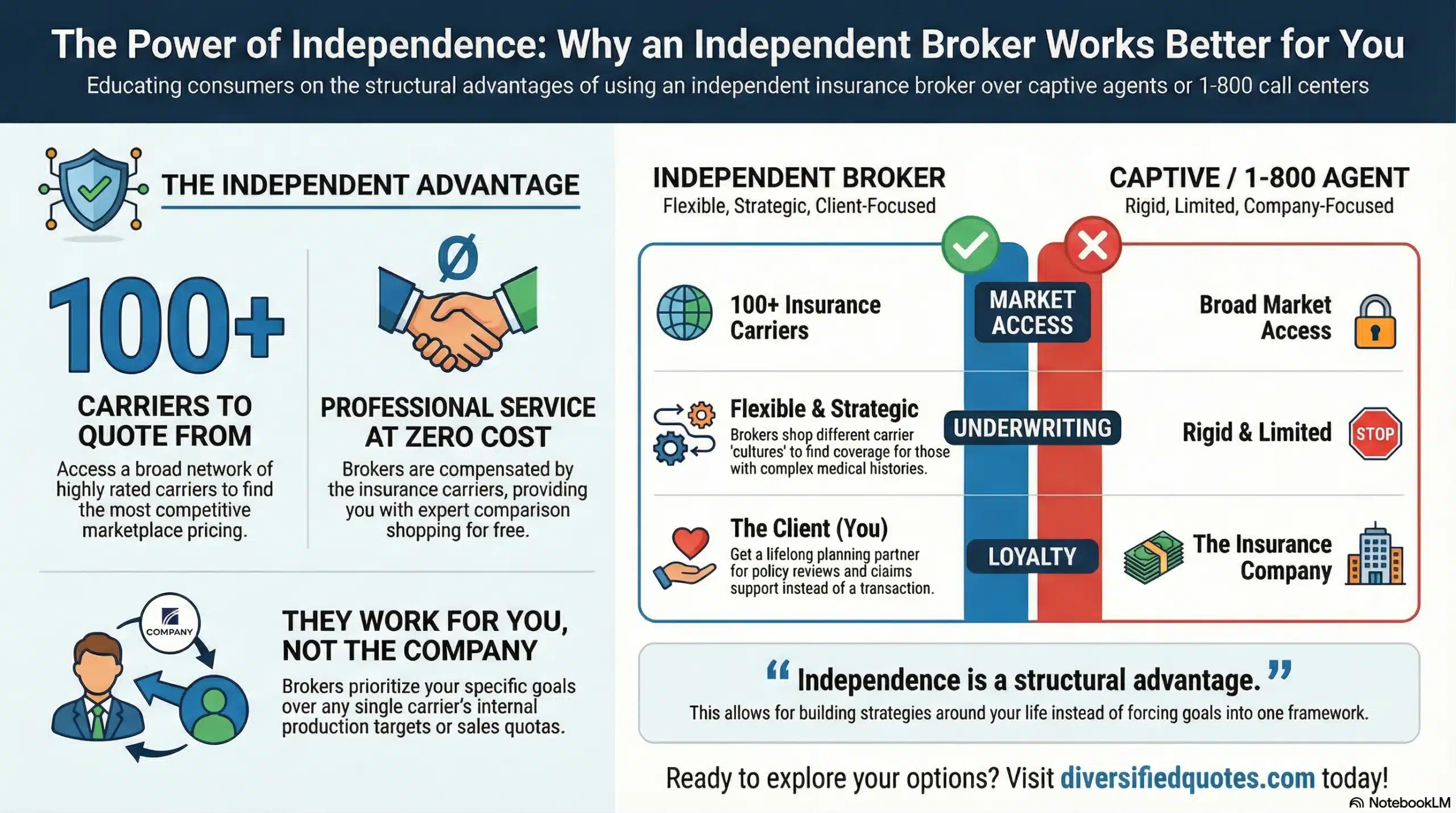
A captive agent who represents only one company can offer only that company’s view. An independent broker can compare several carriers, prescreen the case informally, and direct the application to the carrier whose rules suit your record. That step often matters more than any other in a rated case, because a two-table difference can change the premium significantly over the life of a policy.
Working through a broker does not generally raise your premium. Life insurance premiums are set by each carrier, and the price for a given product and rating class is generally the same whether you buy directly or through a licensed agent. Our article on whether using a broker costs less explains how that works. The practical advantage is access: more carriers, more underwriting views, and someone who knows which questions each underwriter is likely to ask before the application is submitted.
How Our Office Helps
Our office starts by learning the full shape of your history: the type and cause of your hydrocephalus, your treatment, every surgery and its date, any seizures or other effects, and how you live and work today. We also ask what the coverage needs to do, whether that is replacing income for a family, funding a special needs trust, or covering final expenses. Those two pieces of information together point toward the right product and the right carriers.
Next comes an informal prescreen. We share an anonymous summary of your history with underwriters at carriers that look like a good fit, before any formal application exists. Their feedback shows which companies are leaning toward the lowest table, which would probably postpone, and whether a few more months after your last surgery, or a fresh neurosurgery visit, could improve the answer. Only after that do we suggest a carrier and a timeline, and we help you pull together the operative reports, imaging, and follow-up notes that make the file easy to read.
During underwriting, we make sure the underwriter has a clear explanation of the cause of your hydrocephalus and the reason for each revision, and we follow up on slow records requests so the case does not stall. When the decision arrives, we walk you through what it means before you accept. A rating that seems too high is a reason to test the file elsewhere, not to settle. If medically underwritten coverage is out of reach for now, we map out workplace coverage, guaranteed issue policies, and annuity strategies, and set a point to revisit life insurance once more time has passed. Our recommendations are driven by your record, not by any single carrier’s rule book.
Want an underwriter’s read on your hydrocephalus history?
Start My Prescreen
Financial Protection Essentials
Helpful reading for anyone planning coverage around a neurological diagnosis.
Talk With an Advisor Today
Choose how you’d like to connect—call or message us, then book a time that works for you.
Schedule here:
calendly.com/jason-dibcompanies/diversified-quotes
Licensed in all 50 states • Fiduciary, family-owned since 1980
Frequently Asked Questions
Is life insurance available with hydrocephalus?
Yes, many applicants with hydrocephalus can qualify for fully underwritten coverage, usually with a table rating rather than Standard rates. The outcome depends on the cause, the type of treatment, the date of your last surgery, and whether you have lasting effects such as seizures or cognitive changes. Our overview of coverage with pre-existing conditions explains how carriers weigh ongoing health histories.
How long after a shunt revision should I wait to apply?
There is no single rule, because each carrier sets its own guidelines. Applying within the first several months after a placement or revision commonly leads to a postponement. Waiting until your neurosurgeon has documented a stable recovery at a routine follow-up visit usually gives the underwriter the evidence needed to make an offer.
Will I need a medical exam?
Often, yes. Larger fully underwritten policies typically involve a paramedical exam with blood and urine samples, along with medical records from your neurosurgeon or neurologist. The exam itself is routine, and the records usually carry more weight than the lab results in a hydrocephalus case. Our page on what the life insurance exam involves explains each step.
Can I buy coverage without an exam?
Sometimes. Accelerated and simplified issue policies skip the exam and rely on health questions, prescription history, and database checks, but a shunt or recent neurosurgery can push the case into full underwriting or lead to a decline. Reading each carrier’s questions before applying is essential. Our guide to life insurance without an exam covers how those policies work.
I was declined because of my hydrocephalus. What should I do now?
Find out why. A decline may reflect one carrier’s guidelines, a recent surgery, or missing records rather than a final answer. Another carrier may view the same history differently, especially after more time has passed without a revision. Our page on life insurance after an earlier decline covers how to approach a new carrier.
My offer came back rated. Is it worth checking with other carriers?
Usually, yes. Carriers publish different starting ranges for hydrocephalus, so one company’s table rating may not match another’s view of the same file. Comparing offers before you accept can save a meaningful amount over the life of the policy. Our page on getting a second opinion on your quote explains how that review works.
Can my child with hydrocephalus be added to my policy?
It depends on the carrier and the rider. Some child riders ask health questions about each child, and a recent diagnosis or ongoing revisions can lead the carrier to exclude that child or decline the rider. Rules differ widely, so confirm them before you apply. Our page on adding a child rider explains how these riders usually work.
Can I get coverage after a normal pressure hydrocephalus diagnosis later in life?
Possibly. A clear improvement after shunting, with memory and thinking intact, gives an underwriter something to work with, while progressive cognitive decline usually leads fully underwritten carriers to decline. Smaller permanent or guaranteed issue policies can fill the gap. Our guide to coverage for seniors with health issues covers options for older applicants.
Can I add living benefits riders with hydrocephalus?
Often, though availability depends on the carrier and the underwriting outcome. Terminal illness riders are commonly included, while chronic illness riders may be restricted when a neurological condition is present. Ask about rider eligibility before accepting an offer. Our page on accelerated death benefit riders explains the main types.
About the Author:
Jason Stolz, CLTC, CRPC, DIA, CAA and Chief Underwriter at Diversified Insurance Brokers (NPN 20471358), is a senior insurance and retirement professional with more than 25 years of real-world experience helping individuals, families, and business owners protect their income, assets, and long-term financial stability. As a long-time partner of the nationally licensed independent agency Diversified Insurance Brokers, Jason provides trusted guidance across multiple specialties—including fixed and indexed annuities, long-term care planning, personal and business disability insurance, life insurance solutions, Group Health, Travel Medical and Evacuation Insurance, and short-term health coverage. Diversified Insurance Brokers maintains active contracts with over 100 highly rated insurance carriers, ensuring clients have access to a broad and competitive marketplace.
His practical, education-first approach has earned recognition in publications such as VoyageATL, and contributions from his agency featured in Kiplinger and GoBankingRates— highlighting his commitment to financial clarity and client-focused planning. Drawing on deep product knowledge and years of hands-on field experience, Jason helps clients evaluate carriers, compare strategies, and build retirement and protection plans that are both secure and cost-efficient. Visitors who want to explore current annuity rates and compare options across multiple insurers can also use this annuity quote and comparison tool.
Explore More Life Insurance Options: Browse our complete guide to Life Insurance for Chronic, Autoimmune & Neurological Conditions — covering arthritis, lupus, MS, Crohn's, epilepsy, and Parkinson's from 100+ carriers.
Last Reviewed: October 20, 2026 |
Reviewed by: Jason Stolz, CLTC, CRPC, DIA, CAA
Chief Underwriter, Diversified Insurance Brokers, Inc. | NPN: 20471358 | Diversified Insurance Brokers, Inc. — Licensed in all 50 states
Fact Checked by: Tonia Pettitt, CMIP©
Medicare Specialist, Diversified Insurance Brokers, Inc. | NPN: 14374308 | Diversified Insurance Brokers, Inc. — Licensed in all 50 states
Did you find this content helpful? Leave us a Google review — it helps others find trustworthy guidance too.
Editorial Standards: Diversified Insurance Brokers maintains rigorous editorial standards to ensure accuracy, clarity, and independence in all content. Learn more about our editorial standards and commitment to transparency.
