
Annuities as an Alternative to Long-Term Care Insurance
As an Independent Long Term Care Insurance Broker, we compare traditional, hybrid, and partnership-qualified policies across dozens of carriers to find the structure that actually fits your situation.
As an Independent Annuity Broker, we compare rates across 100+ carriers and 1,000 different annuities— not just one company’s product offerings — to find the best fit for your goals.
Annuities as an Alternative to Long-Term Care Insurance

Jason Stolz CLTC, CRPC, DIA, CAA
Traditional long-term care insurance has a hard edge: if you never need care, the premiums are gone. A hybrid asset-based annuity takes a different approach. Your money stays in your own annuity, it can grow, and if you develop a care need it can be opened up or paid out on better terms, while anything you do not use passes to your heirs as a death benefit. Some designs, such as North American’s VersaChoice 10 with its optional enhanced liquidity benefit rider, do this with no medical underwriting for the care-triggered benefits. That combination of protection if you get sick and a legacy if you do not is what makes an annuity a realistic alternative to long-term care insurance, and everything else on this page sits on top of it.
Jason Stolz, CLTC, CRPC, DIA, CAA, is Chief Underwriter at Diversified Insurance Brokers, and annuities with care-triggered benefits are a strategy our office places regularly for clients who cannot qualify for long-term care insurance or would rather not pay for coverage they may never use. As an independent annuity broker holding both annuity and long-term care credentials, Jason can show you where an annuity-based plan works well, where traditional coverage still wins, and how to combine the two.
Want to see how an annuity could cover a future care need without medical underwriting?
Explore My Annuity Options
Four Ways to Fund a Future Care Need
| Feature | Annuity With ADL Rider | PPA Long-Term Care Annuity | Traditional LTC Insurance | Self-Funding |
|---|---|---|---|---|
| Medical Underwriting | None for VersaChoice 10’s ADL-based benefits | Usually required, often simplified | Full underwriting | None |
| Care Money Available | Your own value, with up to a 25% payout enhancement | A benefit pool larger than the deposit | The largest benefit per premium dollar | Only what you have saved; see self-insuring long-term care |
| If Care Is Never Needed | Remaining value passes to heirs | Remaining value passes to heirs | Premiums are not returned; weigh whether LTC insurance is worth it | Savings stay in the estate |
| Tax on Care Money | Taxed like other annuity withdrawals | Qualified LTC benefits generally tax-free | Benefits generally tax-free | Depends on the assets sold |
| Growth Potential | Index-linked or fixed interest | Fixed interest, varies by product | None | Depends on investments |
Ensure you are receiving the absolute top rates
Current Fixed Annuity Rates
Compare today’s best fixed annuity rates from top carriers.
Current Bonus Annuity Rates
See which annuities offer the highest upfront bonus today.
Request an Annuity Quote
Submit our annuity request form to get personalized rate options.
Lifetime Income Calculator
Use our calculator to see how much guaranteed income your annuity can provide.
Why Care Costs Catch Retirement Plans Off Guard
Most retirement plans are built around predictable expenses: housing, food, travel, and health insurance premiums. Long-term care does not fit that pattern. It may never be needed at all, or it may arrive suddenly after a fall or a stroke and require tens of thousands of dollars a year for an unknown length of time. That uncertainty is what makes care so difficult to plan for, and it is why so many people either overinsure, underinsure, or put off the decision entirely.
Health insurance and Medicare are designed for medical treatment, not for ongoing help with bathing, dressing, or supervision. That help, often called custodial care, is the core of most long-term care, and it is generally paid from personal savings, long-term care insurance, or eventually Medicaid once assets have been spent down. For a household with meaningful savings, the question is not whether care can be paid for, but how much of a lifetime of savings it might consume and what will be left for a surviving spouse or children.
Traditional long-term care insurance answers that question by transferring the risk to an insurer, but it requires good health, ongoing premiums, and acceptance that the premiums may never come back. An annuity-based plan answers it differently, by earmarking part of your savings for care, keeping it growing, giving it better access when care is needed, and letting it pass to heirs if it is not. Understanding both approaches is the starting point for deciding which belongs in your plan.
What a Hybrid Asset-Based Annuity Is
A hybrid asset-based annuity is an annuity that does two jobs with the same dollars. Its first job is to hold and grow your savings with the protections of an annuity contract. Its second job is to make that money easier to use, or more valuable, if you develop a long-term care need. The care feature is built into the contract or added through a rider, rather than purchased as a separate insurance policy.
These products fall into three broad groups. The first is the PPA long-term care annuity, which pairs an annuity with a dedicated long-term care benefit pool that is larger than the deposit and is usually medically underwritten. The second is the fixed index or fixed annuity with care-triggered features, such as VersaChoice 10’s activities-of-daily-living benefits, which unlock surrender-free access or an enhanced payout when the owner can no longer perform basic daily activities. The third is the ordinary annuity with built-in waivers, where surrender charges are waived for confinement or terminal illness. Our overview of an annuity with long-term care benefits covers the full category.
What ties them together is ownership. Unlike a traditional long-term care policy, where premiums buy coverage and nothing comes back if care is never needed, the money in a hybrid annuity remains your asset. You decide how it is allocated, it can earn interest, and the remaining value is paid to your beneficiaries at death. The care feature changes how and when you can reach the money; it does not take the money away from you.
That makes hybrid annuities a natural fit for a common planning situation: someone with savings set aside for “just in case” who does not want to spend premiums on insurance they may never use, or who cannot qualify for that insurance in the first place.
If You Never Need Care, Your Heirs Receive the Value
The most important difference between a hybrid annuity and traditional long-term care insurance shows up when care is never needed. With a traditional policy, the premiums have paid for protection, and the coverage ends at death with nothing left to pass on. With an annuity, the remaining accumulation value becomes the death benefit.
North American describes the VersaChoice 10 death benefit simply: your beneficiaries receive the remaining accumulation value of your annuity, either as an immediate lump sum or in installments, which may be reduced for premium taxes where a state requires them. That means every dollar that was not used for care, together with any interest credited along the way, goes to the people you name. Our guide to whether annuity death benefits are taxable explains how beneficiaries are taxed on the gain.
The same principle applies if you use only part of the money. A client who draws on the annuity for a year of home care and then recovers, or who needs care only near the end of life, leaves the balance to heirs. Traditional coverage cannot offer that, which is why the annuity approach appeals to people who see long-term care as one of several things their savings must cover rather than a risk to insure at any price.
There is one important exception on VersaChoice 10. If the owner elects the ADL-based payout benefit described below, all other rights and benefits under the contract, including the surrender value and the death benefit, terminate once it is elected. The legacy feature is preserved when you use the surrender charge waiver and take withdrawals, but not when you convert the contract to the enhanced five-year payout.
No Medical Underwriting: How Qualification Works
For many people, the biggest obstacle to long-term care insurance is underwriting. Traditional policies review medical records, prescriptions, and cognitive and functional status, and applicants with conditions such as diabetes with complications, a history of stroke, or early memory concerns are often declined. Our guides on whether LTC insurance requires a medical exam and on LTC coverage with preexisting conditions explain how demanding that process can be.
VersaChoice 10’s enhanced liquidity benefit works differently. North American states plainly that its ADL-based benefits do not require underwriting. There are no medical exams, no lab work, and no review of your health history for the care-triggered features. The annuity itself is available at issue ages 0 to 79, which may vary by state, with a minimum premium of $20,000.
There is one qualification rule to understand. At the time the rider becomes effective, the annuitant must be able to perform all six activities of daily living: bathing, continence, dressing, eating, toileting, and transferring. In other words, the rider is not available to someone who already needs help with those activities. But a person who manages daily life independently can add it regardless of diagnoses, medications, or medical history that would stop a long-term care insurance application.
That is a meaningful opening for applicants who have been declined for long-term care insurance, who are in their seventies and finding traditional coverage expensive or unavailable, or who simply want to avoid the time and intrusion of a full medical review. It does not make the annuity equivalent to long-term care insurance, as the next sections explain, but it does mean the people who most need a plan can still put one in place.
A Closer Look at the Six Activities of Daily Living
Because VersaChoice 10’s care-triggered benefits depend on activities of daily living, it helps to know exactly how they are defined. North American’s materials describe the six activities this way. Bathing means washing yourself by sponge bath or in a tub or shower, including getting in or out. Continence means bowel and bladder control or, when control cannot be maintained, the ability to perform the associated personal hygiene. Dressing includes putting on and taking off clothing and any necessary braces, fasteners, or artificial limbs.
Eating means being able to feed yourself or manage a feeding tube or intravenous feeding. Toileting means getting to and from the toilet, getting on and off it, and performing associated personal hygiene. Transferring means moving into or out of a bed, chair, or wheelchair. The full definitions appear in the product disclosure, and state variations may apply.
These are the same six activities used throughout the long-term care insurance industry, which makes it easier to compare an annuity-based plan with traditional coverage. The difference lies in what triggers the benefit. Long-term care insurance generally pays when a loss of two activities is expected to last at least 90 days or when there is a severe cognitive impairment. VersaChoice 10’s ADL benefits require certification that the inability to perform two activities is expected to be permanent, and its published materials describe the trigger in terms of the six activities rather than a separate cognitive impairment standard. Families planning around the possibility of dementia should keep that distinction in mind and confirm the details in the disclosure.
Inside VersaChoice 10’s Enhanced Liquidity Benefit
VersaChoice 10 is a modified single premium fixed index annuity issued by North American Company for Life and Health Insurance. The enhanced liquidity benefit, or ELB, is an optional rider with an annual fee equal to 0.60% of the accumulation value, withdrawn as a partial surrender on each contract anniversary while the rider is in place. It adds four features, two that improve standard annuity liquidity and two that are triggered by activities of daily living. Our VersaChoice 10 product review covers the base contract in detail, and North American’s own VersaChoice product page lists the current materials.
The first feature is enhanced penalty-free withdrawals. After the first contract anniversary, you can withdraw up to 20% of the beginning-of-year accumulation value without a surrender charge, provided no withdrawals other than rider charges and strategy fees were taken in the prior year. That is double the 10% penalty-free amount the base contract allows.
The second is a return of premium feature. Any time after the third contract year ends, you may terminate the contract and receive no less than your net premium, which is the total premium reduced dollar for dollar by withdrawals, excluding rider costs, and any premium tax, less any strategy fees.
The third is the ADL-based surrender charge waiver. If the annuitant becomes unable to perform two of the six activities of daily living after the issue date and otherwise qualifies, up to 100% of the accumulation value is available immediately with no surrender charge or market value adjustment. Taking the full amount is treated as a full surrender. The fourth is the ADL-based payout benefit, which the next section explains.
The ADL Payout Benefit and Its Multiplier
If the annuitant cannot perform two of six activities of daily living after the second contract anniversary and otherwise qualifies, the owner can choose to receive income over five years based on an enhanced accumulation value. The enhancement grows the longer the money stays in the contract, reaching its maximum after six years.
| Contract Year | Accumulation Value Multiplier | Payout Base on $100,000 of Value |
|---|---|---|
| 1 and 2 | Not available | Not available |
| 3 | 110% | $110,000 |
| 4 | 115% | $115,000 |
| 5 | 120% | $120,000 |
| 6 and later | 125% | $125,000 |
In practical terms, an owner with $100,000 of accumulation value in contract year six or later who qualifies would receive income over five years based on $125,000, roughly $25,000 a year before any interest or taxes. That 25% enhancement is real money at exactly the moment it is needed, and it is earned simply by keeping the funds in place.
The trade-off is permanent. Once the payout benefit is elected, the surrender value, death benefit, and all other rights under the contract end. An owner who wants to preserve a legacy can use the surrender charge waiver instead, taking only what is needed while the rest remains available to heirs. Choosing between the two depends on how much income the care plan requires and how important the remaining value is to the family, and it is a decision best made with the full numbers in front of you.
To use either ADL benefit, North American requires notice of the election and written proof from a physician, or a licensed health care practitioner in California, certifying that the annuitant cannot perform two of the six activities with an expectation that the condition is permanent. That permanence requirement is stricter than most long-term care policies, which generally pay when a loss of function is expected to last at least 90 days, and it is one of the clearest differences between the two approaches.
Would you like to see VersaChoice 10 illustrated with and without the liquidity rider?
Request an Illustration
How the Money Grows Until It Is Needed
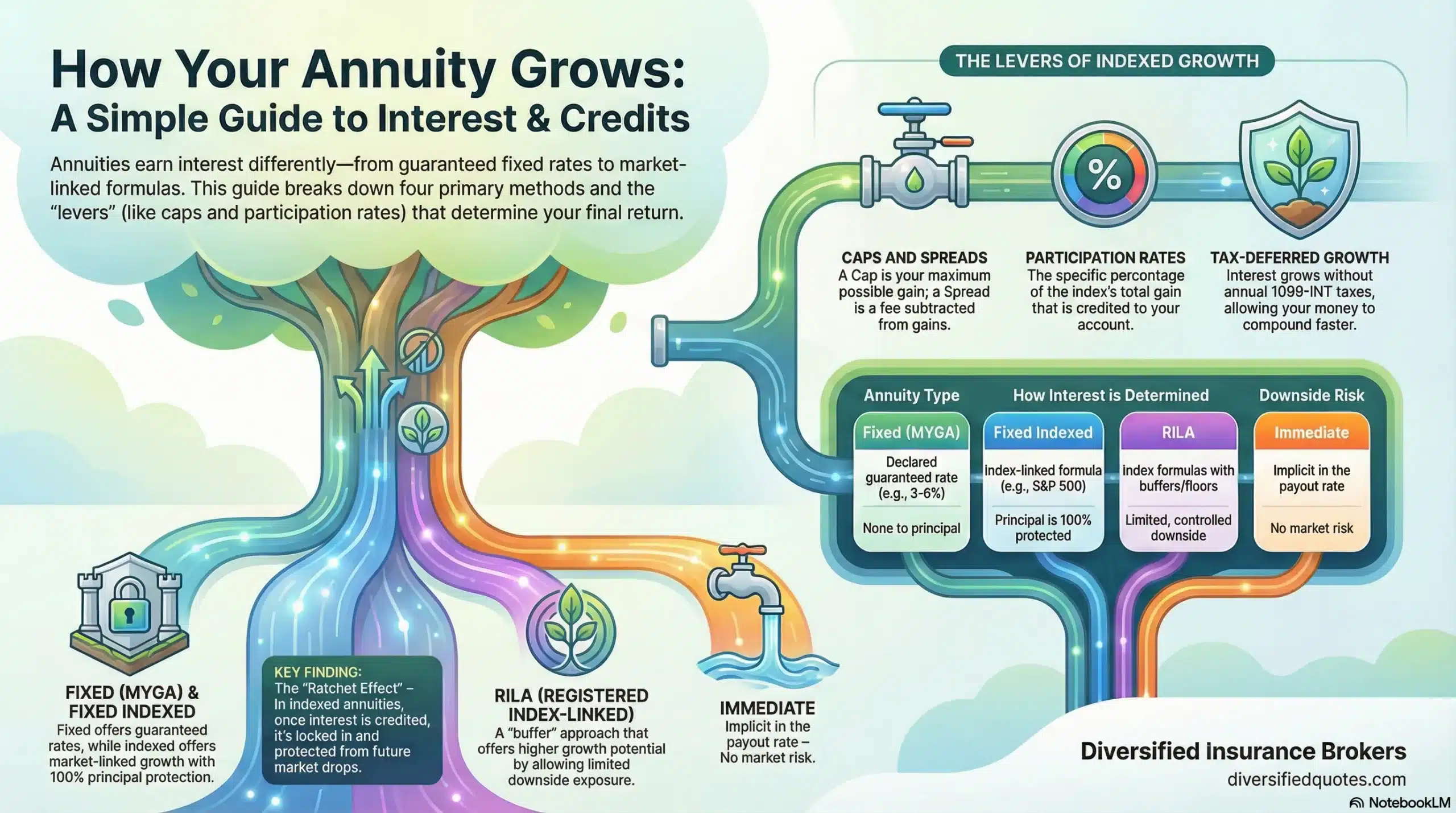
An annuity used for care planning may sit for years before it is needed, so the way it grows matters. VersaChoice 10 lets you allocate your premium between a fixed account and several index accounts. Crediting methods include monthly and annual point-to-point strategies with an index cap rate, annual and two-year point-to-point strategies with a participation rate, and enhanced participation versions of those strategies that carry an annual strategy fee in exchange for higher participation.
The index options include the S&P 500, the S&P Multi-Asset Risk Control 5% Excess Return Index, the Fidelity Multifactor Yield Index 5% ER, the Morgan Stanley Dynamic Global Index, and the Goldman Sachs Equity TimeX Index, with availability depending on the crediting method and state. Index accounts are tied to market performance but are not a direct investment in the market, and in years when an index falls, the premium is not reduced by the market loss.
Interest credits are locked in on each contract anniversary, or every two years for the two-year strategies, and the starting index value resets at the same time. Once credited, interest cannot be taken away by later index declines. You can generally move money between the fixed and index accounts at the end of each crediting term without tax or surrender charges.
Growth benefits both sides of the plan. A larger accumulation value means more money available through the ADL waiver if care is needed, a larger base for the payout multiplier, and a larger death benefit for heirs if it is not. Current caps and participation rates are set by the company and change over time, so an illustration with current rates is the best way to see what a particular allocation might produce.
Other Ways to Take Income From the Annuity
The ADL payout benefit is not the only way to turn VersaChoice 10 into income. The contract also offers standard annuitization options. In all states except Florida, these include income for a specified period, income for a specified amount, life income with a period certain, life income, and joint and survivor life income, with fixed-period options ranging from 5 to 20 years. Florida offers its own set of life and joint life options with 10-year or 20-year period certain choices.
By North American’s current company practice, an owner may receive income based on the accumulation value under certain conditions: after the first contract year when a life income option is chosen, or when the annuity has been in force for at least five years and payments are taken over at least five years. Company practices are not contractual guarantees and can change.
These options give a care plan more flexibility. A couple might choose joint and survivor life income to cover ongoing care costs for whichever spouse needs them, while a single owner with a shorter time horizon might prefer the ADL payout benefit’s enhanced value. Once an annuitization option is elected, it cannot be changed and the other rights under the contract end, so the choice deserves careful thought and a clear comparison of the alternatives.
Annuity-Based Care Funding vs. Long-Term Care Insurance
The honest comparison starts with leverage. A traditional long-term care policy is designed to pay out far more in benefits than the premiums paid, which is why it can protect against a long and expensive claim. An annuity with ADL features mostly gives you better access to your own money, plus an enhancement of up to 25% through the payout benefit. If a multi-year nursing home stay is the risk you most want to cover, insurance usually provides more protection per dollar.
The annuity approach wins on other measures. There is no medical underwriting for the care-triggered benefits, nothing is lost if care is never needed, the money can grow on an index-linked basis, and premiums are not subject to the rate increases that have affected many traditional policies. For someone who already has substantial savings and mainly needs a way to make them accessible and productive, those advantages can matter more than leverage.
Hybrid life insurance policies offer a middle ground, combining a death benefit with a leveraged care pool, though they also require underwriting. Our comparison of hybrid life versus traditional LTC explains how those policies fit between the two extremes.
Many clients end up using more than one tool. A modest traditional or hybrid policy can cover the catastrophic risk of an extended claim, while an annuity with ADL features holds savings that can be tapped for shorter needs, home modifications, or the cost of care during an elimination period, and that will pass to heirs if unused.
PPA Long-Term Care Annuities: The Leveraged Alternative
For buyers who want more leverage than an ADL rider provides, a long-term care annuity built under the Pension Protection Act is the next step. These products pair an annuity with a dedicated long-term care benefit pool, so the money available for qualified care is larger than the deposit. Our explanation of a Pension Protection Act annuity covers how they are structured.
Their biggest advantages are tax treatment and funding flexibility. Withdrawals used for qualified long-term care expenses from a PPA-compliant annuity are generally received free of federal income tax, even if the annuity has a large gain, and an existing non-qualified annuity can often be moved into one through a tax-free exchange. Our guide to how 1035 exchanges work explains that process.
The trade-off is underwriting. Most PPA long-term care annuities require health questions, and some applicants will not qualify. OneAmerica’s Annuity Care is one well-known example, using simplified underwriting rather than a full medical exam, and our review of OneAmerica Asset Care and Annuity Care covers how it works. For an applicant who can qualify, a PPA annuity generally offers more care money per dollar; for one who cannot, an annuity with ADL features may be the most practical option available.
How Care Withdrawals Are Taxed
Taxes are where annuity-based care plans differ most from insurance. Withdrawals from an annuity like VersaChoice 10, including withdrawals made under the ADL-based surrender charge waiver, are generally taxed the same way as any other annuity withdrawal. For a non-qualified annuity, gains are generally withdrawn first and taxed as ordinary income, and withdrawals before age 59½ may be subject to a 10% federal penalty. Our guide to non-qualified annuity taxation explains those rules.
If the annuity holds qualified money, such as an IRA rollover, withdrawals are generally fully taxable as ordinary income. Required minimum distributions continue to apply, and North American’s current company practice allows required distributions from the contract that exceed the penalty-free amount without a surrender charge or market value adjustment, although company practices can change.
Two points soften the tax picture. First, qualified long-term care expenses can count as deductible medical expenses for taxpayers who itemize, which can offset part of the income from withdrawals used to pay for care. Second, by the time most people need care, they may be in a lower tax bracket than during their working years. Even so, the tax treatment is a real cost compared with tax-free benefits from long-term care insurance or a PPA annuity, and it should be part of the comparison. A tax professional can estimate the effect for your situation.
Waivers and Care Features Built Into Other Annuities
Even annuities without a dedicated care rider often include some protection. Many fixed and fixed index annuities include a waiver that removes surrender charges if the owner is confined to a nursing home for a stated period, and some include a terminal illness waiver as well. Our page on an annuity with a nursing home care rider explains how those waivers typically work.
Some annuities go further with income riders that increase lifetime withdrawals when the owner cannot perform activities of daily living or enters a care facility, sometimes called an income doubler. North American also offers BenefitSolutions 10 with built-in care benefits, and several other carriers offer annuities designed around care needs, each with different triggers, waiting periods, and costs.
These features are not identical, and the details matter. Some require confinement in a facility rather than care at home, some impose waiting periods of a year or more, and some apply only to income riders rather than to the account value itself. Comparing the triggers, waiting periods, costs, and effect on the death benefit across several products is the only reliable way to choose, and it is the comparison our office prepares for clients.
Not sure whether an annuity, insurance, or both belong in your care plan?
Compare My Care Options
Fees, Surrender Charges, and Other Trade-Offs
An annuity used for care planning is still a long-term contract, and its costs should be understood before you commit. VersaChoice 10 has a ten-year surrender charge schedule in most states, beginning at 10% in the first two contract years and declining to 0% after year ten, with lower schedules in California and several other states. A market value adjustment can also raise or lower the surrender value during that period. Our explanation of how annuity surrender charges work covers why these schedules exist.
The ELB rider fee of 0.60% a year is deducted whether or not you ever use the care features, and the contract’s enhanced crediting strategies carry their own strategy fees in exchange for higher participation rates. North American cautions that if interest credited is less than rider charges and strategy fees, the result can be a loss of premium. The contract includes an accumulation value true-up feature for strategy charges, and the ELB rider’s return of premium feature provides a floor after the third contract year, but the fees are a real cost in years when index credits are low.
Premiums are accepted only during the first contract year, and the $20,000 minimum applies. For someone whose primary goal is care planning, the key question is whether the liquidity, the ADL features, and the legacy value are worth the rider fee compared with simply holding the same money in a fixed annuity without a rider. Jason can illustrate both versions side by side so you can see the difference in accumulated value over time.
North American’s Financial Strength
A care plan built on an annuity depends on the insurer’s ability to honor its promises years from now. North American Company for Life and Health Insurance, based in West Des Moines, Iowa, is part of Sammons Financial Group, which describes itself as employee owned. According to North American’s own materials, the company is rated A+ by AM Best, A+ by S&P Global Ratings, and A+ by Fitch Ratings. Ratings can change, so they should be confirmed at the time you apply.
Those are strong ratings for a company backing contracts that may run for decades, and they place North American among the more highly rated annuity carriers. As with every annuity, guarantees are backed by the claims-paying ability of the issuing company, and state guaranty associations provide an additional layer of protection up to state limits. Our review of whether North American is a good company covers the carrier in more depth.
Strength matters especially for an annuity used for care, because the features you are paying for may not be needed for many years. A highly rated carrier with a long history provides more confidence that the contract will perform as promised when that time comes.
Who an Annuity-Based Care Plan Fits
An annuity with ADL-based features tends to fit people in their fifties through their seventies who have savings set aside for a possible care need, want those savings to keep growing, and want anything unused to go to their family. It is especially valuable for people who have been declined for long-term care insurance, or who expect to be, because the ADL-based benefits do not depend on medical underwriting, as long as they can perform all six activities of daily living when the rider takes effect.
It also suits people who dislike the idea of paying insurance premiums that may rise and may never be used, and those who want flexibility to use the money for things other than care, such as home modifications, travel, or helping family. The 20% penalty-free withdrawals and return of premium feature add liquidity that a standard annuity does not provide.
It is a weaker fit for people whose main concern is a long, expensive claim, since an annuity provides much less leverage than insurance, and for those who need care benefits to be tax-free. People who already need help with daily activities cannot add the rider, and anyone who may need the money within the first few years should weigh the surrender schedule carefully. For those situations, traditional or hybrid long-term care insurance, or a PPA annuity if you can qualify, may be the better foundation.
Building a Care Plan Around an Annuity
An effective plan starts with an estimate of what care might cost where you live and how long you would want to be able to pay for it. From there, the question becomes how much of that cost your savings can cover, how much you want to insure, and how much you want to leave to heirs.
For many clients, the answer is a layered plan. A portion of savings goes into an annuity with ADL features to provide growth, accessible care money, and a legacy. If health allows, a smaller long-term care or hybrid policy covers the risk of an extended claim. Social Security, pensions, and other income cover ordinary living expenses. Each layer handles the part of the risk it is best suited for.
Couples should consider each spouse separately, since the rider’s benefits are tied to the annuitant’s ability to perform daily activities. Owning annuities on each spouse, or coordinating which spouse is the annuitant, can make sure the care features apply to the person most likely to need them. These choices are easier to make with a full illustration and a clear picture of the household’s assets and income.
Timing deserves attention too. Because the payout multiplier grows from 110% in contract year three to 125% from year six onward, and because the rider requires the annuitant to perform all six activities of daily living when it takes effect, the best time to put the plan in place is while health is good and care is still a distant possibility. Jason can map out how the waiver, the payout benefit, and the death benefit would look at different points in the contract, so you know what the plan would provide whether care is needed in year two, year eight, or never.
Questions to Ask Before Choosing an Annuity for Care
Annuities with care features vary more than their marketing suggests, so a few questions help separate one design from another. Start with the trigger: does the benefit require the inability to perform two activities of daily living, confinement in a facility, or a terminal diagnosis, and must the condition be expected to be permanent? Then ask about timing: how long after purchase each benefit becomes available, and whether there is a waiting period after the condition begins.
Next, ask about cost and effect. What does the rider cost each year, is that cost charged whether or not you use the benefit, and how does using the benefit affect the surrender value and death benefit? On VersaChoice 10, for example, the surrender charge waiver preserves the remaining death benefit, while the enhanced payout benefit ends it.
Finally, ask about taxes and strength. Will withdrawals for care be taxed like ordinary annuity withdrawals, or does the product qualify for tax-free treatment under the Pension Protection Act? How strong is the insurer, and what are its ratings? Clear answers to those questions, compared across several products and against traditional or hybrid long-term care coverage, lead to a plan that does what you expect when the time comes.
How Our Office Helps
Jason and our office start with your goals and your health. If you can qualify for long-term care insurance or a PPA annuity, we show you what that leverage would provide. If you cannot, or would prefer not to, we show you how an annuity with ADL-based benefits such as VersaChoice 10 could fit, including the rider fee, the surrender schedule, and how the payout benefit and waiver would work if care were needed.
Because we work with many carriers, we can compare VersaChoice 10 with other annuities that offer care-related features and with traditional and hybrid long-term care coverage, all on the same assumptions. We also coordinate with your tax advisor on the tax treatment of care withdrawals and with your estate plan on how the death benefit will pass.
The goal is a plan that protects you if you need care and protects your family if you do not, built from the products that fit your health, your savings, and your priorities rather than from a single product.
Ready to build a care plan that leaves the unused money to your family?
Start My Care Plan Review
Financial Protection Essentials
More resources for planning care costs and protecting your savings.
Talk With an Advisor Today
Choose how you’d like to connect—call or message us, then book a time that works for you.
Schedule here:
calendly.com/jason-dibcompanies/diversified-quotes
Licensed in all 50 states • Fiduciary, family-owned since 1980
Frequently Asked Questions
Is an annuity with an ADL rider the same as long-term care insurance?
No. Long-term care insurance pays benefits that can far exceed the premiums paid. An annuity with an ADL rider mainly gives you easier or enhanced access to your own money when you cannot perform daily activities, with an enhancement of up to 25% through VersaChoice 10’s payout benefit. In exchange, the annuity requires no medical underwriting for those benefits and passes unused value to heirs. Our overview of hybrid long-term care options compares the approaches.
I was declined for long-term care insurance. Can I still add the VersaChoice 10 rider?
Often, yes. North American states that the ADL-based benefits do not require underwriting. The key requirement is that the annuitant can perform all six activities of daily living when the rider becomes effective, so someone who already needs help with daily activities cannot add it. Our page on guaranteed issue LTC options covers other alternatives for declined applicants.
Are care withdrawals from VersaChoice 10 tax-free?
Generally not. Withdrawals taken under the ADL surrender charge waiver are taxed like other annuity withdrawals, with gains on a non-qualified annuity generally taxed first as ordinary income. Tax-free treatment for qualified long-term care expenses applies to long-term care insurance and PPA-compliant long-term care annuities. Our article on tax-free long-term care coverage explains which products qualify.
What if I need care in the first year or two?
The ADL-based surrender charge waiver can apply any time after the issue date, so qualifying owners can access up to 100% of the accumulation value without a surrender charge or market value adjustment. The enhanced payout benefit, however, is not available until after the second contract anniversary, and its multiplier starts at 110% in contract year three. Our guide to a fixed annuity with LTC benefits compares other timing structures.
Can I use IRA money for an annuity-based care plan?
Yes. Annuities like VersaChoice 10 can be funded with qualified money such as an IRA rollover, although withdrawals will generally be fully taxable and required minimum distributions still apply. North American’s current practice allows required distributions from the contract above the penalty-free amount without surrender charges, though company practices can change. Our guide on using qualified funds for LTC planning covers related strategies.
How much should I put into an annuity for care?
Start with what care costs where you expect to receive it and how many years you want to be able to pay for it, then subtract what other income and savings would cover. The remaining gap is the amount to plan around, keeping in mind that money in the annuity is subject to a surrender schedule. Our cost of long-term care calculator shows typical costs by state.
Would a medically underwritten annuity pay me more income?
Possibly, if your goal is lifetime income rather than care access. Some income annuities use your health history to increase payouts when your life expectancy is shorter than average, which can raise income for people with serious health conditions. That is a different tool from an annuity with ADL features, and the two can work together. Our page on the medically underwritten annuity explains how it works.
Can your office review an annuity I already own for care features?
Yes. Many existing annuities include nursing home or terminal illness waivers that owners do not know about, while others have surrender charges or income riders that affect how they could be used for care. Our office can review your contract, explain what it would provide if care were needed, and compare it with newer options. You can request a second opinion on your annuity to get started.
What proof is needed to use the ADL benefits?
North American requires notice of the election and written proof, acceptable to the company, from a physician, or a licensed health care practitioner in California, certifying that the annuitant cannot perform two of the six activities of daily living with an expectation that the condition is permanent. Some states may vary, so the full requirements in the product disclosure should be reviewed before relying on the benefit.
About the Author:
Jason Stolz, CLTC, CRPC, DIA, CAA and Chief Underwriter at Diversified Insurance Brokers (NPN 20471358), is a senior insurance and retirement professional with more than 25 years of real-world experience helping individuals, families, and business owners protect their income, assets, and long-term financial stability. As a long-time partner of the nationally licensed independent agency Diversified Insurance Brokers, Jason provides trusted guidance across multiple specialties—including fixed and indexed annuities, long-term care planning, personal and business disability insurance, life insurance solutions, Group Health, Travel Medical and Evacuation Insurance, and short-term health coverage. Diversified Insurance Brokers maintains active contracts with over 100 highly rated insurance carriers, ensuring clients have access to a broad and competitive marketplace.
His practical, education-first approach has earned recognition in publications such as VoyageATL, and contributions from his agency featured in Kiplinger and GoBankingRates— highlighting his commitment to financial clarity and client-focused planning. Drawing on deep product knowledge and years of hands-on field experience, Jason helps clients evaluate carriers, compare strategies, and build retirement and protection plans that are both secure and cost-efficient. Visitors who want to explore current annuity rates and compare options across multiple insurers can also use this annuity quote and comparison tool.
Explore More Long Term Care Insurance Options: Browse our complete guide to Tax, Medicare & Special Situations — covering tax advantages, Medicare vs LTC, seniors, couples, diabetics & age-specific coverage from top carriers.
Last Reviewed: October 7, 2026 |
Reviewed by: Jason Stolz, CLTC, CRPC, DIA, CAA
Chief Underwriter, Diversified Insurance Brokers, Inc. | NPN: 20471358 | Diversified Insurance Brokers, Inc. — Licensed in all 50 states
Fact Checked by: Tonia Pettitt, CMIP©
Medicare Specialist, Diversified Insurance Brokers, Inc. | NPN: 14374308 | Diversified Insurance Brokers, Inc. — Licensed in all 50 states
Did you find this content helpful? Leave us a Google review — it helps others find trustworthy guidance too.
Editorial Standards: Diversified Insurance Brokers maintains rigorous editorial standards to ensure accuracy, clarity, and independence in all content. Learn more about our editorial standards and commitment to transparency.
