
NexAnnuity NexVantage MYGA Annuity
As an Independent Annuity Broker, we compare rates across 100+ carriers and 1,000 different annuities— not just one company’s product offerings — to find the best fit for your goals.
NexAnnuity NexVantage MYGA Annuity
NexVantage MYGA, issued by NexAnnuity/Ohio State Life Insurance Company, puts its liquidity features in the base contract instead of selling them as add-ons. Starting in the second contract year, a tenth of the contract value can come out each year without a surrender charge, split across several withdrawals if you like; required minimum distributions can come out without a surrender charge even in the very first contract year; and the contract value passes to your beneficiaries in full at death. None of that requires a rider election. The trade-off sits with the issuer, a young company without the long financial record most annuity buyers rely on. Everything else on this page sits on top of that.

Issuer Financial Strength Disclosure
NexVantage MYGA is issued by Opportunity Life Insurance Company, an insurer with a brief operating history that is wholly owned by Fortis Life and Annuity Insurance Company. The product materials we reviewed do not cite a financial strength rating for Opportunity Life, and we were unable to locate a published AM Best rating for it. Every guarantee in the contract rests on Opportunity Life’s own claims-paying ability rather than on any affiliated company. Before you apply, confirm whether the issuer has been rated and what that rating is.
Jason Stolz, CLTC, CRPC, DIA, CAA, is Chief Underwriter at Diversified Insurance Brokers, and guaranteed-rate annuities such as NexVantage are contracts our office places regularly for savers seeking certainty over a set term. Our role as an independent annuity broker is to put NexVantage’s built-in features and current rate beside contracts from long-established, highly rated insurers, so you can judge whether the convenience and yield are worth placing money with a new carrier.
Curious how NexVantage stacks up against established MYGA carriers?
See NexVantage Side by Side
NexVantage MYGA Key Features
| Contract Feature | What NexVantage Provides |
|---|---|
| Issuing Company | The Ohio State Life Insurance Company, home office in Dallas, Texas; powered by NexAnnuity; AM Best B+ (Good) |
| Financial Strength Rating | None cited in the product materials; confirm current status before applying |
| Product Design | Single premium deferred annuity with a guaranteed fixed rate |
| Terms | 3, 5, 7, or 10 years |
| Minimum Premium | $50,000; above $1 million requires home office approval |
| Annuitant Ages | Birth through 85, using age last birthday |
| Annual Withdrawal Allowance | Up to 10% of the contract value each contract year after the first, in one or several withdrawals |
| Required Distributions | RMDs exempt from surrender charges from the first contract year onward |
| Death Benefit | Full contract value, with no rider needed |
| Market Value Adjustment | Applies to withdrawals and surrenders; see how a market value adjustment works |
| Payout Choices | Lifetime or defined-period income; see what a life only annuity is |
| Nursing Home Benefit | Not offered |
| States Excluded | Arkansas, California, Hawaii, Idaho, Minnesota, New York, Oregon, Pennsylvania, and Rhode Island, plus any state still awaiting approval |
Ensure you are receiving the absolute top rates
Current Fixed Annuity Rates
Compare today’s best fixed annuity rates from top carriers.
Current Bonus Annuity Rates
See which annuities offer the highest upfront bonus today.
Request an Annuity Quote
Submit our annuity request form to get personalized rate options.
Lifetime Income Calculator
Use our calculator to see how much guaranteed income your annuity can provide.
The Company Behind NexVantage
Three names appear on NexVantage paperwork, and each plays a different role. Opportunity Life Insurance Company, often abbreviated OLIC, is the insurer that issues the contract and owes you the guarantees. OLIC is a wholly owned subsidiary of Fortis Life and Annuity Insurance Company, a Dallas-based company that NexAnnuity’s launch announcement describes as newly formed. NexAnnuity, the Dallas retirement platform behind the NexHaven MYGA as well, supplies product strategy, distribution, and insurance services to Fortis under a carrier partnership.
State insurance filings show that OLIC itself is organized under Ohio law and had only a brief operating history when NexVantage launched, so the issuer has little track record for buyers or analysts to examine. That matters because the materials are explicit that guarantees depend on OLIC’s financial strength and claims-paying ability, and that every company operating under the Nex name answers for its own obligations. The materials do not describe the broader Nex family, which includes an investment management business and a bank, as guaranteeing the contract.
NexAnnuity introduced the product in its NexVantage launch announcement, which outlines the terms, the minimum premium, and the states where the issuer is not licensed. For buyers, the practical takeaway is to treat OLIC as the company you are evaluating. Its size, capital, and track record are what will determine its ability to keep the promises in your contract over the full guarantee period.
What a Missing Rating Means for You
Most established annuity issuers carry a financial strength rating from AM Best, and many also carry ratings from S&P, Fitch, or Moody’s. Those ratings are independent opinions about an insurer’s ability to pay claims, built on years of financial statements, investment results, and management reviews. A brand-new insurer may not yet have the history a rating agency needs, so the absence of a rating does not by itself mean a company is weak. It does mean that one of the most useful outside checks on the insurer is not available to you.
That gap shifts more of the evaluation onto you and your advisor. Questions worth asking include how much capital the issuer holds relative to the business it is writing, how its investment portfolio is managed, who its reinsurance partners are, if any, and how much support its parent has committed. The factors analysts weigh, described in our guide to how AM Best ratings work, make a useful checklist even when no formal rating exists.
Sizing the purchase is the other lever. Each state also runs a life and health guaranty association that steps in, within set limits, when a member insurer becomes insolvent. Keeping the amount placed with an unrated insurer at or below your state’s annuity coverage limit, and spreading larger sums across several carriers, reduces how much depends on any one company. The limits and their fine print vary by state, and our page on guaranty association safety nets explains how the protection works and where it falls short.
How NexVantage Grows Your Money
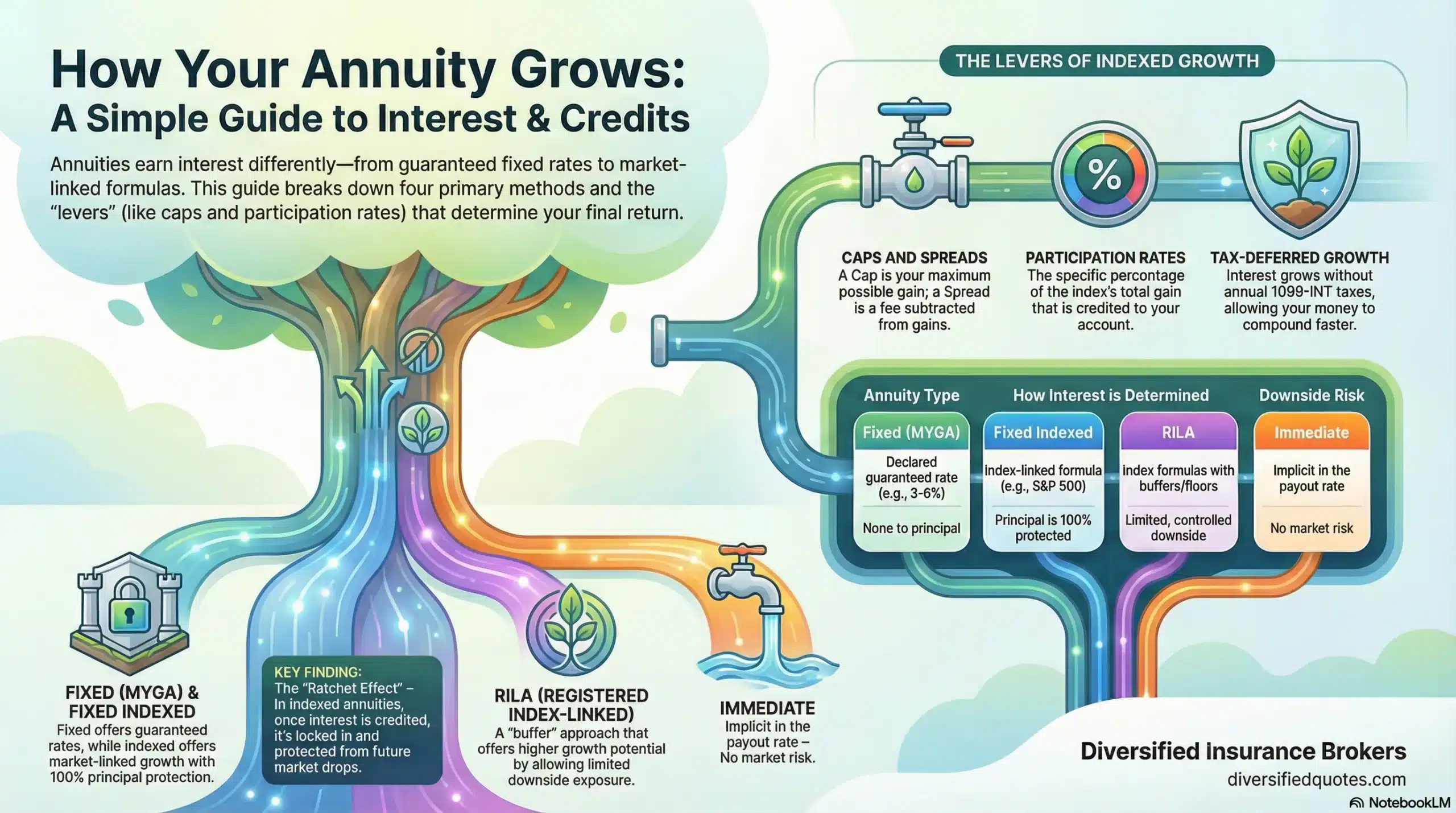
NexVantage is a multi-year guaranteed annuity, so the growth formula is simple. You make one premium payment of at least $50,000, the insurer sets a fixed interest rate when the contract is issued, and that rate holds for the entire initial term you select. There are no index allocations, caps, or participation rates to manage, and the value does not rise or fall with the stock market. Our guide to multi-year guaranteed annuities explains how this category works in more detail.
Your premium is protected from market losses as long as the money stays in the contract for the term, and interest accumulates tax-deferred. The materials describe the fixed annual rate as determined at issue, which means the rate you lock in is whatever the insurer is offering on your issue date, and quoted rates can change at any time before then.
Because the design is so plain, the real decisions are about the term, the amount, and the issuer. A MYGA’s value lies almost entirely in its guaranteed rate, so the rate has to be meaningfully competitive to justify the trade-offs. With NexVantage, that comparison has an added dimension: weighing a rate and a generous set of built-in features against the financial track record of the company making the promise.
Daily Interest, Annual Compounding
NexVantage’s materials describe interest that accrues every day and is folded into the balance once a year, at each policy anniversary, with policy years measured from the issue date. Each anniversary, the interest earned during the year joins the base, so the next year’s interest is figured on a larger balance.
That compounding is why longer terms grow faster than a simple rate multiplied by the number of years would suggest. Simple interest pays the same dollar amount every year, while compound interest pays a little more each year as earlier interest begins to earn its own. Our comparison of simple vs. compound interest annuities shows how wide the gap can become over a decade.
Withdrawals interrupt compounding. Money taken out under the annual allowance, or as a required distribution, stops earning interest, so the balance you finish with reflects every dollar taken out along the way. If you plan to take regular withdrawals, it helps to compare the projected ending value with and without them, so you know what the convenience of access is costing in future growth.
Choosing Among 3, 5, 7, and 10 Years
NexVantage offers four initial terms. The shortest, three years, behaves much like a CD and gives you a decision point soon. The longest, ten years, locks a rate for a decade. On the NexVantage rate sheet and launch announcement we reviewed, the guaranteed rates were paired, with the 3- and 5-year terms matching each other and the 7- and 10-year terms matching each other. When rates line up that way, the choice within each pair comes down to flexibility rather than yield.
In that situation the shorter term in each pair has a clear argument in its favor: it pays the same rate, ends sooner, and lets you reassess earlier. The longer term only makes sense if you specifically want a rate guaranteed for longer, perhaps because you expect rates to fall. Rate patterns change, so this reasoning has to be applied to the rates actually being offered when you apply.
Splitting a larger sum across several NexVantage terms, or across NexVantage and contracts from other insurers, can also make sense. A staggered set of maturities gives you regular points of penalty-free access and spreads both interest rate risk and issuer risk. With a $50,000 minimum per contract, that approach suits larger balances, and our article on laddering fixed annuities for retirement income walks through how to build one.
Withdrawal Charges by Year
Taking out more than the yearly allowance, or cashing in the whole contract before its term is up, triggers a withdrawal charge. We have product sheets for the 3- and 5-year versions, and their schedules appear below; schedules for the 7- and 10-year terms were not part of the materials we reviewed and should be requested with any quote for those terms. Each published schedule begins at 9 percent and falls by a single point annually through the final year of its term.
| Contract Year | NexVantage 3-Year | NexVantage 5-Year |
|---|---|---|
| 1 | 9% | 9% |
| 2 | 8% | 8% |
| 3 | 7% | 7% |
| 4 | Term complete | 6% |
| 5 | Term complete | 5% |
In dollar terms, a $200,000 contract surrendered during its first year would face a charge of about $18,000 at 9 percent, before any market value adjustment. A withdrawal within the allowance in year two or later avoids the charge, and the 30 days after each term ends offer a charge-free exit. Our page on surrender charges and the MVA explains how the two work together. The simplest protection is to choose a term no longer than the time you are confident the money can stay in place.
Where the Market Value Adjustment Fits
NexAnnuity’s launch materials state that market value adjustments apply to NexVantage withdrawals and surrenders. A market value adjustment ties the amount you receive on an early exit to the movement of interest rates since your guarantee period began. When rates have climbed, the adjustment usually trims the payout; when rates have dropped, it can add to it, subject to the formula and limits in the contract.
The adjustment exists because the insurer buys fixed-income assets to support your guaranteed rate. Those assets lose market value when rates rise and gain value when rates fall, and the MVA aligns what a departing owner receives with what the insurer can realize by selling them. The adjustment is aimed at early exits, which is why owners who leave the money in place for the term are generally unaffected.
One question the summaries leave open is how the adjustment interacts with NexVantage’s built-in access. The product sheet describes withdrawals within the 10 percent allowance and required minimum distributions as free of surrender charges, but it does not say in so many words whether the market value adjustment is also waived on them, or during the 30-day window after a term. Because those are exactly the withdrawals most owners take, ask for the contract language on each before you buy.
Want a NexVantage illustration with your withdrawals built in?
Request an Illustration
Built-In Withdrawals Without Penalty
NexVantage’s access provision is part of every contract. Once the first contract year is behind you, each contract year allows charge-free withdrawals totaling as much as one-tenth of the contract value, and you are not limited to one withdrawal: several smaller withdrawals are allowed as long as the year’s total stays within the allowance. Our explainer on what an annuity account value is clarifies the value the allowance is measured against.
The ability to split the allowance matters more than it might seem. An owner who wants a quarterly or monthly supplement to Social Security, or who prefers to take money only as bills arrive, can do so without worrying that an early small withdrawal uses up the year’s only penalty-free opportunity. That flexibility also suits owners who want a cushion for irregular expenses such as home repairs or travel.
Two practical limits still apply. First, the allowance does not begin until the second contract year, so money that might be needed in the first twelve months, other than required distributions, belongs elsewhere. Second, the exact measuring point for the 10 percent, and whether any unused allowance carries over, are defined by the contract rather than the summary sheets. Planning withdrawals within each contract year, and keeping a separate emergency fund, keeps the allowance working as intended.
RMDs From the First Contract Year
For IRA owners, the most distinctive NexVantage provision may be its treatment of required minimum distributions. The product sheets state that RMDs may be withdrawn without a surrender charge during the first contract year and in all subsequent years, subject to the contract’s terms. Some MYGAs, including NexAnnuity’s own NexHaven, tie RMD access to a penalty-free provision that only begins after year one, which can leave a new owner who is already taking RMDs searching for another account to satisfy the first year’s requirement.
That makes NexVantage easier to use for retirees who are already past RMD age or who will reach it during the first contract year. The required amount can come directly from the contract on schedule, without timing the transfer around the distribution or drawing from a different IRA. Our overview of required minimum distribution rules explains how the yearly amount is calculated.
A few details are worth confirming. The summaries do not say whether RMDs taken after the first year count toward the 10 percent annual allowance or sit outside it, or whether the market value adjustment is waived on them. They also do not address required distributions from inherited IRAs, which follow different rules. Those answers affect how much additional money you can take penalty-free in a year, so ask for the contract language if you expect to combine RMDs with other withdrawals.
Moving IRA Money Into NexVantage
Because the contract includes an RMD provision, it is designed to accommodate qualified retirement money as well as after-tax savings. Moving an existing IRA into NexVantage is normally handled as a direct trustee-to-trustee transfer, in which the money goes straight from the current custodian to the insurer without passing through your hands. That keeps the transaction from being treated as a distribution and avoids withholding. Our guide to transferring an IRA to an annuity outlines the paperwork.
Money in an employer plan, such as a 401(k), usually arrives through a direct rollover, landing in an annuity that is titled as an IRA. Before starting, check whether the plan imposes waiting periods, paperwork requirements, or restrictions on in-service rollovers, and whether you would give up any plan features you value, such as institutional pricing on certain funds or loan provisions.
The $50,000 minimum is stated without any distinction between account types, and larger IRA transfers, like any premium above $250,000, may be referred for the additional suitability review described later on this page. It also helps to remember that holding a MYGA inside an IRA does not add a second layer of tax deferral; the IRA already provides it. The reasons to choose NexVantage for IRA money are its fixed rate, its principal protection when held to term, and its first-year RMD flexibility, not any added tax benefit.
Full Contract Value at Death
NexVantage pays the full contract value at death without requiring an optional rider. Some contracts, NexHaven among them in most states, pay only the surrender value at death unless a death benefit rider is purchased, which can reduce what beneficiaries receive by the withdrawal charges and market value adjustment in effect. With NexVantage, the materials describe the full value being available to beneficiaries as part of the base design. Our article asking whether annuities have a death benefit explains the different ways contracts handle it.
That built-in benefit makes NexVantage worth a look for money that may pass to heirs during the term, particularly for older owners or those with health concerns. Because the rate is fixed and interest compounds annually, the value your beneficiaries would receive at any point during the term is predictable, reduced only by any withdrawals you have taken.
Taxes still apply. Heirs of a non-qualified contract generally pay ordinary income tax on the accumulated interest they inherit, since annuity gains are not stepped up to market value at death. For an IRA-funded contract, the inherited IRA rules generally apply to the beneficiary. Keeping beneficiary designations current, and naming contingent beneficiaries, is the simplest way to make sure the money goes where you intend without delay.
Spousal Continuation
NexAnnuity’s materials indicate that NexVantage offers spousal continuation. In general, spousal continuation allows a surviving spouse who is the sole beneficiary to keep the contract in force as the new owner rather than taking the death benefit as a payout. The contract then generally continues under its existing terms, which should be confirmed in the contract itself. Our explainer on what a spousal continuation annuity is covers the rules in more depth.
For married couples, continuation can be valuable. A surviving spouse may not need the money right away and may prefer to keep earning the guaranteed rate rather than reinvesting at whatever rates prevail at the time. Continuing the contract also defers income tax on the accumulated interest for a non-qualified contract, instead of triggering it through a lump-sum payout.
The details of eligibility are set by the contract and by tax law, so they should be confirmed for your situation. Ownership, annuitant, and beneficiary designations all influence how continuation works, and a design that looks sensible at purchase can produce an unexpected result later if those roles are set up carelessly. Reviewing the designations with our office at application, and again after major life events, helps make sure the surviving spouse can take advantage of continuation if the time comes.
No Nursing Home Benefit
NexVantage does not offer a nursing home benefit. Some MYGAs, including NexAnnuity’s own NexHaven contract through an optional rider, allow withdrawal charges to be waived after an extended nursing home stay. NexVantage’s materials list that benefit as not available, and the summaries we reviewed do not describe a terminal illness waiver either.
In practice, that means a long-term care event during the term would be handled with the tools the base contract already provides: the 10 percent annual allowance after year one, any required distributions, and the charge-free window after the term ends. For a buyer who places only part of their savings in NexVantage and keeps other assets liquid, that may be perfectly adequate. For a buyer who would rely on this money to pay for care, it is a meaningful gap.
Buyers concerned about care costs have better tools than any MYGA waiver. Hybrid annuities and life policies with long-term care benefits, traditional long-term care insurance, and annuities that pay enhanced benefits during confinement are all designed to add money for care rather than just unlock existing funds. How those products work, and who they suit, is the subject of our article on annuity-based long-term care planning.
NexVantage Versus NexHaven
NexAnnuity offers two MYGAs that look alike at first glance: the same four terms, the same $50,000 minimum, and the same annuitant age range. The difference is in how the flexibility features are delivered, and in which company issues the contract. The table below summarizes the main differences described in NexAnnuity’s materials.
| Feature | NexVantage | NexHaven |
|---|---|---|
| Issuer | Opportunity Life Insurance Company, a Fortis subsidiary | The Ohio State Life Insurance Company |
| AM Best Rating | None found | B+ (Good) |
| Annual Withdrawals | Built in; multiple withdrawals up to 10% after year one | Optional rider; after year one, only the first withdrawal each year is charge-free, capped at 10% of the anniversary value |
| RMDs | Exempt from surrender charges, including year one | Taken through the withdrawal rider, subject to its terms |
| Death Benefit | Full contract value built in | Full value with optional rider in most states |
| Nursing Home Benefit | Not available | Optional rider in most states |
| States Not Served | AR, CA, HI, ID, MN, NY, OR, PA, RI, plus pending states | CT, ME, NY, VT |
The choice usually turns on two questions. If you value built-in withdrawals, first-year RMD access, and a full death benefit without rider decisions, NexVantage delivers them in one package. If you prefer an issuer with an established AM Best rating, or want a nursing home waiver, NexHaven may fit better. Comparing the current rates for each, net of any NexHaven riders you would add, completes the picture. For many buyers, the deciding factor will be how much weight they give to an issuer’s established rating versus convenience built into the contract, and that is a personal judgment our office can help you frame with real numbers.
The 30-Day Window After Each Term
NexVantage waives withdrawal charges during the 30 days that follow the end of each guaranteed period. That window is your opportunity to take the money, move it elsewhere, or decide whether to stay with the contract for another period. Because it opens after the term ends rather than before, the timing is easy to miss unless you track your contract’s issue date.
The summaries we reviewed do not describe what happens if no decision is made during the window, for instance whether the contract rolls into a new guarantee period and on what terms, and they are silent on whether the market value adjustment reaches withdrawals during those 30 days. Those provisions live in the contract itself, and they deserve a look before you buy, because the end of a term is the point at which your money is most mobile.
A sensible routine is to note the end date of the guarantee period when the contract is issued, request the renewal terms as that date approaches, and compare them with what other insurers are paying for the same and different terms. Given that the issuer is a new company, the end of each term is also a natural moment to review its financial condition and any rating it may have received since you bought. Our office can help you work through that review when the time comes.
Trying to decide between NexVantage and NexHaven?
Compare Both Contracts
Taxes on NexVantage
A non-qualified NexVantage contract defers income tax on its interest until money comes out. When you withdraw, the interest is generally considered to leave the contract before your premium does, so withdrawals are taxable as ordinary income up to the amount of accumulated interest. Only after all the interest has been taken does the tax-free return of your original premium begin. That ordering is worth keeping in mind if you plan regular withdrawals from the annual allowance, because those early dollars will generally be fully taxable.
The IRS may add a 10 percent additional tax on taxable amounts withdrawn before age 59 and a half, and NexAnnuity’s disclosures say so directly. With annuitants eligible from birth, younger owners in particular should treat a non-qualified MYGA as money set aside for later. Our explainer on the early withdrawal penalty rules covers the exceptions and planning strategies.
IRA-funded contracts follow the IRA’s rules instead: every dollar withdrawn from a traditional IRA contract, RMDs included, is generally ordinary income, while qualified Roth withdrawals are generally tax-free. When a contract ends and you choose to cash out rather than continue, a non-qualified owner faces tax on all the accumulated interest in one year, so moving the money directly to another annuity through a tax-free exchange can be the better route when the goal is continued deferral. Because tax law shifts over time, run any large decision past a tax professional.
Turning the Contract Into Income
NexVantage can be converted into guaranteed income through annuitization, choosing between payments for life and payments for a fixed stretch of years. Lifetime income guards against outliving your savings, though a lifetime payout generally stops when the annuitant dies. Payments over a fixed number of years end on schedule, which fits an income need with a known finish line.
Annuitizing is a one-way decision. Once payments begin, the lump-sum value is generally no longer accessible, and the amount of each payment is fixed by the option chosen, the annuitant’s age, and the payout rates at the time. An owner who does not need lifetime income can skip annuitization entirely, taking withdrawals during the term and moving the money at maturity instead. Annuitization tends to make the most sense when guaranteed income is the explicit goal and the payout offered compares well with what other insurers’ immediate annuities pay.
For income needs that are more modest, the built-in withdrawal allowance may be enough. An owner who needs only a few thousand dollars a year can take that amount within the 10 percent allowance after year one, in installments if desired, while the rest of the contract keeps compounding. That approach preserves flexibility and leaves the remaining value available to heirs. The right choice depends on whether you need predictable income for life or simply periodic access to your savings, and on how the numbers compare at the time you are ready to begin.
Ages, Large Premiums, and the Extra Review
NexVantage accepts annuitants from birth through age 85, measured by age last birthday. The wide range allows a grandparent or parent to fund a contract that names a young annuitant, where the ownership arrangement is permitted, and it allows older savers to buy well into retirement. At the upper end, an applicant who has passed an 86th birthday is no longer eligible, so timing matters for buyers close to the limit.
Two groups of applications can draw extra scrutiny: those naming an annuitant who is at least 75, and those with a premium over $250,000. Either may be sent for enhanced underwriting and suitability review, or for home office sign-off. Expect the process to take longer in those cases and to involve questions about your overall finances, your other liquid assets, the purpose of the money, and why the chosen term fits.
That review deserves to be taken seriously rather than treated as paperwork. For an older buyer, a multi-year commitment with withdrawal charges should represent only a portion of total savings, with enough liquidity elsewhere to cover health and living expenses. For a large premium, placing all of it with a single new insurer concentrates risk in one company. Dividing the money across terms and carriers often serves buyers in either situation better, and it tends to make the suitability conversation simpler.
State Availability
Opportunity Life is not licensed in Arkansas, California, Hawaii, Idaho, Minnesota, New York, Oregon, Pennsylvania, or Rhode Island, so residents there cannot buy NexVantage. The rate sheet we reviewed also listed Iowa, Maine, and Virginia as states where availability was still pending, so anyone living in those three states should check whether the contract is offered yet.
Approvals change as an issuer expands, and features can vary from one state to another even where the product is sold. Before you apply, confirm that NexVantage is approved where you live and request the state-specific contract, since the contract language, not the summary sheet, governs your rights.
Your state of residence also determines which guaranty association would protect you if the issuer were to fail and how much protection it would provide. Because Opportunity Life is organized under Ohio law and licensed in many states, coverage generally depends on the guaranty association of the state where you live and its specific limits. For a buyer placing money with a new, unrated insurer, knowing that limit before deciding how much to invest is a basic and worthwhile step.
Who NexVantage Fits, and Who It Does Not
NexVantage tends to fit buyers who want a fixed rate with the most common flexibility features already included, and who are comfortable placing money with a new insurer in exchange for that design and a competitive rate. It is particularly well suited to IRA owners already taking required distributions, since RMDs can come out without a surrender charge from the start, and to owners who want penalty-free withdrawals in several installments each year. Buyers who want a full-value death benefit without paying extra for it will also find the design appealing.
It is a weaker match for anyone who insists on an issuer with an established financial strength rating, since none was cited in the materials and we could not find one. It also does not suit buyers with less than $50,000, buyers who want a nursing home or terminal illness waiver, and residents of the states where the issuer is not licensed. Anyone who may need more than the annual allowance before the term ends should consider a shorter term or keep that money elsewhere.
Ultimately, NexVantage makes the most sense as one part of a diversified fixed-income plan rather than the home for an entire nest egg. Placing an amount within your state’s guaranty association limit, picking a term you can actually wait out, and comparing the rate with contracts from long-established insurers will tell you whether the contract’s convenience and yield are worth the trade-off in issuer history.
Questions to Ask Before You Buy
Begin by examining the issuer. Has Opportunity Life received a financial strength rating from AM Best or another agency since the product launched? How much capital does it hold relative to the business it is writing, and what commitments has its parent made? How much of your money would be covered by your state’s guaranty association if the worst happened?
Then turn to the contract’s mechanics. Is the 10 percent allowance measured from the prior anniversary value, and does any unused amount carry forward? Do RMDs count toward the allowance? Is the market value adjustment waived on allowance withdrawals, RMDs, and withdrawals during the 30-day window after a term? What are the withdrawal charge schedules for the 7- and 10-year terms, and what happens if you take no action when a term ends?
Finally, compare. How does NexVantage’s current rate for your term stack up against MYGAs from highly rated insurers and against NexAnnuity’s own NexHaven, net of any riders you would need there? Is the difference large enough to justify the issuer trade-off for the amount you plan to place? Getting clear answers to these questions before you apply is the surest way to make a decision you will be comfortable with for the full term.
How Our Office Helps
Our first conversation about NexVantage focuses on your comfort with a newer insurer and the role this money plays in your plan. Jason and our office want to know how long the money can stay put, whether you take or will soon take required distributions, whether leaving money to heirs matters, and what share of your total savings this contract would hold. Those answers determine whether NexVantage belongs on your short list and, if so, how much should go into it.
From there, we line up NexVantage’s current rate and built-in features against MYGAs from highly rated carriers and against NexHaven, so the trade-off between convenience, yield, and issuer strength is visible in dollars. We also request the contract details the summary sheets leave open, including the longer-term withdrawal charge schedules and how the market value adjustment applies to allowance withdrawals and RMDs. A common question is whether a broker adds cost, which we answer in does a broker cost more.
When you are ready to move forward, our team takes care of the application, any IRA transfer or 401(k) rollover paperwork, and the suitability information the insurer may request for larger or older-age applications. After issue, we can help you keep an eye on the issuer’s financial progress and on the date your 30-day window opens, so that each renewal decision is made deliberately and with current information.
Ready to see whether NexVantage belongs in your plan?
Talk to Our Office
Financial Protection Essentials
More guides for choosing a fixed-rate annuity with confidence.
Talk to an Advisor or Request Your Annuity Quote
Ready to explore this annuity in more detail—or compare it with other carriers to see if even higher rates are available? With guaranteed income, principal protection, and long-term growth potential on the line, making the right choice is essential. The experienced advisors at Diversified Insurance Brokers will guide you through the options and design a strategy tailored to your retirement goals.
Schedule here:
calendly.com/jason-dibcompanies/diversified-quotes
Licensed in all 50 states • Fiduciary, family-owned since 1980
Frequently Asked Questions
Can I put a maturing CD into NexVantage?
Yes, provided the amount meets the $50,000 minimum. A CD that has reached maturity can be moved without a bank penalty, while one that has not may cost some interest to break early. Weigh FDIC insurance on the CD against the insurer’s guarantee before moving. The process is outlined in our article on moving a CD into an annuity.
How are NexVantage withdrawals taxed outside an IRA?
Interest compounds without current tax. Under the interest-first rule, each withdrawal is generally ordinary income until the accumulated interest is exhausted, and only then does your premium come back untaxed. Taxable amounts taken before 59 and a half may also face a 10 percent IRS penalty. Details are in our guide to non-qualified annuity taxation.
Can I roll my 401(k) or 403(b) into NexVantage?
Yes, typically by having the plan send the money straight to the insurer as a direct rollover to an IRA annuity, so no tax is withheld and the deferral continues. Confirm the plan’s rollover rules and any features you would give up first. Our guide to rolling a 401(k) into a guaranteed annuity explains the steps.
What happens to NexVantage in a divorce?
An annuity can be divided or transferred as part of a divorce settlement, but the method matters for taxes and for any withdrawal charges. A transfer made under a divorce decree is handled differently from a simple withdrawal. Our overview of annuities in a divorce explains the options and pitfalls.
How should I set up beneficiaries on NexVantage?
Name primary and contingent beneficiaries, keep them current after marriages, divorces, and deaths, and coordinate them with your estate plan. Naming a spouse as sole beneficiary may also preserve the option of spousal continuation. Our article on common beneficiary designation mistakes covers the errors to avoid.
Is it riskier to buy from a newly formed insurer?
A new insurer has a short track record and, in this case, no rating cited in the materials, so there is less independent information about its strength. Keeping the amount within your state’s guaranty association limit and spreading larger sums across established carriers reduces the risk. Our guide to safe fixed annuity options covers higher-rated alternatives.
How does NexVantage compare with other fixed annuities?
Its strengths are built-in multiple withdrawals, first-year RMD access, and a full-value death benefit without riders. Its main weakness is the issuer’s limited history. Compare the rate for your term against contracts from established insurers. Our roundup of the best fixed annuities shows how leading contracts differ.
Can NexVantage provide monthly income?
Yes, in two ways. After the first contract year you can take installments within the 10 percent annual allowance, or you can annuitize the contract for lifetime or fixed-period payments. The better option depends on whether you need income for life or just periodic access. Our page on an annuity for monthly retirement income compares approaches.
Should I choose NexVantage or NexHaven?
NexVantage includes multiple annual withdrawals, first-year RMD access, and a full death benefit in the base contract, while NexHaven offers one charge-free withdrawal per year after year one and a full-value death benefit only through optional riders, without first-year RMD access, and adds a nursing home rider option. NexHaven’s issuer carries an AM Best B+ rating, while we found no published rating for NexVantage’s issuer. Compare current rates, net of any NexHaven riders, alongside that difference.
About the Author:
Jason Stolz, CLTC, CRPC, DIA, CAA and Chief Underwriter at Diversified Insurance Brokers (NPN 20471358), is a senior insurance and retirement professional with more than 25 years of real-world experience helping individuals, families, and business owners protect their income, assets, and long-term financial stability. As a long-time partner of the nationally licensed independent agency Diversified Insurance Brokers, Jason provides trusted guidance across multiple specialties—including fixed and indexed annuities, long-term care planning, personal and business disability insurance, life insurance solutions, Group Health, Travel Medical and Evacuation Insurance, and short-term health coverage. Diversified Insurance Brokers maintains active contracts with over 100 highly rated insurance carriers, ensuring clients have access to a broad and competitive marketplace.
His practical, education-first approach has earned recognition in publications such as VoyageATL, and contributions from his agency featured in Kiplinger and GoBankingRates— highlighting his commitment to financial clarity and client-focused planning. Drawing on deep product knowledge and years of hands-on field experience, Jason helps clients evaluate carriers, compare strategies, and build retirement and protection plans that are both secure and cost-efficient. Visitors who want to explore current annuity rates and compare options across multiple insurers can also use this annuity quote and comparison tool.
Explore More Annuity Options: Browse our complete guide to What Is a Fixed Annuity? — covering fixed annuities, MYGAs, laddering strategies & conservative growth options from 100+ carriers.
Last Reviewed: October 19, 2026 |
Reviewed by: Jason Stolz, CLTC, CRPC, DIA, CAA
Chief Underwriter, Diversified Insurance Brokers, Inc. | NPN: 20471358 | Diversified Insurance Brokers, Inc. — Licensed in all 50 states
Fact Checked by: Tonia Pettitt, CMIP©
Medicare Specialist, Diversified Insurance Brokers, Inc. | NPN: 14374308 | Diversified Insurance Brokers, Inc. — Licensed in all 50 states
Did you find this content helpful? Leave us a Google review — it helps others find trustworthy guidance too.
Editorial Standards: Diversified Insurance Brokers maintains rigorous editorial standards to ensure accuracy, clarity, and independence in all content. Learn more about our editorial standards and commitment to transparency.
