
NexAnnuity NexHaven MYGA Annuity
As an Independent Annuity Broker, we compare rates across 100+ carriers and 1,000 different annuities— not just one company’s product offerings — to find the best fit for your goals.
NexAnnuity NexHaven MYGA Annuity
NexHaven MYGA, issued by NexAnnuity/Ohio State Life Insurance Company, is built à la carte. The base contract guarantees a fixed interest rate for three, five, seven, or ten years, but three features that many buyers assume come standard, a penalty-free annual withdrawal, a death benefit that pays full value, and a nursing home waiver, are each optional riders that must be elected and that carry their own cost. Skip them and the contract offers no penalty-free access until each term ends, and your beneficiaries could receive the surrender value rather than the full account value in most states. Deciding which riders you need matters as much as the rate itself. Everything else on this page sits on top of that.

AM Best Rating Disclosure
NexHaven MYGA is issued by The Ohio State Life Insurance Company, which holds an AM Best Financial Strength Rating of B+ (Good), the sixth-highest of AM Best’s thirteen rating levels. That is below the A- level many conservative buyers prefer as a minimum for a multi-year annuity commitment. Every guarantee in the contract depends on Ohio State Life’s financial strength and claims-paying ability. Ratings can change, so confirm the current rating before you apply.
Jason Stolz, CLTC, CRPC, DIA, CAA, is Chief Underwriter at Diversified Insurance Brokers, and fixed-rate MYGAs like NexHaven are contracts our office places regularly when a client values a predictable rate and is comfortable weighing a carrier’s rating against that rate. As an independent annuity broker, we compare NexHaven’s current rate, net of any riders you elect, with MYGAs from higher-rated insurers, so the trade-off between yield and financial strength is visible before you decide.
Want to see NexHaven’s current rate next to A-rated alternatives?
Compare NexHaven Rates
NexHaven MYGA at a Glance
| Feature | Details |
|---|---|
| Issuing Insurer | The Ohio State Life Insurance Company, home office in Dallas, Texas; powered by NexAnnuity; AM Best B+ (Good) |
| Contract Type | Single premium deferred annuity with a guaranteed interest rate (multi-year guaranteed annuity) |
| Guarantee Periods | 3, 5, 7, or 10 years |
| Interest Crediting | Credited daily and compounded at the end of each policy year |
| Premium | $50,000 minimum; over $1 million with home office approval |
| Issue Ages | 0 to 85, based on the annuitant’s age last birthday |
| Surrender Charges | 9%, 8%, 7% on the 3-year term; 9%, 8%, 7%, 6%, 5% on the 5-year term |
| Market Value Adjustment | Applies to amounts withdrawn or surrendered unless a rider waives it |
| Optional Riders | 10% partial withdrawal, death benefit, and nursing home waiver, each with its own cost |
| End of Each Term | Withdrawal charges waived for 30 days after each guaranteed period ends |
| Annuitization | Lifetime or defined-period income; see how a period certain annuity pays |
| Account Types | Non-qualified savings; confirm IRA and rollover eligibility before applying, and see what an IRA annuity is |
| Where It Is Offered | Ohio State Life is not licensed in Connecticut, Maine, New York, or Vermont; rider availability varies by state |
Ensure you are receiving the absolute top rates
Current Fixed Annuity Rates
Compare today’s best fixed annuity rates from top carriers.
Current Bonus Annuity Rates
See which annuities offer the highest upfront bonus today.
Request an Annuity Quote
Submit our annuity request form to get personalized rate options.
Lifetime Income Calculator
Use our calculator to see how much guaranteed income your annuity can provide.
Who Issues NexHaven MYGA
NexHaven MYGA is issued by The Ohio State Life Insurance Company, a life insurer whose home office is in Dallas, Texas. Ohio State Life is owned by NexAnnuity Holdings, Inc., an insurance holding company, and NexAnnuity is the brand name for the annuity platform that develops, distributes, and manages the investments behind Ohio State Life’s retirement products. NexAnnuity, which is based in Dallas, describes itself as part of a family of affiliated financial companies that includes an investment management organization and a bank.
The structure matters for one simple reason: the guarantees in your contract are obligations of Ohio State Life, not of NexAnnuity’s broader family of companies. The product materials state that each subsidiary or affiliate is responsible for its own financial and contractual obligations and that guarantees depend on the claims-paying ability of Ohio State Life. When you evaluate NexHaven, the balance sheet you are relying on is the insurer’s.
One more detail prevents confusion. NexAnnuity also markets a separate multi-year guaranteed annuity called NexVantage, which is issued by a different insurance company. The two products share a platform, but they are distinct contracts with different issuers, so confirm that the quote and application you receive are for NexHaven from Ohio State Life. NexAnnuity’s multi-year fixed annuities page lists both products and their issuers. Ohio State Life has operated for more than a century, according to NexAnnuity, though its current ownership and product focus are much more recent.
Ohio State Life’s Financial Strength Rating
AM Best rates Ohio State Life B+ (Good) for financial strength, and NexAnnuity reports that AM Best has reiterated that rating with a stable outlook. On AM Best’s scale, the A++ and A+ ratings are Superior, A and A- are Excellent, B++ and B+ are Good, and the ratings below that run from Fair to Poor. B+ is therefore a secure rating in AM Best’s own terminology, but it sits two notches below the A- level that many buyers use as a cutoff for long-term annuity money. The full scale, with what each grade signals, is laid out in AM Best ratings explained.
When AM Best first assigned the rating, it described Ohio State Life’s balance sheet strength as adequate, its operating performance as marginal, its business profile as limited, and its enterprise risk management as appropriate. The marginal operating performance reflected, in part, the way MYGA sales costs hit statutory earnings up front, and the limited business profile reflected the company’s concentration in a narrow range of fixed annuity products. Those assessments can change as the company grows, which is why the current rating report is worth checking before you buy.
A lower rating does not mean a contract is unsafe, but it does change how the money should be sized. If you choose a B+ rated carrier for its rate, one prudent approach is to keep the amount placed with that carrier within the coverage limits of your state’s guaranty association, which provides a backstop if an insurer becomes insolvent. Those limits differ from state to state; how the backstop works, and why it is no substitute for choosing a sound insurer, is explained on our page about state guaranty association protection.
How NexHaven Works
NexHaven is a multi-year guaranteed annuity, the most predictable kind of deferred annuity. You pay a single premium, Ohio State Life sets a fixed interest rate at issue, and that rate is guaranteed for the full initial guarantee period you choose. Your principal is protected from market losses when the contract is held to the end of its term, and interest grows tax-deferred until you withdraw it. Our overview of what a fixed annuity is explains how this category differs from indexed and variable contracts.
Because the rate is set at issue, the exact number you receive depends on the rates Ohio State Life is offering on the date your contract is issued. Rates for MYGAs move with the broader interest rate environment, and the carrier can change the rates it offers on new contracts at any time. Once your contract is issued, however, your rate for the initial guarantee period is locked and does not change.
The price of that guarantee is commitment: the money is meant to stay in the contract for the full term. Withdrawals beyond what an elected rider allows, and full surrenders before the term ends, are subject to withdrawal charges and a market value adjustment. That combination is what allows the insurer to invest your premium for the length of the term and offer a fixed rate in return. A MYGA works best when the term you choose matches the time the money can truly stay untouched.
How Interest Is Credited
NexAnnuity’s materials describe the crediting method plainly: interest is credited daily and compounded at the end of each policy year. Policy years begin on the issue date and on the same month and day each year after that. In practice, that means your account value grows a little each day during the year, and at each anniversary the year’s interest becomes part of the base that earns interest in the following year.
Annual compounding is what makes the stated rate meaningful over a multi-year term. A guaranteed rate applied to a growing balance produces more total interest each year than the year before, so the difference between a three-year and a ten-year contract at similar rates is larger than a simple multiplication would suggest. When you compare NexHaven with another MYGA, make sure both are quoted on the same basis, because a rate that compounds annually and one described differently are not always directly comparable.
Daily crediting also matters if money leaves the contract mid-year. Because interest accrues each day, a withdrawal or death claim during a policy year generally reflects interest earned up to that point rather than only through the last anniversary. The precise calculation, including how interim balances are handled, is defined in the contract, and our office can show you how the value would look at any point during a term before you commit.
Four Guarantee Periods
NexHaven offers initial guarantee periods of three, five, seven, and ten years. Shorter terms suit buyers who want CD-like timing or who expect to want a fresh rate decision soon. Longer terms suit buyers who know the money will sit undisturbed and want the rate secured for many years. On NexAnnuity’s rate sheets, the rates for different terms do not always rise with length, so a shorter term can sometimes pay as much as or more than a longer one.
That pattern is worth noticing whenever it appears. When a shorter term pays the same or more than a longer one, the shorter term gives up nothing in rate while preserving flexibility and creating an earlier exit point. When longer terms pay noticeably more, the decision becomes a genuine trade between yield and access. Because rates move, this comparison only means something when it uses the rates offered on your application date.
Several NexHaven contracts with different terms can also be combined into a ladder, so that part of your money comes due every few years. A ladder spreads interest rate risk, creates regular points of penalty-free access, and lets you reinvest maturing money at whatever rates prevail. Our guide to the fixed annuity ladder strategy shows how to structure one, and with a $50,000 minimum per contract, a NexHaven ladder suits larger balances.
Surrender Charges
On the 3- and 5-year terms, NexHaven’s withdrawal charges decline each year of the guarantee period. The product sheets supplied for the 3- and 5-year terms show the schedules below; the 7- and 10-year terms have their own schedules, which our office can provide with a quote for either of those terms. For background on how charges like these are structured industry-wide, see annuity surrender charges explained.
| Term | Year 1 | Year 2 | Year 3 | Year 4 | Year 5 |
|---|---|---|---|---|---|
| NexHaven 3 | 9% | 8% | 7% | – | – |
| NexHaven 5 | 9% | 8% | 7% | 6% | 5% |
Both schedules start at 9 percent and drop one point a year. On a $100,000 contract with no partial withdrawal rider, surrendering in the first year would cost about $9,000 in withdrawal charges before any market value adjustment. Matching the term to a realistic horizon is the first defense against that cost, and it is also why the partial withdrawal rider deserves careful thought if there is any chance you will need some of the money before the term ends. Keep in mind that the market value adjustment is applied alongside these charges, so the true cost of an early exit can land above or below the schedule depending on how interest rates have moved.
The Market Value Adjustment
NexHaven’s materials state that a market value adjustment applies to any amount withdrawn or surrendered, unless an elected rider waives it. The MVA changes the amount you receive based on how interest rates have moved since your guarantee period began. Rising rates generally push the adjustment negative and falling rates can push it positive, within limits the contract sets.
The reasoning comes from how insurers back fixed annuities. Your premium is typically invested in bonds and similar assets matched to the term. An early exit after rates climb forces the insurer to sell bonds that have lost value, and the MVA passes some of that loss to the owner who is leaving. An exit after rates drop means those bonds have gained value, and the MVA can pass some of the gain back. Our explainer on what a market value adjustment is covers the mechanics in more depth.
On NexHaven, the riders determine where the MVA stops. The partial withdrawal rider waives both withdrawal charges and the MVA on its qualifying annual withdrawal, and the death benefit rider waives both at death. The nursing home rider is described as waiving withdrawal charges, so how the MVA is treated on a nursing home withdrawal should be confirmed from the contract. Without the riders, the MVA can apply to every early dollar that leaves the contract.
Not sure which NexHaven riders are worth their cost?
Review My Rider Options
Optional Riders: Building Your Contract
Many MYGAs include a penalty-free withdrawal allowance and a full-value death benefit in the base contract. NexHaven separates them. The base contract provides the guaranteed rate and principal protection, and three riders can be elected: a free partial withdrawal rider, a death benefit rider, and a nursing home waiver of withdrawal charge rider. Each benefit is available only if the rider is elected, and each rider’s terms control how it works.
Each rider also has a cost. NexAnnuity’s rate sheet lists the cost of each rider in basis points, the same hundredths-of-a-percent units used to express interest rates, and on that sheet the death benefit rider costs roughly twice as much as either of the other two. Because the costs are expressed this way, the clearest comparison is the net rate you would earn after the riders you elect, which our office can show side by side with other MYGAs. Rider costs, like rates, can change for new contracts.
| Rider | What It Does | Limits and Availability |
|---|---|---|
| Partial Withdrawal | Waives withdrawal charges and the MVA on the first withdrawal each policy year, up to 10% of the prior-anniversary account value | Available after the first policy year |
| Death Benefit | Pays beneficiaries the full account value, with withdrawal charges and the MVA waived | Not applicable in Florida; in California applies only below age 65 |
| Nursing Home Waiver | Waives withdrawal charges if the annuitant is confined to a nursing home for 90 days before the request | Not available in California or South Dakota |
The Partial Withdrawal Rider
Without this rider, NexHaven offers no penalty-free withdrawals during a guarantee period. With it, after a one-year waiting period, you can take one withdrawal each policy year of up to 10 percent of the account value as of the preceding policy anniversary, with withdrawal charges and the market value adjustment waived. Our guide to annuity free withdrawal rules compares how these provisions work across contracts.
One detail separates this rider from the allowance on many other MYGAs: the waiver applies to the first withdrawal in a policy year. An owner who takes a small amount early in the year and then needs more later may find that the second withdrawal is charged, even if the total stays under 10 percent. If you elect the rider, plan to take each year’s penalty-free amount in a single withdrawal, sized to what you will need.
The rider is most valuable for owners who expect to draw income from the contract, who place IRA money subject to required minimum distributions in the contract, where that account type is accepted, or who simply want a safety valve. It is least valuable for owners who are certain the money will stay untouched until the term ends. For a 3-year contract, where the rider becomes usable only in years two and three, the value of the rider is narrower than on a 7- or 10-year contract, where it can be used many times over the life of the term.
The Death Benefit Rider
Without the death benefit rider, NexHaven’s materials describe the beneficiary as receiving the surrender value or the accumulated value, depending on the terms and the state. In practical terms, a death during the guarantee period could leave beneficiaries with the account value reduced by withdrawal charges and a market value adjustment. With the rider, the death benefit equals the full account value, with both waived. Our article on annuity beneficiary death benefits explains how these provisions compare.
State rules change the picture in two places. In Florida, the death benefit already equals the account value, so the rider does not apply there. In California, the death benefit equals the account value for annuitants age 65 and older, so the rider matters only for younger annuitants in that state. Everywhere else, the rider is the difference between full value and surrender value at death during a term.
Whether the rider is worth its cost depends on age, health, term length, and the purpose of the money. For a younger, healthy buyer with a short term, the chance of a death during the term is low and the cost may not be justified. For an older buyer, a buyer with health concerns, or money intended for heirs, the rider can protect beneficiaries from withdrawal charges that start at 9 percent on the 3- and 5-year terms, plus any market value adjustment, and its cost may be well worth paying. Our office compares the two outcomes in dollars for your age and term.
The Nursing Home Rider
The nursing home waiver of withdrawal charge rider allows the owner to access the account value without withdrawal charges if the annuitant has been confined to a nursing home for 90 days before the request. It is designed for the situation many retirees worry about: an extended nursing home stay that creates an urgent need for cash while the money is still locked in a guarantee period.
The rider is not available in California or South Dakota, and the materials describe it as waiving withdrawal charges; how the market value adjustment applies to a nursing home withdrawal should be confirmed in the contract. Like the other riders, it applies only if elected, so plan on choosing it when you apply rather than assuming it can be added after a health change. Buyers who expect to rely on it should also confirm how the contract defines an eligible nursing home and what proof of confinement is required.
It is important to see the rider for what it is. It improves access to your own money during a care event; it does not add any money to pay for care. Buyers whose main concern is the cost of long-term care may be better served by products built for that purpose; our article on using annuities as a long-term care alternative explains the options. For buyers who simply want a safety valve on money that could be needed for care, the rider can be a reasonable addition at a modest cost.
Deciding Which Riders to Elect
Because each rider has a cost, the right combination depends on what could realistically happen during the term. A useful way to decide is to ask three questions. First, is there any reasonable chance you will need part of the money before the term ends? If yes, the partial withdrawal rider is the cheapest insurance against a full withdrawal charge. Second, how likely is a death during the term, and who would bear the cost? If the money is intended for heirs or the annuitant is older, the death benefit rider deserves serious consideration, except in Florida, where it does not apply.
Third, how concerned are you about a long nursing home stay during the term? For buyers in their seventies or eighties, the nursing home rider can preserve access at a time when access matters most, provided it is available in your state.
The other side of the decision is the cost. Each rider you elect reduces the net value of the contract, so a buyer who adds all three is comparing a lower effective rate against other MYGAs that may include similar features at no added charge. That comparison is the real test of NexHaven’s value: if the base rate minus the cost of the riders you need still beats comparable contracts from higher-rated insurers, NexHaven may be the better choice; if not, a bundled contract may serve you better.
The 30 Days After Each Term
At the end of each guaranteed period, NexHaven waives withdrawal charges for the following 30 days. That window is your scheduled opportunity to take the money, move it to another contract, or decide whether to stay for another period. Because the window runs after the period ends rather than before, it is important to know your contract’s anniversary dates and to act promptly once a term concludes.
A few fixed annuities add a safety valve known as a bail-out, which releases the owner from charges when a renewal rate drops under a preset floor. Nothing in NexHaven’s materials mentions such a feature, which makes the post-term window your main chance to react to a renewal rate that disappoints. To see how those features operate elsewhere, read annuity bail-out provisions explained.
The materials summarized here do not spell out exactly what happens if no action is taken during the window, such as the length of any renewal period or the renewal rate that would apply, and they do not say how the market value adjustment is treated during the window. Those terms are set by the contract, and they should be confirmed before you buy. Our office can help you note your term dates and review your choices when a window approaches, so the decision is made on your schedule rather than by default.
Turning NexHaven Into Income
NexHaven can be annuitized, converting the account value into a stream of guaranteed payments. The product sheet describes the flexibility to choose a payout over a lifetime or over a defined period. A lifetime payout continues for as long as the annuitant lives, while a defined-period payout runs for a set number of years regardless of how long the annuitant lives.
Annuitization is a permanent decision. Once payments begin, the account value is generally no longer available as a lump sum, and the payment amount is fixed based on the payout option, the annuitant’s age, and the rates in effect at the time. For that reason, it often makes sense to keep a MYGA in accumulation and take withdrawals, or to move the money at the end of a term to a contract designed specifically for income.
For owners who do want guaranteed payments, the choice of payout option matters a great deal. Lifetime payouts generally pay more per month for older annuitants, while period certain payouts provide a known number of payments that continue to beneficiaries if the annuitant dies early. Comparing NexHaven’s annuitization rates with those of immediate annuities from other insurers at the time you are ready for income is a sensible step, since the best payout may not come from the company where the money has been accumulating.
Want your net rate with only the riders you need?
Get My NexHaven Quote
How NexHaven Is Taxed
Interest inside NexHaven grows tax-deferred, so no income tax is due on it while it stays in the contract. With a non-qualified contract, the IRS generally applies an interest-first rule: each withdrawal counts as taxable interest, at ordinary income rates, until all of the accumulated interest is out, and only then does the untaxed return of premium begin. A full surrender makes all of the accumulated interest taxable in a single year, which is worth planning around if the amount is large.
NexAnnuity’s disclosures also note the 10 percent IRS penalty that can apply when taxable amounts come out before age 59 and a half, in addition to the income tax. Because NexHaven can be issued at any age up to 85, younger buyers in particular should understand the penalty and its exceptions before committing money. When it applies, and how it can sometimes be sidestepped, is covered in our article on avoiding the IRS early withdrawal penalty.
When a MYGA holds IRA or other qualified money, the account’s own rules apply instead. Traditional IRA and rollover withdrawals are generally taxable in full, and required minimum distributions must be taken on schedule, which is one reason the partial withdrawal rider deserves a close look on qualified contracts. If your annual required distribution could exceed what the rider allows, or would need to come out during the first policy year, plan in advance how it will be satisfied. Tax rules change, and a tax professional should review any large or complex situation.
Issue Ages From Birth to 85
NexHaven can be issued for annuitants from age 0 through 85, measured by the annuitant’s age at last birthday. An issue age of 0 opens the door to contracts for children or grandchildren, where the carrier permits an adult owner, custodian, or trust to hold the policy. Any such arrangement involves ownership, tax, and gifting questions that should be settled with an attorney or tax professional before the contract is issued.
At the other end of the range, buyers can apply through age 85. For older buyers, the term and rider choices become more important. A shorter term creates earlier exit points, while the death benefit rider can protect beneficiaries from withdrawal charges if the annuitant dies during the term, and the nursing home rider can preserve access during a care event in states where it is available. Each of those riders works only if elected, so decide on them when you apply.
The age-last-birthday convention is also worth noticing. An annuitant who is 85 and a few months old is still treated as 85 for issue purposes, but one who has passed an 86th birthday is not eligible. Buyers near the upper limit should apply well before that birthday, since applications for older annuitants may take longer to process, as the next section explains.
Enhanced Underwriting and Suitability Review
NexAnnuity’s materials state that applications for annuitants age 75 or older, or for contracts above $250,000, may be referred for enhanced underwriting and suitability review or home office approval. The materials do not detail the review, but for an annuity it generally centers on whether the contract is appropriate for the buyer’s age, finances, liquidity needs, and objectives. Our explainer on what annuity suitability means describes what insurers and agents are required to consider.
For buyers in those groups, the practical effect is that the application may take longer and may require more information. Expect questions about how the premium fits within your overall savings, whether you have other liquid funds for emergencies, how the money will be used, and why the chosen term fits your timeline. Clear, complete answers keep the review moving.
The review also serves a protective purpose. Placing a large share of savings in a single multi-year contract with withdrawal charges can be a poor fit for some older buyers, especially if they may need access for health or living expenses. A buyer who keeps an adequate cash reserve elsewhere, chooses a term that matches a realistic horizon, and elects the riders that address their real risks will usually find that the suitability review simply confirms a sound plan.
Where NexHaven Is Offered
Ohio State Life is not licensed in Connecticut, Maine, New York, or Vermont, so NexHaven is not available to residents of those states. In other states, the contract and its riders are subject to state regulation, and features may vary. The nursing home rider is not available in California or South Dakota, and the death benefit rules differ in Florida and California, as described above.
Availability can change as the insurer adds or adjusts approvals, and NexAnnuity’s site has noted a start date for new business in North Carolina, so residents there in particular should confirm current availability. NexAnnuity’s own product pages note that availability varies by state, and its materials state that certain features or optional benefits may not be available everywhere. Before applying, confirm that both the contract and every rider you want are approved in your state of residence.
State of residence also affects your protection if an insurer fails, because guaranty association coverage depends on where you live and on that state’s limits. For buyers placing a large sum with a B+ rated carrier, the state’s guaranty association limit is a sensible planning reference when deciding how much to place in a single contract, and how much to spread across other insurers.
NexHaven Versus a Bank CD
Certificates of deposit are the natural benchmark for any MYGA, since each locks in a rate for a defined period and charges for leaving early. The comparison is useful, but three differences stand out with NexHaven. First, interest in a non-qualified MYGA is tax-deferred, while CD interest held in a taxable account is generally reportable every year, whether or not you withdraw it. Over a multi-year term, deferral can leave more of the interest working.
Second, the protections differ. A CD is insured by the FDIC within federal limits. NexHaven, like every annuity, is not FDIC insured; its guarantees depend on Ohio State Life’s claims-paying ability, with state guaranty associations providing limited protection. Given Ohio State Life’s B+ rating, that difference deserves more weight than it would with a highly rated insurer.
Third, access works differently. Most CDs charge an early withdrawal penalty measured in months of interest, while NexHaven applies percentage-based withdrawal charges and a market value adjustment, softened only by the riders you elect. For money that might be needed early, a CD’s penalty structure is often simpler and more forgiving. For money that can stay put for the full term, NexHaven’s tax deferral and fixed rate may offer an advantage, provided the rate after rider costs is competitive.
Who NexHaven Fits, and Who It Does Not
NexHaven tends to fit buyers with at least $50,000 to place who want a guaranteed fixed rate, can commit the money for the entire term, and are comfortable with a B+ rated insurer in exchange for a competitive rate. It can also suit buyers who prefer to pay only for the features they need, such as an owner who wants the death benefit rider for heirs but has no need for withdrawals, and buyers looking for an annuity that accepts annuitants from birth through age 85. Our guide to the multi-year guaranteed annuity for retirees covers how these contracts fit into retirement plans.
The contract suits buyers less well when they insist on an A-rated insurer, buyers with less than $50,000, and buyers who want penalty-free access and a full-value death benefit included without added cost. The same is true for anyone who might need money in the first policy year, since the partial withdrawal rider becomes usable only after that year, and for residents of Connecticut, Maine, New York, and Vermont.
Finally, NexHaven makes the most sense when its rate, after the cost of the riders you need, beats comparable contracts from higher-rated insurers by enough to justify the difference in financial strength. When the gap is small, the stronger carrier usually wins. When it is meaningful and the amount placed is sized sensibly, NexHaven can earn its place in a portfolio.
Questions to Ask Before You Buy
Begin with the rating question. Are you comfortable placing this amount with a B+ rated insurer, and does the amount fit within your state’s guaranty association limits? If not, how much higher would NexHaven’s rate need to be to justify the difference, and do current rates actually offer that?
Next, decide on the term and riders together. How long can the money stay untouched? Will you need any access before the term ends? Is the money intended for heirs? Could a nursing home stay create a need for cash? Each answer points toward or away from a specific rider, and each rider changes your net rate.
Then confirm the details the summaries do not settle. Ask for the withdrawal charge schedule for the 7- and 10-year terms if you are considering them, what happens if you take no action during the 30 days after a term ends, how the market value adjustment is applied in that window and on nursing home withdrawals, and which account types and states the contract accepts for your situation. Finally, compare the net rate with competing MYGAs for the same term. Working through these questions before you apply is the best way to make sure the contract you choose is the one that serves you.
How Our Office Helps
A NexHaven recommendation from our office starts with your goals and your comfort with carrier ratings. Jason and our office want to know the purpose of the money, when you might need it, whether heirs are a priority, and how much of your savings this purchase would represent. Those answers determine whether NexHaven belongs on the short list, which term fits, and which riders are worth their cost.
From there, we calculate the net rate for the rider combination you need and place it beside comparable MYGAs from A-rated insurers, so you can see exactly what the rating trade-off is worth in dollars. We also confirm the contract details that matter for your situation, including the longer-term withdrawal charge schedules, state availability, and how the end-of-term window works. A common question is whether using a broker adds cost, and we answer it in is using a broker cheaper.
Once you decide to proceed, our office handles the application, any transfer or rollover paperwork, and the suitability information Ohio State Life may request. After the contract is issued, we can help you keep track of the end of your term and review your options when the 30-day window opens, so your money moves to the best available choice at each decision point.
Ready to weigh NexHaven against the rest of the MYGA market?
Talk to Our Office
Financial Protection Essentials
More resources for growing savings at a guaranteed rate.
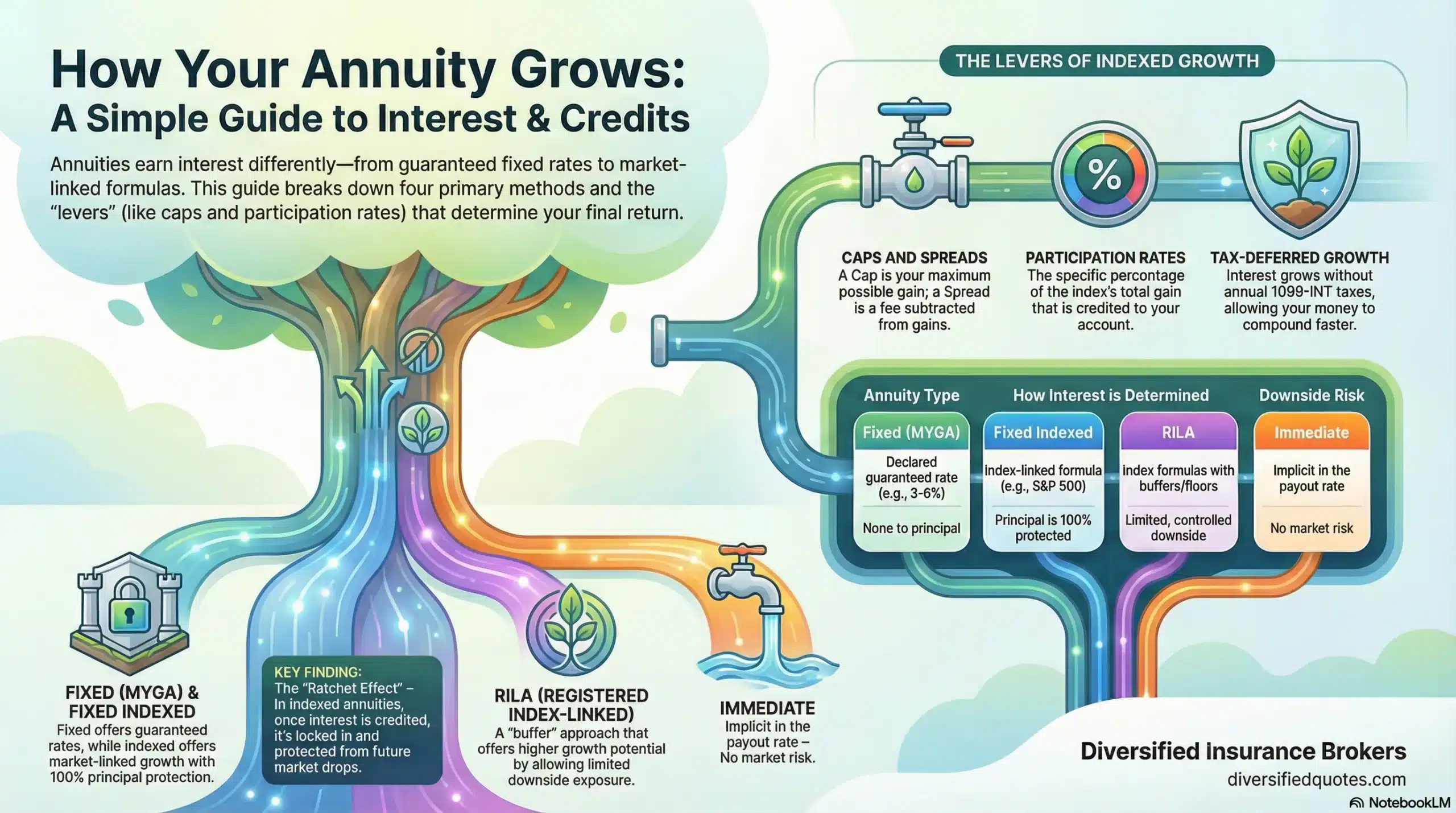
Talk to an Advisor or Request Your Annuity Quote
Ready to explore this annuity in more detail—or compare it with other carriers to see if even higher rates are available? With guaranteed income, principal protection, and long-term growth potential on the line, making the right choice is essential. The experienced advisors at Diversified Insurance Brokers will guide you through the options and design a strategy tailored to your retirement goals.
Schedule here:
calendly.com/jason-dibcompanies/diversified-quotes
Licensed in all 50 states • Fiduciary, family-owned since 1980
Frequently Asked Questions
Is NexHaven a better choice than a bank CD?
It depends on the rate after rider costs, how long the money can stay put, and how much weight you give to FDIC insurance versus an insurer’s guarantee. NexHaven offers tax deferral on non-qualified money, while a CD offers federal deposit insurance within limits. Our comparison of fixed annuities versus CDs lays out the trade-offs.
How is NexHaven interest taxed?
No tax is due on interest left inside the contract. After it is withdrawn from a non-qualified contract, it is generally taxed as ordinary income, with interest treated as leaving before premium, and taking taxable money out before 59 and a half generally adds a 10 percent penalty unless an exception applies. Our guide explaining how annuities are taxed covers the details.
Can I exchange an existing annuity into NexHaven?
Generally yes, through a tax-free exchange for non-qualified money or a direct transfer for IRA money, provided the receiving contract accepts it. Before moving, compare the old contract’s remaining charges and benefits with what NexHaven offers. Our explainer on how 1035 exchanges work walks through the process.
Does NexHaven work for IRA money subject to RMDs?
If NexHaven accepts your IRA money, plan carefully. Without the partial withdrawal rider there is no penalty-free withdrawal during a term, and even with it, the waiver covers only the first withdrawal each year after the first policy year. Make sure your required distributions can be met within those limits or from another account. The current requirements are summarized in required distributions after SECURE 2.0.
Can I roll a 401(k) into NexHaven?
Employer plan money is usually moved by direct rollover into an IRA annuity, which keeps it tax-deferred and avoids mandatory withholding. Confirm before applying that NexHaven accepts the account type you plan to use. Each step is described in moving a 401(k) into an annuity.
Can I leave NexHaven to a charity?
Annuity contracts generally allow a charity to be named as a beneficiary, which can be useful for money you intend to give away. Buyers who want lifetime payments and a charitable deduction now may prefer a different arrangement. That option is outlined in our explainer on how charitable gift annuities work.
How does NexHaven compare with other MYGAs?
The real comparison is the net rate after the riders you need, measured against contracts from insurers with stronger ratings for the same term. NexHaven’s strengths include issue ages from birth to 85 and the ability to pay only for chosen riders. For a market-wide view, see our list of the best MYGA annuity rates.
Is a B+ rated insurer safe for my savings?
B+ is a Good rating in AM Best’s terminology, but it is below the A-rated level many conservative buyers prefer. Sizing the amount sensibly, often within your state’s guaranty association limits, and comparing the rate premium you receive for the lower rating are both prudent steps. Our guide to fixed annuities for conservative investors covers higher-rated options.
Is NexHaven the same as NexAnnuity’s NexVantage MYGA?
No. Both are marketed under the NexAnnuity name, but NexHaven is issued by The Ohio State Life Insurance Company, while NexVantage is issued by a different insurer. The contracts have their own terms, ratings, and availability, so confirm which one your quote and application describe.
About the Author:
Jason Stolz, CLTC, CRPC, DIA, CAA and Chief Underwriter at Diversified Insurance Brokers (NPN 20471358), is a senior insurance and retirement professional with more than 25 years of real-world experience helping individuals, families, and business owners protect their income, assets, and long-term financial stability. As a long-time partner of the nationally licensed independent agency Diversified Insurance Brokers, Jason provides trusted guidance across multiple specialties—including fixed and indexed annuities, long-term care planning, personal and business disability insurance, life insurance solutions, Group Health, Travel Medical and Evacuation Insurance, and short-term health coverage. Diversified Insurance Brokers maintains active contracts with over 100 highly rated insurance carriers, ensuring clients have access to a broad and competitive marketplace.
His practical, education-first approach has earned recognition in publications such as VoyageATL, and contributions from his agency featured in Kiplinger and GoBankingRates— highlighting his commitment to financial clarity and client-focused planning. Drawing on deep product knowledge and years of hands-on field experience, Jason helps clients evaluate carriers, compare strategies, and build retirement and protection plans that are both secure and cost-efficient. Visitors who want to explore current annuity rates and compare options across multiple insurers can also use this annuity quote and comparison tool.
Explore More Annuity Options: Browse our complete guide to What Is a Fixed Annuity? — covering fixed annuities, MYGAs, laddering strategies & conservative growth options from 100+ carriers.
Last Reviewed: October 19, 2026 |
Reviewed by: Jason Stolz, CLTC, CRPC, DIA, CAA
Chief Underwriter, Diversified Insurance Brokers, Inc. | NPN: 20471358 | Diversified Insurance Brokers, Inc. — Licensed in all 50 states
Fact Checked by: Tonia Pettitt, CMIP©
Medicare Specialist, Diversified Insurance Brokers, Inc. | NPN: 14374308 | Diversified Insurance Brokers, Inc. — Licensed in all 50 states
Did you find this content helpful? Leave us a Google review — it helps others find trustworthy guidance too.
Editorial Standards: Diversified Insurance Brokers maintains rigorous editorial standards to ensure accuracy, clarity, and independence in all content. Learn more about our editorial standards and commitment to transparency.
