
Where to Buy an Annuity
As an Independent Annuity Broker, we compare rates across 100+ carriers and 1,000 different annuities— not just one company’s product offerings — to find the best fit for your goals.
Where to Buy an Annuity

Jason Stolz CLTC, CRPC, DIA, CAA
The best place to buy an annuity is a licensed, independent source that can compare contracts from many insurers, explain the trade-offs in plain language, and stay with you after the sale. That is the role Diversified Insurance Brokers is built to fill. You can buy an annuity from a bank, a captive agent, a brokerage firm, an online platform, or directly from some insurers, and every one of those channels can be legitimate. The difference is how many carriers you get to see, how the seller is paid, and whether anyone is looking out for the contract once it is issued. A family-owned independent brokerage licensed in all 50 states and representing more than 100 carriers, our office works with clients nationwide by phone and video, completes applications by electronic signature, and is paid by the insurance company rather than by you. This page explains each place you can buy an annuity, how to check any seller before you commit, and exactly how the process works when you buy through us.
Jason Stolz, CLTC, CRPC, DIA, CAA, is Chief Underwriter at Diversified Insurance Brokers, and our office places multi-year guaranteed annuities, fixed indexed annuities, and income annuities for clients across the country regularly. As an independent annuity broker with more than four decades in the insurance business, more than 40,000 clients served, and over 1,000 products available across our product lines, we compare annuities side by side from many carriers instead of steering every client to one company’s contract. That independence is what lets us show you the wider market before you choose.
Ready to compare annuities from more than 100 carriers?
Start My Annuity Quote
Where You Can Buy an Annuity: Your Options Compared
Each channel below can sell a legitimate annuity. The table shows how they differ in carrier choice, how the seller is paid, which products they usually offer, and what to watch for.
| Where You Buy | Carrier Choice | How the Seller Is Paid | Products Usually Offered | What to Watch For |
|---|---|---|---|---|
| Independent broker (such as our office) | Many carriers | Commission paid by the insurer | MYGAs, fixed indexed annuities, income annuities | Confirm licensing and how many carriers the broker actually represents |
| Captive agent | One company | Commission paid by the insurer | That company’s annuity lineup | No comparison with other carriers’ terms |
| Bank or credit union | A few carriers chosen by the bank | Commission to the bank’s insurance agency or licensed rep | Fixed and indexed annuities, sometimes variable | Annuities are not FDIC-insured bank products |
| Brokerage firm or financial advisor | Varies by firm | Commission or an ongoing advisory fee | Often variable annuities and RILAs, plus some fixed | Layered fees on variable contracts and advisory accounts |
| Directly from an insurer or online | One company, or several on a platform | Built into the insurer’s pricing | Mostly MYGAs and simple income annuities | Limited guidance on fit, replacement, and taxes |
| Employer retirement plan | Selected by the plan | Set by the plan’s arrangements | In-plan income options, where offered | Choices limited to what the plan provides |
Ensure you are receiving the absolute top rates
Current Fixed Annuity Rates
Compare today’s best fixed annuity rates from top carriers.
Current Bonus Annuity Rates
See which annuities offer the highest upfront bonus today.
Request an Annuity Quote
Submit our annuity request form to get personalized rate options.
Lifetime Income Calculator
Use our calculator to see how much guaranteed income your annuity can provide.
Why Diversified Insurance Brokers Is a Trusted Place to Buy an Annuity
Trust in an annuity purchase comes from three things: access to enough of the market to find the right contract, clarity about trade-offs, and someone accountable after the sale. Our office was built around all three. As a family-owned brokerage we have served clients for more than four decades, and we are licensed to help buyers in every state. Because we represent more than 100 insurance carriers, we can compare multi-year guaranteed annuities, fixed indexed annuities, and income annuities from many companies at once and show you how their rates, surrender schedules, withdrawal provisions, and carrier ratings line up. A captive agent can only show one company’s lineup, and a bank usually offers a short list chosen by the bank.
Independence also shapes the advice. Like most annuity agents, we are paid by commission, and commissions vary by product, which is why our comparison starts with your goal, your timeline, and the carrier’s financial strength, and why you see the competing options side by side rather than a single pick. Part of our job is to show where a contract fits and where it does not, including cases where an annuity is not the right tool. Our office focuses on the fixed side of the annuity market, so we do not sell variable annuities or registered index-linked annuities, which require a securities license; if one of those is what you need, we will say so. Whether you are moving a maturing CD, rolling over a retirement plan, or building guaranteed income, the relationship does not end when the contract is issued. Before a guarantee period ends, we send clients advance notice of the coming maturity and current options to compare, so the next decision is made with full information rather than by default.
How Buying an Annuity With Our Office Works
Buying an annuity through our office is designed to be simple and fully remote. It starts with a phone or video conversation about what the money needs to do, how long it can stay in place, where it is coming from, and how you want to be able to reach it. From there, we run quotes across our carriers for the annuity types that fit, and we walk you through the leading options side by side, including the declared rate or crediting terms, surrender schedule, free-withdrawal provision, market value adjustment if any, and the issuing carrier’s rating. In most states, the sale also includes a disclosure document and an annuity buyer’s guide that summarize the contract’s key terms, and reviewing quotes carries no obligation to buy.
Once you choose a contract, we complete the application with you and you sign it electronically, so there is no need to visit an office. Funding depends on the source. New savings can be sent directly to the insurer. IRA money moves by trustee-to-trustee transfer, and employer plan balances move by direct rollover, both of which avoid an accidental taxable distribution; our guide on transferring a retirement account to an annuity covers the paperwork. An existing non-qualified annuity can move to a new one through a tax-free exchange, and the rules for that are laid out in how 1035 exchanges work for annuity owners. Transfers can take several weeks depending on the institution releasing the money, and the contract is issued once the carrier receives the funds. After delivery, you can still review the contract during the free-look period and return it if it is not what you expected, and we remain your point of contact for questions.
What to Have Ready Before You Request a Quote
A few details make the first conversation faster and the quotes more accurate. The most important is the amount you plan to deposit, since many carriers price in bands and the deposit size can change the rate or the payout. Next is the source of the money: new savings, a maturing CD, an IRA, an employer plan, or an existing annuity, because each one is moved and taxed differently. Your timeline matters as well, including when you might need access to part of the money and when, if ever, you want income to begin. For income quotes, we need the birth dates of everyone who will receive payments, since payouts depend on age and on whether income covers one life or two.
If you already own an annuity that you are thinking about replacing, have a recent statement on hand showing the current value, surrender charges, and any income or death benefit features, so we can lay out the benefits and the costs of switching before anything changes. It also helps to know your state of residence, the beneficiaries you plan to name, and whether the money is meant for growth, income, or a specific future expense. You do not need every answer before reaching out; we can work through the open questions together on the first call.
How We Compare Annuities Across Carriers
A useful annuity comparison looks at far more than the headline number, and the factors that matter depend on the type of contract. For a MYGA, we line up the declared rate at your exact term and deposit size, because many carriers price in bands and a larger deposit can move you into a higher tier. Next to the rate, we compare the length and steepness of the surrender schedule, how much you can withdraw each year without a charge, whether that allowance starts in the first year, whether required minimum distributions are allowed without a charge, and whether a market value adjustment applies. A contract that pays slightly less but offers better access can be the stronger choice for a buyer who may need some of the money during the term.
For fixed indexed annuities, the comparison shifts to crediting terms, index choices, the length of the initial guarantee on caps and participation rates, and the carrier’s history of setting renewal terms after that period ends. When an income rider is involved, we compare the roll-up, the withdrawal percentage at your expected start age, and the annual rider fee together, since a generous roll-up paired with a low withdrawal percentage can produce less income than it appears. For income annuities, the comparison is the guaranteed payment itself, quoted for your age, start date, and payout option. Across every type, the comparison also covers the carrier’s financial strength rating, whether the product is approved in your state, and how long the carrier will hold a quoted rate while funds transfer. Seeing all of those factors side by side is what makes the final choice clear.
What It Costs to Buy an Annuity Through Our Office
Buying an annuity through our office does not add a fee to your purchase. We are paid a commission by the insurance company that issues the contract, and on the fixed, indexed, and income annuities we place, that commission is not deducted from your deposit, so the full premium goes into the contract. The insurer builds its distribution costs into the product’s pricing, which is one reason surrender charges exist during the early years of most contracts. In most cases, the same contract carries the same declared rate or crediting terms no matter which licensed agent sells it, so working with an independent broker generally does not cost more than buying the same product elsewhere. For a closer look at agent pay across insurance products, read whether using a broker costs more before you shop.
What can cost you money are the features inside the contract, and those should be understood before you sign. Surrender charges apply if you take out more than the free-withdrawal amount during the surrender period, and some contracts add a market value adjustment; our page on annuity surrender charges explained walks through how those schedules work. Optional riders, such as lifetime income riders or enhanced death benefits, usually carry an annual charge, while most MYGAs and basic income annuities have no annual fee at all. Our guide on whether annuities have fees lists the charges to look for by annuity type. When we present options, these costs are part of the comparison, so a contract with a slightly higher headline number but a costly rider is not mistaken for the better deal.
The Annuities We Help Clients Buy
Our office concentrates on the annuities most retirees and pre-retirees use for safety, growth, and income. Each type is built for a different goal, and the right one depends on what the money needs to do. If you are still deciding which type fits, our guide to the best annuities by retirement goal matches each goal with the annuity type that usually serves it best.
Multi-Year Guaranteed Annuities
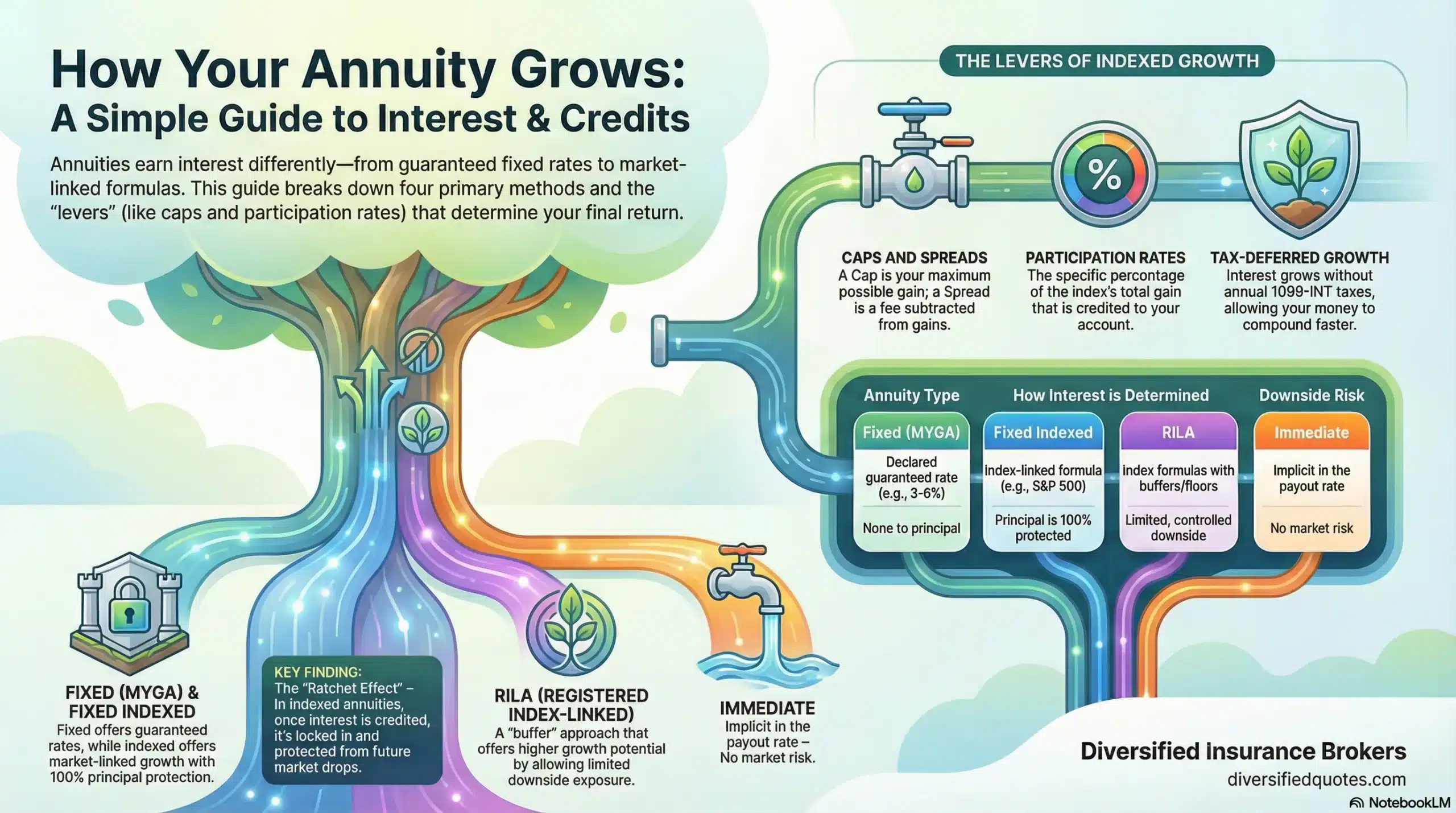
A multi-year guaranteed annuity locks a declared rate for a set guarantee period, so the ending value is known on the day the contract is issued, as long as no withdrawals are taken. MYGAs are a common choice for buyers moving money from CDs or savings who want a guaranteed result and no market exposure. Because MYGA pricing changes with interest rates and differs widely by carrier, term, and deposit size, comparing many carriers is where an independent broker adds the most value. Our page of today’s highest annuity rates shows current MYGA benchmarks by term, and we can confirm the live rate for your state and premium before you apply. We also look at the surrender schedule, the free-withdrawal provision, and the carrier’s rating alongside the rate, since the highest number is not always the best contract for the term you need.
Fixed Indexed Annuities
A fixed indexed annuity credits interest based on the movement of a market index, limited by a cap, participation rate, or spread, with a floor that keeps index losses from reducing your value. Buyers use FIAs for protected growth potential, and many add a lifetime income rider for future guaranteed income. FIAs vary widely in their crediting options, surrender lengths, bonuses, and rider costs, so a side-by-side comparison matters. We review the initial crediting terms, how the carrier has handled renewal rates, the index choices available, and any rider fees, and we explain which features add value for your goal and which only add cost. Because crediting terms are usually guaranteed only for an initial period, the carrier’s track record on renewals is part of the comparison, not an afterthought.
Immediate, Deferred, and QLAC Income Annuities
Income annuities turn a lump sum into guaranteed payments. A single premium immediate annuity starts income within about a year, a deferred income annuity starts it at a later date you choose, and a qualifying longevity annuity contract lets part of an IRA buy deferred income that can begin as late as age 85, within IRS limits; our page explaining what a QLAC is covers the rules. Payout amounts for the same premium can differ meaningfully from one carrier to the next and depend on your age, sex, the start date, and whether income covers one life or two. That is why we quote income annuities across multiple carriers for your exact situation and show the options for joint payouts, cash refund features, and period-certain guarantees before you choose.
Want to see which annuity type fits your goal?
Get Personalized Annuity Options
Buying an Annuity From a Bank or Credit Union
Many people first hear about annuities from their bank, often when a CD is maturing. Banks and credit unions usually sell annuities through an affiliated insurance agency or a third-party program, with licensed representatives offering a lineup chosen by the institution. The contracts are issued by insurance companies, not the bank, which means they are not bank deposits and are not covered by FDIC or credit union share insurance; the guarantees depend on the issuing insurer’s claims-paying ability. Buying at a bank can be convenient, especially if you already have a relationship there, but the carrier list is typically short, and the representative may not be able to show you how the bank’s offering compares with the wider market.
The most common situation is a saver comparing a renewing CD with a MYGA. The two are similar in structure, with a guaranteed rate for a fixed term, but they differ in insurance backing, tax treatment, and access. Interest on a non-qualified MYGA is tax-deferred until it is withdrawn, while CD interest is taxable each year, and earnings withdrawn from an annuity before age 59½ may face a 10% IRS additional tax; our article on the IRS early withdrawal penalty explains when that tax applies and when it does not. Our guide to how MYGAs compare to CDs walks through the full comparison. If your bank has offered an annuity, we are glad to compare that quote with offers from other carriers so you can see where it stands before you decide.
Buying From a Captive Agent or Directly From an Insurer
A captive agent works for, or sells exclusively for, a single insurance company. Captive agents can be knowledgeable and well trained, and if their company’s contract happens to be the best fit for your goal, buying through them can work well. The limitation is structural: a captive agent cannot show you a competing carrier’s rate, crediting terms, or income payout, so you would need to gather and compare those yourself. Some insurers also sell annuities directly, most often simple MYGAs and income annuities, through a website or a call center. Direct purchase can be quick for buyers who already know exactly what they want, but it usually means a single company’s products and limited guidance about fit, taxes, and the impact of replacing an existing contract.
Whichever route you take, the carrier’s financial strength matters as much as the terms it offers, because every guarantee depends on the insurer’s ability to pay. To read the letter grades correctly, see what an AM Best rating means for annuity buyers, and our library of insurance company reviews covers individual carriers in more detail. When you buy through an independent broker, the carrier comparison and the rating review happen together, so you can weigh a higher rate from one company against a stronger rating from another instead of seeing only one side of that trade-off.
Buying Through a Brokerage Firm or Financial Advisor
Brokerage firms and financial advisors are a common source of annuities, particularly for investors who already have an account there. Representatives at broker-dealers hold securities licenses, which allows them to sell variable annuities and registered index-linked annuities, both of which are securities products with market exposure. Some advisors also use advisory or fee-based annuities, which pay no commission but are held inside an advisory relationship that charges an ongoing fee, often as a percentage of assets. These channels make sense for buyers who want market-based annuities as part of a managed portfolio. The trade-off is cost: variable annuities carry insurance and fund charges, optional benefits add more, and an advisory fee on top of those can noticeably reduce long-term results.
Our office does not sell variable annuities or registered index-linked annuities. We focus on fixed, fixed indexed, and income annuities, where principal is not exposed to market losses and pricing differences among carriers are large enough that independent comparison pays off. If your goal is guaranteed growth, protected growth potential, or guaranteed lifetime income, those are the products we compare. If your goal calls for a variable product, a securities-licensed advisor is the right place to buy it, and knowing the difference before you shop helps you go to the right seller the first time.
Buying an Annuity Online
A growing number of people search for a place to buy an annuity online, and it is now common to compare quotes, review contracts, and sign applications without ever visiting an office. Online annuity marketplaces display rates from several carriers, and some insurers accept applications directly through their websites. Behind every legitimate online sale is still a licensed insurance agency, because annuities must be sold by an agent licensed in your state. The question is not whether to buy online but how much guidance comes with the purchase. A rate table alone does not tell you whether the term fits your timeline, whether a replacement makes sense, how the funding source affects taxes, or how a contract’s withdrawal provisions will work for you.
Our office combines the convenience of an online purchase with a conversation. You can request quotes through our website, review options with us by phone or video, and sign the application electronically, all from home. That remote process lets us work with buyers in every state, and it gives you someone to call when questions come up later, which an anonymous rate page cannot provide. If you prefer to research on your own first, the calculator and rate resources on this page are a good place to start, and you can contact us whenever you are ready to compare specific contracts.
Buying an Annuity Through an Employer Plan or the TSP
Some employer retirement plans now offer income options inside the plan, and federal employees and service members can buy a life annuity through the Thrift Savings Plan’s annuity provider. These in-plan options can be convenient because the money never leaves the plan, and they may be priced on a group basis. The trade-off is choice. The plan decides which insurer and which contract designs are available, so you cannot shop other carriers’ payouts, compare different guarantee structures, or pick features the plan does not include. Once a TSP annuity is purchased, or once in-plan income payments begin, the choice generally cannot be changed, so it is worth comparing before committing.
The alternative is to move eligible plan money to an IRA through a direct rollover and buy an annuity inside the IRA from the wider market. That route lets you compare income payouts, MYGAs, and fixed indexed annuities from many carriers, and it keeps the money tax-deferred when the rollover is done directly between institutions. Whether a rollover makes sense depends on what the plan offers, whether you are still working for the employer, any plan rules about partial withdrawals, and how the plan’s annuity compares with outside quotes for the same premium. We can run those outside quotes for your age and start date so you can compare them with the plan’s offer before deciding which route to take.
How to Verify Any Annuity Seller Before You Buy
Before buying an annuity from anyone, including our office, take a few minutes to confirm who you are dealing with. Start with licensing. Every state insurance department offers an online lookup that shows whether an agent or agency holds an active license, and the National Association of Insurance Commissioners recommends verifying the licensing of both the agent and the company in its consumer guide on how to choose an insurance agent. The same guide suggests checking complaints against the agent and the company, confirming the company’s financial rating, and asking what any professional designations after an agent’s name mean and how they were earned.
Next, look at the insurer behind the contract. Financial strength ratings from AM Best and other agencies, along with complaint data available through state regulators, show how a carrier compares with its peers. Ask the seller how many carriers they represent, how they are paid, and whether the contract they recommend replaces one you already own. Ask for the disclosure document and buyer’s guide, and read the surrender schedule and withdrawal provisions before signing. A trustworthy seller welcomes these questions. Our checklist of questions to ask when researching annuities covers what to ask about the contract itself, and the same questions work for any agent, broker, bank, or advisor you are considering.
Want an independent comparison before you buy?
Compare Annuity Options
Consumer Protections When You Buy an Annuity
Annuity buyers have meaningful protections no matter where they buy. Every state has adopted a best-interest standard for annuity recommendations, which requires the agent to act in the consumer’s best interest, consider the buyer’s financial situation and objectives, and disclose how the agent is paid and any material conflicts of interest. The insurer must also have procedures to review recommendations for suitability. Most states require that buyers receive a disclosure document and an annuity buyer’s guide, and replacements of existing contracts trigger additional forms and comparisons, because exchanging one annuity for another can restart a surrender schedule or give up benefits already earned.
After the contract is delivered, most annuities include a free-look period that gives you time to review the contract and cancel for a refund. The length is set by state law or by the contract and typically runs from about 10 to 30 days, with some states requiring longer periods for older buyers or for replacement contracts, so the exact period depends on where you live. Beyond the sale itself, the contract’s own provisions protect you as well. Some annuities include a bail-out provision that lets you leave without a surrender charge if the renewal rate drops below a stated level; the mechanics are covered in what an annuity bail-out provision is and when it applies. State guaranty associations provide a limited, last-resort safety net set by state law, but that coverage is not a reason to choose any product, and the issuing carrier’s financial strength remains the first line of protection.
Red Flags When Shopping for an Annuity
Certain patterns are worth recognizing when you shop for an annuity. Pressure to decide immediately is a classic red flag, since a legitimate seller will give you time to review quotes, disclosures, and the contract itself. Promises that sound too good to be true, such as market returns with no risk, a bonus with no trade-offs, or guaranteed income that ignores the cost of a rider, deserve close scrutiny. Be cautious of anyone who recommends replacing an existing annuity without showing you the surrender charges, lost benefits, and new surrender period involved, or who cannot explain why the new contract is better for you rather than for the seller.
Other warning signs include a seller who will not tell you how they are paid, who represents only one company but describes themselves as shopping the market, or who discourages you from asking questions or seeking a second opinion. Sales pitches built around state guaranty association coverage are another concern, since many states prohibit using that coverage as a selling point. Older buyers should also be wary of seminars or pitches that promise to help qualify for government benefits through an annuity purchase, because benefit rules, including VA pension rules, can treat certain asset transfers harshly. If something feels rushed or unclear, pause and get an independent review before signing anything.
Common Mistakes When Choosing Where to Buy an Annuity
The most common mistake is buying from the first place an annuity is offered, whether that is a bank branch during a CD renewal, a seminar, or a single company’s website, without seeing how the offer compares with the rest of the market. The second is focusing on one number. A top rate from a carrier with a weaker rating, a long surrender schedule, or a small free-withdrawal allowance may not be the best contract for your situation, and a large bonus on an indexed annuity is often offset by lower caps or a longer surrender period. Comparing the whole contract, not just the headline figure, avoids most regrets.
Other mistakes are about timing and fit. Placing emergency money or funds needed within a year or two into an annuity can lead to surrender charges when the money is needed. Choosing a term longer than your actual timeline creates the same problem later. Replacing an existing annuity too soon can restart a surrender schedule and give up benefits already earned, so any replacement should be justified in writing. Funding mistakes also happen, such as taking a 401(k) distribution personally instead of using a direct rollover, which can trigger withholding and a 60-day deadline. Finally, some buyers never confirm whether a product is approved in their state until late in the process. Working through these points with an experienced broker before applying keeps the purchase on track.
After You Buy: Service That Continues
An annuity can last five, ten, or twenty years or more, so the relationship with the person who sold it matters long after the application is signed. Through the contract’s life, questions come up about free withdrawals, required minimum distributions, beneficiary changes, and what to do as the guarantee period nears its end. Our office remains your point of contact for those questions. One part of that service is specific: before a guarantee period ends, we send clients advance notice of the coming maturity along with current options to compare, so the decision to renew, move, or take income is made with up-to-date information rather than by default.
Planning also changes over time. A contract bought for growth may later need to provide income, money set aside for a known expense may no longer be needed for that purpose, and tax rules or family circumstances can shift. When those changes happen, we can review the contract’s options, explain what the free-withdrawal provision, surrender schedule, and any income or death benefit features allow, and compare alternatives when a change makes sense. Having someone who knows the contract and the market in one place makes those decisions easier than starting over with a new seller each time.
Matching Where You Buy to What You Need
The right place to buy an annuity follows from the job the annuity needs to do. If you are replacing a maturing CD and want a guaranteed rate for a few years, the decision comes down to comparing MYGA rates, terms, and carrier strength, which is where shopping many carriers makes the biggest difference. If you are rolling over a 401(k) or IRA near retirement, you also need help with the transfer mechanics, the tax treatment, and how required minimum distributions will work inside the contract. If you want guaranteed lifetime income, you need payout quotes from several insurers for your exact age and start date, along with a clear explanation of joint, refund, and period-certain options.
If you want market-based investments inside an annuity, a securities-licensed advisor is the right channel. If you only need a single, simple contract and already know exactly which one you want, buying direct can work. For most retirees and pre-retirees whose goal is safety, guaranteed growth, protected growth potential, or lifetime income, an independent broker who compares fixed, indexed, and income annuities from many carriers covers the widest range of needs in one place. Many households end up pursuing more than one of these goals at once, such as a MYGA for money needed in a few years and an income annuity for essential bills, and buying both through the same office keeps the plan coordinated and the paperwork simple.
Is Buying Through an Independent Broker Right for You?
Buying through an independent broker is a strong fit if you want to see more than one company’s contracts, value a comparison that weighs rate, terms, and carrier strength together, and prefer the convenience of working by phone and video from home. It suits savers moving money from CDs or retirement plans, retirees who want guaranteed income and need payout quotes across several insurers, and anyone who wants an ongoing point of contact through the life of the contract. Because our office is paid by the insurer and adds no fee to your purchase, the comparison costs nothing to request.
An independent broker focused on fixed annuities is not the right fit for everyone. If you want a variable annuity or a registered index-linked annuity, you need a securities-licensed advisor. If you want all of your investments managed under one advisory fee, a fee-based advisor may suit you better. And if the money may be needed within a short time or is your emergency fund, an annuity may not be the right tool at all. Answering those questions first makes it clear where to buy. When the goal is guaranteed growth, protected growth potential, or lifetime income from a fixed or indexed contract, an independent comparison across many carriers is a practical way to compare contracts and find the right fit.
Ready to buy an annuity with a trusted independent broker?
Request My Annuity Quote
Financial Protection Essentials
More planning resources for protecting income, savings, and family in retirement.
Talk With an Advisor Today
Choose how you’d like to connect—call or message us, then book a time that works for you.
Schedule here:
calendly.com/jason-dibcompanies/diversified-quotes
Licensed in all 50 states • Fiduciary, family-owned since 1980
Frequently Asked Questions
Where is the best place to buy an annuity?
For most buyers, the best place to buy an annuity is a licensed independent broker who represents many insurance carriers, because that is the channel built to compare rates, terms, and carrier ratings from several companies in one conversation. Banks, captive agents, brokerage firms, and some insurers’ websites also sell annuities, but each tends to show a narrower slice of the market. Our office represents more than 100 carriers, works with clients in all 50 states, and focuses on fixed, fixed indexed, and income annuities. Our guide to getting an annuity for retirement income walks through the buying steps from start to finish.
Is it better to buy an annuity from a bank or an independent broker?
Both can sell legitimate contracts, but they differ in choice. A bank usually offers annuities from a few carriers it has selected, sold through an affiliated insurance agency, while an independent broker can compare contracts across many insurers. Annuities bought at a bank are still insurance products, so they are not bank deposits and are not FDIC-insured. If your bank has offered an annuity, comparing that quote with the wider market before you sign is a simple way to confirm it is competitive. Our comparison of fixed annuities versus bank CDs also helps if you are weighing an annuity against a renewing CD.
Can I buy an annuity directly from an insurance company?
Some insurers sell annuities directly, usually simple MYGAs or income annuities, through a website or a call center staffed by licensed representatives. Buying direct can be quick when you already know exactly what you want, but you see only that company’s products and typically receive limited guidance on fit, taxes, or replacing an existing contract. Through an independent broker, you buy the same kind of contract from the insurer, while also seeing how it compares with other carriers. Whichever route you choose, the guarantees depend on the issuing insurer, as our page on how annuity guarantees work explains.
How do I know an annuity seller is trustworthy?
Start by confirming the agent’s and agency’s licenses through your state insurance department’s online lookup, then check for complaints against the agent and the insurance company. Ask how many carriers the seller represents, how they are paid, and whether the recommended contract would replace one you already own. Review the carrier’s financial strength rating, and ask for the disclosure document and buyer’s guide before signing. A trustworthy seller gives you time to decide and answers these questions without hesitation. To see how our office approaches accuracy and disclosure, read our editorial standards and credentials.
Does it cost more to buy an annuity through an independent broker?
Generally, no. Our office is paid a commission by the insurer that issues the contract, and we charge no separate fee to the client. On the fixed, indexed, and income annuities we place, that commission is not deducted from your deposit, so the full premium goes into the contract. In most cases, a given contract carries the same declared rate or crediting terms no matter which licensed agent sells it, so buying through an independent broker typically does not cost more than buying the same product elsewhere. The costs to understand are inside the contract itself, such as surrender charges, any market value adjustment, and fees for optional riders.
Can I buy an annuity from your office if I don’t live near Georgia?
Yes. Although our office is based in Suwanee, Georgia, we are licensed in all 50 states and work with clients nationwide by phone and video. Quotes, contract reviews, and questions are handled remotely, and applications are signed electronically, so there is no need to visit an office at any point. Funding is handled directly between your current institution and the insurance company, whether the money comes from savings, a maturing CD, an IRA transfer, an employer plan rollover, or an exchange from an existing annuity. Product availability can vary by state, so it is important to confirm that any contract quoted is approved where you live before you apply, and we can check that for you.
Can I use my 401(k) or IRA to buy an annuity?
Yes. IRA money can move into an IRA annuity through a trustee-to-trustee transfer, and a 401(k) or other employer plan balance can move through a direct rollover, which keeps the money tax-deferred without creating a taxable distribution. The annuity is then held as an IRA. In a traditional IRA, withdrawals are taxed as ordinary income and required minimum distributions apply, while a Roth IRA follows Roth rules, so for traditional IRA money it is worth confirming that the contract allows RMD withdrawals without a surrender charge. Avoid having a plan distribution paid to you personally, which can trigger withholding and a 60-day deadline. Our guide to the best annuities for 401k rollovers compares options for plan money.
How much money do I need to buy an annuity?
Minimum deposits are set by each contract and vary widely, and some products pay higher rates once a deposit reaches a larger band. The more useful question is how much of your savings belongs in an annuity at all. Money you may need for emergencies or near-term expenses usually belongs somewhere with full access, while money set aside for guaranteed growth or income can go into an annuity whose term matches your timeline. For income annuities, the deposit needed depends on how much monthly income you want, your age, and when payments start. Our immediate annuity calculator tool estimates how much income a given deposit could buy.
What happens if I change my mind after buying an annuity?
Most annuities include a free-look period after delivery, set by state law or by the contract and typically ranging from about 10 to 30 days, during which you can cancel the contract and receive a refund. Some states require longer periods for older buyers or for contracts that replace an existing annuity. After the free-look period ends, you can still access money through the contract’s free-withdrawal provision, which often allows a percentage of the value each year without a surrender charge. Withdrawing more than that amount during the surrender period can trigger charges. For details on those allowances, see annuity free withdrawal rules and how they apply.
How can I get annuity quotes from multiple carriers?
The simplest way is to work with an independent broker who can run the same request across many insurers at once. For a MYGA, that means comparing declared rates, surrender schedules, and withdrawal provisions at the same term and deposit size. For an income annuity, it means quoting guaranteed payments for your exact age, start date, and payout option, since results can differ meaningfully from one carrier to the next. You can request quotes through our website or by phone, and we review the leading options with you before you decide. Our page on lifetime income annuity quotes explains what goes into an income quote.
About the Author:
Jason Stolz, CLTC, CRPC, DIA, CAA and Chief Underwriter at Diversified Insurance Brokers (NPN 20471358), is a senior insurance and retirement professional with more than 25 years of real-world experience helping individuals, families, and business owners protect their income, assets, and long-term financial stability. As a long-time partner of the nationally licensed independent agency Diversified Insurance Brokers, Jason provides trusted guidance across multiple specialties—including fixed and indexed annuities, long-term care planning, personal and business disability insurance, life insurance solutions, Group Health, Travel Medical and Evacuation Insurance, and short-term health coverage. Diversified Insurance Brokers maintains active contracts with over 100 highly rated insurance carriers, ensuring clients have access to a broad and competitive marketplace.
His practical, education-first approach has earned recognition in publications such as VoyageATL, and contributions from his agency featured in Kiplinger and GoBankingRates— highlighting his commitment to financial clarity and client-focused planning. Drawing on deep product knowledge and years of hands-on field experience, Jason helps clients evaluate carriers, compare strategies, and build retirement and protection plans that are both secure and cost-efficient. Visitors who want to explore current annuity rates and compare options across multiple insurers can also use this annuity quote and comparison tool.
Explore More Annuity Options: Browse our complete guide to Choosing & Buying an Annuity — covering how to choose, compare & buy the right annuity from 100+ carriers.
Last Reviewed: November 14, 2026 |
Reviewed by: Jason Stolz, CLTC, CRPC, DIA, CAA
Chief Underwriter, Diversified Insurance Brokers, Inc. | NPN: 20471358 | Diversified Insurance Brokers, Inc. — Licensed in all 50 states
Fact Checked by: Tonia Pettitt, CMIP©
Medicare Specialist, Diversified Insurance Brokers, Inc. | NPN: 14374308 | Diversified Insurance Brokers, Inc. — Licensed in all 50 states
Did you find this content helpful? Leave us a Google review — it helps others find trustworthy guidance too.
Editorial Standards: Diversified Insurance Brokers maintains rigorous editorial standards to ensure accuracy, clarity, and independence in all content. Learn more about our editorial standards and commitment to transparency.
