
F&G Safe Income Advantage Annuity – Built-In Income and Health-Based Multipliers
F&G Safe Income Advantage Annuity – Built-In Income and Health-Based Multipliers
At Diversified Insurance Brokers, we specialize in helping individuals secure guaranteed lifetime income, tax-deferred growth, and protection from market downturns through customized annuity strategies built around real retirement goals. The Safe Income Advantage Fixed Indexed Annuity, issued by Fidelity & Guaranty Life Insurance Company (F&G), is designed for retirees and pre-retirees who want dependable income with built-in safeguards for health-related events later in life. In today’s retirement environment, volatility, longevity risk, inflation, and long-term care exposure are all legitimate concerns. Many investors are discovering that relying solely on market-based withdrawals from IRAs or brokerage accounts introduces unnecessary risk — especially during the first decade of retirement when sequence-of-returns risk can permanently reduce portfolio sustainability. The Safe Income Advantage addresses these concerns by combining principal protection with indexed growth potential and an automatically included Enhanced Guaranteed Minimum Withdrawal Benefit (EGMWB) rider. If you are still evaluating whether annuities belong in your retirement strategy, you may also want to review Are Annuities Worth It? and Are Annuities a Good Investment in Retirement? to better understand how income annuities compare to traditional portfolio drawdown approaches.

Ensure you are receiving the absolute top rates
Current Fixed Annuity Rates
Compare today’s best fixed annuity rates from top carriers.
Current Bonus Annuity Rates
See which annuities offer the highest upfront bonus today.
Request an Annuity Quote
Submit our annuity request form to get personalized rate options.
Lifetime Income Calculator
Use our calculator to see how much guaranteed income your annuity can provide.
F&G Safe Income Advantage Fixed Indexed Annuity: Key Product Features at a Glance
| Product Feature | Details |
|---|---|
| Issuing Carrier | Fidelity & Guaranty Life Insurance Company (F&G), Des Moines, Iowa. Founded 1959. AM Best: A (Excellent), 3rd highest of 13, rated March 2025. S&P: A-. Majority-owned by Fidelity National Financial (FNF Group); Blackstone serves as investment manager. Over $59 billion in total assets (December 31, 2024); $73+ billion AUM before flow reinsurance (2025). One of the fastest-growing annuity carriers in the United States. Available in all 50 states and the District of Columbia. Not FDIC insured. All guarantees backed by claims-paying ability of Fidelity & Guaranty Life Insurance Company. |
| Product Type | Flexible-premium deferred fixed indexed annuity (FIA). Additional premiums of at least $2,000 accepted at any time before the maturity date and before income election. Maximum total premium: $2,000,000. Issue ages: non-qualified 0–80; qualified 18–80. EGMWB rider included at no additional charge. Principal protected from negative index performance. Tax-deferred growth. 10-year surrender period. Not a direct market investment. Not FDIC insured. |
| Minimum Premium | $10,000 initial minimum. Additional premium payments accepted (minimum $2,000 per payment) at any time prior to maturity date and before income election. Minimum allocation to any index account is $2,000 per contract year. |
| Surrender Charge Period | 10-year surrender period. Surrender charges: 9%, 9%, 8%, 7%, 6%, 5%, 4%, 3%, 2%, 1% (declining annually). MVA also applies to excess withdrawals during the surrender period. Surrender charges and MVA are waived for RMDs, terminal illness, nursing home confinement, and home health care qualifying events after the first contract year. |
| EGMWB Rider — Built In, No Added Cost | Enhanced Guaranteed Minimum Withdrawal Benefit (EGMWB) rider automatically included at issue at no additional charge. Creates a separate income base that grows at a guaranteed 7.2% compound annual roll-up rate for up to 10 years or until the owner reaches age 85 — whichever comes first. The income base doubles in approximately 10 years with no withdrawals. Roll-up continues as long as no withdrawals are taken; guaranteed minimum roll-up rate is 3% even on contract restart. The income base grows by the greater of the guaranteed roll-up or indexed performance, subject to contract terms. The income base is not the contract value — it is the calculation base for lifetime withdrawals. |
| Lifetime Income Calculation | The Lifetime Annual Withdrawal amount = Lifetime Withdrawal Percentage × Income Base at activation. Withdrawal percentages are age-based and gender-neutral. At age 70 with 10 years of deferral, the current lifetime withdrawal rate is approximately 7.9% of the income base. Withdrawals continue for life even if the contract value reaches zero due to withdrawals. |
| Impairment Multiplier Benefit | Included in the EGMWB rider at no additional charge. If the owner is unable to perform two or more of the six Activities of Daily Living (ADLs: Bathing, Dressing, Eating, Continence, Toileting, Transferring) for at least 60 consecutive days with the expectation the condition will continue at least 90 days, income payments can double for up to five years. Available in California (a distinguishing feature — many competing ADL-based income doublers are not available in CA). Requires physician documentation. Qualifying condition must begin after contract issue. |
| Free Withdrawal Provision | Beginning in year 2: up to 10% of the total account value annually without surrender charges or MVA. Year 1: no standard free withdrawal provision. Excess withdrawals above 10% are subject to surrender charges and MVA. Note: withdrawals from the contract value before or during income phase reduce the income base — excess withdrawals in the income phase reduce future lifetime income proportionally. |
| Health Event Waivers | Three no-cost waivers after the first contract year (waive surrender charges and MVA): Nursing Home Waiver — confined to qualified nursing home for at least 60 consecutive days; Terminal Illness Waiver — prognosis of 12 months or less; Home Health Care Waiver — unable to perform two of six ADLs for at least 60 days, expected to continue at least 90 days. The Home Health Care Waiver is uncommon among competing income FIAs and allows penalty-free contract value access for ADL impairment before income is activated. RMD Waiver also included. All require physician documentation. |
| Index Crediting Strategies | S&P 500 (annual point-to-point with cap); Balanced Asset 5 Index (CIBC; no cap or spread; participation rates 80–130%; note: 0.85% daily maintenance fee deducted from index level reduces effective returns); BlackRock Market Advantage Index (50–70% participation). Fixed interest account available. Annual reset locks in credited interest. In negative index periods, credited interest is 0% — no loss of principal due to market performance alone. The income base grows by the greater of the guaranteed roll-up or index performance; the contract value grows only through actual index credits. |
| Death Benefit | Death benefit equals the contract value, subject to withdrawals and contract terms. No surrender charges at death. Beneficiaries receive the contract value — not the income base. Beneficiary designations allow assets to pass outside of probate in most cases when properly completed. |
| Tax Treatment | Interest grows tax-deferred until withdrawal. Non-qualified: LIFO taxation. Qualified accounts: full distributions taxed as ordinary income. Withdrawals before age 59½ subject to 10% IRS early withdrawal penalty. An annuity inside a qualified plan provides no additional tax deferral. Not FDIC insured. |
About Fidelity & Guaranty Life Insurance Company
Fidelity & Guaranty Life Insurance Company (F&G) was founded in 1959, is headquartered in Des Moines, Iowa, and has grown into one of the fastest-growing fixed annuity carriers in the United States. F&G holds an AM Best A (Excellent) Financial Strength Rating (3rd highest of 13, affirmed March 2025) and an S&P A- rating. The company is majority-owned by Fidelity National Financial (FNF Group), a Fortune 500 title-insurance company that acquired F&G in 2020 and re-listed it on the NYSE in 2022. Blackstone serves as F&G’s investment manager — not as the equity owner, a distinction that is frequently confused. The Blackstone investment management relationship is part of why F&G has been able to grow rapidly and offer competitive crediting rates, but all guarantees are backed by F&G’s own claims-paying ability, not Blackstone’s balance sheet. With over $59 billion in total assets and $73+ billion in AUM before flow reinsurance, F&G is a materially larger carrier than many competing income FIA issuers and has demonstrated consistent growth across its annuity product lineup. For a full carrier evaluation, our resource on whether F&G is a good insurance company is already linked above — first and only use of that URL on this page.
The EGMWB Rider: A 7.2% Compound Roll-Up Built In at No Added Cost
The cornerstone of the Safe Income Advantage is the Enhanced Guaranteed Minimum Withdrawal Benefit (EGMWB). Unlike optional riders that increase cost and complexity, this benefit is automatically included at issue — simplifying planning and eliminating the annual rider fee drag that competes with accumulation value growth on most income FIAs. The rider creates an income base that grows at a guaranteed 7.2% compound annual rate for up to 10 years or until age 85. Because it is compound interest, the income base roughly doubles in 10 years with no withdrawals — regardless of what markets do. The income base can also grow by the greater of the guaranteed 7.2% rate or indexed performance, subject to contract terms, meaning strong index crediting years can produce above-guaranteed income base growth. For retirees who want clarity around how guaranteed withdrawal riders function, reviewing How Does a GLWB Work? provides additional technical insight into lifetime income mechanics.
The 7.2% compound roll-up is one of the highest guaranteed compound rates among income FIAs from A-rated carriers. For comparison: the North American Income Pay Pro offers 8% compound but charges 1.15% annually; the Corebridge Power 10 Protector Plus Income offers 9% simple roll-up with a ~1.10% annual charge; the Midland National IncomeVantage Pro includes a no-charge GLWB but uses a market-linked benefit base growth formula rather than a fixed roll-up. The Safe Income Advantage’s no-additional-cost structure preserves the accumulation value more effectively in zero-credit years — when many competitors are still deducting 1.10%–1.25% from the contract value for their income riders.
The Impairment Multiplier and Three No-Cost Health Event Waivers
Another defining feature is the Impairment Multiplier Benefit. Long-term care remains one of the largest financial risks in retirement, and many individuals either cannot qualify for traditional long-term care insurance or are uncomfortable with use-it-or-lose-it standalone policies. The Impairment Multiplier allows income payments to double for up to five years if the owner meets qualifying criteria: unable to perform two or more of the six Activities of Daily Living for at least 60 consecutive days, expected to continue at least 90 days. This feature is notably available in California — where several competing ADL-triggered income doublers are not available, including the Income Enhancement Benefit on the Forethought Income 150+ SE. Physician documentation is required. If you are researching alternatives to traditional policies, you may also explore Short-Term Care Insurance Alternatives to understand how annuity-based solutions compare. While this is not a replacement for comprehensive LTC insurance, it can meaningfully offset care costs within the simplicity of a single contract.
Beyond the Impairment Multiplier on income payments, the Safe Income Advantage includes three no-cost contract-level health event waivers that remove surrender charges and MVA — giving access to the full contract value penalty-free. The Nursing Home Waiver applies after 60 consecutive days of qualified confinement after year one. The Terminal Illness Waiver applies upon a 12-month or less prognosis after year one. The Home Health Care Waiver — uncommon among income FIAs — applies when the owner is unable to perform two of six ADLs for at least 60 days, expected to continue 90 days, and provides penalty-free contract value access outside a nursing facility setting. This trio of waivers creates a more comprehensive health safety net than most competing income FIAs that include only nursing home and terminal illness waivers. All waivers require physician documentation, waive surrender charges and MVA, and apply after the first contract year.
Growth Strategies, Tax Deferral, and the Balanced Asset 5 Index
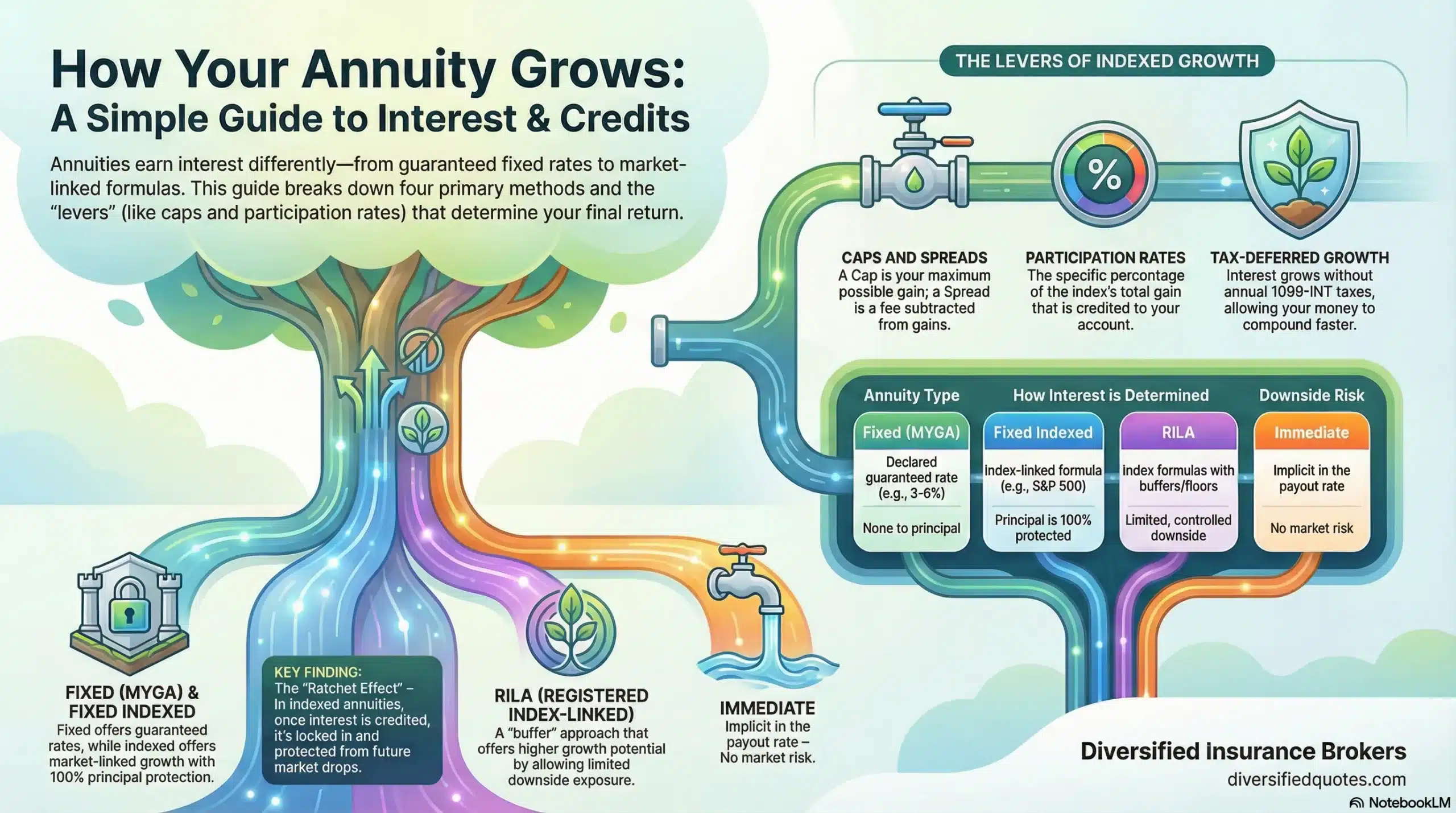
The Safe Income Advantage offers multiple indexing strategies designed to balance upside opportunity with risk controls. Available options include the Balanced Asset 5 Index (CIBC), the BlackRock Market Advantage Index, and the S&P 500, each providing performance-linked crediting without exposing principal to direct market losses. Because this is a fixed indexed annuity, your original premium is not invested directly in equities — instead, interest credits are calculated based on index performance subject to caps, spreads, or participation rates. Market downturns do not reduce your contract value due to negative index performance.
The Balanced Asset 5 Index deserves explicit disclosure: it carries a 0.85% annual maintenance fee deducted daily from the index level. This fee reduces the net credited interest compared to the raw index return. The Balanced Asset 5 Index uses CIBC’s methodology and offers participation rates of 80–130% — meaning after the fee reduction, the actual credited interest can still be competitive in strong market environments. The BlackRock Market Advantage Index offers 50–70% participation. Both are volatility-controlled strategies designed to smooth return profiles compared to uncontrolled benchmarks. Performance-trigger crediting options within these strategies may also allow for interest credits in flat or slightly negative markets. For clients asking Can You Lose Money in an Annuity? — with fixed indexed structures like this one, market downturns do not reduce contract value through index losses. Tax deferral further enhances compounding: earnings are not taxed until withdrawn, allowing interest to compound without annual tax drag. For individuals repositioning retirement funds, understanding how annuities integrate with qualified plans is covered in What Is an IRA Annuity?
Liquidity, Free Withdrawals, and Who This Product Fits Best
Liquidity is built into the contract through the 10% annual free withdrawal provision beginning in year 2, three no-cost health event waivers, and the RMD waiver for qualified accounts. Like many income-focused annuities, the Safe Income Advantage permits penalty-free withdrawals under qualifying health circumstances after year one. To better understand how surrender schedules and withdrawal allowances operate, review Annuity Free Withdrawal Rules. Note that year 1 has no standard free withdrawal provision — buyers who anticipate needing access in the first 12 months should maintain adequate liquid assets outside the contract.
The Safe Income Advantage is particularly well-suited for pre-retirees and retirees who want to create a retirement income floor — combining Social Security benefits with guaranteed annuity income so essential living expenses are covered without relying on unpredictable market withdrawals. It can also be relevant for individuals in good health today who want protection in case their health changes (via the Impairment Multiplier and Home Health Care Waiver), and for retirees repositioning IRA or 401(k) assets into predictable lifetime income. For those comparing this product against other carriers, reviewing Is Delaware Life a Good Company? or exploring Today’s Best Annuity Rates and Highest Guaranteed Annuity Rates can help contextualize how this contract compares across the broader marketplace. Every annuity differs in roll-up rates, caps, multipliers, rider costs, and crediting strategies — so side-by-side evaluation is critical.
For families concerned about legacy planning, the Safe Income Advantage includes standard annuity death benefit provisions ensuring beneficiaries receive the contract value, subject to withdrawals and contract terms. Understanding beneficiary mechanics is essential in retirement income planning, and additional guidance is available at Annuity Beneficiary Death Benefits.
Related Pages
Explore additional annuity education and retirement income planning resources.
Financial Protection Essentials
Insurance planning resources covering post-surgery underwriting, retirement income planning, and conservative annuity strategies.
Talk to an Advisor or Request Your Annuity Quote
Ready to explore this annuity in more detail—or compare it with other carriers to see if even higher rates are available? With guaranteed income, principal protection, and long-term growth potential on the line, making the right choice is essential. The experienced advisors at Diversified Insurance Brokers will guide you through the options and design a strategy tailored to your retirement goals.
Schedule here:
calendly.com/jason-dibcompanies/diversified-quotes
Licensed in all 50 states • Fiduciary, family-owned since 1980
FAQs: F&G Safe Income Advantage Fixed Indexed Annuity
How does a 7.2% compound roll-up at no charge compare to competing products that charge for their riders?
The Safe Income Advantage’s EGMWB rider grows the income base at a guaranteed 7.2% compound annual rate at no additional cost to the contract owner. To understand the real-world advantage this creates, consider the standard alternatives: the North American Income Pay Pro charges 1.15% of the GLWB value annually for its 8% compound roll-up; the Corebridge Power 10 Protector Plus Income charges approximately 1.10% for a 9% simple roll-up; the American Equity IncomeShield 10 charges approximately 1.20% for its IAV roll-up structure. On a $200,000 contract with an income base growing to $300,000 after several years, a 1.15% annual charge on that income base equals approximately $3,450 per year — deducted from the accumulation value regardless of whether the indexed strategies credit any interest. In a zero-credit year, competing products take that fee hit while the Safe Income Advantage does not reduce the accumulation value by any rider fee. Over a 10-year deferral period, the cumulative impact of no rider fee on the accumulation value can be meaningful. The trade-off, as with the MNL IncomeVantage Pro (also a no-charge built-in GLWB), is that the income crediting rates and contract crediting terms may reflect the embedded cost of the income rider guarantee — the cost is in the product economics rather than as a visible annual deduction. A personalized side-by-side income illustration comparing the Safe Income Advantage against charged-rider competitors at your specific premium, age, and deferral period is the most reliable basis for determining which structure produces the better net outcome.
What makes the Home Health Care Waiver unusual, and how does it differ from the Impairment Multiplier?
The Safe Income Advantage includes three distinct health event provisions — and understanding how they differ is essential for retirement planning. The Home Health Care Waiver is a contract-level waiver: it waives surrender charges and MVA so the owner can access up to 100% of the contract value without penalty when they are unable to perform two of six ADLs for at least 60 days (expected to continue 90 days) after the first contract year. This waiver provides penalty-free access to the accumulation value — the actual cash in the contract — in situations where the owner needs to access the full lump sum to pay for care. The Home Health Care Waiver is uncommon among income FIAs: most competing products include only nursing home confinement and terminal illness waivers that typically require formal nursing facility confinement. The fact that the Home Health Care Waiver applies to ADL impairment outside a nursing facility — including home care or assisted living scenarios — is a meaningful structural advantage. The Impairment Multiplier, by contrast, is an income-phase provision: it does not provide access to the contract value; instead, it doubles the guaranteed GLWB income payment for up to five years when the same ADL-impairment criteria are met. These are two separate financial functions. The waiver protects penalty-free contract exit; the multiplier enhances ongoing income. A retiree who activates the Impairment Multiplier continues receiving twice their normal guaranteed income for up to five years — they do not simultaneously trigger a surrender or access the full contract value. A retiree who uses the Home Health Care Waiver accesses the full contract value but terminates the GLWB income structure in that scenario. Understanding which provision is appropriate for a given health event requires understanding which financial need is being addressed: income supplementation or lump-sum access.
Why is there no standard free withdrawal in year 1, and how does this affect planning?
The Safe Income Advantage’s 10% annual free withdrawal provision begins in year 2 — not year 1. In the first contract year, there is no standard penalty-free withdrawal option available other than through qualifying waiver provisions. This is more restrictive than the North American Income Pay Pro, which allows 10% free withdrawals from year one, and is consistent with the Aspida Synergy Choice Income (also begins year 2). The first-year restriction means buyers who anticipate needing any access to their funds within the first 12 months should ensure adequate liquid assets are maintained outside the contract before funding. The one practical exception: the three health event waivers (nursing home confinement, terminal illness, home health care) each waive surrender charges and MVA after the first contract year — year 1 is explicitly excluded from all waivers as well, meaning even qualifying health events in the first 12 months do not trigger penalty-free access. This is a stricter first-year provision than most competing income FIAs, and it reinforces that the Safe Income Advantage is intended for long-term income planning — not as a liquid asset or short-term reserve. Buyers who fund the contract with full awareness that year 1 is fully locked (outside of surrender for a loss) and who maintain adequate external liquidity will not encounter this limitation in practice.
What is the Balanced Asset 5 Index, and how does the 0.85% daily maintenance fee affect credited interest?
The Balanced Asset 5 Index is a proprietary volatility-controlled index administered by Canadian Imperial Bank of Commerce (CIBC) and maintained by Bloomberg Finance L.P. It targets a 5% volatility level, using a balanced asset allocation that shifts between equity and lower-volatility components based on prevailing market conditions. Participation rates on this strategy are higher than many other indexed strategies available in the FIA market — ranging from 80–130% — because the embedded 0.85% annual maintenance fee (deducted daily from the index level) partially funds those higher rates. The 0.85% daily-accruing fee is important to understand: it reduces the net level of the index compared to what its components would otherwise produce. A participation rate of 100% on the Balanced Asset 5 Index does not mean you receive 100% of the raw underlying portfolio return — you receive 100% of the return after the 0.85% annual fee has already been deducted from the index level. In practice, this means evaluating Balanced Asset 5 Index credited interest requires looking at the net return (after the fee) multiplied by the participation rate — not the headline participation rate alone. In strong market environments where the underlying components generate meaningful positive returns, the high participation rate can produce competitive credits even after the fee. In flat or modestly positive environments, the 0.85% fee reduces the net index return to a level where credits may be modest. As with all proprietary volatility-controlled index strategies, a multi-scenario analysis of historical credited interest across different market environments — not just the headline participation rate — is the appropriate evaluation tool before committing allocation to the Balanced Asset 5 Index.
How does the Safe Income Advantage compare to the Forethought Income 150+ SE and other income FIAs?
The Safe Income Advantage and the Forethought Income 150+ SE are both income-focused FIAs that include the income rider at no additional charge and feature an ADL-triggered income doubling provision. Key structural differences: the Safe Income Advantage uses a fixed 7.2% compound roll-up (guaranteed, not market-linked); the Income 150+ SE uses a multi-stage boost structure (20% day-one bonus, 7.5% annual boosts in years 2–5, Year 10 Bonus tied to index performance). The Safe Income Advantage’s 7.2% compound roll-up provides more predictable income base projections across all market environments; the Income 150+ SE’s multi-stage structure may outperform in shorter deferral windows or strong crediting environments but is more market-dependent. The Safe Income Advantage’s Impairment Multiplier is available in California; the Income 150+ SE’s Income Enhancement Benefit is not. The Safe Income Advantage includes the unusual Home Health Care Waiver (allowing penalty-free contract value access for ADL impairment outside a nursing facility); the Income 150+ SE does not include a comparable standalone waiver. The Safe Income Advantage’s free withdrawal begins in year 2; the Income 150+ SE’s begins in year 2 as well. F&G (AM Best A) and Forethought/Global Atlantic (AM Best A) are at the same carrier financial strength tier. Against the Midland National Income Planning Annuity and North American Income Pay Pro (both A+ carriers), the Safe Income Advantage offers competitive income mechanics and health benefit provisions at the A-tier carrier strength level, with the no-charge rider structure providing an accumulation value advantage in zero-credit years. Side-by-side income illustrations at your specific age, premium, state, and income activation date remain the most reliable comparison tool.
What happens if I take withdrawals before activating income, and how does that affect the EGMWB?
Taking withdrawals from the contract value before income is activated can affect both the EGMWB income base and the 7.2% compound roll-up. The income base in the Safe Income Advantage grows from the initial premium (and any subsequent premiums) at the compound roll-up rate. A withdrawal from the contract value before income election reduces the income base proportionally — similar to most other income FIA products where pre-income withdrawals reduce the benefit calculation base. The 10% annual free withdrawal (available from year 2) is the permitted non-surrender-charge withdrawal mechanism, but even those free withdrawals reduce the income base if taken during the deferral phase. Additionally, any withdrawal above 10% in years 2–10 triggers surrender charges and MVA on the excess, further reducing the accumulation value. After income is activated under the EGMWB, excess withdrawals — amounts above the guaranteed Lifetime Annual Withdrawal amount — reduce future lifetime income proportionally. Taking excess withdrawals during the income phase can permanently reduce the guaranteed income amount for all future periods. The appropriate planning discipline for the Safe Income Advantage is consistent with all income-focused FIAs: maintain adequate liquid assets outside the contract so the annuity can be used as designed — as a long-term income vehicle — without needing to access the contract value except through the normal EGMWB income election and the 10% annual free withdrawal.
How does F&G’s ownership by FNF Group and Blackstone’s investment management role affect the product?
F&G’s ownership and investment management structure is frequently misunderstood, and clarifying it is important for buyers evaluating the company’s institutional backing. Fidelity National Financial (FNF Group) — a Fortune 500 title insurance and real estate services company — is the majority equity owner of F&G, having acquired it in 2020 and re-listed it on the NYSE in 2022. Blackstone is F&G’s investment manager, not its equity owner. This distinction matters: Blackstone manages a significant share of F&G’s general account assets through its investment management capabilities, which has been a key driver of F&G’s ability to offer competitive annuity rates by accessing alternative investment strategies that generate higher yields. However, Blackstone’s role ends there — it does not provide equity backing or guarantee F&G’s obligations. All annuity guarantees are backed solely by F&G’s own claims-paying ability as reflected in its AM Best A (Excellent) rating. The Blackstone investment management relationship is part of why F&G has grown from approximately $50 billion in assets to over $73 billion in AUM before flow reinsurance in a relatively short period. That growth trajectory and the FNF Group parent provide institutional context that is favorable for a carrier making 10-year income commitments — but buyers should evaluate F&G on its own financial strength ratings (AM Best A, S&P A-) rather than on the Blackstone or FNF names, since those entities are not the obligors on annuity contracts.
Who is the Safe Income Advantage best suited for, and who should consider alternatives?
The Safe Income Advantage is particularly well-suited for buyers who want a predictable, guaranteed compound roll-up on the income base without paying an annual rider fee; buyers who want the income doubling multiplier available in California; buyers who value the Home Health Care Waiver for penalty-free contract value access in ADL impairment scenarios outside a nursing facility; buyers with smaller allocation amounts (the $10,000 minimum is competitive with the Income 150+ SE at $10,000 and lower than the $20,000–$25,000 minimums on competing income FIAs); and buyers ages 0–80 (non-qualified) or 18–80 (qualified) who are within the eligible age range. The Safe Income Advantage is less appropriate for buyers who require year 1 liquidity beyond health event waivers; buyers who want the highest possible compound roll-up rate (North American Income Pay Pro at 8% compound, charged at 1.15%, produces a higher income base in an apples-to-apples comparison over 10 years); buyers who prioritize A+ carrier financial strength over A-tier (Midland National and North American offer A+ at Sammons Financial, Prudential’s Pruco Life offers A+); and buyers who want aggressive accumulation-value growth rather than income base optimization (the product is designed as income-first, not accumulation-first). The no-additional-charge income rider structure is the Safe Income Advantage’s most distinctive competitive advantage — for buyers who have eliminated the competing products from other criteria, the no-charge EGMWB with the 7.2% compound guarantee and the trio of health waivers creates a compelling income planning tool at the A-rated carrier tier.
About the Author:
Jason Stolz, CLTC, CRPC, DIA, CAA and Chief Underwriter at Diversified Insurance Brokers (NPN 20471358), is a senior insurance and retirement professional with more than 25 years of real-world experience helping individuals, families, and business owners protect their income, assets, and long-term financial stability. As a long-time partner of the nationally licensed independent agency Diversified Insurance Brokers, Jason provides trusted guidance across multiple specialties—including fixed and indexed annuities, long-term care planning, personal and business disability insurance, life insurance solutions, Group Health, Travel Medical and Evacuation Insurance, and short-term health coverage. Diversified Insurance Brokers maintains active contracts with over 100 highly rated insurance carriers, ensuring clients have access to a broad and competitive marketplace.
His practical, education-first approach has earned recognition in publications such as VoyageATL, and contributions from his agency featured in Kiplinger and GoBankingRates— highlighting his commitment to financial clarity and client-focused planning. Drawing on deep product knowledge and years of hands-on field experience, Jason helps clients evaluate carriers, compare strategies, and build retirement and protection plans that are both secure and cost-efficient. Visitors who want to explore current annuity rates and compare options across multiple insurers can also use this annuity quote and comparison tool.
Browse More Resources: Return to our complete Fixed Indexed Annuity Products & Education guide — covering FIA products and education from top carriers.
Last Reviewed: June 22, 2026 |
Reviewed by: Jason Stolz, CLTC, CRPC, DIA, CAA
Chief Underwriter, Diversified Insurance Brokers, Inc. | NPN: 20471358 | Diversified Insurance Brokers, Inc. — Licensed in all 50 states
Fact Checked by: Tonia Pettitt, CMIP©
Medicare Specialist, Diversified Insurance Brokers, Inc. | NPN: 14374308 | Diversified Insurance Brokers, Inc. — Licensed in all 50 states
Did you find this content helpful? Leave us a Google review — it helps others find trustworthy guidance too.
Editorial Standards: Diversified Insurance Brokers maintains rigorous editorial standards to ensure accuracy, clarity, and independence in all content. Learn more about our editorial standards and commitment to transparency.
