
The Standard Thrive Plus Fixed Indexed Annuity
As an Independent Annuity Broker, we compare rates across 100+ carriers and 1,000 different annuities— not just one company’s product offerings — to find the best fit for your goals.
The Standard Thrive Plus Fixed Indexed Annuity
Thrive Plus is a fixed indexed annuity from Standard Insurance Company — issued in three distinct versions, with a genuinely comprehensive set of hardship waivers, an optional death benefit rider with real mechanical depth, and, as of this writing, a significant piece of carrier-level news that any prospective buyer needs to understand before applying. At Diversified Insurance Brokers, we have worked through the full mechanics of Thrive Plus — its three product versions, its crediting strategies, its bonus and vesting structure, its optional rider, and the carrier transition currently underway — and can tell you plainly what it does well, where its terms deserve extra scrutiny, and whether it is the right fit for your specific retirement goals. This is a well-constructed product with some genuinely strong features, particularly its hardship waivers and its optional legacy-focused rider. It also carries a piece of very current, material context about the company behind it that deserves real attention rather than a footnote — which is exactly where we start.

Been shown a Thrive Plus illustration? Let us walk you through exactly what it means — including the carrier transition.
Request a Personalized Illustration
| Version | Issue Ages | Surrender Period | Premium Bonus | Best For |
|---|---|---|---|---|
| Thrive Plus 7 | Through age 90 | 7 years | None | Older buyers wanting a shorter commitment and full crediting rates. |
| Thrive Plus 10 | Through age 80 | 10 years | None | Longer horizon buyers wanting the strongest crediting rates. |
| Thrive Plus 10 Bonus | Through age 80 | 10 years | Currently 12% on premium (10-yr vesting) | Buyers who value an immediate account bump enough to accept lower crediting rates. |
The rest of this page covers each of these versions and their tradeoffs in detail — how the premium bonus and its vesting schedule actually work, the index choices and crediting strategies available, the surrender charge and market value adjustment mechanics, Thrive Plus’s genuinely strong lineup of hardship waivers, the optional enhanced death benefit rider and its real limits, a planning idea worth knowing about its free withdrawal feature, how the regulatory best-interest standard is supposed to protect you in this purchase, and — importantly — what the current transition of Standard Insurance Company’s annuity business means for anyone considering this product today.
Ensure you are receiving the absolute top rates
Current Fixed Annuity Rates
Compare today’s best fixed annuity rates from top carriers.
Current Bonus Annuity Rates
See which annuities offer the highest upfront bonus today.
Request an Annuity Quote
Submit our annuity request form to get personalized rate options.
Lifetime Income Calculator
Use our calculator to see how much guaranteed income your annuity can provide.
Important First: A Current Development at Standard Insurance Company
Before anything else, honesty requires that we lead with this rather than bury it: in May 2026, Standard Insurance Company announced a definitive agreement to transition its entire individual annuities business — including Thrive Plus — to Pacific Guardian Life, a sister company within the same corporate family. The transaction is expected to close in early 2027, pending regulatory approval. This is directly relevant to anyone considering Thrive Plus right now, and it deserves a clear explanation rather than a passing mention.
Here is what is actually happening. Standard Insurance Company and Pacific Guardian Life are both members of the Meiji Yasuda Life Insurance Company family — Meiji Yasuda is a large, well-established Japanese insurer that has owned Standard’s parent company for roughly a decade. This is an internal restructuring within that same corporate family, not a distressed sale to an unrelated third party. Under the agreement, Standard Insurance Company retains its existing closed block of in-force annuities, serviced by the same team that is transitioning to Pacific Guardian Life — so continuity of service is preserved for policies already on the books. Going forward, Pacific Guardian Life acquires the annuities business itself, including the operations and distribution relationships, and will continue selling new individual annuities under the Standard brand for a period of time before eventually transitioning to its own brand.
What does this mean if you’re considering a Thrive Plus purchase today? A few things, stated plainly. First, this is not a signal of financial distress — Pacific Guardian Life itself carries a strong financial strength rating from AM Best, and the transaction is being driven by strategic focus within the Meiji Yasuda family rather than any weakness at either company. Second, the timing of your application relative to the transaction’s close matters: a policy issued now, before closing, is expected to remain part of Standard Insurance Company’s retained block with continuity of servicing, while the exact issuing entity for applications submitted closer to or after the transition should be confirmed directly at the time of application. Third, and most importantly, no matter which entity ultimately administers the contract, the guarantees in your policy are contractual — they do not change based on which affiliated company is standing behind the day-to-day servicing. Still, this is exactly the kind of detail a knowledgeable broker should walk you through before you apply, not something you should discover after the fact, and we make a point of confirming the current status of this transition with any client evaluating Thrive Plus. Our companion review, is Standard Insurance Company a good insurance company, covers this transition and the carrier’s broader financial position in full detail.
| Feature | What to Know | What It Means for You |
|---|---|---|
| Issuing Carrier | Standard Insurance Company; individual annuities business is transitioning to sister company Pacific Guardian Life, expected to close early 2027. | Confirm which entity is the contractual issuer at the time you apply. |
| Product Versions | Three versions: Thrive Plus 7, Thrive Plus 10, and Thrive Plus 10 Bonus. | The right version depends on your time horizon and your view on the bonus tradeoff. |
| Premium | Minimum $50,000; maximum $1,000,000 without carrier pre-approval. | Sets the realistic buyer profile this product is built for. |
| Issue Ages | Through age 90 on Thrive Plus 7; through age 80 on Thrive Plus 10 and Thrive Plus 10 Bonus. | Thrive Plus 7 uniquely fits older buyers who want a shorter commitment. |
| Surrender Period | 7 years (Thrive Plus 7) or 10 years (Thrive Plus 10 and 10 Bonus), with a declining withdrawal charge. | Match the version to money you can realistically leave in place for the full period. |
| Premium Bonus | Currently 12% on Thrive Plus 10 Bonus only, with a 10-year vesting schedule. | Funded by lower crediting rates elsewhere in the contract — never a free add-on. |
| Free Withdrawals | 15% of account value annually, available starting in the first contract year. | More generous than the 10% allowance common on many competing indexed annuities. |
| Crediting Strategies | Cap Rate, Locked Cap Rate, Trigger Rate, Trigger Rate Plus, Participation Rate, and Fixed Interest. | Strategy and guarantee-period availability differ by which version and index you choose. |
| Hardship Waivers | Charge-free access for death, annuitization, terminal condition, nursing home residency, and ADL inability. | A broader lineup than many competing fixed indexed annuities offer. |
| Death Benefit | Full account value paid to beneficiaries with no charges or MVA; optional Enhanced Death Benefit Rider available at purchase. | The optional rider is a legacy-planning add-on with real growth mechanics and a real ceiling. |
| Financial Strength | AM Best A (Excellent), affirmed November 2025 with a stable outlook. | One of only eight life and health insurers rated A or higher continuously since 1928. |
| State Availability | Not available in New York. | Confirm availability in your state before applying. |
Three Versions of Thrive Plus: Which One Fits
Thrive Plus is not a single product but a family of three closely related versions, and choosing correctly among them is the first and most consequential decision.
Thrive Plus 7 is the shortest-commitment version, with a seven-year surrender charge period and issue ages extending all the way to 90 — notably higher than the other two versions, which makes it a natural fit for older buyers who want the protection and growth potential of an indexed annuity without a decade-long commitment.
Thrive Plus 10 extends the surrender period to ten years but, in exchange, generally offers the strongest available crediting rates and the longest rate-guarantee periods on certain index strategies, discussed below. It carries no premium bonus, which is precisely why its underlying crediting potential is stronger — the same tradeoff we cover in depth in our overview of bonus annuity pros and cons.
Thrive Plus 10 Bonus shares the same ten-year surrender schedule and issue-age limit as Thrive Plus 10, but adds an upfront premium bonus. Standard Insurance Company’s own materials state directly that the bonus version “may feature lower crediting rates for the interest crediting strategies offered” than the non-bonus versions — an admirably direct disclosure, and exactly the tradeoff our page on whether bonus annuities are a good deal walks through in detail. Whether that tradeoff works in your favor depends entirely on your time horizon and objectives, not on the size of the bonus alone.
The Premium Bonus: How It Works and What It Costs
The Thrive Plus 10 Bonus currently offers a premium bonus — as of this writing, 12 percent — credited to your account value at issue. Bonus percentages are set by the carrier and can change over time, so confirming the currently available bonus at the time you apply is essential; what matters more than the headline number is understanding the mechanics behind it.
The bonus is calculated by multiplying your premium by the bonus percentage, and it is added to your account value immediately, where it earns interest alongside the rest of your contract based on your selected crediting strategies with no risk of loss from market declines. But the bonus is not immediately yours to keep in full. It follows a ten-year vesting schedule: five percent of the bonus amount vests with each contract year, so that by the start of contract year ten, forty-five percent has vested — and then, at the start of the eleventh contract year, the remaining balance vests all at once, reaching one hundred percent. If you withdraw more than your contract’s free withdrawal allowance before the bonus is fully vested, the unvested portion is subject to recapture — the carrier’s own materials are candid that this recapture mechanism is precisely what allows it to offer higher crediting rates than it otherwise could on the non-bonus version. This is the exact three-part tradeoff — reduced crediting, a longer commitment, and bonus recapture risk — that our detailed guide on when a bonus annuity makes sense walks through, and it applies directly here.
The practical takeaway: the bonus genuinely increases your account value from day one, which is real and valuable for a buyer who intends to hold the contract for the long haul. It is not a good fit for someone who may need to access more than the free withdrawal allowance during the first decade, since doing so risks forfeiting bonus dollars you never truly had full claim to. If simplicity and a straightforward guaranteed rate appeal to you more than navigating a bonus tradeoff, a multi-year guaranteed annuity is worth comparing against any of the three Thrive Plus versions.
Trying to decide between Thrive Plus 10 and the Bonus version? We’ll model both against your actual time horizon.
Get Your Personalized Comparison
How Your Money Grows: Indices and Crediting Strategies
Thrive Plus offers both fixed interest crediting and index-linked crediting across three underlying indices, each paired with specific crediting strategies. Understanding both dimensions — which index, and which crediting method applied to it — is what actually determines your growth potential.
The S&P 500 is available with the broadest set of crediting strategies: a standard one-year point-to-point cap rate, a locked cap rate (more below), a trigger rate, and a participation rate. Two additional indices round out the lineup, both built around volatility control — a design that manages how much an index moves up and down in pursuit of steadier, more predictable crediting. The S&P 500 Dynamic Intraday TCA Index applies an intraday volatility-control mechanism targeting a defined volatility level and is available with a cap rate and a trigger rate plus strategy. The Barclays Fortune 500 ER Dividends Index tracks large-cap U.S. companies from the Fortune 500 list with its own volatility target, paired with a participation rate strategy.
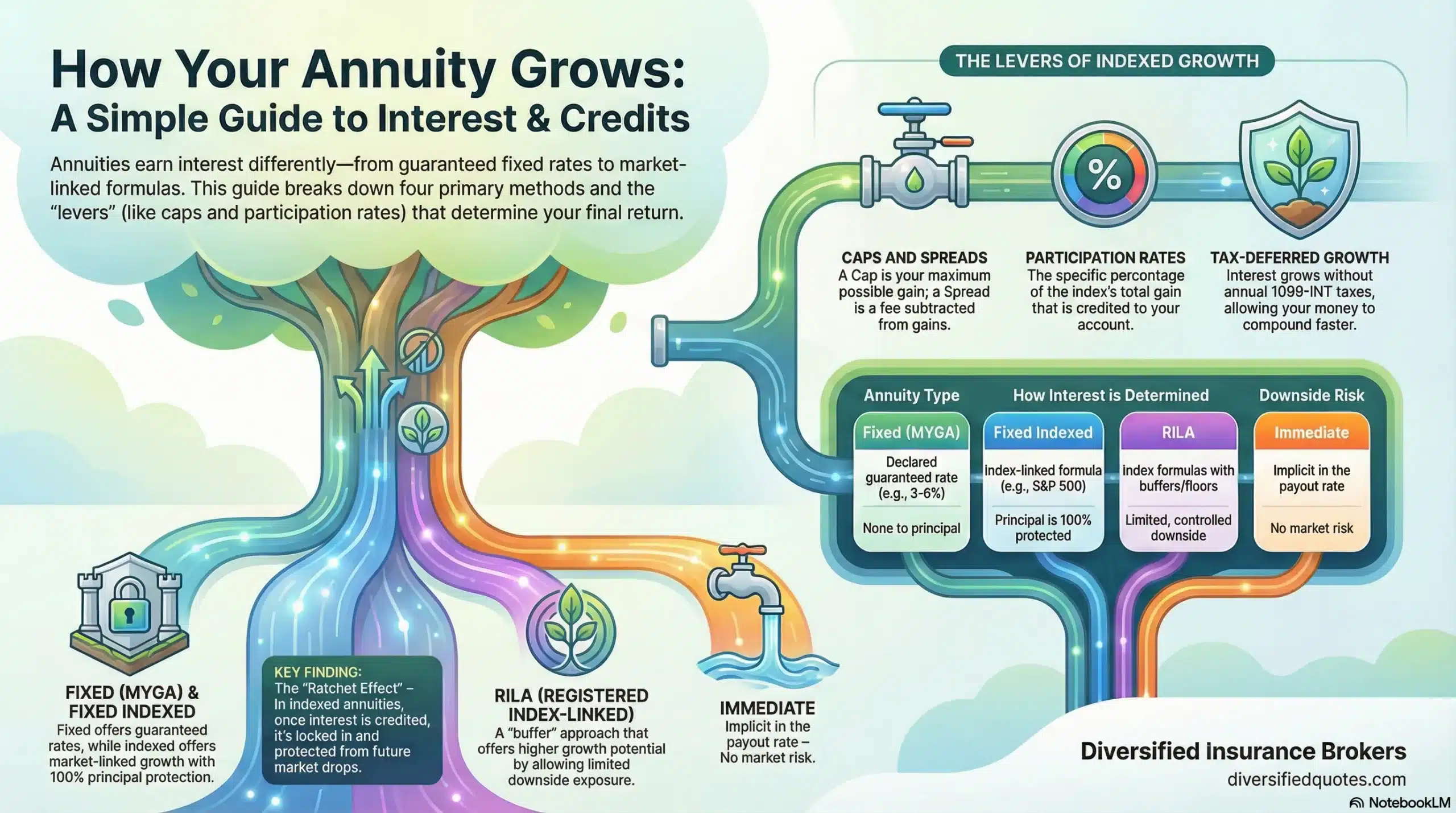
Each crediting strategy behaves differently, and understanding the mechanics — not just the labels — matters. A cap rate credits the full index gain up to a stated ceiling; strong index performance simply hits the cap, while negative performance always credits zero, never a loss. A locked cap rate is a variant available only at purchase: the cap is fixed for a seven-year guarantee period and cannot be reallocated until that period ends, trading flexibility for a longer rate guarantee. A trigger rate credits a fixed amount whenever the index is flat or positive, regardless of how far it rises — a design that can outperform a cap rate in modestly positive years but caps your upside in a strongly positive one. A trigger rate plus strategy adds a further protection: even in a negative index year, a smaller guaranteed rate is still credited, rather than zero. A participation rate credits a percentage of whatever the index actually returns, with no ceiling — in a strong year, a high participation rate can outperform a cap, while in a weak year it simply delivers a smaller share of a smaller number, never less than zero.
One detail worth knowing before you choose a version: the length of the rate guarantee period on certain strategies actually differs across the three Thrive Plus versions. On the S&P 500 Dynamic Intraday TCA Index, for example, Thrive Plus 7 guarantees its cap and trigger-plus rates for seven years, while Thrive Plus 10 extends that guarantee to ten years — and the trigger rate plus strategy on that index is not offered at all on the Bonus version. Similarly, the Barclays Fortune 500 participation rate is guaranteed for seven years on Thrive Plus 7 versus ten years on the other two versions. These differences are easy to miss when comparing brochures side by side, and they are exactly the kind of detail we confirm before recommending a specific version for a specific strategy.
Liquidity, Surrender Charges, and the Market Value Adjustment
Every deferred annuity balances growth against access, and Thrive Plus’s liquidity terms are worth understanding in full before you commit funds.
Free withdrawals are genuinely generous relative to many competing products: Thrive Plus allows withdrawals of up to fifteen percent of your account value annually starting in the very first contract year, with no withdrawal charge or market value adjustment — well above the ten percent allowance common on many competing indexed annuities. Required minimum distributions on qualified contracts are also available penalty-free even when they exceed that fifteen percent allowance.
Beyond the free withdrawal amount, a withdrawal charge applies during the surrender period, declining each year: on Thrive Plus 7, the charge runs for seven years, starting just under ten percent and stepping down annually to roughly three and a half percent in the final year. On Thrive Plus 10 and Thrive Plus 10 Bonus, the same declining pattern extends across ten years, starting at the same level and stepping down to a fraction of a percent by the final year before disappearing entirely. Our overview of how annuity surrender charges work covers how to plan around a schedule like this.
A market value adjustment also applies to withdrawals and surrenders beyond the free amount during the surrender period. In plain terms: if market interest rates have risen since you purchased the contract, the adjustment will generally reduce what you receive on an early withdrawal; if rates have fallen, it will generally increase it. This mechanism cuts both ways, and its purpose is to let the carrier offer more competitive rates elsewhere in the contract in exchange for accepting this interest-rate-linked variability if you exit early — it does not apply to free withdrawals, required minimum distributions, death benefit payments, or any of the hardship waivers described next. Throughout the surrender period, a guaranteed minimum value provision ensures your contract’s value can never fall below a specified guaranteed floor, regardless of market value adjustments or charges.
One additional feature worth flagging as a genuine positive: if you access funds before a twelve-month index term completes and the index has grown during that partial period, Thrive Plus applies a partial index credit for that stub period — on death benefits, annuitization, terminal-condition withdrawals, nursing home withdrawals, and ADL-triggered withdrawals. Many indexed annuities simply forfeit any mid-term growth on an early exit; crediting a partial share of it is a meaningfully better design.
A Genuinely Strong Feature: Comprehensive Hardship Waivers
This is one of the areas where Thrive Plus distinguishes itself clearly, and it deserves real emphasis. Beyond the standard free withdrawal allowance, the contract includes five separate circumstances under which you can access funds without a withdrawal charge or market value adjustment — a broader set of protections than many competing indexed annuities offer.
Death benefits are always payable in full, without any withdrawal charge or market value adjustment, under any circumstance. Annuitization — converting your deferred contract into a guaranteed income stream — is available at any time, with a choice of lifetime income or payments guaranteed for at least five years. Terminal condition access applies if, after the first contract year, you are diagnosed with a terminal condition carrying a life expectancy of seventeen months or less; the full account becomes accessible without charge. Nursing home residency access applies after thirty or more consecutive days of residency in a nursing facility, again after the first contract year. And inability to perform activities of daily living applies if you become unable to perform at least two of the six standard activities of daily living — bathing, dressing, eating, transferring, toileting, or continence — again after the first contract year.
This lineup matters because it addresses exactly the scenarios that most commonly force a retiree into an unplanned early withdrawal — a health crisis, a long-term care need, or a terminal diagnosis — precisely the moments when the last thing anyone should have to absorb is a surrender charge on top of everything else. A buyer who is weighing Thrive Plus against a competing indexed annuity should specifically compare this waiver lineup, because it is genuinely one of the stronger sets we see in this product category, and it is a meaningful reason this contract can make sense even for buyers who are a little more risk-averse about locking money away for a decade.
The Optional Enhanced Death Benefit Rider
Buyers age 80 or younger can add an optional enhanced death benefit rider at the time of purchase, for an annual charge calculated against the death benefit base — a rider built specifically for legacy planning rather than income or growth. It is not available to add later, so the decision to include it has to be made at purchase.
The rider works through two independent growth components, and each year your death benefit base steps up to whichever is higher. The first, a guaranteed enhancement value, compounds at a fixed annual rate regardless of what the market does — a floor that keeps growing even through flat or negative index years. The second, a performance protection value, grows by the full amount of interest actually credited to your annuity each year, and critically, that growth is calculated before the rider charge is deducted — meaning the charge does not erode the pace at which this value accumulates. Because your death benefit base takes the higher of these two paths every year, it is structurally designed to keep climbing across a range of market conditions, whether the market delivers strong, modest, or flat returns in any given year.
There is an important limit worth understanding clearly, because it tempers what could otherwise sound like unlimited guaranteed growth: the death benefit base cannot grow indefinitely. It is capped at the greater of a set percentage of your surrender value, or your total premium accumulated at a defined annual rate up to a maximum multiple of your original premium. In practice, this means the rider’s guaranteed growth engine has real teeth for a meaningful stretch of years, but it is not an unbounded promise — and any illustration you’re shown should make that ceiling explicit rather than projecting compounding growth indefinitely.
The rider also interacts favorably with required minimum distributions: withdrawals up to your RMD amount reduce the death benefit values dollar-for-dollar rather than proportionally, which in some scenarios allows the death benefit to continue growing even while you take RMDs — a detail worth understanding if you plan to fund the contract with qualified money. And for married couples, a surviving spouse who is the joint owner or sole primary beneficiary has two distinct paths: continue the base annuity contract alone, with any enhanced death benefit amount folded into the account value and the rider then terminating, or continue both the annuity and the rider itself, letting the enhanced death benefit keep growing until the surviving spouse’s own passing. That is a genuinely meaningful choice for couples doing legacy planning together, and it deserves a deliberate decision rather than a default. Our broader overview of how annuity death benefits work covers the base-contract death benefit that applies with or without this optional rider.
A Planning Idea Worth Knowing: Free Withdrawals as a Tax-Planning Tool
Most people think of an annuity’s free withdrawal allowance purely as a liquidity feature — a safety valve in case you need cash. It can also be a more deliberate planning tool, and Thrive Plus’s unusually generous fifteen percent allowance makes this idea especially relevant here.
Because withdrawals from a qualified annuity are taxable as ordinary income when taken, scheduled withdrawals spread across several years — rather than one large distribution — can sometimes be managed more deliberately for tax purposes than an all-at-once approach. For a client who is still working and remains eligible to make Roth IRA contributions, including catch-up contributions for those age fifty and older, that spread-out taxable cash flow could potentially be redirected to fund those contributions — moving assets from a tax-deferred structure into one offering tax-free growth potential, subject to the usual Roth contribution limits, income restrictions, and IRS requirements. This is not technically a Roth conversion, but it can serve a related planning purpose for the right client and the right timing.
This is a planning idea worth raising with your tax advisor, not a strategy to pursue unilaterally — the right questions are whether withdrawals can be spread across multiple tax years, how they would coordinate with your other retirement income sources, and whether a more gradual distribution approach genuinely helps your overall tax picture. We are not tax advisors, and any withdrawal strategy involving qualified or non-qualified funds should be reviewed with a qualified tax professional before you act on it — but knowing that this kind of planning is even possible is exactly the sort of thing an experienced broker should be raising with you, not something you discover after the fact.
How the Best-Interest Standard Is Supposed to Protect You
Annuity sales in the United States are governed by a best-interest standard of care, and understanding what that means gives you a genuine tool for evaluating any recommendation you receive — including ours. A producer recommending an annuity is required to act in your best interest, without placing their own or the insurer’s financial interest ahead of yours, and to do so based on a real understanding of your specific situation.
In practice, that means a proper recommendation should be grounded in a genuine review of your age, income, financial situation and existing obligations, financial experience, insurance needs, financial objectives, intended use of the annuity, time horizon, existing assets and other financial products you hold, liquidity needs, risk tolerance, and tax status — not a one-size-fits-all pitch. If you are replacing or exchanging an existing annuity for a new one, including into Thrive Plus, the standard requires specific extra scrutiny: whether you’ll incur a new surrender charge or start a new surrender period, whether you’ll lose existing benefits in the process, and whether the new product would substantially benefit you over the life of the product compared to what you’re giving up — not simply whether it offers a higher headline rate or bonus. You are also entitled to know the producer’s role in the transaction, whether they are compensated by commission, and, upon request, a reasonable estimate of that compensation.
We hold every recommendation we make to this exact standard, whether or not the person we’re speaking with knows to ask about it — a proper recommendation is grounded in genuine annuity suitability, not a product’s headline feature. If you’re considering moving funds from an existing annuity into Thrive Plus, that decision deserves the same scrutiny; our overview of how 1035 exchanges work covers the mechanics and the questions worth asking before you move.
The Carrier Behind the Contract
Standard Insurance Company has been in business since 1906 and carries a genuinely remarkable financial-strength track record: an A (Excellent) rating from AM Best, affirmed in November 2025 with a stable outlook, and the distinction of being one of only eight life and health insurers in the country to have maintained an A rating or higher continuously since 1928, the first year AM Best began issuing ratings. The company’s parent, Meiji Yasuda Life Insurance Company, is one of Japan’s oldest and largest life insurers, having acquired Standard’s holding company roughly a decade ago — a deep-pocketed, financially stable ownership structure standing behind the contract.
As covered above, the most important current consideration is the announced transition of Standard’s individual annuities business to Pacific Guardian Life, expected to close in early 2027. Pacific Guardian Life itself is well-rated and well-established — founded in 1961, Hawaii’s largest life insurer — which is a reassuring detail, but the transition itself is still worth confirming in detail with your broker at the time of application given how directly it can affect which entity ultimately stands behind a newly issued contract. Our full carrier review, is Standard Insurance Company a good insurance company, covers the transition and the company’s financial position in complete detail.
Thrive Plus is not available in New York. As with any annuity, your state’s guaranty association provides a secondary backstop beyond the carrier’s own claims-paying ability, and our overview of what an AM Best rating means helps you interpret the scale correctly.
Who Thrive Plus Fits — and Who It Doesn’t
Thrive Plus fits well for a buyer who wants principal protection with index-linked growth potential, values a genuinely strong lineup of hardship waivers over a rigid, narrow contract, and either has a clear time horizon matching the surrender period they select or a legacy-planning goal well served by the optional death benefit rider. Its unusually generous free withdrawal allowance also makes it a reasonable fit for a buyer who wants more built-in flexibility than many competing indexed annuities offer, without giving up principal protection.
It fits less well for a buyer whose primary goal is guaranteed lifetime income through a withdrawal benefit rider — Thrive Plus’s own structure emphasizes accumulation, hardship access, and legacy planning rather than a dedicated income rider, so a buyer whose central objective is turning savings into guaranteed income for life should compare it directly against products built specifically around that goal, which our overview of lifetime income annuities covers. It also fits less well for anyone who cannot commit to a seven- or ten-year surrender schedule, or who is drawn to the Bonus version primarily by its headline percentage without having compared it honestly against the non-bonus version for their specific time horizon.
How We Evaluate Thrive Plus for You
We know this contract in real depth — its three versions, its crediting mechanics, its bonus structure, its waivers, and its optional rider — and that depth is exactly why our recommendation is never automatic. We start with your actual objective: growth, legacy planning, flexibility, or some combination, and we work out which of the three Thrive Plus versions, if any, genuinely fits. We model the bonus version against the non-bonus version over your real time horizon rather than comparing headline numbers, we make sure you understand the surrender schedule, the market value adjustment, and the hardship waivers completely, and we walk you through exactly what the current Pacific Guardian Life transition means for a policy issued now.
Then we put Thrive Plus in the field. Because we represent more than one hundred carriers, we can show you directly how it compares against other strong fixed indexed annuities for your specific goals — not in the abstract, but with real numbers for your age, premium, and objectives. If Thrive Plus is genuinely the best fit, we’ll show you why in those numbers. If a different carrier’s product serves you better, we’ll show you that instead, because our compensation does not depend on steering you toward any one company. If you’ve already been shown a Thrive Plus illustration and want an honest, independent read on whether it’s genuinely your best option, that is exactly what our second-opinion review is for — including the realistic outcome that we confirm it’s a strong choice.
Ready to see how Thrive Plus compares against the full annuity market for your specific goals?
Get Your Free Annuity Comparison
Financial Protection Essentials
Explore additional carrier reviews and retirement distribution strategies.
Talk to an Advisor or Request Your Annuity Quote
Ready to explore this annuity in more detail—or compare it with other carriers to see if even higher rates are available? With guaranteed income, principal protection, and long-term growth potential on the line, making the right choice is essential. The experienced advisors at Diversified Insurance Brokers will guide you through the options and design a strategy tailored to your retirement goals.
Schedule here:
calendly.com/jason-dibcompanies/diversified-quotes
Licensed in all 50 states • Fiduciary, family-owned since 1980
What is the difference between Thrive Plus 7, Thrive Plus 10, and Thrive Plus 10 Bonus?
All three are versions of the same fixed indexed annuity with different tradeoffs. Thrive Plus 7 has the shortest commitment — a seven-year surrender charge period — and the highest issue-age limit, extending to age 90, making it a natural fit for older buyers who don’t want a decade-long commitment. Thrive Plus 10 extends the surrender period to ten years and issue ages to 80, but in exchange generally offers the strongest crediting rates and longest rate-guarantee periods on certain strategies, since it carries no premium bonus to fund. Thrive Plus 10 Bonus shares the same ten-year surrender schedule and age limit as Thrive Plus 10 but adds an upfront premium bonus credited to your account value at issue. The carrier’s own materials disclose directly that the bonus version may carry lower crediting rates than the non-bonus versions — the bonus is funded by that reduced crediting potential, not given away free. Choosing correctly among the three comes down to your time horizon and whether the day-one bonus is worth accepting reduced crediting potential and a bonus vesting schedule in exchange, which is exactly the analysis our page on whether bonus annuities are a good deal walks through.
How does the Thrive Plus 10 Bonus premium bonus and vesting schedule work?
The bonus, currently 12 percent as of this writing (bonus percentages are set by the carrier and can change, so confirm the current rate at application), is calculated by multiplying your premium by the bonus percentage and credited to your account value immediately, where it earns interest based on your selected crediting strategies with no risk of loss from market declines. It follows a ten-year vesting schedule: five percent vests with each contract year, reaching forty-five percent vested by the start of year ten, and then the remaining balance vests all at once at the start of the eleventh contract year, reaching one hundred percent. If you withdraw more than your free withdrawal allowance before the bonus is fully vested, the unvested portion can be recaptured — the carrier’s own materials note that this recapture mechanism is part of what allows it to offer higher crediting rates than it could otherwise. The bonus is real and valuable for a buyer who intends to hold the contract through the vesting period, but it is a poor fit for anyone who may need to access more than the free withdrawal allowance within the first decade. Our guide on how annuity bonuses work covers this mechanism across products more broadly.
What crediting strategies and indices does Thrive Plus offer?
Thrive Plus offers fixed interest crediting plus index-linked crediting across three indices. The S&P 500 carries the broadest set of strategies: a standard one-year cap rate, a locked cap rate fixed for a seven-year guarantee period, a trigger rate, and a participation rate. Two volatility-controlled indices round out the lineup — the S&P 500 Dynamic Intraday TCA Index, paired with a cap rate and a trigger rate plus strategy, and the Barclays Fortune 500 ER Dividends Index, paired with a participation rate. Mechanically: a cap rate credits index gains up to a stated ceiling, with zero credited (never a loss) if the index falls. A trigger rate credits a fixed amount whenever the index is flat or positive, regardless of how far it rises. A trigger rate plus strategy adds a smaller guaranteed credit even in a negative year rather than zero. A participation rate credits a percentage of the actual index return with no ceiling, which can outperform a cap in a strong year. One detail worth knowing: rate-guarantee periods on certain strategies actually differ by which Thrive Plus version you choose — for example, the Dynamic Intraday TCA cap rate is guaranteed for seven years on Thrive Plus 7 versus ten years on Thrive Plus 10, and the trigger rate plus strategy on that index isn’t offered at all on the Bonus version. Confirming these version-specific differences before choosing a strategy is a detail worth getting right.
How much of my money can I access, and what does early access cost?
Thrive Plus allows withdrawals of up to fifteen percent of your account value annually starting in the first contract year, with no withdrawal charge or market value adjustment — notably more generous than the ten percent allowance common on many competing indexed annuities. Required minimum distributions on qualified contracts are available penalty-free even beyond that fifteen percent allowance. Beyond the free amount, a withdrawal charge applies during the surrender period: seven years on Thrive Plus 7, ten years on Thrive Plus 10 and Thrive Plus 10 Bonus, starting just under ten percent and declining each year to a small fraction before disappearing entirely. A market value adjustment also applies to withdrawals beyond the free amount during the surrender period — generally reducing what you receive if interest rates have risen since purchase, and generally increasing it if rates have fallen — though a guaranteed minimum value provision ensures your contract can never fall below a specified floor regardless of charges or adjustments. One additional positive: if you access funds mid-term and the index has grown during that partial period, Thrive Plus credits a partial share of that growth on death benefits, annuitization, and hardship-waiver withdrawals, rather than forfeiting it entirely as some competing contracts do.
What hardship waivers does Thrive Plus offer?
This is one of Thrive Plus’s genuine strengths, with a broader lineup than many competing indexed annuities. Beyond the standard free withdrawal allowance, five separate circumstances allow access without a withdrawal charge or market value adjustment. Death benefits are always payable in full under any circumstance. Annuitization — converting the contract into guaranteed income — is available at any time, with a choice of lifetime income or payments guaranteed for at least five years. Terminal condition access applies, after the first contract year, if you’re diagnosed with a life expectancy of seventeen months or less. Nursing home residency access applies after thirty or more consecutive days in a facility, again after the first contract year. And inability to perform activities of daily living access applies if you become unable to perform at least two of the six standard activities of daily living — bathing, dressing, eating, transferring, toileting, or continence — after the first contract year. This lineup addresses exactly the scenarios that most commonly force an unplanned early withdrawal, and it’s a meaningful reason this contract can suit even buyers who are somewhat cautious about locking money away for a decade.
How does the optional Enhanced Death Benefit Rider work?
The rider, available for buyers age 80 or younger and addable only at purchase, uses two independent growth components, with your death benefit base stepping up each year to whichever is higher. A guaranteed enhancement value compounds at a fixed annual rate regardless of market performance, providing steady growth even in flat or declining markets. A performance protection value grows by the full amount of interest actually credited to your annuity each year, calculated before the annual rider charge is deducted, so the charge doesn’t erode this value’s growth pace. Because the death benefit base takes the higher path every year, it’s structurally designed to keep climbing across a range of market conditions. There is an important limit, though: the death benefit base cannot grow indefinitely — it’s capped at the greater of a set percentage of your surrender value or your premium accumulated at a defined rate up to a maximum multiple of the original premium, so any illustration should make that ceiling explicit rather than projecting unlimited compounding. The rider is also RMD-friendly: withdrawals up to your required minimum distribution reduce the death benefit values dollar-for-dollar rather than proportionally, which in some scenarios lets the death benefit keep growing even while you take RMDs. For couples, a surviving spouse can choose to continue the annuity alone, with any enhanced amount folded into the account value and the rider terminating, or continue both the annuity and the rider so the enhanced death benefit keeps growing until the surviving spouse’s own passing.
What is happening with Standard Insurance Company’s annuity business, and should I still consider Thrive Plus?
In May 2026, Standard Insurance Company announced a definitive agreement to transition its entire individual annuities business — including Thrive Plus — to Pacific Guardian Life, a sister company within the same Meiji Yasuda Life Insurance Company family, expected to close in early 2027 pending regulatory approval. This is an internal restructuring within the same corporate family rather than a distressed sale, and Pacific Guardian Life itself carries a strong AM Best financial strength rating. Under the agreement, Standard Insurance Company retains its existing closed block of in-force annuities, serviced by the same team transitioning to Pacific Guardian Life, preserving continuity of service for policies already issued. Going forward, Pacific Guardian Life acquires the annuities business and will continue selling new individual annuities under the Standard brand for a period before eventually transitioning to its own brand. What this means for a prospective buyer: your contract’s guarantees are contractual and don’t change based on which affiliated company administers them day to day, but the timing of your application relative to the transaction’s close does affect which entity is expected to be the long-term counterparty on your specific policy, and that is worth confirming directly at the time of application. This is exactly the kind of detail we walk every client through before recommending Thrive Plus, rather than something to discover afterward. Our full carrier review, is Standard Insurance Company a good insurance company, covers this transition in complete detail.
Who is Thrive Plus a good fit for?
Thrive Plus fits well for a buyer who wants principal protection with index-linked growth potential, values a genuinely strong lineup of hardship waivers over a rigid, narrow contract, and either has a time horizon matching the surrender period selected or a legacy-planning goal well served by the optional death benefit rider. Its unusually generous fifteen percent free withdrawal allowance also makes it a reasonable fit for a buyer who wants more built-in flexibility than many competing indexed annuities offer without giving up principal protection. It fits less well for a buyer whose primary goal is guaranteed lifetime income through a dedicated withdrawal benefit rider, since Thrive Plus’s structure emphasizes accumulation, hardship access, and legacy planning rather than income — a buyer with that central objective should compare it directly against products built specifically around guaranteed lifetime income. It also fits less well for anyone who cannot commit to a seven- or ten-year surrender schedule, or who is drawn to the Bonus version primarily by its headline percentage without comparing it honestly against the non-bonus version for their specific time horizon and goals.
About the Author:
Jason Stolz, CLTC, CRPC, DIA, CAA and Chief Underwriter at Diversified Insurance Brokers (NPN 20471358), is a senior insurance and retirement professional with more than 25 years of real-world experience helping individuals, families, and business owners protect their income, assets, and long-term financial stability. As a long-time partner of the nationally licensed independent agency Diversified Insurance Brokers, Jason provides trusted guidance across multiple specialties—including fixed and indexed annuities, long-term care planning, personal and business disability insurance, life insurance solutions, Group Health, Travel Medical and Evacuation Insurance, and short-term health coverage. Diversified Insurance Brokers maintains active contracts with over 100 highly rated insurance carriers, ensuring clients have access to a broad and competitive marketplace.
His practical, education-first approach has earned recognition in publications such as VoyageATL, and contributions from his agency featured in Kiplinger and GoBankingRates— highlighting his commitment to financial clarity and client-focused planning. Drawing on deep product knowledge and years of hands-on field experience, Jason helps clients evaluate carriers, compare strategies, and build retirement and protection plans that are both secure and cost-efficient. Visitors who want to explore current annuity rates and compare options across multiple insurers can also use this annuity quote and comparison tool.
Explore More Annuity Options: Browse our complete guide to What Is a Fixed Annuity? — covering fixed annuities, MYGAs, laddering strategies & conservative growth options from 100+ carriers.
Last Reviewed: September 26, 2026 |
Reviewed by: Jason Stolz, CLTC, CRPC, DIA, CAA
Chief Underwriter, Diversified Insurance Brokers, Inc. | NPN: 20471358 | Diversified Insurance Brokers, Inc. — Licensed in all 50 states
Fact Checked by: Tonia Pettitt, CMIP©
Medicare Specialist, Diversified Insurance Brokers, Inc. | NPN: 14374308 | Diversified Insurance Brokers, Inc. — Licensed in all 50 states
Did you find this content helpful? Leave us a Google review — it helps others find trustworthy guidance too.
Editorial Standards: Diversified Insurance Brokers maintains rigorous editorial standards to ensure accuracy, clarity, and independence in all content. Learn more about our editorial standards and commitment to transparency.
