
Oxford Life Select Series Annuity – Market Growth with Lifetime Income and Principal Protection
As an Independent Annuity Broker, we compare rates across 100+ carriers and 1,000 different annuities— not just one company’s product offerings — to find the best fit for your goals.
Oxford Life Select Series Annuity – Market Growth with Lifetime Income and Principal Protection
At Diversified Insurance Brokers, we help clients navigate retirement with annuity strategies built for growth, protection, and guaranteed income. The Oxford Life Select Series Fixed Indexed Annuity is designed for individuals who want the opportunity for market-linked growth without exposing their principal to market losses — while also building a reliable income stream that can last a lifetime. In today’s retirement landscape, where volatility, inflation, and longevity risk all play a role in financial uncertainty, fixed indexed annuities continue to gain traction as a middle ground between traditional fixed annuities and direct market investing. The Select Series is structured to help retirees and pre-retirees balance growth potential with contractual protection, making it particularly appealing for those who want disciplined accumulation without sacrificing long-term income security. For buyers who want to understand the full FIA category before evaluating a specific product, our breakdown of how fixed annuities differ from fixed indexed annuities positions the Select Series within its broader competitive context.

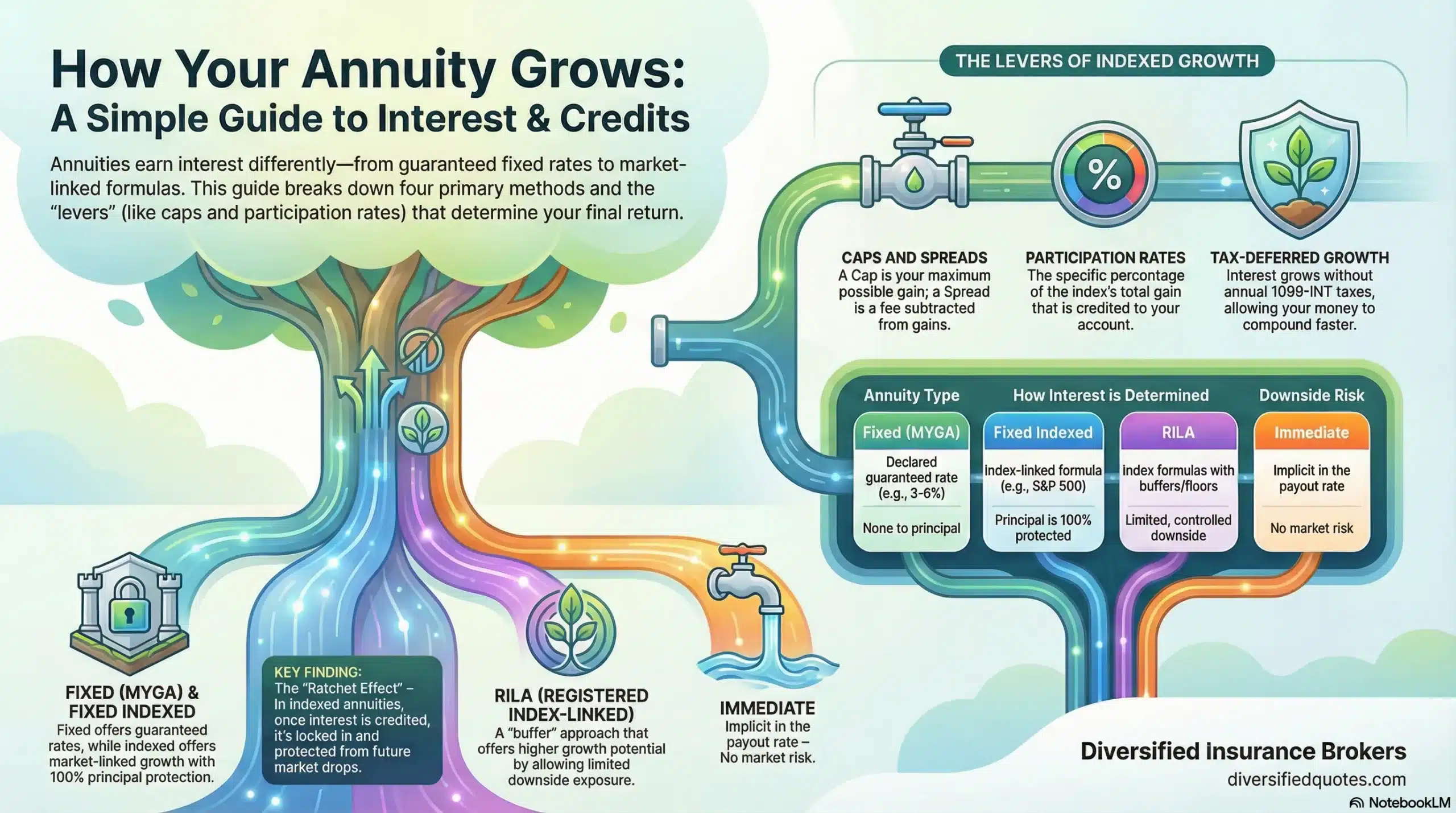
Unlike direct equity investments, the Select Series credits interest based on the performance of selected market indices but protects your principal from downturns. If the index has a negative year, your account does not lose value due to market performance — you simply receive zero interest for that crediting period. Over time, this “floor of zero” approach can create more stable accumulation patterns compared to fully exposed market portfolios, directly addressing the sequence-of-returns risk that is one of the most damaging forces in early-retirement portfolio management. Our dedicated resource on is an indexed annuity safe? provides context around how principal protection functions inside these designs. Many clients also explore what is a RILA? to better understand how fixed indexed annuities differ from registered index-linked annuities that carry limited downside exposure. The straightforward clarification: unlike a RILA, the Select Series FIA cannot lose principal to market-driven index declines — the floor is zero, not negative. Our resource on whether you can lose principal in an indexed annuity confirms that distinction.
Ensure you are receiving the absolute top rates
Current Fixed Annuity Rates
Compare today’s best fixed annuity rates from top carriers.
Current Bonus Annuity Rates
See which annuities offer the highest upfront bonus today.
Request an Annuity Quote
Submit our annuity request form to get personalized rate options.
Lifetime Income Calculator
Use our calculator to see how much guaranteed income your annuity can provide.
Oxford Life Select Series: Key Product Features at a Glance
| Product Feature | Details |
|---|---|
| Issuing Carrier | Oxford Life Insurance Company, Scottsdale, Arizona. Founded 1965. Subsidiary of U-Haul Holding Company. AM Best: A (Excellent). Available in 48 states and Washington D.C. Not FDIC insured. All guarantees backed by the claims-paying ability of Oxford Life Insurance Company. Understanding what AM Best’s A (Excellent) rating means provides context for evaluating Oxford Life’s financial strength against other carriers. |
| Product Type and Terms | Single-premium deferred fixed indexed annuity (FIA). Available surrender periods: 3, 5, 7, and 10 years — chosen at issue. Minimum premium: $20,000. Qualified and non-qualified funding accepted. Premium bonus included — vests over 10 years; non-vested bonus amounts are recaptured on withdrawals exceeding the penalty-free allowance. Products with a bonus typically have lower fixed account rates and lower index caps than similar no-bonus products; confirm at application. State availability may vary; confirm at application. |
| Index Crediting Strategies | Multiple crediting strategies available: fixed declared rate option; monthly averaging index strategy; annual point-to-point index strategy. Strategies use cap rates, participation rates, or spreads to calculate credited interest. Zero floor on all indexed strategies: if the selected index declines in a crediting period, credited interest is zero — not negative. Annual reset: credited interest is locked in at the end of each year and cannot be reversed by future market declines. Allocations may be split across multiple strategies. Crediting rates are subject to change at renewal. Confirm current index options, strategies, and rates at application. |
| Free Withdrawal Provisions | Year 1: interest-only free withdrawal (accumulated credited interest, penalty-free). Year 2+: up to 10% of accumulated value per year, penalty-free (noncumulative). RMDs: accommodated for qualified accounts. Health waivers at no charge: nursing home confinement, home health care, and terminal illness — surrender charges waived upon qualifying events. Confirm specific qualifying conditions and state-level variations at application. |
| Surrender Charges and MVA | Surrender charges begin at 10% in year 1 and decline by 1% per year (reaching 0% at the end of the selected surrender period). Understanding how surrender charges and MVA interact is essential before application. Market Value Adjustment (MVA): applies to excess withdrawals; may increase or decrease surrender value based on interest rate movements since issue. Both charges reach zero at the end of the selected surrender period. No annual administrative fee on the base contract. Confirm exact surrender schedule and MVA terms for the selected term at application. |
| GLWB Income Rider | The Guaranteed Lifetime Withdrawal Benefit (GLWB) rider is optional, available for an annual fee charged against the account value. The income account value (benefit base) is separate from the account value and is used solely to calculate lifetime withdrawal amounts — it is not available for cash surrender, withdrawal, or as a death benefit. Income account value grows based on the rate at issue for the first 10 contract years. Lifetime withdrawal amounts are determined by the income account value and the applicable payout percentage at the time income is activated. Confirm current rider fee, income account value growth rate, and withdrawal percentages at application. Rider forms GLWB210 and GLWB320 (state variations may apply). |
| Death Benefit | Beneficiaries receive the full accumulation value with no surrender charges applied at death. With a named beneficiary, the death benefit generally passes outside of probate. Beneficiaries may elect lump-sum or annuitization options. Our guide to what happens to an annuity at death covers the distribution election process and tax treatment at claim. |
| Tax Treatment | Tax-deferred accumulation — no annual 1099 during the accumulation phase. Non-qualified funds: LIFO withdrawal treatment — credited interest distributed first as ordinary income; original premium recovered tax-free over time. Qualified accounts: full distributions taxed as ordinary income. Withdrawals before age 59½ subject to 10% IRS early withdrawal penalty. Full framework at how annuities are taxed. |
The Oxford Life Select Series offers multiple crediting strategies, typically including a fixed account option, a monthly average index strategy, and an annual point-to-point index strategy. This structure allows you to allocate funds based on your personal comfort level and outlook. Some clients prefer a portion in the fixed account for predictable interest, while allocating the remainder to indexed strategies for greater upside potential. Our guide on how annuity income is calculated can help clarify how accumulation ultimately translates into retirement income. Indexed annuities differ from traditional fixed contracts because interest is not declared upfront — it is credited based on index performance, subject to caps, spreads, or participation rates defined in the contract. The crediting rates on indexed strategies are subject to change at each renewal period, which means buyers should request the carrier’s historical rate record at application to gauge how Oxford Life has managed crediting terms across market cycles.
One of the most compelling features of the Select Series is its Guaranteed Lifetime Withdrawal Benefit (GLWB) rider. This rider allows you to build an income base — the income account value — that grows based on the rate at issue for the first 10 contract years, before turning on lifetime income withdrawals. Even if the accumulation value fluctuates due to credited interest patterns, market zero-credit years, or rider fee deductions, the income account value may continue to grow during the deferral period according to rider provisions. When income begins, you receive guaranteed withdrawals for life, regardless of how long you live. For married couples, joint life payout options can ensure that income continues for a surviving spouse at a lower payout percentage. Clients frequently compare income riders across carriers, and transferring a deferred compensation plan to an annuity can be relevant if repositioning qualified funds into an income-focused contract.
Liquidity is also built into the contract. In year one, interest-only free withdrawals are available. Beginning in year two, you can withdraw up to 10% of the contract value annually without surrender charges. Additional waivers apply in cases such as nursing home confinement, terminal illness, or qualifying home health care situations — all at no additional charge. These provisions are especially important for retirees concerned about unexpected healthcare costs. If you are evaluating healthcare-related retirement planning risks, our resource on Medicare supplement coverage for cancer treatment outlines how medical expenses can intersect with retirement income planning. Our guide on annuities with nursing home care riders also provides context for comparing Oxford Life’s built-in waiver against products that charge an additional premium for similar confinement provisions.
From a legacy perspective, the Select Series provides a death benefit equal to the full accumulation value, allowing beneficiaries to receive funds directly without probate delays. For clients who want to combine income and legacy objectives, indexed annuities can provide a balanced approach — protecting principal, offering growth potential, and preserving a residual value for heirs. Those comparing different accumulation-focused products may also explore IUL in qualified plans to understand how life insurance-based strategies differ from annuity-based solutions for the same objectives. For IRA or 401(k) rollovers into the Select Series, our guides to how to transfer an IRA to an annuity and how to transfer a 401(k) to an annuity cover the rollover mechanics that protect the tax-advantaged status of the funds during transfer.
At Diversified Insurance Brokers, our approach is comparative and client-focused. We evaluate multiple carriers, surrender schedules, rider structures, and crediting strategies before making recommendations. Some clients prefer shorter surrender periods for flexibility; others are comfortable with longer time horizons in exchange for stronger income roll-up provisions. We also consider how indexed annuities integrate with Social Security planning considerations — if you are still planning your claiming strategy, coordinating guaranteed annuity income with Social Security timing can reduce bracket exposure and maximize the value of both income sources. Every recommendation is built around risk tolerance, liquidity needs, tax positioning, and long-term income objectives.
Indexed annuities are not designed to replace market investments entirely, nor are they intended to outperform equities in strong bull markets. Instead, they are designed to smooth volatility and provide protected compounding over time. For individuals approaching retirement who want to reduce sequence-of-returns risk while preserving upside opportunity, the Select Series can serve as a strategic middle ground. How fixed indexed annuities protect against market downturns explains the zero floor’s role in that protection in detail — and why it creates a fundamentally different accumulation experience than a balanced portfolio of stocks and bonds exposed to the same market conditions.
If you are repositioning conservative savings, rolling over a 401(k), or reallocating maturing fixed annuities, our team can provide side-by-side comparisons that outline guaranteed values, hypothetical index credits, and lifetime withdrawal projections. Transparency matters — understanding how caps, spreads, participation rates, the premium bonus vesting schedule, and the GLWB rider fee interact is critical before committing to a contract. Our advisors take the time to explain these details clearly so that you can make an informed decision with confidence.
The GLWB Rider in Depth: Income Account Value vs. Account Value
The Select Series GLWB rider introduces two separate values that run simultaneously inside the contract — the account value and the income account value — and confusing the two creates unrealistic expectations about the product’s liquidity and death benefit. This is one of the most commonly misunderstood aspects of income FIAs, and it deserves a clear explanation before application.
The account value is the actual cash value — the premium plus credited indexed interest and premium bonus (vested), minus rider fees and any withdrawals. This is the value used to calculate surrender value, the death benefit, and the available cash if the contract is terminated. The income account value (also called the benefit base) is a separate calculation used only to determine the lifetime withdrawal amount — it cannot be surrendered for cash, accessed as a lump sum, or inherited by beneficiaries as the death benefit. It is purely a computational tool for determining how much guaranteed income the rider will pay. The income account value grows at the rate specified in the rider contract for the first 10 years of the policy. This growth — which continues independent of whether the indexed crediting strategies produce positive or zero credits — creates the compounding that makes the income payout grow over the deferral period. Our resource on how an annuity income benefit base works explains this dual-value structure in plain terms.
When income is activated, the guaranteed withdrawal amount is calculated as the income account value multiplied by the payout percentage applicable to the owner’s age at activation. Joint life payout percentages are lower than single life percentages to cover two lifetimes. Once withdrawals begin, the guaranteed amount continues for life even if the account value reaches zero — as long as the depletion results from normal distributions and rider fees rather than excess surrenders. The annual rider fee is deducted from the account value — not the income account value — each year. Evaluating whether income rider fees are worth their cost requires projecting the full illustration at your specific age, premium, and planned deferral period before application. Our dedicated guide to how a GLWB works walks through the full activation mechanics in detail. The Select Series GLWB is positioned alongside the best in our market-wide comparison of fixed indexed annuities with income riders — a category in which the income rider fee, income account value growth rate, and lifetime payout percentages must all be compared before determining which carrier offers the best lifetime income output for a specific age and premium.
The Premium Bonus: What It Adds, What It Costs, and How to Evaluate It
The Select Series includes a premium bonus credited at issue — an upfront enhancement to the account value and income account value that vests over a 10-year period. The bonus is a genuine planning tool, but it comes with trade-offs that buyers must understand before assuming it makes the Select Series superior to no-bonus alternatives.
The bonus enhances the starting income account value, which means the 10-year compounding period that determines lifetime withdrawal amounts begins from a higher base. For buyers with a defined deferral horizon who intend to hold the contract for the full 10 years before activating income, the bonus’s compounding benefit over that period can meaningfully increase the guaranteed lifetime income. The trade-off: products with a premium bonus typically offer lower index cap rates, lower participation rates, and a lower fixed account rate than comparable no-bonus FIAs from the same or competing carriers. The carrier funds the bonus by investing the difference in crediting budget — a buyer receives a boost in the income account value in exchange for lower ongoing accumulation potential in the indexed strategies. Whether the bonus provides a net benefit relative to a higher-crediting no-bonus alternative depends entirely on the specific rates at application, the planned deferral period, and whether the income rider is activated. Our independent illustration process always presents the Select Series alongside no-bonus income FIAs with higher cap rates so buyers can evaluate the full 10-year income projection side by side before committing.
The vesting schedule on the bonus is equally important: if the owner makes withdrawals exceeding the penalty-free amount during the surrender period, the non-vested portion of the bonus is recaptured. The practical implication is that the bonus is only fully realized by owners who hold the contract through the vesting period and stay within annual free withdrawal limits. Buyers who anticipate needing access to more than 10% of the account value in any given year during the surrender period should evaluate whether a no-bonus product with better standard free withdrawal terms better matches their liquidity needs. Our comparison of the best fixed indexed annuities for income and the best annuity for lifetime income provides the full competitive context for that comparison at current declared rates and rider terms.
Suitability: Who the Select Series Is Built For
The Oxford Life Select Series performs best when matched to a specific buyer profile — someone who has a defined accumulation and deferral horizon aligned with one of the four available surrender periods, who values the combination of market-linked growth potential with principal protection, and who intends to use the GLWB rider’s lifetime income guarantee as a foundational income source in retirement. Our framework for who is best suited for an indexed annuity provides the starting framework; the Select Series-specific profile sharpens it.
The ideal Select Series buyer is typically a pre-retiree in their mid-50s to mid-60s who wants to activate guaranteed lifetime income in 5–10 years, who has qualified assets in an old 401(k) or IRA available for repositioning, who values the peace of mind of principal protection during the accumulation phase, and who can commit funds for the selected surrender period without needing full liquidity. The premium bonus and income account value growth rate reward buyers with a 10-year deferral horizon most directly — the compounding works in favor of those who allow the full 10-year growth period before income activation. Buyers who need income within three years are not well-served by the 10-year income account value growth design. Buyers who want uncapped equity participation should evaluate growth-only products without an income rider’s fee drag. Buyers who want a pure MYGA rate without index-linked variability should evaluate Oxford Life’s Multi-Select MYGA instead. Honest evaluation of the downsides of a fixed indexed annuity — including the liquidity restriction, the premium bonus trade-off, and the rider fee’s effect on accumulation — is essential before any application. Our broader guide to annuities for conservative investors frames the buyer profile across the full spectrum of annuity options available at A-rated carriers.
The Select Series Within a Broader Retirement Income Plan
The Oxford Life Select Series works best as one component in a coordinated retirement income plan — not as a standalone vehicle for an entire retirement savings pool. Its guaranteed lifetime income, principal protection, and health waivers position it as the income and protection layer within a plan that may also include Social Security, other annuity products, investment accounts, and long-term care coverage.
Coordinating the GLWB activation date with Social Security claiming decisions is one of the highest-leverage retirement income planning decisions for Select Series buyers. The guaranteed annuity income can be used to bridge the gap between early retirement and the age at which Social Security reaches its maximum benefit — freeing the buyer to defer Social Security claiming to 70 and allowing those benefits to compound by 8% per year during the bridge period. This coordination eliminates or significantly reduces the need to draw down investment accounts or use other assets during the deferral period. The Select Series GLWB’s income guarantee — which is not dependent on index performance or market conditions — pairs well with Social Security’s inflation-adjusted benefit to create a combined income floor that covers essential retirement expenses without requiring investment account withdrawals. Our market-wide review of the best fixed indexed annuities places the Select Series in competitive context — buyers should compare its income output against Athene, Midland National, North American, and other income FIA specialists before finalizing the selection. The Oxford Life product family may have multiple offerings worth comparing, and our independent illustration process covers all of them alongside the Select Series before any recommendation is made.
Related Pages
Explore additional retirement and annuity planning resources.
Financial Protection Essentials
Explore global travel medical coverage, disability insurance purchasing strategies, and specialized insurance solutions for international situations and retirement planning.
Talk to an Advisor or Request Your Annuity Quote
Ready to explore this annuity in more detail—or compare it with other carriers to see if even higher rates are available? With guaranteed income, principal protection, and long-term growth potential on the line, making the right choice is essential. The experienced advisors at Diversified Insurance Brokers will guide you through the options and design a strategy tailored to your retirement goals.
Schedule here:
calendly.com/jason-dibcompanies/diversified-quotes
Licensed in all 50 states • Fiduciary, family-owned since 1980
What is the income account value on the Select Series, and why can’t I access it as cash?
The income account value (also called the benefit base) is a separate calculation that exists only to determine your guaranteed lifetime withdrawal amount under the GLWB rider. It is not the same as the account value — it cannot be surrendered, withdrawn as a lump sum, used as a death benefit, or accessed in any form as cash. Think of it as a computational ledger that tracks how much guaranteed income the rider is obligated to pay you for life. The income account value begins at the premium plus any applicable bonus and grows at the rate specified in the rider contract for the first 10 policy years. This growth is guaranteed regardless of how the indexed strategies perform — even in a year where indexed crediting produces zero, the income account value advances. When you activate lifetime income, Oxford Life multiplies the income account value by the applicable payout percentage for your age to determine your annual guaranteed withdrawal amount. That amount continues for life even if the actual account value reaches zero — as long as the depletion comes from normal distributions and rider fees rather than excess surrenders. The account value, by contrast, fluctuates based on credited interest, rider fee deductions, and withdrawals taken — it is the real cash value of the contract at any given moment. Our resource on whether fixed indexed annuity rates change explains why the income account value’s guaranteed growth rate is more predictable than the indexed crediting strategies that affect the account value.
How does the premium bonus on the Select Series work, and what are the trade-offs?
The Select Series credits a premium bonus at contract issue that vests over 10 years. The bonus immediately increases the account value and income account value, giving the income rider’s compounding calculation a higher starting point. The trade-off is that Oxford Life, like most carriers offering bonuses, funds the bonus by offering lower indexed cap rates, lower participation rates, and a lower fixed account rate than it would offer on a similar no-bonus product. Over a 10-year deferral period, the question to evaluate is: does the bonus’s compounding advantage on the income account value outweigh the lower ongoing crediting potential? The answer depends on the specific rate differential at application, your age, and how long you plan to defer income. Additionally, the non-vested portion of the bonus is recaptured if withdrawals exceed the penalty-free limit during the surrender period — so buyers who take more than 10% annually lose part of the bonus they received. Our independent illustration process runs the Select Series alongside no-bonus income FIAs from other carriers so you can see exactly where the guaranteed income output compares at your specific age and premium at current rates. Our guide on annuity death benefit tax treatment also explains how the bonus interacts with the death benefit calculation in qualified vs. non-qualified accounts.
What happens to the Select Series if I need access to funds during the surrender period?
The Select Series provides two layers of liquidity during the surrender period. First, the standard free withdrawal: interest-only access in year one; 10% of accumulated value per year from year two onward, penalty-free. These are noncumulative — unused free withdrawal amounts do not roll over to the next year. Second, the health waivers: if you are confined to a nursing home, receive qualifying home health care, or are diagnosed with a terminal illness, surrender charges are waived on those withdrawals. These waivers are built into the contract at no additional cost. Withdrawals beyond the free amount trigger the declining surrender charge schedule (starting at 10% in year one, declining 1% per year) and may also trigger a Market Value Adjustment. The non-vested portion of the premium bonus is also recaptured on excess withdrawals. For retirement buyers who anticipate needing more than 10% of this specific pool of funds in any given year, the Select Series may not be the appropriate vehicle for that portion of savings. The practical solution — which our advisors implement routinely — is to ensure that liquid assets outside the annuity (money market, short-term CD, or investment account) cover near-term needs, while the Select Series operates as the protected income core. Our resource on how indexed annuities work and who should consider them addresses the liquidity planning framework in full.
Is the Oxford Life Select Series appropriate for someone who is already retired and needs income now?
It depends on how soon income is needed and what “now” means. The GLWB rider on the Select Series can begin paying income as early as the second contract year provided the owner has reached age 50 — so if the buyer purchases at age 65 and wants income to start at 67, a 2-year deferral is possible. However, the income account value’s guaranteed growth is designed to compound over 10 years, meaning buyers who defer longer receive more guaranteed income. Someone who needs income to begin within one year of the purchase date — or who cannot wait even two years — is not well-matched to the Select Series design and should evaluate a single premium immediate annuity (SPIA) or a deferred income annuity (DIA) with a shorter deferral trigger instead. Someone who is 64, planning to retire at 67, and wants to lock in today’s annuity income rates while allowing three years of guaranteed income account value growth is squarely in the Select Series’ target profile. Our annuity payout calculator can help illustrate what the guaranteed withdrawal amount might look like at various income start ages so you can compare the Select Series against immediate income alternatives side by side.
How does the Oxford Life Select Series compare to other income-focused fixed indexed annuities on the market?
The Select Series competes in the income FIA market against products from Athene, Midland National, North American, Corebridge, Global Atlantic, and others — each of which has its own GLWB rider fee structure, income account value growth rate, lifetime withdrawal percentages, and premium bonus design. The comparison that matters most for income-focused buyers is not headline rate or bonus size — it is the guaranteed lifetime income output at a specific age, premium, and deferral period. A product with a lower bonus but higher cap rates may produce more account value at deferral end, while a product with a higher income account value growth rate may produce more guaranteed income from that same account value. Our independent process runs multi-carrier income illustrations covering the Select Series and its primary competitors before any recommendation is made. Our review of the best fixed indexed annuities for income provides the market-wide framework for that comparison, and our overview of the best annuity for lifetime income identifies which product categories and carrier types consistently produce the strongest income guarantees at current rates. Oxford Life’s A (Excellent) AM Best rating places it in a strong financial strength tier for a long-term income commitment — which matters because your lifetime income guarantee is only as strong as the carrier’s ability to pay it.
About the Author:
Jason Stolz, CLTC, CRPC, DIA, CAA and Chief Underwriter at Diversified Insurance Brokers (NPN 20471358), is a senior insurance and retirement professional with more than 25 years of real-world experience helping individuals, families, and business owners protect their income, assets, and long-term financial stability. As a long-time partner of the nationally licensed independent agency Diversified Insurance Brokers, Jason provides trusted guidance across multiple specialties—including fixed and indexed annuities, long-term care planning, personal and business disability insurance, life insurance solutions, Group Health, Travel Medical and Evacuation Insurance, and short-term health coverage. Diversified Insurance Brokers maintains active contracts with over 100 highly rated insurance carriers, ensuring clients have access to a broad and competitive marketplace.
His practical, education-first approach has earned recognition in publications such as VoyageATL, and contributions from his agency featured in Kiplinger and GoBankingRates— highlighting his commitment to financial clarity and client-focused planning. Drawing on deep product knowledge and years of hands-on field experience, Jason helps clients evaluate carriers, compare strategies, and build retirement and protection plans that are both secure and cost-efficient. Visitors who want to explore current annuity rates and compare options across multiple insurers can also use this annuity quote and comparison tool.
Explore More Lifetime Income Options: Browse our complete guide to Lifetime Income Annuities & Products — covering best annuities for lifetime income, GLWB riders, joint income annuities & top carrier products from 100+ carriers.
Explore More Annuity Options: Browse our complete guide to Best Fixed Indexed Annuity Products — covering individual fixed indexed annuity product reviews from top-rated carriers from 100+ carriers.
Last Reviewed: June 24, 2026 |
Reviewed by: Jason Stolz, CLTC, CRPC, DIA, CAA
Chief Underwriter, Diversified Insurance Brokers, Inc. | NPN: 20471358 | Diversified Insurance Brokers, Inc. — Licensed in all 50 states
Fact Checked by: Tonia Pettitt, CMIP©
Medicare Specialist, Diversified Insurance Brokers, Inc. | NPN: 14374308 | Diversified Insurance Brokers, Inc. — Licensed in all 50 states
Did you find this content helpful? Leave us a Google review — it helps others find trustworthy guidance too.
Editorial Standards: Diversified Insurance Brokers maintains rigorous editorial standards to ensure accuracy, clarity, and independence in all content. Learn more about our editorial standards and commitment to transparency.
