
Heartland National Secure Rate Annuity – Fixed Growth with Flexible Access and Low Entry Point
As an Independent Annuity Broker, we compare rates across 100+ carriers and 1,000 different annuities— not just one company’s product offerings — to find the best fit for your goals.
Heartland National Secure Rate Annuity – Fixed Growth with Flexible Access and Low Entry Point
At Diversified Insurance Brokers, we help individuals secure their retirement with fixed annuities that offer stability, tax-deferred accumulation, and financial confidence. The Heartland National Secure Rate Multi-Year Guarantee Annuity (MYGA) is designed for individuals who want predictable returns, flexible access to funds, and strong protection of principal without exposure to stock market volatility. In an environment where interest rates shift, markets fluctuate, and retirees are increasingly concerned about preserving what they have built, a MYGA provides clarity. You know your rate. You know your term. You know your outcome — assuming you hold through the surrender period. Given Heartland National’s current AM Best Negative outlook, buyers should evaluate this product alongside A-rated MYGA alternatives and factor carrier strength into the comparison, not just declared rate.

That simplicity is powerful. Many of our clients compare options on our top fixed annuity rates page before selecting a carrier, because even small rate differences can significantly impact long-term accumulation when compounded over several years. For conservative investors, pre-retirees, and retirees who are reallocating funds from CDs, savings accounts, or maturing annuities, the Secure Rate MYGA offers a structured path forward with guaranteed growth and clearly defined liquidity provisions. A portion of retirement savings exposed to sequence-of-returns risk can be meaningfully stabilized by anchoring it in a guaranteed-rate instrument during the critical years surrounding retirement.
Unlike variable investments or indexed strategies that fluctuate based on market performance, a multi-year guarantee annuity locks in a fixed interest rate for a selected term. With the Secure Rate MYGA, you can choose from 3, 5, 7, or 10-year guarantee periods, allowing you to align your annuity with your retirement timeline. Whether you are parking funds temporarily while waiting for future opportunities or building a laddered annuity strategy for steady maturities, this flexibility matters. Many clients who explore broader strategies on our Compare Annuities page ultimately decide that a MYGA provides the right balance of return and safety for a portion of their portfolio. With a low $5,000 minimum premium, this annuity remains accessible while still offering the structural predictability that conservative investors value. Interest compounds tax-deferred, meaning you do not pay taxes on gains until you withdraw — an advantage that can meaningfully accelerate growth compared to taxable alternatives. Our resource on how tax deferral creates long-term compounding advantages quantifies that difference across rate and time horizon scenarios.
Ensure you are receiving the absolute top rates
Current Fixed Annuity Rates
Compare today’s best fixed annuity rates from top carriers.
Current Bonus Annuity Rates
See which annuities offer the highest upfront bonus today.
Request an Annuity Quote
Submit our annuity request form to get personalized rate options.
Lifetime Income Calculator
Use our calculator to see how much guaranteed income your annuity can provide.
Heartland National Secure Rate MYGA: Key Product Features at a Glance
| Product Feature | Details |
|---|---|
| Issuing Carrier | Heartland National Life Insurance Company, Independence, Missouri. Founded 1993/1994. AM Best: B++ (Good) — Negative Outlook (revised August 2025). S&P and Fitch: not rated. NAIC Complaint Index for individual annuities: 3.36 (more than 3x the 1.00 industry average). Not available in NY, CA, VA, and other states; confirm state availability at application. Not FDIC insured. All guarantees backed solely by the claims-paying ability of Heartland National Life Insurance Company. Buyers requiring A- or higher from AM Best should compare against A-rated alternatives; see our full carrier analysis at what AM Best ratings mean. |
| Product Type and Terms | Single-premium deferred multi-year guaranteed annuity (MYGA). Available guarantee periods: 3, 5, 7, and 10 years — chosen at issue. Fixed interest rate declared at issue and locked for the full guarantee period. No index crediting, caps, or participation rates. Minimum premium: $5,000. Maximum: $1,000,000. Issue ages: 0–90. Qualified and non-qualified funding accepted. Our comparison of best 5-year annuity rates benchmarks the Secure Rate against A-rated competitors at current rate levels. |
| Free Withdrawal Provision | Base contract: annual accumulated interest earned in any contract year may be withdrawn without surrender charges or MVA, beginning after the first 30-day right-to-examine period. This is an interest-only provision — withdrawals that reduce the accumulated value below the original premium are subject to surrender charges and MVA. Optional riders available: a 5% (or greater) free withdrawal rider and riders for terminal illness and nursing home confinement are available for additional flexibility. Confirm whether RMD withdrawals are accommodated penalty-free for the specific contract version at application — RMDs are not confirmed as penalty-free in the base contract on all versions. |
| Surrender Charges and MVA | Declining surrender charge schedule aligned with the selected guarantee period — charges apply on withdrawals above the free interest amount and reach zero at the end of the term. Market Value Adjustment (MVA) applies on excess withdrawals and may increase or decrease the surrender value depending on interest rate movements since contract issue. Understanding how surrender charges and MVA interact is essential before application. Confirm exact surrender schedule, MVA formula, and state-specific variations at application. |
| Death Benefit | Beneficiaries receive the full accumulation value with no surrender charges applied at death. With a named beneficiary, the death benefit generally passes outside of probate. Beneficiaries may choose lump-sum distribution or available annuitization options at the time of claim. Our overview of what happens to an annuity at death covers the distribution election process and tax treatment at claim. |
| Tax Treatment | Tax-deferred accumulation — no annual 1099 during the guarantee period. Non-qualified funds: LIFO withdrawal treatment — interest distributed first as ordinary income; original premium recovered tax-free via the exclusion ratio at annuitization. Qualified accounts: full distributions taxed as ordinary income. Withdrawals before age 59½ subject to 10% IRS early withdrawal penalty. Full framework at how annuities are taxed. |
| Renewal at Maturity | At the end of each guarantee period, the contract may be renewed at a newly declared rate (new surrender schedule begins), surrendered penalty-free during the renewal window, or converted to an income stream through annuitization. No surrender charges or MVA apply during the 30-day renewal window following the end of the guarantee period. Confirm renewal mechanics and auto-renewal defaults for your specific state at application. |
The Secure Rate MYGA is structured as a single premium deferred annuity. You contribute one lump sum, and the carrier guarantees the rate for the chosen term. There are no moving parts, no index caps to monitor, and no participation rates to analyze. For individuals who have asked whether annuities are a good investment in retirement — a question we explore further on our Are Annuities a Good Investment in Retirement? page — the answer often depends on objectives. If the objective is preservation, steady accumulation, and insulation from volatility, then a MYGA can be a strong component within a diversified retirement income strategy. Many retirees use fixed annuities alongside Social Security and pensions to create a predictable foundation before layering in other growth-oriented assets.
Liquidity is often a concern with fixed annuities, and it’s important to understand how access works. The Secure Rate MYGA base contract allows annual penalty-free withdrawals of accumulated interest — the interest earned in that contract year can be withdrawn without surrender charges. In addition, optional riders provide additional protection: a 5% (or higher) withdrawal rider expands penalty-free access beyond just the interest-only provision, while terminal illness and nursing home confinement riders allow access to contract funds without surrender charges upon qualifying health events. These features help ensure that your annuity remains aligned with real-life needs. For clients comparing different contract structures, our Fixed Indexed Annuity Myths Debunked resource explains how various designs differ from traditional MYGAs and when each might be appropriate.
It is also important to understand surrender schedules and Market Value Adjustments. Like most MYGAs, the Secure Rate contract includes a surrender period that aligns with the term you select. If you withdraw more than the allowed penalty-free amount during that period, surrender charges may apply, along with an MVA that can increase or decrease the payout depending on prevailing interest rate movements since issue. This mechanism helps carriers manage rate risk and allows them to offer competitive fixed rates up front. Our detailed guide on annuity surrender charges covers the full mechanics of declining schedules and how to evaluate early-exit costs against the benefit of the locked-in rate.
Beyond accumulation and liquidity, legacy protection matters. The Secure Rate MYGA includes a death benefit that pays beneficiaries the full accumulation value without surrender penalties, ensuring your savings transfer efficiently and predictably. For retirees without pensions or with limited guaranteed income sources, our resource on Annuity Options for Retirees Without Pensions outlines how fixed and income-focused annuities can replace or supplement traditional pension structures. For buyers using qualified assets, reviewing how to transfer an IRA to an annuity and how to transfer a 401(k) to an annuity covers the rollover mechanics that protect the tax-advantaged status of the funds during transfer. For non-qualified funds, a 1035 exchange from a lower-yielding contract may allow repositioning into the Secure Rate without a taxable event.
Many clients eventually reposition MYGA assets into income-generating strategies at maturity. At the end of your selected term, you may renew at a new guaranteed rate, withdraw funds penalty-free during the renewal window, or convert to a structured income stream. This flexibility makes a MYGA not just a static savings vehicle but a strategic planning tool. At Diversified Insurance Brokers, our role is not simply to present one product — it is to help you evaluate whether this product aligns with your timeline, tax situation, income needs, risk tolerance, and carrier strength requirements. With access to over 100 carriers, we compare contract structures objectively — and for buyers with carrier strength concerns about Heartland National’s current Negative outlook, that comparison always includes A-rated alternatives at the same term.
Choosing the Right Guarantee Period: 3, 5, 7, or 10 Years
The Secure Rate MYGA’s four-term menu — 3, 5, 7, and 10 years — covers a wider range of commitment horizons than many competing single-carrier MYGA products, and choosing the right term is among the most consequential decisions at application. Longer terms generally offer higher declared rates, but they also impose a longer surrender charge period and a longer window during which the MVA can affect excess withdrawal values. Matching the term to your actual liquidity horizon — the period before you genuinely expect to need access beyond the interest-only free withdrawal — is the starting point for that decision.
The 3-year term suits buyers who have a near-term event — a planned expenditure, a CD maturing alongside this annuity, or a desire to reassess the rate environment in three years without waiting five or seven years for a penalty-free window. Our comparison of best 3-year annuity rates shows the full A-rated competitive field at that shorter term. The 5-year term is the most popular duration in the MYGA market — balancing a meaningfully higher rate against a manageable five-year liquidity horizon. The 7- and 10-year terms reward buyers who have the longest accumulation runway and can commit funds for the extended period without concern about the surrender schedule. Our comparisons of best 7-year and best 10-year annuity rates benchmark those longer terms against the full A-rated market at current rate levels. A comprehensive introduction to how term selection interacts with rate and liquidity trade-offs is covered in our guide to how multi-year guaranteed annuities work.
MYGA Laddering: Using the Secure Rate Across Multiple Terms
The Secure Rate’s four-term structure makes it well-suited for a laddering strategy — dividing a savings pool across multiple annuity terms so that a portion matures on a staggered schedule. Our guides to the fixed annuity ladder strategy and the power of laddering fixed annuities for retirement income provide the full framework; the Secure Rate-specific application is straightforward.
A buyer allocating $200,000 might divide equally across the 3-year, 5-year, and 7-year Secure Rate terms — each earning different declared rates, all from the same carrier for administrative simplicity. The 3-year tranche matures first, providing a penalty-free decision window at year three. The 5-year matures two years later. The 7-year matures two years after that. Over the full seven-year horizon, the buyer has a penalty-free exit or renewal decision every two years, while the interest-only free withdrawal on all three tranches runs simultaneously throughout. This rolling liquidity structure reduces the cost of the 5% vs. 10% free withdrawal limitation on any single tranche — across three tranches with staggered maturities, the practical annual liquidity is higher than any single contract’s provision suggests. However, the Negative AM Best outlook on Heartland National warrants an important planning note: for very large allocations or for buyers with a low tolerance for carrier risk, distributing this laddered strategy across Heartland National and one or two A-rated MYGA carriers may better manage the single-carrier concentration that an all-Heartland ladder creates.
The Interest-Only Free Withdrawal: What It Provides and What It Doesn’t
The base Secure Rate MYGA’s annual free withdrawal of accumulated interest is a nuanced liquidity provision that deserves explicit explanation before a buyer assumes it is equivalent to the “10% of account value” provision on many competing MYGAs. Understanding the difference determines whether the Secure Rate’s liquidity is sufficient for your situation or whether the optional liquidity rider is worth adding.
In the base contract, only the interest earned in that year can be withdrawn without penalty. On a $100,000 Secure Rate at a 5.50% declared rate, year-one interest is approximately $5,500 — roughly 5.5% of the original balance. In year two, accumulated interest grows; the withdrawable amount increases modestly each year as the balance compounds. This is similar to the structure used by the EquiTrust Certainty Select and the SBLI ECAccumulate — interest-only access preserves the compounding base intact while giving the owner access to the annual yield. The difference from a 10%-of-account-value provision only becomes material if the owner needs access to more than approximately 5–6% of the account in any given year. For buyers who want a guaranteed 10% access tier, the optional 5% (or higher) withdrawal rider expands that provision — at an additional cost or rate reduction that should be confirmed at application. The competitive context for evaluating whether the Secure Rate’s base provision is sufficient, or whether an A-rated MYGA with a built-in 10% free withdrawal better matches the buyer’s needs, is available on our highest guaranteed annuity rates comparison page.
Carrier Strength Evaluation: What Buyers Need to Know Before Committing
The Heartland National carrier situation — B++ rating, Negative outlook, elevated complaint index — requires honest discussion because buyers considering a 7- or 10-year Secure Rate commitment are making a multi-year bet on this carrier’s financial stability. The AM Best Negative outlook means AM Best has identified specific concerns sufficient to flag the possibility of a downgrade within the next 12–24 months. It does not mean a downgrade is certain, but it does mean the conditions that could lead to one are present and being monitored.
For perspective: a B++ rating with a Stable outlook from AM Best places a carrier in the “Good” tier — acceptable to many buyers. The same rating with a Negative outlook signals that the Good tier placement is currently under pressure. The three specific drivers AM Best identified (rapid growth outpacing capitalization, single-reinsurer concentration, and statutory net losses) are addressable risks — the potential equity injection mentioned in AM Best’s commentary could resolve them. But as of this writing, that transaction has not been confirmed. Buyers for whom AM Best’s A- threshold is a non-negotiable requirement should select a competing MYGA from an A-rated carrier — our independent process provides that comparison. Buyers who are comfortable with a B++ carrier after a full review of the risks, who are attracted by the Secure Rate’s competitive declared rate and four-term flexibility, and who are allocating an amount within their personal carrier concentration comfort level can consider the Secure Rate within a broader diversified strategy. Our overview of annuities for conservative investors addresses how carrier quality fits into the full evaluation framework, and our resource on why more retirees are choosing MYGAs covers the broader MYGA market context in which Heartland National competes.
At Maturity: Renewal, Income Conversion, and Redeployment
The 30-day penalty-free renewal window at the end of each Secure Rate guarantee period is the most important moment in the contract’s lifecycle. All surrender charges and MVA reach zero — the full accumulated value is accessible penalty-free. The correct approach is to begin evaluating the renewal decision at least 60 days in advance, comparing Heartland National’s renewal rate against the best available rates across the full MYGA market at that time. Our live comparisons of how MYGAs compare to CDs and other fixed-income alternatives provide the benchmark for that redeployment decision.
For buyers who want to convert the Secure Rate’s accumulated value into guaranteed lifetime income at maturity, two paths are available. Annuitization within the contract converts the balance into a scheduled income stream. Alternatively, surrendering at maturity and repositioning into a fixed indexed annuity with an income rider at a different carrier provides income activation flexibility — the GLWB structure lets the buyer choose when income starts while the account value continues to compound. The mechanics of how guaranteed lifetime withdrawal benefits work are covered in our dedicated resource on that topic. Coordinating the maturity date with Social Security claiming decisions — using the annuity to bridge the income gap while Social Security compounds toward its maximum benefit age — is one of the most effective positioning decisions for this product at maturity.
Related Pages
Explore MYGA rate comparisons, surrender charge guides, and annuity planning resources.
Financial Protection Essentials
Explore Medicare supplement coverage, annuity rate benchmarks, long-term care planning, and final expense protection resources.
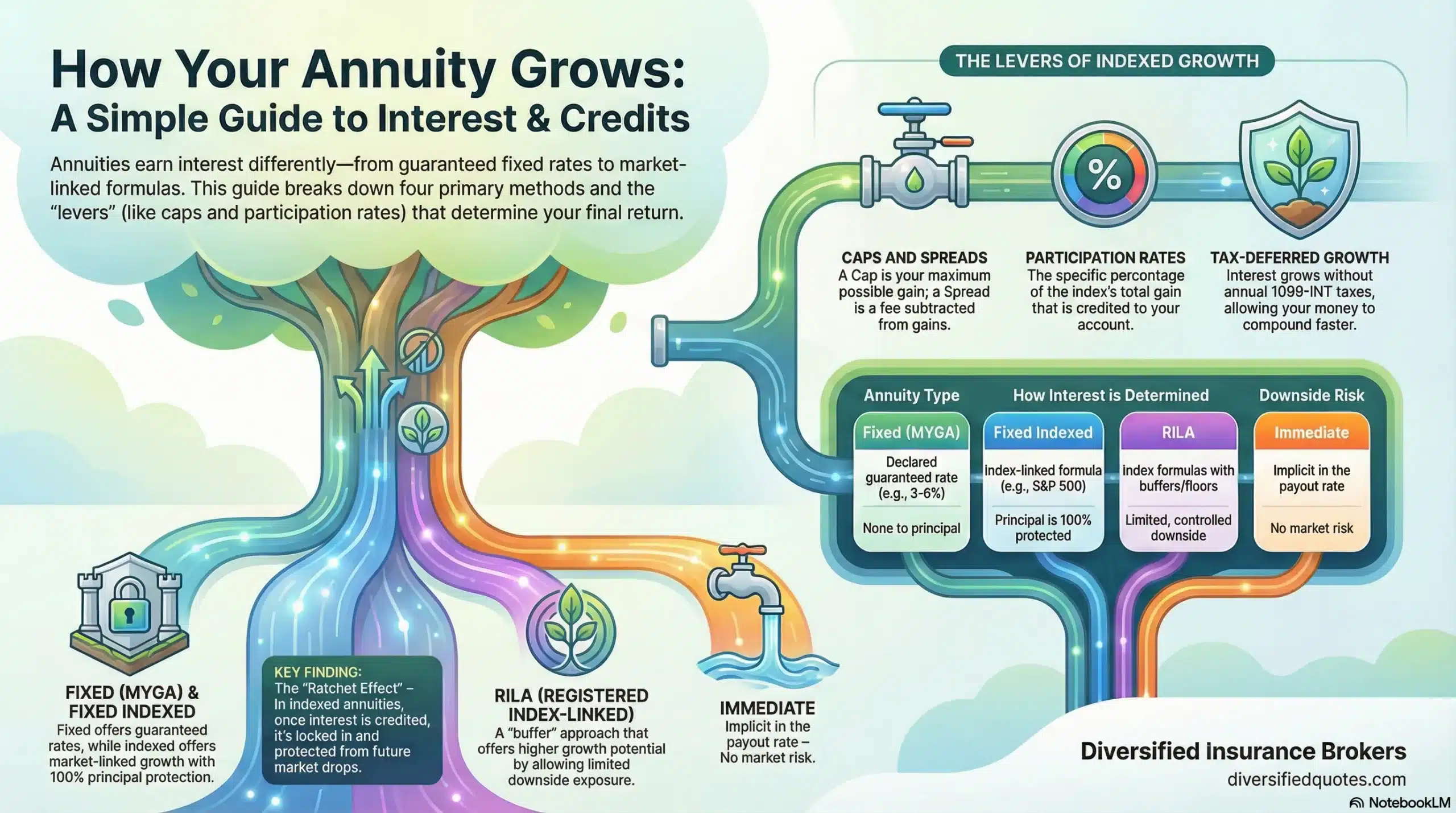
Talk to an Advisor or Request Your Annuity Quote
Ready to explore this annuity in more detail—or compare it with other carriers to see if even higher rates are available? With guaranteed income, principal protection, and long-term growth potential on the line, making the right choice is essential. The experienced advisors at Diversified Insurance Brokers will guide you through the options and design a strategy tailored to your retirement goals.
Schedule here:
calendly.com/jason-dibcompanies/diversified-quotes
Licensed in all 50 states • Fiduciary, family-owned since 1980
What does Heartland National’s AM Best Negative Outlook mean for someone considering the Secure Rate MYGA?
The Negative Outlook means AM Best has identified specific conditions that could lead to a rating downgrade within the next 12–24 months if not resolved. The current B++ (Good) rating is not a downgrade — it is the existing rating, maintained as of August 2025. The Negative Outlook is a forward-looking warning that the conditions justifying the Good rating are under pressure. AM Best specifically identified rapid annuity growth outpacing capitalization, single-reinsurer concentration (Converge Re II), and statutory net losses as the drivers. A potential equity investment from a third-party group was mentioned as a possible resolution, but had not been confirmed at the time of this writing. For a 3-year Secure Rate, the risk horizon is shorter and the exposure to a potential rating change is more limited. For a 7- or 10-year Secure Rate, the buyer is committing to a carrier whose financial trajectory is under active review for a period that extends well beyond the current rating action’s typical 12–24 month window. Our full analysis of these risks is available on our Heartland National carrier review. Buyers who want the Secure Rate’s competitive rate without these carrier concerns should request our side-by-side illustration comparing the Secure Rate against A-rated MYGAs at the same terms. The comparison will show the rate differential — and the buyer can decide whether that spread is worth the carrier risk for their specific premium and time horizon.
How does the Secure Rate MYGA’s free withdrawal work, and is it different from the “10% free withdrawal” on other MYGAs?
Yes — the base Secure Rate MYGA’s free withdrawal is interest-only, not 10% of account value. Each year, the accumulated interest earned in that year may be withdrawn without surrender charges or MVA — beginning after the first 30-day right-to-examine period. On a $100,000 Secure Rate at 5.50%, year-one interest is approximately $5,500. That is the penalty-free accessible amount in year one. In contrast, a competing MYGA with a 10%-of-account-value provision would allow $10,000 in penalty-free access on the same balance. In later contract years, as interest compounds, the interest-only amount grows — eventually potentially exceeding 10% of the original balance on longer terms. An optional rider is available that provides access beyond just the interest-only provision (5% or more of accumulated value), at an additional cost or rate reduction that should be confirmed at application. Buyers who need more than approximately 5–6% of their balance in any given year during the surrender period should evaluate whether the optional rider is worth adding, or whether a competing MYGA with a 10% free withdrawal built into the base contract at a comparable or better rate is a more appropriate fit. Our comparison of how to find the best annuity rates includes guidance on evaluating free withdrawal provisions as part of a complete product comparison.
Can I make required minimum distributions (RMDs) from a Secure Rate MYGA penalty-free?
RMD treatment on the base Secure Rate MYGA should be confirmed at application. Unlike most large MYGA carriers that explicitly include RMD accommodation as a standard penalty-free provision, available product reviews for the Secure Rate indicate that RMDs are “not free” unless they fall within the available free withdrawal amount — meaning RMDs that exceed the annual accumulated interest provision may be subject to surrender charges or MVA in the base contract. An optional rider may expand the penalty-free amount to accommodate typical RMD levels; confirm this at application for the specific version and state. This RMD treatment is a meaningful factor for buyers who will be 72 or older during the Secure Rate’s guarantee period — the mandatory annual distribution from a qualified account could exceed the base contract’s interest-only free provision and trigger charges on the excess. Buyers with significant qualified account balances requiring large annual RMDs should confirm in writing what the Secure Rate’s exact RMD accommodation looks like for their specific contract at application. Our live comparison of today’s highest annuity rates includes carriers that explicitly offer 10% free withdrawals including RMDs as a standard base contract feature, giving you a benchmark for comparison.
What does the death benefit pay on the Secure Rate MYGA, and does it avoid probate?
The Secure Rate MYGA pays beneficiaries the full accumulation value — principal plus all credited interest — at the time of the owner’s death, with no surrender charges or MVA applied. Because the fixed rate contract never loses value from market performance, the accumulated value at death reflects the full compounding of credited interest on an undepleted principal base. With a named beneficiary designated on the contract, the death benefit generally passes directly to the beneficiary outside of the probate process, avoiding the delays, public disclosure, and costs associated with probate administration. Beneficiaries may typically elect lump-sum distribution or available annuitization options depending on the contract terms and the beneficiary’s relationship to the owner. Non-spouse beneficiaries who inherit a qualified annuity are subject to the 10-year distribution rule under current tax law. Confirm available beneficiary options and distribution elections at the time of claim. Our overview of whether annuity death benefits are taxable explains the income tax treatment for beneficiaries across qualified and non-qualified contracts.
Is the Secure Rate MYGA appropriate for a large IRA rollover or for building a laddered strategy?
The Secure Rate can serve both purposes, but the carrier’s current Negative AM Best outlook warrants an additional consideration for large allocations. For IRA rollovers, the product accepts qualified funding and the rollover mechanics — direct trustee-to-trustee transfer — are standard; our guide to transferring an IRA to an annuity covers the execution details. For large allocations — $250,000 or more — we recommend distributing across two or more carriers rather than concentrating the full amount in a single B++ carrier with a Negative outlook, regardless of how attractive the declared rate is. A Secure Rate 5-year alongside an A-rated MYGA at the same or different term provides rate optimization alongside carrier diversification. Our resource on MYGA strategies for larger premium allocations covers carrier diversification, guaranty association coverage limits by state, and how to structure multi-carrier ladders effectively. For the laddering use case specifically, the Secure Rate’s four-term menu offers the convenience of keeping all tranches at one carrier — balanced against the carrier concentration risk that creates when the carrier holds a Negative outlook from AM Best. Our comparison of today’s top annuity rates shows where A-rated competitors stand at current rate levels so you can evaluate the premium for diversifying carrier risk against any rate differential at the time of application.
About the Author:
Jason Stolz, CLTC, CRPC, DIA, CAA and Chief Underwriter at Diversified Insurance Brokers (NPN 20471358), is a senior insurance and retirement professional with more than 25 years of real-world experience helping individuals, families, and business owners protect their income, assets, and long-term financial stability. As a long-time partner of the nationally licensed independent agency Diversified Insurance Brokers, Jason provides trusted guidance across multiple specialties—including fixed and indexed annuities, long-term care planning, personal and business disability insurance, life insurance solutions, Group Health, Travel Medical and Evacuation Insurance, and short-term health coverage. Diversified Insurance Brokers maintains active contracts with over 100 highly rated insurance carriers, ensuring clients have access to a broad and competitive marketplace.
His practical, education-first approach has earned recognition in publications such as VoyageATL, and contributions from his agency featured in Kiplinger and GoBankingRates— highlighting his commitment to financial clarity and client-focused planning. Drawing on deep product knowledge and years of hands-on field experience, Jason helps clients evaluate carriers, compare strategies, and build retirement and protection plans that are both secure and cost-efficient. Visitors who want to explore current annuity rates and compare options across multiple insurers can also use this annuity quote and comparison tool.
Browse More Resources: Return to our complete Fixed Indexed Annuity Products & Education guide — covering FIA products and education from top carriers.
Last Reviewed: June 24, 2026 |
Reviewed by: Jason Stolz, CLTC, CRPC, DIA, CAA
Chief Underwriter, Diversified Insurance Brokers, Inc. | NPN: 20471358 | Diversified Insurance Brokers, Inc. — Licensed in all 50 states
Fact Checked by: Tonia Pettitt, CMIP©
Medicare Specialist, Diversified Insurance Brokers, Inc. | NPN: 14374308 | Diversified Insurance Brokers, Inc. — Licensed in all 50 states
Did you find this content helpful? Leave us a Google review — it helps others find trustworthy guidance too.
Editorial Standards: Diversified Insurance Brokers maintains rigorous editorial standards to ensure accuracy, clarity, and independence in all content. Learn more about our editorial standards and commitment to transparency.
