
NexAnnuity NexCompounder Fixed Indexed Annuity
As an Independent Annuity Broker, we compare rates across 100+ carriers and 1,000 different annuities— not just one company’s product offerings — to find the best fit for your goals.
NexAnnuity NexCompounder Fixed Indexed Annuity
NexCompounder Fixed Indexed Annuity, issued by The Ohio State Life Insurance Company, gives you a small, easy-to-follow menu: three indexes, a choice between a cap and a participation rate on each one where offered, and a one-year fixed rate, all measured over one-year terms that reset annually. You also pick a 7-year or 10-year surrender schedule. On the rate sheet we reviewed, both schedules carried identical crediting rates, which means the shorter commitment gave up nothing in growth potential while ending three years sooner. That one detail can save you from locking money away longer than necessary. Everything else on this page sits on top of that.

AM Best Rating Disclosure
The insurer behind NexCompounder, The Ohio State Life Insurance Company, reports that AM Best grades its financial strength B+ (Good). That grade is sixth on AM Best’s thirteen-step scale, two notches below the A- many cautious retirement savers set as their minimum. Principal protection and every other promise in this annuity depend on Ohio State Life’s ability to pay, so verify the insurer’s current rating before you commit.
Jason Stolz, CLTC, CRPC, DIA, CAA, is Chief Underwriter at Diversified Insurance Brokers, and fixed indexed annuities are contracts our office places regularly for clients seeking market-linked growth without market losses. As an independent annuity broker, we compare NexCompounder’s current caps and participation rates, and the strength of the insurer behind them, against fixed indexed annuities from other carriers before recommending where your money should go.
Want the current NexCompounder caps and participation rates?
Get NexCompounder Rates
NexCompounder at a Glance
| Item | NexCompounder Specification |
|---|---|
| Insurer | The Ohio State Life Insurance Company, Dallas, Texas; AM Best B+ (Good) |
| Product Type | Single premium deferred indexed annuity that accepts added premiums during the first year |
| Premium | $25,000 initial; additional deposits of $25,000 or more allowed throughout year one |
| Issue Ages | Through age 85, measured by whoever on the contract is oldest |
| Surrender Schedules | 7 or 10 years, starting at 9%; see annuity surrender charges explained |
| Index Options | S&P 500, Nasdaq-100 Volatility Control 12% NC Index, and Franklin US Core Plus Index |
| Crediting Methods | 1-year point-to-point with a cap or a participation rate, plus a 1-year fixed rate |
| Annual Withdrawal Allowance | After the first policy year, up to 10% of account value annually without surrender charges or MVA |
| Market Value Adjustment | Applies to excess withdrawals during the surrender period, except required minimum distributions |
| Account Types | Traditional, Roth, SEP, and SIMPLE IRAs, non-qualified money, and some employer plans with approval; see moving a SIMPLE IRA into an annuity |
| Maturity | No later than the first policy anniversary on or after the oldest owner’s or annuitant’s 95th birthday |
| Not Offered In | Connecticut, Maine, New York, and Vermont |
Ensure you are receiving the absolute top rates
Current Fixed Annuity Rates
Compare today’s best fixed annuity rates from top carriers.
Current Bonus Annuity Rates
See which annuities offer the highest upfront bonus today.
Request an Annuity Quote
Submit our annuity request form to get personalized rate options.
Lifetime Income Calculator
Use our calculator to see how much guaranteed income your annuity can provide.
Issued by Ohio State Life
NexCompounder is NexAnnuity’s fixed indexed annuity, and its issuer is Ohio State Life, the Dallas-headquartered insurer owned by NexAnnuity Holdings. Ohio State Life also issues the NexHaven multi-year guaranteed annuity, while NexAnnuity’s other MYGA, NexVantage, comes from a separate insurer. Because NexCompounder’s floor, its credited interest, and its account value all depend on Ohio State Life, the issuer deserves as much attention as the crediting rates.
The company reports a B+ (Good) financial strength grade and a bbb- (Good) issuer credit grade from AM Best, each carrying a stable outlook. AM Best’s published commentary has described an adequate balance sheet supported by parent capital contributions, marginal operating performance typical of a fast-growing annuity writer, and a limited business profile because of the company’s narrow product range. NexCompounder is part of how that product range has broadened.
We cover the company in depth in our review asking is Ohio State Life a good company, including its history, ownership, investments, and how to size a purchase with a B+ rated insurer. The short version: a fixed indexed annuity is usually a long commitment, so buyers who choose NexCompounder should be comfortable with the issuer’s rating for the full surrender period, and should consider keeping the amount within their state’s guaranty association limit.
How a Fixed Index Annuity Credits Interest
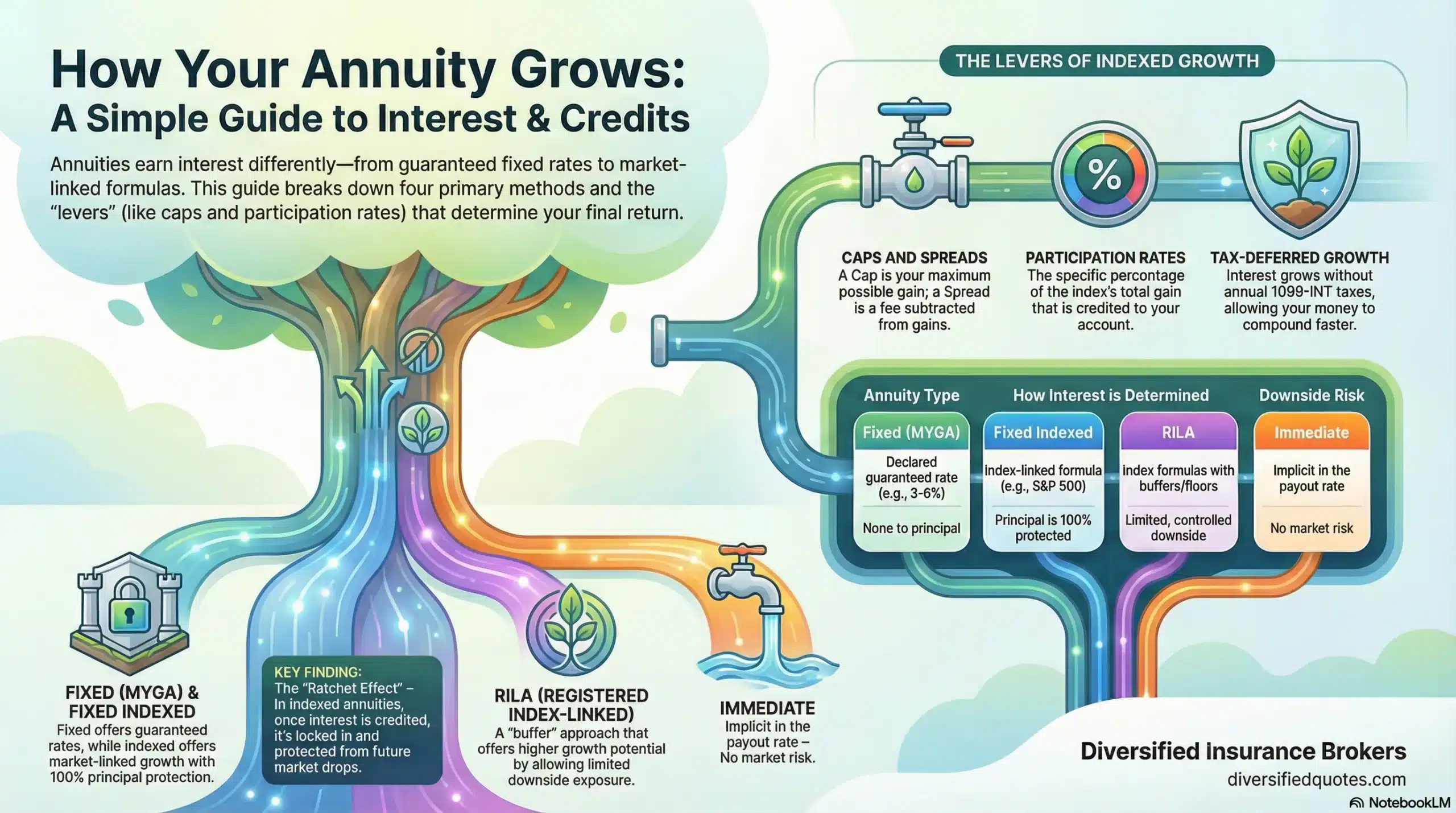
A fixed indexed annuity does not invest your money in the stock market. Instead, the insurer credits interest based on how a market index performs over a set period, subject to limits such as a cap or a participation rate, with a floor that prevents any loss from index declines. The basics are covered in fixed indexed annuities explained.
NexCompounder uses one-year point-to-point crediting for every index strategy. At the start of each one-year term, the index value is recorded. At the end of the term, it is compared with the starting value. If the index rose, interest is credited according to the cap or participation rate you selected; if it was flat or fell, the credit for that year is zero. NexAnnuity’s materials state plainly that indexed interest will never be less than zero.
Two features of this design matter most. First, gains credited at the end of each term become part of your account value and cannot be lost to later index declines, so the contract ratchets upward over time. Second, each term stands alone: a strong year cannot carry extra credit into the next year beyond the cap or participation limit, and a poor year does not reduce the value. Credits on price indexes such as the S&P 500 also exclude the dividends paid by the companies in the index, which is one reason indexed results differ from investing directly in the market.
Point-to-Point With a Cap
A cap sets the ceiling on what a single term can credit. If the index gain is below the cap, you receive the full gain; if it is above the cap, you receive the cap. NexCompounder offers capped strategies on the S&P 500 and on the Nasdaq-100 Volatility Control 12% NC Index. Our article on what an annuity cap rate is explains how carriers set caps.
The table below shows how a capped strategy works using a purely hypothetical cap of 8 percent and hypothetical index returns. These figures are not NexCompounder’s current rates and do not represent any actual market period.
| Hypothetical Index Change for the Year | Interest Credited With an 8% Cap | Why |
|---|---|---|
| +15% | 8% | Gain above the cap is limited to the cap |
| +5% | 5% | Gain below the cap is credited in full |
| 0% | 0% | No gain, no credit |
| -12% | 0% | The floor prevents any loss from the decline |
Capped strategies tend to work best in years of moderate gains, when much of the index’s rise falls under the cap. In very strong years they give up the upside above the cap. Because the cap is declared for each one-year term and can change at renewal, the cap you start with is not guaranteed for the life of the contract.
Point-to-Point With a Participation Rate
A participation rate hands you a set share of the index’s gain, with no ceiling on how large the credit can be. If the participation rate is 50 percent and the index rises 10 percent in a term, the credit is 5 percent; if the index rises 30 percent, the credit is 15 percent. As with caps, a flat or negative year credits zero. Our explainer on what an annuity participation rate is goes deeper.
NexCompounder offers participation strategies on all three of its indexes. Participation rates on volatility-controlled indexes are typically set higher than on the S&P 500, because those indexes are designed to move less dramatically. On NexCompounder’s rate sheet, the participation rate on the Franklin US Core Plus Index was set above 100 percent, meaning the strategy credited more than the index’s own gain, while the S&P 500’s participation rate was the lowest of the three. Those relationships can change whenever rates are reset.
The choice between a cap and a participation rate comes down to the kind of year you expect. A participation strategy captures a share of very large gains that a cap would cut off, while a cap strategy usually credits more in modest years. Many owners split their allocation between the two, so that the contract benefits in either kind of market without needing to predict which will occur.
The Three Index Choices
The S&P 500 is the most familiar benchmark, tracking 500 large U.S. companies, and NexCompounder pairs it with both a capped and a participation strategy. Its price movements are well understood and widely reported, which makes it easy to follow. NexAnnuity’s fixed index annuities page describes all three of NexCompounder’s indexes. Our guide to the S&P 500 index in an annuity covers how it is used in indexed contracts.
The Nasdaq-100 Volatility Control 12% NC Index is built on the Nasdaq-100, a group of large, growth-oriented, technology-heavy companies, with a mechanism that adjusts exposure to target annualized volatility of about 12 percent. It is available with a cap or a participation rate. Our page on Nasdaq indexes in annuities explains how these indexes are typically constructed.
The Franklin US Core Plus Index blends U.S. equities and fixed income and uses a volatility control target of 7.5 percent, offered only with a participation rate. Volatility-controlled indexes smooth returns by shifting toward cash or bonds when markets become turbulent, which tends to produce steadier but more modest index performance, often paired with higher participation rates. Our article on why volatility targeting is widely used explains the trade-off between smoother results and lower raw returns.
The One-Year Fixed Rate Option
Alongside the indexed strategies, NexCompounder offers a one-year fixed rate strategy. Money allocated there earns a declared interest rate for the year, regardless of index performance. The rate is declared for one year at a time and can change in later years.
The fixed option serves several purposes. It gives conservative owners a predictable piece of the contract while the rest pursues index-linked growth. It provides a parking place for money when an owner prefers not to take index exposure in a given year. And in most fixed indexed annuities, allocations can be changed at each term anniversary, which lets owners move between fixed and indexed crediting as their outlook or needs change; NexCompounder’s reallocation rules should be confirmed in the contract.
On the rate sheets we reviewed, NexCompounder’s one-year fixed rate was in the same range as the longer-term rates on NexAnnuity’s own MYGAs, which made a partial fixed allocation a reasonable anchor. That relationship can shift as rates reset. Owners who want a guaranteed rate for several years, rather than one year at a time, may find a MYGA better suited to that portion of their money, as described later on this page.
Rates Reset Every Year
One of the most important facts about NexCompounder is that its caps, participation rates, and fixed rate are not locked for the full surrender period. NexAnnuity’s rate sheet states that indexed caps and participation rates are declared for each interest term and are subject to change, that the fixed rate is declared for one year, and that renewal rates may differ from the initial rates. Our article asking whether fixed indexed annuity rates change explains how renewals work across the market.
That matters when comparing illustrations. An illustration that assumes today’s cap or participation rate for every year of the contract shows only one possible outcome, and it can overstate results if renewal rates fall. Ask any illustration to show a range of rate assumptions, and pay attention to the insurer’s history of renewal rates on existing business when that information is available.
Renewal rate behavior is one of the hardest things to evaluate with a young product from a smaller insurer, because there is little track record to examine. Most fixed indexed annuity contracts set minimum guaranteed caps and participation rates that limit how low renewal rates can go, and those minimums become important protection in that situation; review NexCompounder’s in the contract before you buy. Our office can request them along with a current illustration.
Choosing Among Strategies
With six strategies to choose from, the allocation decision can feel complicated, but it can be approached in steps. Start with how much of the contract you want in the fixed option for predictability. Then decide between broad-market exposure through the S&P 500 and smoother, volatility-controlled exposure through the Nasdaq-100 or Franklin indexes. Finally, choose caps, participation rates, or a mix, based on whether you expect modest or large gains. A step-by-step framework appears in how to pick annuity indexes.
Diversifying across strategies is a common and sensible approach. No single strategy wins every year, and spreading money across two or three of them reduces the chance that one disappointing year dominates your results. Because each strategy credits on its own one-year term, a diversified allocation tends to produce steadier year-to-year growth.
Allocations are usually not permanent. In most fixed indexed annuities, owners can reallocate at each term anniversary based on the new rates declared for the coming year, and the NexCompounder contract defines how that works. Reviewing the renewal rates each year, and moving money toward the strategies offering the best terms at that time, is one of the simplest ways to get the most from a fixed indexed annuity over the full surrender period.
How Annual Locking Plays Out
A short hypothetical shows why annual resets and locked-in gains matter. Using the same illustrative 8 percent cap from the table above, imagine $100,000 placed in a capped strategy over three years in which the index rises 15 percent, then falls 12 percent, then rises 5 percent. The first year credits the cap, bringing the value to $108,000. The second year credits nothing, but the value stays at $108,000. The third year credits the full 5 percent, raising the value to $113,400.
Compare that with the index itself, which would have ended the three years only modestly higher after the decline. The annual reset meant the contract did not have to recover the second year’s loss before earning again; each new term started from the index level at the beginning of that term. In markets that swing up and down, that feature can work in the owner’s favor.
The same example shows the cost. In the strong first year, the cap gave up 7 of the index’s 15 percentage points of gain. Over long, steadily rising markets, a capped indexed annuity will usually trail the index itself. These figures are hypothetical and use an illustrative cap rather than NexCompounder’s current rates, which change from term to term.
Not sure how to split your money among NexCompounder’s strategies?
Help Me Allocate
7-Year or 10-Year Surrender Schedule
NexCompounder is offered with two surrender charge schedules. Both begin at 9 percent and decline over time, but the 10-year version stretches the decline over three more years. The product sheet notes that the percentages shown are rounded to whole numbers and that schedules may vary by state, so the exact figures in your contract are the ones that count.
| Policy Year | 7-Year Schedule | 10-Year Schedule |
|---|---|---|
| 1 | 9% | 9% |
| 2 | 8% | 8% |
| 3 | 8% | 8% |
| 4 | 7% | 7% |
| 5 | 6% | 6% |
| 6 | 5% | 5% |
| 7 | 4% | 4% |
| 8 | Schedule ends | 3% |
| 9 | Schedule ends | 2% |
| 10 | Schedule ends | 1% |
The first seven years are identical on both schedules. The only difference is that the 10-year version adds charges of 3, 2, and 1 percent in years eight through ten. On the rate sheet we reviewed, the caps, participation rates, and fixed rate were the same for both schedules, so the 10-year version offered no crediting advantage in exchange for the longer commitment. Unless current rates show a meaningful difference in favor of the 10-year schedule, the 7-year version is usually the better choice. It keeps the same early-year protection for the insurer and the same growth potential for you, while freeing your money three years sooner.
Annual Withdrawals and the MVA
Once the first policy year is over, each year you may take as much as a tenth of the account value without triggering a surrender charge or the MVA. The allowance is based on the account value at the previous policy anniversary, after that year’s index and interest credits are applied, so it grows as the contract earns interest.
Withdrawals above that allowance during the surrender period face both a surrender charge and a market value adjustment. The product sheet describes the MVA as an adjustment that can increase or decrease the amount withdrawn, determined by a formula tied to an external index, and adjustments of this kind generally respond to changes in interest rates. Our explainer on market value adjustments covers the mechanics.
Because no penalty-free withdrawals are described during the first policy year, money that might be needed within twelve months of purchase belongs elsewhere. After that, keeping annual withdrawals within the allowance is the simplest way to avoid both charges. Owners who expect to need regular income from the contract should plan their withdrawals around the policy anniversary, when the allowance is recalculated.
RMDs and Qualified Money
NexCompounder can be held as a traditional, Roth, SEP, or SIMPLE IRA, as well as with non-qualified money, and pension, profit-sharing, and defined benefit plan funding may be available with carrier approval. That breadth makes it usable for most retirement accounts an individual buyer is likely to have.
For required minimum distributions, the product sheet specifically excludes RMDs from the market value adjustment on withdrawals above the free amount. It does not say whether RMDs are also exempt from surrender charges, or how an RMD due in the first policy year would be handled, when no penalty-free allowance applies. Owners who are already subject to RMDs, or will be during the surrender period, should confirm those details in the contract and plan how each year’s distribution will be satisfied.
For Roth IRA money, a fixed indexed annuity’s tax-deferred growth becomes tax-free growth if withdrawals are qualified, and the original owner has no lifetime RMDs under current rules. That combination can make a Roth-funded NexCompounder an efficient place for money intended to compound for many years. For SIMPLE IRA money, timing matters, because early transfers out of a SIMPLE IRA can carry additional tax consequences, so check eligibility before moving it.
Adding Money During the First Year
Many single premium annuities accept only one payment. NexCompounder is described as a single premium deferred indexed annuity that allows additional premiums during the first year: the initial payment must be at least $25,000, and further deposits of $25,000 or more can be made throughout year one, with no stated limit on the number of deposits.
That flexibility can be useful for buyers whose money arrives in stages, such as a CD maturing a few months after a rollover, a home sale closing later in the year, or a bonus paid at year end. Rather than buying separate contracts, the buyer can consolidate the money in one contract during its first year.
Two practical points apply. First, each additional deposit is subject to the contract’s terms, including the surrender schedule, so confirm how the schedule applies to money added after issue. Second, after the first year ends, new money cannot be added, so any later savings would need a separate contract. Planning the full amount you intend to place before the first anniversary avoids having to open a second policy.
Funding With Multiple Transfers
A detail in the product sheet deserves attention from anyone funding NexCompounder with more than one source at the outset. If the policy is being funded with multiple purchase payments, such as several exchanges from existing annuities, the funds are held and the policy is not issued until all of the payments have been received. Interest is not credited between the dates the payments arrive and the date the policy is issued.
In practice, that means a slow transfer from one source can delay the start of interest on all of the money. If one custodian processes its transfer in a week and another takes six weeks, the money from the first source sits uncredited until the second arrives. For more on the exchange process itself, see 1035 exchanges in annuity planning.
There are ways to manage this. Starting the slowest transfer first, confirming each institution’s processing time in advance, and asking whether the contract can be issued with the first payment and the others added as first-year additional premiums can all reduce idle time. Our office can coordinate multi-source funding so the contract starts earning as soon as possible.
Owners, Annuitants, and Joint Contracts
The product sheet lists two ownership arrangements: a single owner, or joint annuitant and owner. The owner controls the contract, chooses allocations, takes withdrawals, and names beneficiaries, while the annuitant is the person whose life and age are used for contract purposes such as payout calculations. In many contracts the same person fills both roles.
When two people are on the contract, the age rules use whoever is oldest. A couple in which one spouse is 84 and the other is 80 is treated as 84 for issue purposes, and the latest maturity date is tied to the oldest person’s 95th birthday. That can shorten the time before the contract must begin paying out, which is worth considering when spouses are several years apart.
Joint arrangements also affect what happens at the first death and how the contract passes to heirs, and those provisions are set by the contract and state law rather than the summary sheets. Couples considering joint ownership should review those terms, and the beneficiary designations, with our office before applying.
Beneficiaries and the Death Benefit
The NexCompounder product sheet and rate sheet we reviewed do not describe the death benefit, so this is a provision to confirm in the contract itself. Many fixed indexed annuities pay beneficiaries the full account value at death without surrender charges, but some apply charges or pay a different value, and the difference can be substantial during the surrender period.
The question matters more for older buyers and for money intended for heirs. If a large share of the contract could pass to beneficiaries during the surrender period, the death benefit terms deserve as much attention as the caps and participation rates. Ask specifically whether the death benefit equals the account value, whether surrender charges or the market value adjustment apply, and what payout options beneficiaries will have.
When a non-qualified contract passes to heirs, the accumulated gains are generally taxable to them as ordinary income, since annuity gains do not get a stepped-up basis. Keeping primary and contingent beneficiaries current, and coordinating them with your estate plan, ensures the contract passes as you intend.
Funding NexCompounder from several accounts?
Coordinate My Transfers
Turning NexCompounder Into Income
NexCompounder is built for accumulation. The product sheet and rate sheet we reviewed do not describe a guaranteed lifetime withdrawal benefit or other income rider. For an accumulation annuity like this, annuitization is the usual route to guaranteed lifetime income, and the contract’s maturity date marks the latest point at which payouts must generally begin. Annuitization converts the account value into a stream of payments, either for life or for a set period, based on the payout rates available when you begin.
For buyers whose main goal is a guaranteed paycheck starting at a future date, that design is a limitation. Contracts with income riders let the income base grow at a guaranteed rate during deferral and allow lifetime withdrawals while the owner keeps access to the remaining account value. Annuitization, by contrast, generally gives up access to the lump sum in exchange for the payments.
For buyers whose main goal is growth with principal protection, having no income rider works in their favor, since no annual rider charge is being subtracted from the account value. Those owners can take withdrawals within the 10 percent annual allowance for supplemental income, annuitize later if guaranteed lifetime income becomes the priority, or move the money at the end of the surrender period to a contract designed specifically for income. Deciding which of those paths you expect to follow is part of deciding whether NexCompounder fits.
Ages and the Maturity Date
NexCompounder can be issued from age 0 through 85, and the age limit is measured by the oldest of all owners and annuitants: a policy cannot be issued on or after the 86th birthday of the oldest person on the contract. For joint ownership, that means the older spouse’s age is the one that counts.
The contract also has a latest annuity maturity date, no later than the first policy anniversary on or after the oldest owner’s or annuitant’s 95th birthday. By that point, the contract must generally begin paying out under its terms. For an older buyer, the maturity date can arrive within or shortly after the surrender period, so it is worth understanding what options the contract provides when that date approaches.
Age also affects suitability. A buyer in their late seventies or eighties placing money in a 7- or 10-year fixed indexed annuity is committing a large share of their remaining years to the surrender schedule, which is why insurers and advisors look closely at liquidity and other assets in those cases. For older buyers, the 7-year schedule, a meaningful cash reserve elsewhere, and a clear plan for the money at the end of the term all carry extra weight.
NexCompounder Versus NexAnnuity’s MYGAs
NexAnnuity offers two multi-year guaranteed annuities alongside NexCompounder, and the choice between them comes down to how you want to earn interest. Our review of the NexHaven MYGA annuity covers Ohio State Life’s fixed-rate contract, which locks a rate for 3, 5, 7, or 10 years and sells its withdrawal, death benefit, and nursing home features as optional riders.
Our review of the NexVantage MYGA annuity covers the other fixed-rate option, which builds its flexibility features into the base contract and is issued by a different, newer insurer. Both MYGAs guarantee their rates for the full initial term, while NexCompounder’s caps, participation rates, and fixed rate are declared one year at a time.
The practical difference is certainty versus potential. A MYGA tells you exactly what you will earn over the term. NexCompounder offers the chance to earn more in strong market years, with zero credited in flat or down years and renewal rates that can change. NexCompounder also has a lower minimum premium than the MYGAs and accepts additional deposits during its first year. Some buyers split their money, placing the portion they want fully predictable in a MYGA and the portion they are comfortable leaving to index performance in NexCompounder.
Where NexCompounder Is Available
Four states fall outside Ohio State Life’s licensing, Vermont, Maine, Connecticut, and New York, and residents there cannot purchase NexCompounder. The rate sheet we reviewed also noted that North Carolina was scheduled to begin accepting new business at a future date, so North Carolina residents should confirm whether the product is open to them.
Elsewhere, the product and its features remain subject to state approval, and the product sheet notes that surrender charge schedules may vary by state. Before applying, confirm that NexCompounder and the specific strategies and schedule you want are approved in your state, and request the state-specific contract.
Your state of residence also determines your guaranty association protection if the insurer were ever to fail. Coverage limits for annuities vary by state, and for a B+ rated issuer, that ceiling makes a useful yardstick for sizing any one purchase, with anything larger divided among several insurers and products.
How NexCompounder Is Taxed
Interest credited to a non-qualified NexCompounder contract, whether from index strategies or the fixed rate, is tax-deferred until withdrawn. When money comes out, the IRS generally treats gains as leaving first and taxes them at ordinary income rates, and withdrawing taxable money ahead of age 59 and a half can add a 10 percent penalty. Index-linked interest is taxed as ordinary income, not as capital gains, even though it is based on stock index performance.
Inside an IRA, the IRA’s own rules apply: traditional and SEP IRA withdrawals are generally fully taxable, qualified Roth withdrawals are generally tax-free, and the contract does not add any tax benefit beyond what the account already provides. Moving money into NexCompounder from another IRA or annuity is normally done by direct transfer or tax-free exchange to avoid triggering tax.
At the end of the surrender period, owners who no longer need tax deferral can take the money, while those who want continued deferral can leave it in place or move it to another annuity through a tax-free exchange. Because a full surrender of a non-qualified contract makes all accumulated gains taxable in one year, spreading withdrawals or exchanging the contract can help manage taxes. A tax professional should review any significant decision.
Who NexCompounder Fits, and Who It Does Not
NexCompounder tends to fit savers with at least $25,000 who want index-linked growth potential with protection from market losses, can leave the money in place for seven or ten years, and are comfortable with a B+ rated insurer. It also suits buyers who want a simple strategy menu, those who plan to add money during the first year, and those who prefer a contract without income rider fees.
The product suits buyers less well if they want guaranteed lifetime income with a growing income base, since no income rider is described, and for those who want a rate locked for several years, who are usually better served by a MYGA. It also does not suit buyers who need access to more than 10 percent of their money in a year during the surrender period, who need access in the first year, or who require an A-rated insurer. And it is off the table entirely in the four states where the issuer holds no license.
The final test is the comparison. NexCompounder’s caps and participation rates should be weighed against fixed indexed annuities from higher-rated insurers with similar surrender periods. If NexCompounder’s terms are meaningfully better, and the amount placed is sized sensibly, it can serve well as the growth-oriented, principal-protected portion of a retirement plan.
Questions to Ask Before You Buy
Open with the surrender schedule: do current rates differ between the 7-year and 10-year versions, and if not, is there any reason to choose the longer one? Then look at the strategies. What are the current caps, participation rates, and fixed rate? What minimum guaranteed caps and participation rates does the contract set, and how have renewal rates on existing NexCompounder contracts compared with initial rates?
Next, cover access and liquidity. How are required minimum distributions treated, including in the first year? How does the surrender schedule apply to additional premiums made during year one? What happens at the maturity date, and does the contract include a death benefit provision that pays the full account value without surrender charges? These details are set by the contract and should be confirmed before you apply.
Finally, consider the issuer and the alternatives. Are you comfortable with Ohio State Life’s B+ rating for the full surrender period? Does your planned purchase fit under the guaranty association ceiling where you live? Would a MYGA, or a fixed indexed annuity from a higher-rated insurer, serve the same purpose with less risk or more certainty? Clear answers make it far easier to commit confidently for seven or ten years.
How Our Office Helps
Any NexCompounder recommendation from our office starts with what the money needs to accomplish and how long it can stay committed. Jason and our office ask about your timeline, your comfort with index-linked results versus fixed rates, whether lifetime income is a goal, how much of your savings the purchase represents, and how you feel about a B+ rated insurer.
From there, we compare NexCompounder’s current caps, participation rates, and fixed rate with fixed indexed annuities and MYGAs from other carriers, including higher-rated insurers, and we show how different allocations might perform under a range of rate assumptions rather than a single optimistic case. We also confirm the contract details the summary sheets leave open. If you wonder whether a broker adds cost, our article is using a broker cheaper answers that.
When you decide to move forward, we coordinate the application, transfers, rollovers, and any first-year additional deposits so the contract starts crediting as soon as possible. After issue, we can review your allocation at each anniversary as new rates are declared, so your money stays in the strategies offering the best terms throughout the surrender period.
Ready to see how NexCompounder compares with other indexed annuities?
Talk to Our Office
Financial Protection Essentials
More guides to fixed indexed annuities and how to choose one.
Talk to an Advisor or Request Your Annuity Quote
Ready to explore this annuity in more detail—or compare it with other carriers to see if even higher rates are available? With guaranteed income, principal protection, and long-term growth potential on the line, making the right choice is essential. The experienced advisors at Diversified Insurance Brokers will guide you through the options and design a strategy tailored to your retirement goals.
Schedule here:
calendly.com/jason-dibcompanies/diversified-quotes
Licensed in all 50 states • Fiduciary, family-owned since 1980
Frequently Asked Questions
Is my principal at risk in NexCompounder?
Not from index declines, because indexed interest is never less than zero and credited gains are locked in each year. You can lose value by surrendering early, since surrender charges and a market value adjustment can apply, and all guarantees depend on Ohio State Life’s ability to pay. Our article asking whether you lose principal in an indexed annuity explains the protections.
Does NexCompounder have an income rider?
The materials we reviewed do not describe one. Guaranteed income would generally come from annuitizing the contract, and no guaranteed lifetime withdrawal benefit with a growing income base is described. Buyers who want that feature should compare contracts built for it, such as the designs covered in indexed annuities with income riders.
Does NexCompounder offer a premium bonus?
No premium bonus is described in the product sheet or rate sheet we reviewed. That is not necessarily a drawback, since bonus annuities often fund the bonus through longer surrender periods or lower crediting rates. Judge the contract on its caps, participation rates, surrender schedule, and issuer rather than on whether it offers a bonus.
How are NexCompounder withdrawals taxed in retirement?
With non-qualified money, the IRS treats earnings as leaving before premium, and those earnings, index-linked interest included, count as ordinary income. IRA-held contracts follow the IRA’s rules, with traditional IRA withdrawals generally fully taxable. Our guide to annuity taxes in retirement covers each situation.
How does NexCompounder handle required minimum distributions?
The product sheet exempts RMDs from the market value adjustment when they exceed the annual allowance, but it does not spell out surrender charge treatment or first-year handling. Confirm those terms in the contract before funding with IRA money subject to RMDs. How the yearly amount is figured is covered in the rules for required distributions.
Can I use NexCompounder for a Roth conversion?
NexCompounder accepts Roth IRA funding, so converted money can be placed in it to grow with principal protection and, if withdrawals are qualified, without future income tax. The conversion itself is taxable in the year it occurs. Our article on Roth conversions with a fixed index annuity covers the strategy.
Should I choose NexCompounder or a fixed-rate annuity?
Choose a fixed-rate MYGA if you want a known rate for the full term, and an indexed annuity like NexCompounder if you want the chance at higher credits in exchange for years that may credit nothing. Some buyers use both. Our comparison of fixed vs. fixed indexed annuities lays out the trade-offs.
Can I withdraw money before age 59 and a half?
You can, within the contract’s withdrawal rules, but taxable money taken out before that age generally carries an extra 10 percent IRS penalty along with regular income tax. Exceptions exist, and planning can sometimes avoid the penalty. Our guide to avoiding the early withdrawal penalty explains the options.
What is the difference between point-to-point and other crediting methods?
Point-to-point compares the index value at the start and end of each term and ignores movements in between. Other methods, such as monthly averaging or monthly caps, measure performance differently and can produce different results in the same market. Our overview of index annuity crediting methods compares them.
About the Author:
Jason Stolz, CLTC, CRPC, DIA, CAA and Chief Underwriter at Diversified Insurance Brokers (NPN 20471358), is a senior insurance and retirement professional with more than 25 years of real-world experience helping individuals, families, and business owners protect their income, assets, and long-term financial stability. As a long-time partner of the nationally licensed independent agency Diversified Insurance Brokers, Jason provides trusted guidance across multiple specialties—including fixed and indexed annuities, long-term care planning, personal and business disability insurance, life insurance solutions, Group Health, Travel Medical and Evacuation Insurance, and short-term health coverage. Diversified Insurance Brokers maintains active contracts with over 100 highly rated insurance carriers, ensuring clients have access to a broad and competitive marketplace.
His practical, education-first approach has earned recognition in publications such as VoyageATL, and contributions from his agency featured in Kiplinger and GoBankingRates— highlighting his commitment to financial clarity and client-focused planning. Drawing on deep product knowledge and years of hands-on field experience, Jason helps clients evaluate carriers, compare strategies, and build retirement and protection plans that are both secure and cost-efficient. Visitors who want to explore current annuity rates and compare options across multiple insurers can also use this annuity quote and comparison tool.
Explore More Annuity Options: Browse our complete guide to Best Fixed Indexed Annuity Products — covering individual fixed indexed annuity product reviews from top-rated carriers from 100+ carriers.
Last Reviewed: October 19, 2026 |
Reviewed by: Jason Stolz, CLTC, CRPC, DIA, CAA
Chief Underwriter, Diversified Insurance Brokers, Inc. | NPN: 20471358 | Diversified Insurance Brokers, Inc. — Licensed in all 50 states
Fact Checked by: Tonia Pettitt, CMIP©
Medicare Specialist, Diversified Insurance Brokers, Inc. | NPN: 14374308 | Diversified Insurance Brokers, Inc. — Licensed in all 50 states
Did you find this content helpful? Leave us a Google review — it helps others find trustworthy guidance too.
Editorial Standards: Diversified Insurance Brokers maintains rigorous editorial standards to ensure accuracy, clarity, and independence in all content. Learn more about our editorial standards and commitment to transparency.
