
How to Prescreen a Disability Insurance Application
As an Independent Disability Insurance Broker, we have access to exclusive discounts and negotiated pricing most captive agents can’t offer — see the full breakdown near the end of this page.
How to Prescreen a Disability Insurance Application

Jason Stolz CLTC, CRPC, DIA, CAA
A disability insurance prescreen does everything a life insurance prescreen does and then tests two things a life prescreen barely touches: how each carrier will classify your occupation, and how much monthly benefit your documented income will support. Those two factors often move the premium more than your health does. The same anesthesiologist, attorney, dentist, or engineer can land in different occupation classes at different carriers, with different own-occupation definitions, benefit limits, and discounts, and the only way to see those differences before you apply is to test the case first. Everything else on this page sits on top of that.
Jason Stolz, CLTC, CRPC, DIA, CAA, is Chief Underwriter at Diversified Insurance Brokers, and prescreening disability applications is work our office handles regularly for physicians, dentists, attorneys, business owners, and other professionals whose income depends on specialized skills. As an independent disability insurance broker, our office tests your occupation, income, and medical history against the carriers most likely to treat them favorably, then recommends where to apply and how to structure the policy before a single formal application is filed.
Want to know how carriers will classify your occupation before you apply?
Start My Disability Prescreen
What a Disability Insurance Prescreen Tests
| Prescreen Area | What We Gather | Why It Matters |
|---|---|---|
| Occupation and Duties | Title, specialty, daily duties, percentage of time on physical tasks | Sets the occupation class, which drives price and contract options |
| Earned Income | Salary, bonuses, business income, tax returns, years in practice | Determines the maximum monthly benefit a carrier will issue |
| Existing Coverage | Group long-term disability, other individual policies, association plans | Counts against the total coverage a carrier allows |
| Medical History | Conditions, treatment, medications, injuries, mental health history | Predicts exclusions, ratings, or postponements |
| Lifestyle and Records | Avocations, driving record, foreign travel, financial history | Can add exclusions or limit eligibility |
| Discount Eligibility | Association memberships, employer groups, training status | Can lower premiums without changing the coverage |
| Policy Design | Benefit period, elimination period choices explained, definition preferences | Lets carriers be compared on equal terms; see disability insurance riders explained |
What Is a Disability Insurance Prescreen?
A prescreen is an informal review of your case by carrier underwriters before you submit a formal application. Our office summarizes your occupation, duties, income, existing coverage, and health history, removes identifying details such as your name and date of birth, and asks underwriters at the carriers most likely to fit your profile how they would view the case. Their answers are opinions rather than offers, but they show which companies are likely to approve you, at what occupation class, with what exclusions, and with how much benefit.
The process mirrors the one we use for life insurance, described in our guide on how to prescreen a life insurance application. Because the inquiry is anonymous, it does not create the application record that a formal submission does. That matters, because a formal decline or a heavily modified offer from one carrier must often be disclosed on later applications and can shape how other underwriters read your file.
A disability prescreen is also a comparison tool. Carriers do not just differ in price; they differ in how they define disability, how they handle partial disability, which riders they offer, and how they classify each occupation. Testing several carriers at once shows those differences side by side, so the final recommendation is based on the full contract rather than the first quote.
Prescreen feedback is not binding. Underwriters base their opinions on the summary they receive, and the formal application, medical records, and any exam can still change the result. A well-prepared prescreen, however, narrows the uncertainty dramatically and keeps you from applying blind to a carrier that was never going to offer the terms you need.
Why Disability Prescreens Go Further Than Life Prescreens
A life insurance underwriter is asking one question: how long is this person likely to live? A disability insurance underwriter is asking a harder one: how likely is this person to become unable to work, for how long, and how much would the carrier pay? That difference changes almost everything about how a disability case should be prepared.
First, occupation matters far more. Life carriers care about occupation mainly when the job is physically dangerous. Disability carriers care about every occupation, because the duties of the job determine how easily an injury or illness could stop you from working, and because claims experience varies widely between professions. Each carrier sorts occupations into classes, and the class sets your price, your contract options, and sometimes whether coverage is available at all.
Second, income matters as a limit, not just a justification. Life carriers want to see that a death benefit is reasonable relative to income and net worth. Disability carriers cap the monthly benefit at a share of your earned income, after counting any coverage you already have, because a benefit that exceeds lost earnings removes the incentive to return to work.
Third, medical history is read differently. Conditions that barely affect life insurance pricing, such as a back injury, carpal tunnel symptoms, migraines, or past counseling for anxiety, can lead to exclusions on a disability policy. That is why a disability prescreen tests all three dimensions together: a carrier with an excellent occupation class for your profession may be strict about a condition in your history, while another may be more flexible medically but less favorable on class.
Occupation Classes: The Biggest Variable
Every individual disability carrier assigns applicants to occupation classes, usually numbered from one through five or six, sometimes with letters added to mark medical or professional subcategories. Higher classes are reserved for occupations with the lowest claims risk, typically office-based professionals, and they come with lower premiums, longer benefit periods, and the strongest contract features. Lower classes apply to occupations with more physical exposure and come with higher costs and fewer options. Our overview of disability insurance by occupation shows how widely occupations are treated.
The crucial point is that classes are not standardized. Each carrier publishes its own occupation guide, built on its own claims experience, and the same occupation can be placed in different classes by different carriers. A specialty one company treats as its top class may sit a class lower at another company. Even within a single carrier, the class can change with duties, such as whether a dentist performs surgery, whether an engineer works in the field, or whether a physician performs procedures.
Because the class affects so much at once, a one-class difference can change the premium significantly and can determine whether a true own-occupation definition is available. Testing the class at several carriers is therefore the first job of a disability prescreen, and it is often where the largest savings are found.
Class guides also change over time as carriers update their experience and their appetite for certain professions. A class assignment that was accurate a few years ago may not reflect how a carrier treats your specialty today, which is another reason to test current underwriting rather than rely on a published chart alone.
Describing Your Duties Accurately
Underwriters classify the work you actually do, not just your title. Two people with the same title can have very different duties: a general contractor who manages projects from an office versus one who works on job sites daily, or a nurse in an administrative role versus one providing bedside care. Carriers often ask what percentage of your time you spend on physical tasks, travel, supervision, and office work, and those percentages can move you between classes.
For many occupations, the job descriptions published by the U.S. Bureau of Labor Statistics are a useful starting point for thinking about typical duties, but the description that matters is the one that matches your own workday. If you have a specialized role, a mixed role, or recent changes in your duties, the prescreen should say so clearly, because a vague description often leads underwriters to assume the riskier version of the job.
Accuracy works in both directions. Understating physical duties to reach a better class can create problems at claim time, when the carrier reviews what you actually did before becoming disabled. Overstating them can cost you a better class you have earned. The goal is a precise, honest description that gives each underwriter what it needs to classify you correctly.
Occupations with elevated physical exposure or unusual hazards deserve particular care. Our page on disability insurance for high-risk occupations covers the extra steps those cases often require, including carriers or programs that accept occupations the mainstream market avoids. For any occupation, our office reviews the description with you before it goes to underwriters, so that the classification reflects how you really work.
Own-Occupation Definitions Depend on Your Class
The definition of disability is the most important provision in any disability policy, and the prescreen should confirm which definitions each carrier will offer for your occupation. Under a true own-occupation definition, total disability means being unable to handle the material and substantial duties of the occupation you hold, whether or not you earn money doing something else. Our guide to own-occupation disability insurance explains how those definitions vary.
Carriers often tie definitions to occupation class. Professionals in the top classes can usually buy true own-occupation coverage, sometimes built into the base contract and sometimes as a rider. Lower classes may be limited to modified own-occupation definitions, which stop paying total disability benefits if you choose to work in another occupation, or to shorter own-occupation periods that later switch to a broader definition.
That link means the class question and the definition question have to be answered together. A carrier that offers a slightly lower premium may do so because it places you in a class that does not qualify for true own-occupation coverage, while a carrier with a slightly higher premium may include the stronger definition. Comparing premiums without comparing definitions can lead to a policy that costs less only because it promises less.
For specialists, the definition can also be refined. Some carriers recognize a medical or dental specialty as the occupation itself, so a surgeon who can no longer operate is treated as disabled even if able to teach or consult. A prescreen should confirm how each carrier will describe your occupation in the contract, since that description determines what the definition actually protects.
Medical Professionals: Why Carrier Choice Matters So Much
Physicians, dentists, and other medical professionals are among the most important disability insurance buyers, because their incomes are high, their training is long, and their careers depend on specialized skills. They are also among the professions where carrier differences are greatest. Carriers have different claims experience with different specialties, and that experience shows up in how each one classifies surgeons, anesthesiologists, emergency physicians, dentists, and other specialists.
Those differences affect more than price. They determine whether the specialty can be named as the occupation, how residual benefits are calculated, how future purchase options can be exercised as income rises, and whether discounts apply. Our page on disability insurance for physicians covers how carriers approach the medical profession broadly.
Timing is another factor. Residents and fellows often have access to programs that allow meaningful coverage without full income documentation and with discounts that are not available later, and buying during training can lock in definitions and health status before any medical history develops. Our guide to disability insurance during medical residency explains those options.
For practicing physicians, the prescreen focuses on which carriers classify the specialty most favorably, which will name the specialty in the contract, and which discounts the physician qualifies for. Carriers frequently compared for medical professionals include those covered in our reviews of Guardian Provider Choice disability insurance and Ameritas DInamic Cornerstone income protection, among others, and the right choice depends on the specialty, the state, and the features that matter most to the physician.
From Our Office: An Anesthesiologist’s Rate Review
An anesthesiologist came to our office with an existing disability insurance quote and a simple question: could we improve the rate? We could, for two reasons that illustrate exactly why prescreening matters for medical professionals. The first was an exclusive association discount available through our office, which lowered the premium without changing the coverage. The second was our knowledge of which carriers are most favorable to medical professionals, including how each one classifies anesthesiology.
Anesthesiology is a specialty where carrier differences are meaningful. Some carriers place it in their top medical class with strong specialty definitions, while others are more conservative in classification or contract terms. Knowing where each carrier currently stands allowed the case to go to the companies most likely to classify the client well, rather than to whichever carrier produced the first quote. Our page on disability insurance for anesthesiologists covers the specialty in more detail.
A lower premium only helps if the coverage is at least as strong, so every rate review should compare the definition of disability, the residual and recovery benefits, the cost-of-living and future increase options, and the treatment of mental and nervous conditions alongside the price. A discount on weaker coverage is not an improvement.
The broader lesson applies well beyond anesthesiology. Many professionals hold quotes or policies that were never tested against the full market, never had available discounts applied, or were placed with a carrier that classifies their occupation less favorably than others do. A prescreen is how those gaps are found before you commit to a policy, and a review is how they are found afterward.
Income: How Much Benefit You Can Qualify For
Disability carriers will not insure all of your income. Each carrier publishes issue and participation limits that cap the total monthly benefit you can have from all sources, generally as a percentage of earned income that declines as income rises. The limits differ from carrier to carrier, so the same income can support a different maximum benefit at different companies.
Existing coverage counts against those limits. A group long-term disability plan through your employer, an association plan, or another individual policy reduces the amount a new carrier will issue. Group benefits that are paid with pre-tax employer dollars may also be treated differently from individual coverage, because the benefit would be taxable. The prescreen should account for every existing policy so the requested amount is realistic.
Documentation is the other half of the income question. Employees usually document income through pay stubs, W-2 forms, and tax returns. Bonuses and commissions are often averaged over several years. Some carriers allow special programs for residents, new graduates, and professionals early in their careers that provide coverage with limited income documentation, while others require a full financial history.
Income that is not earned through work, such as investment income or rental income, generally does not support disability coverage, and very large unearned income can even reduce how much a carrier will issue. A prescreen that tests income alongside occupation and medical history shows which carrier will offer the most usable benefit, not just the lowest premium per dollar of coverage.
Self-Employed Professionals and Business Owners
Self-employed applicants face the most detailed income review. Carriers generally base the benefit on net earned income after business expenses, as shown on personal and business tax returns, rather than on gross revenue. Owners of practices and firms may also have income flowing through partnerships, S corporations, or other entities, and each carrier has its own rules for counting salary, distributions, and retained earnings. Our guide on whether self-employed people can get disability insurance covers the documentation carriers typically require.
Time in business matters as well. Applicants who have been self-employed for only a year or two may face lower benefit limits or extra documentation, while established owners with several years of consistent returns usually qualify for the full amount their income supports. A business that shows a lower profit because of aggressive expense deductions can also produce a lower benefit, which is a trade-off worth discussing with your CPA.
The prescreen is especially valuable here because carriers differ in how they read business income. One carrier may add back certain expenses or count a portion of retained earnings, while another may use only the taxable income on the return. Presenting the financials to several underwriters before applying shows which one will support the benefit you actually need.
Business owners should also consider coverage beyond personal income protection. Business overhead expense coverage pays fixed business costs during a disability, and buy-sell and key person disability coverage protect partners and the business itself. A prescreen can test those coverages at the same time, since many of the same documents support all of them.
Medical History in a Disability Prescreen
Disability underwriters review medical history with the question of future work capacity in mind, which leads them to use tools life underwriters rarely need. The most common is an exclusion rider, which removes coverage for disabilities arising from a specific condition or body part, such as the lower back or a previously injured knee, while leaving everything else covered. Others include premium ratings, shortened benefit periods, and postponements until a condition has been stable for a period of time.
Conditions that appear minor on a life application can matter here. Back and neck problems, joint injuries, carpal tunnel symptoms, migraines, sleep disorders, and past treatment for anxiety or depression are all common reasons for exclusions or modifications. Our guide to disability insurance with preexisting conditions explains how carriers handle the most common histories.
Carriers vary widely on these decisions. One may exclude a recovered back injury for the life of the policy, while another may offer coverage without an exclusion after a symptom-free period or may limit the exclusion to a specific diagnosis. Some carriers will reconsider an exclusion after several years without treatment. The prescreen describes the history with dates, treatment, and current status so each underwriter can give its most accurate opinion.
The prescreen also anticipates what the formal application will require. Depending on age, benefit amount, and carrier, underwriting may include a paramedical exam, blood and urine testing, or a phone interview, and higher benefits generally mean more requirements. Exam requirements are covered in our article answering whether disability coverage requires an exam.
Residual Benefits and Riders the Prescreen Should Compare
Two policies with the same monthly benefit and the same definition can still pay very differently, because the riders and partial disability provisions differ. A prescreen should compare those features at each carrier alongside class and price, so the recommendation reflects how the policy would actually perform at claim time.
Residual disability benefits pay a portion of the monthly benefit when a disability reduces your income without stopping you from working entirely. Carriers differ in the minimum income loss that triggers benefits, in how prior income is measured, and in whether residual coverage is built into the base contract or added by rider. Our explanation of residual disability benefits explained covers those differences. For professionals whose income could drop sharply after a partial disability, these provisions often matter as much as the total disability definition.
Future increase options allow additional coverage to be added later, as earnings rise, with no fresh medical review, a feature that is especially valuable for younger professionals and those early in practice. Our page on the future insurability rider for disability coverage explains how these options work. Cost-of-living adjustments, mental and nervous provisions, and catastrophic disability benefits round out the comparison.
Because riders add cost, the prescreen also identifies which ones are worth paying for in your situation. A carrier that includes a feature in its base contract may be a better value than one that sells the same feature as an add-on, even when the base premium looks higher.
Discounts the Prescreen Should Uncover
Discounts are one of the most overlooked parts of disability insurance pricing, and they can change which carrier offers the best value. Carriers commonly offer discounts for association membership, for groups of employees who buy coverage together through an employer, and for medical and dental residents. Some carriers also offer pricing advantages for applying through certain application processes or for accepting certain contract provisions.
Not every applicant qualifies for every discount, and the rules vary by carrier, state, and occupation. Some discounts require membership in a specific association, a minimum number of participants, or a particular training status. Others are available only for certain occupation classes. A discount that looks large on one carrier’s quote may also depend on accepting a narrower provision, so the discount and the coverage need to be evaluated together.
The exclusive association discount available through our office is one example of how this can change a result, as the anesthesiology case above shows. When the discount is combined with a carrier that classifies the occupation favorably, the savings can be significant without any loss of coverage.
A prescreen checks discount eligibility at the start rather than after an application has been submitted. That way, the quotes being compared already reflect every discount you qualify for, and the recommendation is based on your real cost. If you already own a policy, a review can show whether a discount was missed when it was issued.
Already have a disability quote or policy you want tested against the market?
Review My Disability Quote
Testing Benefit Periods and Elimination Periods
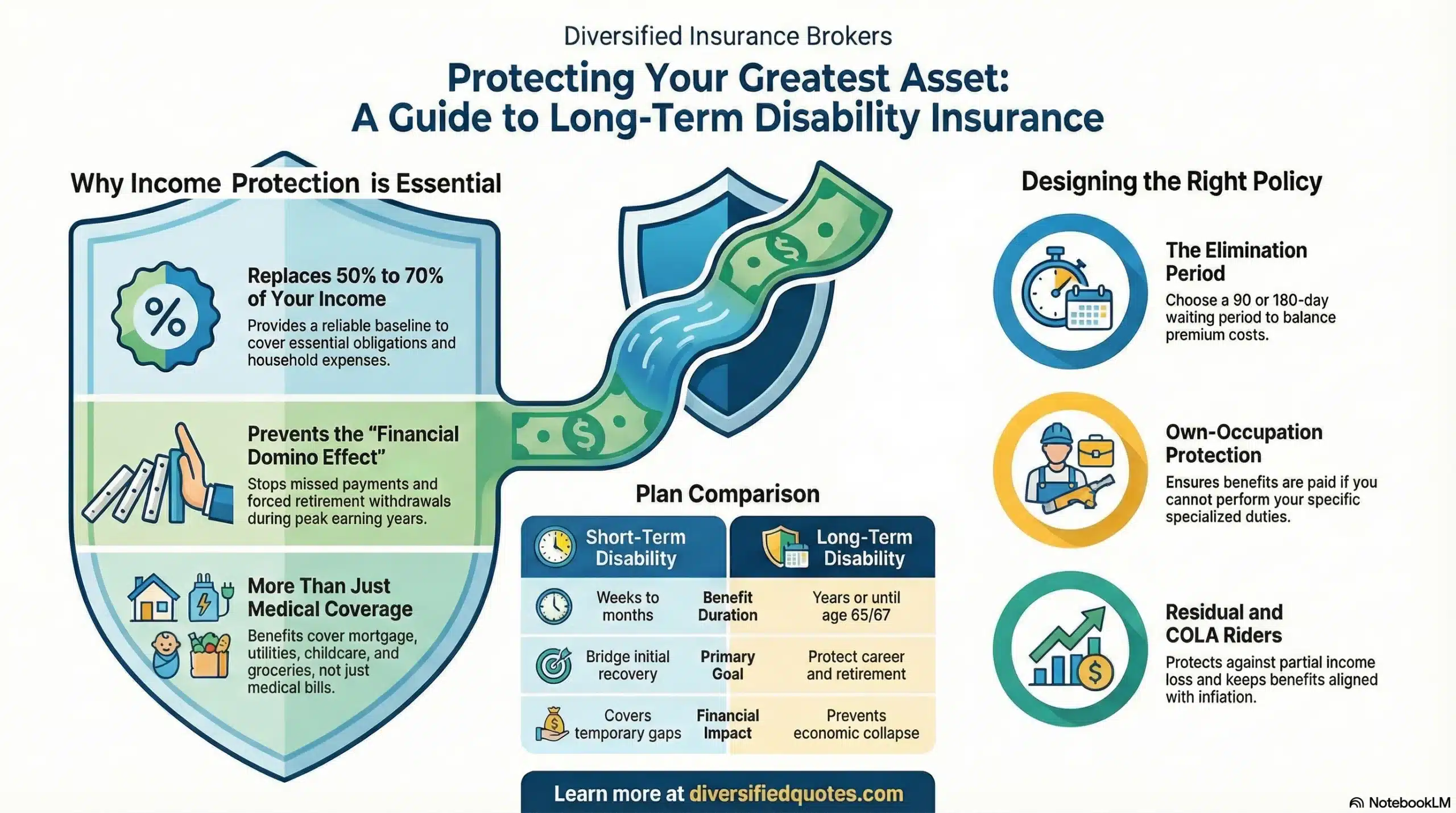
A prescreen is also the right time to settle the two policy settings that shape cost the most after occupation class: the benefit period and the elimination period. The benefit period is how long benefits can be paid during a covered disability, commonly a set number of years or to a specified age such as 65 or 67. The elimination period is the waiting time between the start of a disability and the first benefit payment, commonly 90 days for professionals, though shorter and longer options exist.
Each setting involves a trade-off. A benefit period that runs to retirement age protects against a career-ending disability but costs more than a shorter period. Waiting longer for benefits to start reduces the premium, provided savings or other income can carry you through the gap. For a professional with substantial emergency savings, a longer elimination period can free up premium dollars for stronger contract features. For someone early in a career with limited savings, a shorter wait may be worth the higher cost.
Carriers do not price these choices identically. One carrier may charge relatively little to extend the benefit period, while another may offer a larger discount for a longer elimination period. Some limit the options available to certain occupation classes. Testing the same settings at each carrier, and then testing one or two alternatives, shows where the best value lies.
The prescreen therefore compares carriers on equal terms first, using the same benefit period, elimination period, and riders, and only then explores whether a different combination would deliver better protection for the money. That sequence keeps the comparison honest and prevents a lower premium from hiding a shorter benefit period or a longer wait.
Group Coverage Versus Individual Coverage in a Prescreen
Many professionals already have group long-term disability coverage through an employer, a hospital, or a professional association, and the prescreen should evaluate it carefully rather than simply subtracting it from the benefit limit. Group coverage is valuable, but it often differs from an individual policy in ways that matter at claim time.
Group plans frequently use an own-occupation definition only for an initial period, commonly two years, before switching to a broader definition that asks whether you can work in any occupation suited to your training. Many limit benefits for mental and nervous conditions, and benefits from employer-paid plans are generally taxable. Group coverage also typically ends or must be converted when you leave the employer, so a physician who changes practices or a professional who starts a business can lose it at exactly the wrong time.
Individual coverage, by contrast, belongs to you, stays in force as long as premiums are paid, and can be written with a true own-occupation definition for the full benefit period. For many professionals, the right answer is a combination: keeping the group benefit while it lasts and adding individual coverage that fills the gaps and continues regardless of where they work.
The prescreen accounts for all of this. It confirms how each carrier treats your existing group benefit in its limits, how much individual coverage you can add on top, and whether replacing part of the group benefit with individual coverage would make sense if your employment is likely to change.
When the Prescreen Says Wait
Not every prescreen ends with a recommendation to apply immediately. Sometimes the best advice is to wait, and knowing that before submitting an application protects you from a decline or a heavily modified offer that would follow you to future applications.
Medical timing is the most common reason. Underwriters often postpone applications while a diagnosis is being worked up, while treatment is ongoing, or until a condition has been stable for a set period. A prescreen that reveals a likely postponement lets you apply once the waiting period has passed, often with a much better outcome.
Income timing is another. A professional finishing training, changing practices, or starting a business may have income that is about to rise sharply or is not yet documented. Some carriers will base the benefit on new contracted income, while others require a history. Depending on the carrier and situation, applying now for a smaller benefit with a future increase option may be better than waiting for full documentation, or the reverse.
Occupational timing matters as well. If your duties are about to change, such as moving from clinical work into administration or from field work into management, the class you receive may depend on when you apply. The prescreen identifies these timing questions so the application goes in at the moment that produces the strongest result.
Prescreening Across Professions
While medical professionals are among the most common prescreen clients, the same approach matters for many occupations. Attorneys are generally placed in high classes, but carriers differ in how they treat trial work, solo practice, and income from firm ownership. Engineers, architects, and other technical professionals may move between classes depending on how much time they spend in the field versus the office.
Executives and business owners often face the most complex income review, with compensation that includes bonuses, deferred compensation, and business distributions. Financial professionals, consultants, and technology workers may have income that varies widely from year to year. Each of these situations benefits from presenting the case to several underwriters before choosing a carrier.
Skilled trades and physically demanding occupations face a different challenge: many carriers offer limited options or exclude certain occupations entirely. For these applicants, the prescreen often focuses on finding the carriers or specialty programs willing to write the occupation at all, and on choosing benefit periods and elimination periods that keep the coverage affordable.
Whatever the profession, the questions are the same: how will each carrier classify the work, how much benefit will the income support, how will the medical history be treated, and which discounts apply. Answering them before applying is what turns a quote into the right policy.
What to Prepare Before a Disability Prescreen
A thorough prescreen starts with the right information, and gathering it in advance shortens the process considerably. For occupation, prepare your exact title and specialty, a description of your daily duties with the approximate share of time spent on each, your work setting, and any recent or planned changes in your role. Professionals should note licenses, board certifications, and whether they perform procedures or surgery.
For income, gather your last two years of tax returns, recent pay stubs or a year-to-date profit and loss statement, and details of any bonuses, commissions, or business distributions. List any existing disability coverage, including group long-term disability through an employer, association plans, and other individual policies, with the monthly benefit and who pays the premium.
For medical history, list your current medications and the conditions they treat, any surgeries, injuries, or hospitalizations, and any treatment for back, joint, or mental health conditions, with approximate dates and current status. Note your height and weight, tobacco use, and any family history that could be relevant.
Finally, include details that can affect eligibility or discounts: hazardous avocations, recent driving violations, plans for extended foreign travel, association memberships, and whether your employer might offer coverage to a group. With that information in hand, our office can build a prescreen summary that gives each underwriter a complete picture and produces reliable opinions the first time.
Common Disability Application Mistakes
The most expensive mistake is applying to a single carrier without testing the market. If that carrier classifies your occupation less favorably than others, adds an exclusion another would not, or caps your benefit lower, you may accept a weaker policy without knowing better terms were available. If it declines or modifies the offer, that history can follow you to the next application.
The second mistake is describing the occupation loosely. A vague title or an incomplete description of duties often leads underwriters to assume the more hazardous version of the job, which can cost you a class. The third is overlooking existing coverage. Forgetting to list a group long-term disability plan can lead to an offer that must be reduced later, or to coverage that exceeds what the carrier would have allowed.
The fourth mistake is comparing premiums without comparing contracts. A lower price can reflect a weaker definition of disability, a less generous residual benefit, a shorter benefit period, or a mental and nervous limitation that another carrier does not impose. The fifth is waiting too long. Health changes, a new diagnosis, or a minor injury can lead to exclusions that would not have applied a year earlier, and premiums rise with age.
A structured prescreen addresses every one of these mistakes before they happen, which is why our office prescreens disability applications rather than submitting them blind.
Ready to see which carriers will treat your occupation best?
Prescreen My Occupation
How Our Office Helps
Every disability prescreen starts with a conversation about your work. Jason and our office learn exactly what you do, how your income is structured, what coverage you already have, and what your health history includes. We then build an anonymous summary and present it to the underwriters at the carriers most likely to classify your occupation favorably and treat your history fairly.
When the underwriters respond, we compare their opinions on class, definition, benefit limits, exclusions, and discounts side by side, and we explain which carrier offers the strongest coverage for your money. Only then do we recommend a formal application, structured to match the prescreen so there are no surprises.
After the policy is issued, we stay involved. We help you use future increase options as your income grows, review your coverage when your occupation or practice changes, and compare it with the market if a better option becomes available. As an independent office, we let your profession and goals, not one carrier’s appetite, shape the recommendation.
Protect your income with the carrier that fits your profession.
Talk to Our Office
Financial Protection Essentials
More ways to protect your income, your practice, and your business.
Talk With an Advisor Today
Choose how you’d like to connect—call or message us, then book a time that works for you.
Schedule here:
calendly.com/jason-dibcompanies/diversified-quotes
Licensed in all 50 states • Fiduciary, family-owned since 1980
Frequently Asked Questions
Does a disability prescreen affect my insurance record?
No. A prescreen is an anonymous, informal inquiry, so it does not create the application record that a formal submission does. Only the formal application, which you approve after reviewing the prescreen results, goes through the carrier’s full underwriting and database checks.
Can you prescreen a quote I already received from another agent?
Yes. We can compare that quote’s occupation class, definition, riders, discounts, and price against other carriers and tell you whether better terms are available. Many professionals find that a discount was missed or that another carrier classifies their occupation more favorably. You can start with a second opinion on your disability quote.
Will I need a medical exam after the prescreen?
It depends on your age, the benefit amount, and the carrier. Some programs issue moderate benefits with health questions and records alone, while larger benefits usually require labs or an exam. The prescreen tells you what to expect before you apply. Our guide to no-exam disability insurance options explains where simplified programs fit.
What if my medical history will probably lead to an exclusion?
That is exactly when a prescreen helps most. Carriers differ in whether they exclude a condition, how broadly the exclusion is written, and whether it can be removed after a symptom-free period. Testing several carriers shows which will offer the narrowest terms. Our page on disability coverage for medical challenges covers the options.
I am an independent contractor. How is my income evaluated?
Carriers generally use net earnings after business expenses from your tax returns, often averaged over two years, and newer contractors may face lower limits. Presenting the returns in the prescreen shows which carrier will support the most benefit. Our guide to disability insurance for 1099 workers covers the documentation.
Will my disability benefits be taxable?
It depends on who pays the premium. Benefits from an individual policy you pay for with after-tax dollars are generally received income-tax-free, while benefits from employer-paid coverage are generally taxable. That difference also affects how much coverage you need. Our article on whether disability insurance payments are taxable explains the rules.
How can I lower my disability insurance premium?
Apply while you are young and healthy, describe your occupation precisely, claim every discount you qualify for, and choose an elimination period and riders that fit your savings and goals. Comparing carriers through a prescreen is often the biggest lever. More cost-cutting strategies appear in our guide to lowering your disability premium.
My practice has several employees. Is group coverage an option?
Often, yes. Employer-sponsored programs for a minimum number of employees can offer simplified or guaranteed issue underwriting and discounted rates, which helps when some employees have health histories. Owners can sometimes combine group coverage with individual policies. The structure is outlined in our overview of guaranteed issue group disability coverage.
Do dentists face the same carrier differences as physicians?
Yes. Carriers classify general dentists and dental specialists differently, and some recognize the dental specialty in the definition of disability while others do not. Hand, wrist, and back histories are also reviewed closely for dentists. Our page on disability insurance for dentists covers the profession in detail.
About the Author:
Jason Stolz, CLTC, CRPC, DIA, CAA and Chief Underwriter at Diversified Insurance Brokers (NPN 20471358), is a senior insurance and retirement professional with more than 25 years of real-world experience helping individuals, families, and business owners protect their income, assets, and long-term financial stability. As a long-time partner of the nationally licensed independent agency Diversified Insurance Brokers, Jason provides trusted guidance across multiple specialties—including fixed and indexed annuities, long-term care planning, personal and business disability insurance, life insurance solutions, Group Health, Travel Medical and Evacuation Insurance, and short-term health coverage. Diversified Insurance Brokers maintains active contracts with over 100 highly rated insurance carriers, ensuring clients have access to a broad and competitive marketplace.
His practical, education-first approach has earned recognition in publications such as VoyageATL, and contributions from his agency featured in Kiplinger and GoBankingRates— highlighting his commitment to financial clarity and client-focused planning. Drawing on deep product knowledge and years of hands-on field experience, Jason helps clients evaluate carriers, compare strategies, and build retirement and protection plans that are both secure and cost-efficient. Visitors who want to explore current annuity rates and compare options across multiple insurers can also use this annuity quote and comparison tool.
Explore More Disability Insurance Options: Browse our complete guide to Disability Insurance Planning & Education — covering how it works, riders, elimination periods, own occupation, costs & buying guides from 100+ carriers.
Last Reviewed: October 12, 2026 |
Reviewed by: Jason Stolz, CLTC, CRPC, DIA, CAA
Chief Underwriter, Diversified Insurance Brokers, Inc. | NPN: 20471358 | Diversified Insurance Brokers, Inc. — Licensed in all 50 states
Fact Checked by: Tonia Pettitt, CMIP©
Medicare Specialist, Diversified Insurance Brokers, Inc. | NPN: 14374308 | Diversified Insurance Brokers, Inc. — Licensed in all 50 states
Did you find this content helpful? Leave us a Google review — it helps others find trustworthy guidance too.
Editorial Standards: Diversified Insurance Brokers maintains rigorous editorial standards to ensure accuracy, clarity, and independence in all content. Learn more about our editorial standards and commitment to transparency.
