
Does Disability Insurance Cover Pregnancy
As an Independent Disability Insurance Broker, we have access to exclusive discounts and negotiated pricing most captive agents can’t offer — see the full breakdown near the end of this page.
Does Disability Insurance Cover Pregnancy

Jason Stolz CLTC, CRPC, DIA, CAA
The short answer is generally no: an individual disability insurance policy usually does not pay for a normal pregnancy and delivery. Recovery from an uncomplicated birth typically ends before the policy’s elimination period, which is often 90 days, so no benefit becomes payable. The exception is a complication. When a pregnancy-related condition, such as preeclampsia, a high-risk pregnancy that requires bed rest, or a serious postpartum condition, keeps you from working beyond the elimination period, a policy that was in place before the pregnancy, without a pregnancy exclusion, can pay just as it would for any other illness. That distinction between a normal pregnancy and a complication that outlasts the waiting period is the heart of this topic, and everything else sits on top of it.
Jason Stolz, CLTC, CRPC, DIA, CAA, is Chief Underwriter at Diversified Insurance Brokers, and helping women and couples plan disability coverage around a future pregnancy is work our office handles regularly. As an independent disability insurance broker with access to the major disability carriers, our office can explain how each policy treats pregnancy, when to apply to avoid an exclusion, and how employer, state, and individual coverage fit together.
Planning a family and want to know what your disability coverage would actually pay?
Review My Disability Coverage
How Pregnancy Is Treated by Each Type of Coverage
| Coverage Type | Normal Delivery and Recovery | Pregnancy Complications | Buying While Pregnant |
|---|---|---|---|
| Employer Group Short-Term Disability | Usually covered for the recovery period your physician certifies | Usually covered like any other illness | Often available at enrollment; pre-existing condition limits may apply |
| Employer Group Long-Term Disability | Rarely pays; recovery usually ends before the waiting period | Can pay if disability lasts past the waiting period | Often available at enrollment; pre-existing condition limits may apply |
| Individual Long-Term Disability | Generally not paid; recovery ends before the elimination period | Can pay if the policy predates the pregnancy and disability lasts past the elimination period | Pregnancy exclusion or postponement is common; see what disability insurance costs before you start a family |
| Individual Short-Term Disability | Varies by policy; may require coverage in force for a set period first; compare individual short-term disability coverage | Varies by policy and waiting period | The current pregnancy is generally excluded |
| State Disability Programs | Covered in states with temporary disability programs | Covered under state rules | Based on covered employment, not health |
Why the Elimination Period Decides Most Pregnancy Claims
Every disability policy has an elimination period, the stretch of time you must be disabled before benefits begin. For individual long-term disability coverage, 90 days is the most common choice, although periods from 30 days to a year or more are available. Our guide to disability insurance elimination periods explains how they work and how they affect price.
Recovery from an uncomplicated delivery is usually measured in weeks, not months. Short-term disability plans commonly certify about six weeks for a vaginal delivery and about eight weeks for a cesarean delivery, depending on the physician and the plan. Both fall well short of a 90-day elimination period, which is why a normal pregnancy rarely produces a long-term disability benefit, even under a policy that does not exclude pregnancy at all.
Complications change the math. If a physician orders bed rest at 28 weeks because of a high-risk condition, the disability begins then, not at delivery. Add the weeks before delivery to an extended recovery afterward, and the total time away from work can easily pass 90 days. At that point, a policy without a pregnancy exclusion begins paying benefits for the remaining period of disability, subject to its terms.
The details of how the elimination period is counted matter. Some policies require consecutive days of disability, while others allow days to accumulate across separate periods within a set window. Some count days of partial disability toward the elimination period. Reviewing those provisions before a claim, or before buying a policy, helps set realistic expectations.
A Timeline Example: When a Complication Becomes a Claim
A simple example shows how the elimination period plays out. Suppose a woman with an individual long-term disability policy, bought before her pregnancy with no exclusion and a 90-day elimination period, develops a complication and her physician restricts her from working ten weeks before her due date. She delivers by cesarean, and her physician certifies eight weeks of recovery afterward.
Ten weeks before delivery plus eight weeks after delivery adds up to about eighteen weeks, or roughly 126 days, of continuous disability. The first 90 days satisfy the elimination period, and the policy would then pay benefits for the remaining weeks until she is able to return to work, subject to the policy’s terms and the medical documentation. If her recovery were extended by a further complication, such as an infection or a postpartum heart condition, benefits would continue for as long as she remained disabled under the policy’s definition.
Now change one detail. If the same woman had an uncomplicated pregnancy, worked until delivery, and was certified for six weeks of recovery after a vaginal birth, she would be disabled for about 42 days. That never reaches a 90-day elimination period, so the long-term policy would pay nothing, while a group short-term plan, if she had one, could cover those weeks.
The difference between those two outcomes is entirely about duration and documentation. That is why the date a physician first restricts your work, and the medical records that support it, matter so much in a pregnancy-related claim.
Pregnancy Complications That Can Lead to a Claim
Disability insurance treats a pregnancy complication like any other medical condition. If a physician certifies that the condition prevents you from performing the duties of your occupation, and the disability lasts beyond the elimination period, benefits can be payable. The key is that the condition must actually be disabling and medically documented, not simply a normal part of pregnancy.
Conditions that can lead to extended time away from work include preeclampsia and other hypertensive disorders of pregnancy, placenta previa or placental abruption, severe nausea and vomiting known as hyperemesis gravidarum, cervical insufficiency or preterm labor requiring activity restrictions, complications of gestational diabetes, and multiple pregnancies with high-risk features. After delivery, complications can include surgical complications or infection after a cesarean delivery, significant blood loss, peripartum cardiomyopathy, and severe postpartum depression or other mental health conditions.
Mental health claims deserve a note. Many disability policies limit benefits for mental and nervous conditions to a set period, often 24 months, while some offer broader coverage. A serious postpartum mood disorder that prevents work can be a covered disability, but the policy’s mental health provisions determine how long benefits can last.
Whether any particular complication produces a benefit depends on its severity, its duration, the policy’s definition of disability, and whether the policy carries a pregnancy exclusion. Our overview of long-term disability insurance explains the core policy provisions that govern any claim.
Definitions of Disability and Why They Matter
Every disability policy defines what it means to be disabled, and that definition determines whether a complication qualifies. An own-occupation definition pays if you cannot perform the material duties of your own occupation, even if you could work in another field. A modified own-occupation definition pays if you cannot perform your own occupation and are not working elsewhere. An any-occupation definition pays only if you cannot work in any occupation reasonably suited to your education and experience.
For most pregnancy complications, the definition matters less than it does for a long-term illness, because the disability is usually measured in weeks or months and the restriction applies to working at all. Still, the definition can come into play for women in physically demanding roles. A surgeon, nurse, or dental hygienist may be unable to perform her specific duties during a high-risk pregnancy while still being able to do lighter work, and an own-occupation definition protects her in that situation.
Group long-term disability plans often use an own-occupation definition for an initial period, commonly 24 months, and then shift to an any-occupation definition. Individual policies offer a wider range, including true own-occupation coverage for the life of the benefit period. Understanding which definition applies to you is part of understanding what a pregnancy-related claim would pay.
Group Short-Term Disability and Maternity Leave
For many women, the coverage that pays during maternity leave is employer-sponsored short-term disability. Group short-term plans commonly have short waiting periods, often one to two weeks, and pay a portion of income for the recovery period a physician certifies after delivery. They also generally cover pregnancy complications like any other illness. Our guide to short-term disability coverage explains how these plans are structured.
Federal law plays a role. Under the Pregnancy Discrimination Act, as explained in the EEOC’s pregnancy discrimination fact sheet, an employer must treat a woman who is temporarily disabled by pregnancy the same as any other temporarily disabled employee, and employers that provide disability leave or benefits for other temporary disabilities must provide the same for pregnancy-related conditions. The law applies to employers that meet its size threshold, and plan details still vary.
Timing matters with group coverage too. Plans that are voluntary or employee-paid may include pre-existing condition limitations for new enrollees, which can exclude a pregnancy that began before coverage took effect. Enrolling when you are first eligible, or during open enrollment before a pregnancy, is generally the best way to avoid that limitation. Some employers also offer guaranteed issue group disability insurance, which can be valuable for employees with health histories that complicate individual underwriting.
Group coverage has limits. Benefits are often capped, may be taxable if the employer pays the premium, and usually end if you leave the job. For that reason, many professionals pair group coverage with an individual policy they own.
Short-Term vs. Long-Term Coverage During Pregnancy
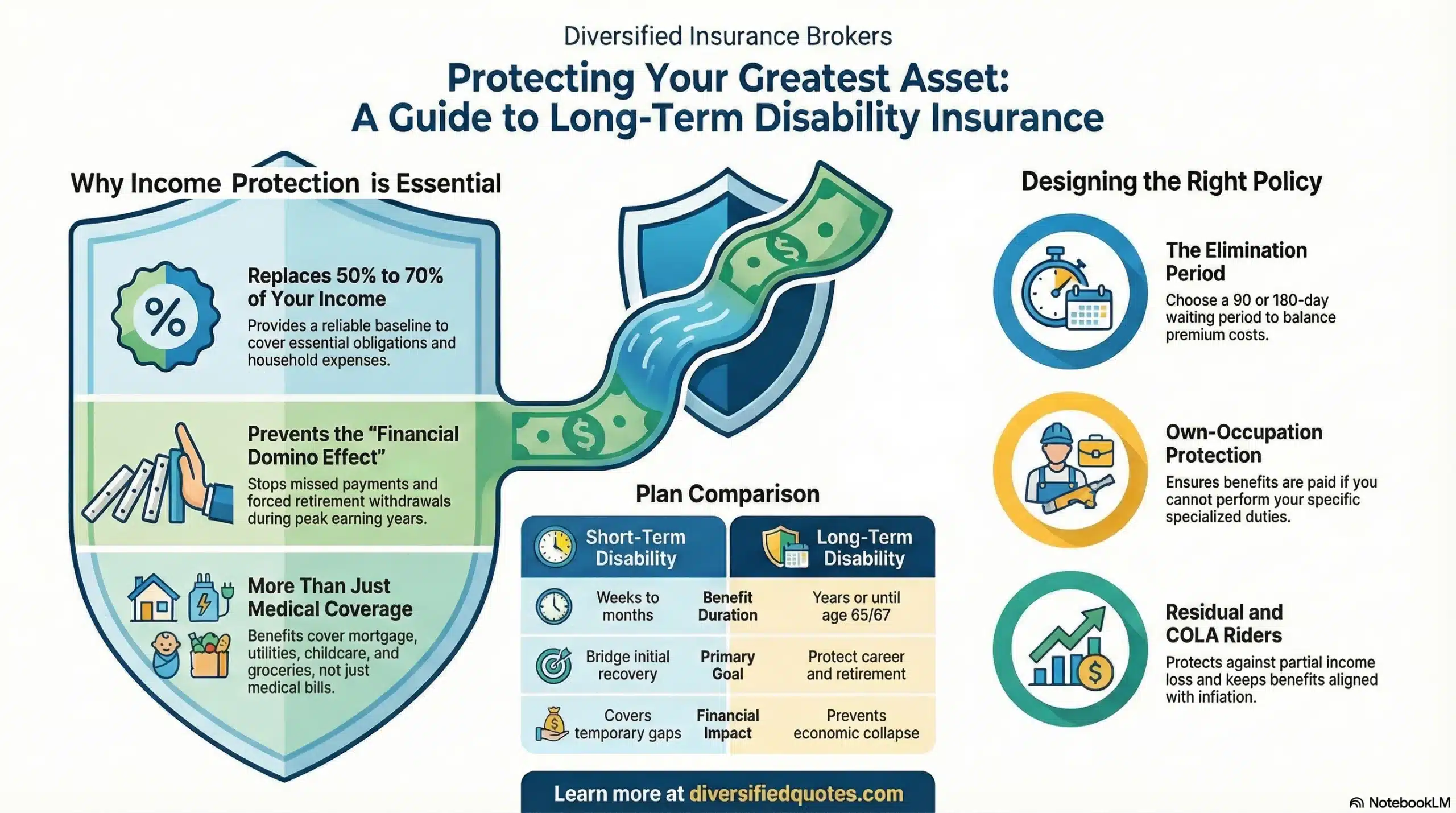
Short-term and long-term disability coverage play very different roles around pregnancy. Short-term coverage, whether through an employer or purchased individually, has a waiting period measured in days or weeks, so it can pay during a normal maternity recovery when the policy covers childbirth. Long-term coverage, with an elimination period measured in months, is designed for longer disabilities and generally pays only when a complication extends the time away from work. Our comparison of short-term versus long-term disability insurance explains how the two fit together.
Individual short-term disability policies differ widely in how they treat pregnancy. Some exclude normal childbirth, some cover it only after the policy has been in force for a stated period, and nearly all exclude a pregnancy that already exists when the policy is purchased. Anyone counting on an individual short-term policy for a planned maternity leave should confirm the pregnancy provisions in writing before buying.
Long-term coverage is where the larger financial risk sits. A serious complication that keeps someone out of work for many months, or a condition that develops during pregnancy and becomes long-lasting, is exactly the kind of event long-term disability insurance is designed to address. That is why the most important step for most women is having individual long-term coverage in place before a pregnancy begins.
State Disability and Paid Leave Programs
Some states provide their own disability coverage that includes pregnancy. California, Hawaii, New Jersey, New York, and Rhode Island operate temporary disability insurance programs that pay partial wage replacement to eligible workers who are unable to work because of a non-work-related disability, including pregnancy and childbirth. Puerto Rico also has a temporary disability program.
A growing number of states have also created paid family and medical leave programs. Depending on the state, these programs may provide benefits for a worker’s own medical recovery after childbirth, time to bond with a new child, or both. Eligibility, benefit amounts, and durations are set by each state and change over time, so the state’s program rules should be checked for current details.
The federal Family and Medical Leave Act is different. It provides eligible employees of covered employers with up to 12 weeks of job-protected leave, but that leave is generally unpaid unless the employee uses accrued paid time off. Job protection and income replacement are separate questions, and disability insurance addresses the income side.
State programs and employer plans often coordinate with one another, and benefits from one may reduce benefits from another. Understanding how they work together in your state is part of building a realistic plan for time away from work around a birth.
Want coverage in place before you start a family?
Get a Disability Quote
Buying Disability Insurance Before, During, and After Pregnancy
When you apply for individual disability insurance matters as much as which policy you choose. Before a pregnancy, a healthy applicant can generally obtain coverage without any pregnancy-related limitation, so a complication that occurs later can be covered like any other illness. That is the ideal time to apply.
During a pregnancy, the picture changes. Individual disability carriers underwrite each applicant, and a current pregnancy is generally treated as a known condition. Depending on the carrier, an applicant who is pregnant may be offered a policy with an exclusion for pregnancy and its complications, or the carrier may postpone a decision until after delivery. A history of complications in a prior pregnancy, such as preeclampsia or preterm labor, can also lead to an exclusion. Our guides on disability insurance with preexisting conditions and on whether disability insurance requires a medical exam explain the underwriting process.
After delivery, many carriers will consider a full offer once the pregnancy is complete and recovery is documented. In some cases, an exclusion placed during pregnancy can later be reviewed for removal after an uncomplicated delivery, if the carrier allows it and updated medical records support it. Practices vary from carrier to carrier, which is one reason the choice of carrier matters for women planning a family.
Because carriers handle pregnancy differently, Jason reviews the timing and each carrier’s approach before an application is submitted, so you know whether to apply now, apply with an expected exclusion, or wait until after delivery for a cleaner offer.
How Pregnancy Shows Up in the Application
Individual disability applications ask about your current health and medical history, and pregnancy is part of that review. Applicants are commonly asked whether they are currently pregnant, and underwriters may review prior pregnancies for complications such as preeclampsia, gestational diabetes, or preterm labor. Medical records and prescription history are often part of the process as well.
Accurate answers matter. A policy issued on incomplete or inaccurate information can be challenged if the carrier later discovers the omission, particularly during the contestable period, which generally runs for the first two years. An application that discloses a current pregnancy may lead to an exclusion or a postponement, but a policy with a clearly stated exclusion is far better than a policy that could be rescinded when it is needed most.
Fertility treatment can also affect underwriting. Applicants who are undergoing or planning fertility treatment may be offered coverage with a pregnancy-related exclusion, depending on the carrier’s guidelines, and the terms for removing such an exclusion vary. Anyone in that situation benefits from discussing carrier options before applying, since the choice of carrier can make a meaningful difference.
Our office reviews these questions with you before an application is submitted, so the disclosures are complete and the carrier selected is the one most likely to offer the best terms for your situation.
Why Women Planning a Family Should Lock In Coverage Early
Buying individual disability insurance before a pregnancy offers more than avoiding an exclusion. A non-cancelable policy locks in the premium and policy terms while you are young and healthy, and those terms cannot be changed by the carrier as long as premiums are paid. That stability matters over a career that may include several pregnancies.
The definition of disability matters too. A true own-occupation disability policy pays if you cannot perform the duties of your specific occupation, which is especially valuable for physicians, dentists, and other professionals whose work requires physical stamina or fine motor skills that a complication could affect.
Riders can also help. A future insurability rider allows benefit increases as income grows without new medical underwriting, which means a pregnancy or complication later in life will not prevent you from increasing coverage to match a higher income. A residual or partial disability rider can pay when you return to work part-time while recovering. Our overview of disability insurance riders covers these options.
For many women, the best time to buy individual coverage is early in their career, when premiums are lowest and health histories are simplest. Securing coverage before starting a family protects both the income and the insurability that make it possible to plan around future pregnancies.
Returning to Work Part-Time After a Complication
Recovery from a pregnancy complication is not always all or nothing. A woman may be able to return to work on a reduced schedule before she is fully recovered, especially in professions that allow flexible hours. Policies with residual or partial disability benefits can pay a portion of the monthly benefit in proportion to the income lost during that period.
Residual benefits are particularly valuable for professionals whose income depends on their own production, such as physicians, dentists, and business owners. A gradual return to work can reduce income for months, and a residual benefit helps bridge that gap. How the benefit is calculated, and whether it requires a period of total disability first, varies by policy.
Some policies also include recovery benefits that continue to pay after you return to work if your income remains reduced because of the disability. Reviewing these provisions with a broker before buying, rather than after a claim, ensures the policy matches how your work and income actually function.
Self-Employed Women and Business Owners
Self-employed women face a particular challenge: there is no employer short-term disability plan to cover a maternity recovery, and no paid leave policy to fall back on. Unless they live in a state with a program that covers self-employed workers who opt in, the income gap during a normal recovery is generally theirs to plan for through savings. Our guide on whether you can get disability insurance if you’re self-employed explains the options.
Individual long-term disability coverage remains important for self-employed women because it protects against the larger risk of a complication or other illness that keeps them out of work for months or years. For business owners, the business itself is also exposed. Rent, staff salaries, and other fixed expenses continue during an extended absence, and business overhead expense coverage can help pay those costs during a covered disability.
Planning for a normal maternity leave usually means setting aside savings to cover the weeks of recovery and any elimination period, while relying on disability insurance for the possibility of a longer disability. Building both into the plan before a pregnancy gives a self-employed woman the most control over her time away from work.
When a Newborn Needs Care
Disability insurance protects your income when you are disabled. It generally does not pay when you stop working to care for someone else, including a newborn with medical needs. That gap surprises many families, because a child’s medical complications can keep a parent home for months even when the parent is fully healthy.
Some programs and policies address it in part. State paid family leave programs in some states provide benefits for caring for a family member or bonding with a new child. In the individual disability market, The Standard’s Platinum Advantage policy includes a Family Care Benefit that can pay when the insured reduces working hours by at least 20% to care for a seriously ill family member, a feature that is unusual among the major carriers. Our review of The Standard Platinum Advantage policy explains how that benefit works and its limits.
For most families, the practical approach is to combine savings, any available paid leave, and an emergency fund for the possibility that a parent needs extended time at home for a child’s care. Understanding where disability insurance applies and where it does not helps families plan for both scenarios.
Coordinating Group, State, and Individual Benefits
Many women have more than one source of disability coverage, and how those sources interact affects what they actually receive. Group long-term disability plans commonly reduce their benefits by other income received for the same disability, such as state disability benefits or Social Security disability benefits. Group short-term plans may also coordinate with state programs in states that have them.
Individual disability policies work differently. A policy you own generally pays its benefit according to its own terms, regardless of what a group plan pays, although carriers consider your existing coverage when deciding how much individual coverage to issue. That independence is one of the main reasons professionals carry individual coverage alongside a group plan.
For a pregnancy-related disability, coordination usually looks like this: a group short-term plan or state program covers the early weeks, and an individual long-term policy begins paying if the disability extends beyond its elimination period. Mapping out those layers in advance shows whether there are gaps, such as an elimination period longer than the short-term coverage, that savings would need to fill.
Taxes on Pregnancy-Related Disability Benefits
Whether disability benefits are taxable depends on who paid the premiums and how. When an employer pays the premiums for a group plan and does not include them in the employee’s taxable income, the benefits are generally taxable to the employee. When the employee pays the premiums with after-tax dollars, the benefits are generally received income tax-free.
Individual disability policies purchased with personal, after-tax dollars generally pay tax-free benefits, which is one reason an individual policy can replace a meaningful share of take-home pay even though it covers only part of gross income. Tax treatment of state disability and paid leave benefits depends on the state program and federal rules, so it is worth confirming with a tax professional.
For women comparing coverage options, tax treatment is part of the true value of each benefit. A group plan that replaces 60% of gross income on a taxable basis delivers less spendable income than an individual policy with the same benefit paid tax-free, and that difference grows during a long recovery.
How Much Coverage You Need
Individual disability insurance typically replaces a portion of your income, often around 60%, with carriers setting limits based on earnings and occupation. The right amount depends on your household budget, other income sources, and how much of your income you would need if you could not work for an extended time. Our guide to how much disability insurance you need walks through that calculation.
For women planning a family, a few factors deserve extra weight. Household expenses often rise with a new child, and childcare costs may continue even during a disability. A two-income household may rely on both incomes for the mortgage and other fixed costs, so the loss of either income for many months can be difficult to absorb.
The elimination period is also a planning choice. A longer elimination period lowers the premium but requires more savings to cover the initial months of a disability. Women who expect to have a short-term plan through work or a state program may choose a 90-day elimination period on an individual policy, letting short-term coverage bridge the gap. Those without short-term coverage may prefer a shorter elimination period or a larger emergency fund.
Life Insurance During Pregnancy
Disability insurance protects your income if you cannot work. Life insurance protects your family if you die. For expecting parents, both matter, and the timing questions are similar. Life insurance is often available during a healthy pregnancy, although underwriting rules vary by carrier and some may adjust their approach based on the stage of pregnancy or any complications.
Our guide to life insurance for pregnant women explains how carriers underwrite expecting mothers, when to apply, and how much coverage new parents typically consider. Many families address both disability and life insurance at the same time, since the same life event, a growing family, raises the need for each.
Coordinating the two also helps with budgeting. Term life insurance for a healthy young parent is often inexpensive, while individual disability insurance costs more because the probability of a disability during a working career is meaningful. Seeing both priced together helps a household decide how to allocate its protection budget.
Already pregnant and wondering what you can still qualify for?
Ask About My Options
Filing a Pregnancy-Related Disability Claim
If a complication keeps you from working, start the claim process early, even before the elimination period ends. Notify your insurer or your employer’s plan administrator promptly, since most policies require notice within a set time after a disability begins, and late notice can complicate a claim.
The claim will require a physician’s statement describing the diagnosis, the restrictions on your activities, the date the disability began, and the expected duration. For complications that begin during pregnancy, the date your physician first restricted your work activity is important because it starts the elimination period. Keep copies of medical records, work restrictions, and any communication with your employer about reduced hours or leave.
If you have more than one source of coverage, such as a group short-term plan, a state program, and an individual long-term policy, file with each one. Benefits may be coordinated or offset, but an individual policy you own generally pays according to its own terms. Having your coverage reviewed in advance makes the process far easier when it matters.
It also helps to keep a simple record during the pregnancy itself. Note the dates of appointments where your physician changed your work restrictions, keep any written restriction notes from your employer, and save the names of the treating providers. If a complication develops after delivery, the same applies to postpartum visits. Those records establish when the disability began and how long it lasted, which are the two facts that decide whether the elimination period has been met. Jason and our office can help you understand what each carrier will ask for, so the claim can move forward without delays while you focus on your health and your new child.
Common Misconceptions About Pregnancy and Disability Insurance
A few misunderstandings come up often. The first is that long-term disability insurance pays for maternity leave. In most cases it does not, because a normal recovery ends before the elimination period. The second is the opposite: that disability insurance never covers anything related to pregnancy. Complications that keep you out of work beyond the elimination period can be covered under a policy without a pregnancy exclusion, just like any other illness.
A third misconception is that the Family and Medical Leave Act provides paid leave. It provides job protection for eligible employees, but the leave is generally unpaid unless you use accrued paid time off. A fourth is that filing a claim will cause an individual policy to be canceled or repriced. A non-cancelable individual policy cannot be canceled or have its premium raised by the carrier as long as premiums are paid, regardless of claims.
A fifth is that a past pregnancy permanently limits your options. Once a pregnancy is complete and recovery is documented, many carriers will consider a full offer, although a history of complications can still affect the terms. The most reliable way to avoid all of these issues is to put individual coverage in place before a pregnancy, and to understand exactly what your group coverage provides.
Questions to Ask About Your Current Coverage
If you are planning a pregnancy, a short review of your current coverage can prevent unpleasant surprises. For an employer short-term plan, ask whether it covers a normal delivery, how long the waiting period is, what percentage of income it replaces, whether there is a weekly maximum, and whether a pre-existing condition limitation applies to new enrollees. For an employer long-term plan, ask about the elimination period, the definition of disability, and which other benefits it offsets.
For an individual policy, check whether it includes a pregnancy exclusion, how the elimination period is counted, how mental health conditions are treated, and whether it includes residual or partial disability benefits. If you live in a state with a disability or paid leave program, confirm your eligibility and how benefits coordinate with your employer’s plan.
Jason can review all of this with you, including the policy language that determines how a complication would be handled, and point out any gaps before a pregnancy rather than after. That review often shows that the most valuable step is simply adding individual long-term coverage while health is good and the pregnancy has not yet begun.
Who Should Plan Ahead
Planning disability coverage around a pregnancy is most important for women whose income is essential to the household, professionals with high earning potential, self-employed women and business owners without employer coverage, and anyone with a history of pregnancy complications or a condition that could make a future pregnancy high-risk.
Physicians, dentists, attorneys, and other professionals early in their careers have particular reason to act early, since individual policies with strong own-occupation definitions are generally easiest to obtain before health histories become complicated. Couples who expect both incomes to support the household should consider coverage for each earner.
Women who already have strong group coverage should still review it carefully. Group benefits may be capped, may be taxable, may end with a job change, and may include pre-existing condition limitations for new enrollees. An individual policy can fill those gaps and stay with you throughout your career.
Women who have already experienced a complicated pregnancy have particular reason to review their coverage before trying again. Existing individual policies bought before that history remain in force on their original terms, which makes them especially valuable to keep, and any new coverage should be shopped carefully across carriers whose guidelines treat that history most favorably.
How Our Office Helps
Jason and our office start by understanding your plans and your current coverage: what your employer provides, whether your state offers a disability or paid leave program, and whether you already own an individual policy. From there, we explain what each source of coverage would pay for a normal delivery and for a complication, and where the gaps are.
If an individual policy makes sense, we compare the major carriers on their definitions of disability, mental health provisions, residual benefits, riders, and, importantly, how each handles pregnancy in underwriting. For applicants who are already pregnant, we explain which carriers are likely to offer coverage with an exclusion, which may postpone, and whether waiting until after delivery would produce a better result.
Because we are independent, our recommendation is based on your situation rather than a single carrier’s product. The goal is coverage that protects your income through every stage of building a family.
Ready to protect your income before, during, and after pregnancy?
Start My Disability Review
Financial Protection Essentials
More ways to protect your income and your growing family.
Talk With an Advisor Today
Choose how you’d like to connect—call or message us, then book a time that works for you.
Schedule here:
calendly.com/jason-dibcompanies/diversified-quotes
Licensed in all 50 states • Fiduciary, family-owned since 1980
Frequently Asked Questions
Will short-term disability pay for my maternity leave?
Often, yes, if you have employer-sponsored short-term disability. Group plans commonly pay for the recovery period your physician certifies after delivery, often about six weeks for a vaginal delivery and eight for a cesarean. Individual short-term policies vary widely and usually exclude a pregnancy that already exists when you buy. Our guide on how to buy short-term disability insurance online explains what to check.
Can I buy individual disability insurance while I’m pregnant?
Often you can, but the policy will usually exclude the current pregnancy and its complications, and some carriers postpone a decision until after delivery. A history of complications in a prior pregnancy can also lead to an exclusion. Applying before a pregnancy is the surest way to avoid these limits. Our guide to getting the best disability insurance rates covers timing and other ways to improve an offer.
Does disability insurance pay if my doctor puts me on bed rest?
It can. Physician-ordered bed rest because of a complication is a medical restriction that can make you disabled under the policy, and the elimination period begins on the date the restriction starts. If the restriction and recovery together last longer than the elimination period, benefits can be payable under a policy without a pregnancy exclusion. How your occupation is defined also matters, as our overview of disability insurance by occupation explains.
I’m a physician planning to start a family. When should I buy coverage?
Before the pregnancy, ideally early in training or practice. Individual policies with strong own-occupation definitions and future increase options are easiest to obtain while your health history is simple, and a policy bought before pregnancy can cover complications that arise later. Our guide to disability insurance for physicians covers the features that matter most for medical professionals.
I own my practice. Who pays the overhead if a complication keeps me out?
Business overhead expense coverage is designed for exactly that situation. It reimburses fixed business expenses such as rent, staff salaries, and utilities during a covered disability, including a pregnancy complication that lasts beyond its elimination period. Like personal disability coverage, it generally will not pay for a normal maternity recovery. Our overview of business overhead expense insurance explains how it works.
I’m a teacher. Does my school district’s disability plan cover pregnancy?
It depends on the plan. Many school districts offer group short-term or long-term disability coverage, and employer plans generally must treat pregnancy-related disability the same as other temporary disabilities. Some districts rely on sick leave banks instead of short-term coverage. Your benefits office can confirm the details. Our guide to disability insurance for teachers covers how educators can fill the gaps.
Will my premium go up after a pregnancy-related claim?
Not on a non-cancelable individual policy. As long as premiums are paid, the carrier cannot raise your premium or change the policy because of a claim. Guaranteed renewable policies can have rates adjusted, but only for an entire class of policyholders rather than for an individual claim. Our page on the best disability insurance rates explains how pricing works.
Can you review my coverage before I start a family?
Yes. Our office can review your employer plan, any state program available to you, and any individual policy you own, and explain what each would pay for a normal delivery and for a complication. If there are gaps, we can compare carriers on how they handle pregnancy in underwriting. You can request a second opinion on your disability coverage to get started.
Does disability insurance cover postpartum depression?
It can, when postpartum depression or another postpartum mood disorder is severe enough to keep you from working beyond the elimination period and is documented by a treating professional. Many policies limit benefits for mental and nervous conditions to a set period, often 24 months, so the policy’s mental health provisions determine how long benefits can last.
About the Author:
Jason Stolz, CLTC, CRPC, DIA, CAA and Chief Underwriter at Diversified Insurance Brokers (NPN 20471358), is a senior insurance and retirement professional with more than 25 years of real-world experience helping individuals, families, and business owners protect their income, assets, and long-term financial stability. As a long-time partner of the nationally licensed independent agency Diversified Insurance Brokers, Jason provides trusted guidance across multiple specialties—including fixed and indexed annuities, long-term care planning, personal and business disability insurance, life insurance solutions, Group Health, Travel Medical and Evacuation Insurance, and short-term health coverage. Diversified Insurance Brokers maintains active contracts with over 100 highly rated insurance carriers, ensuring clients have access to a broad and competitive marketplace.
His practical, education-first approach has earned recognition in publications such as VoyageATL, and contributions from his agency featured in Kiplinger and GoBankingRates— highlighting his commitment to financial clarity and client-focused planning. Drawing on deep product knowledge and years of hands-on field experience, Jason helps clients evaluate carriers, compare strategies, and build retirement and protection plans that are both secure and cost-efficient. Visitors who want to explore current annuity rates and compare options across multiple insurers can also use this annuity quote and comparison tool.
Explore More Disability Insurance Options: Browse our complete guide to Disability Insurance Planning & Education — covering how it works, riders, elimination periods, own occupation, costs & buying guides from 100+ carriers.
Last Reviewed: October 8, 2026 |
Reviewed by: Jason Stolz, CLTC, CRPC, DIA, CAA
Chief Underwriter, Diversified Insurance Brokers, Inc. | NPN: 20471358 | Diversified Insurance Brokers, Inc. — Licensed in all 50 states
Fact Checked by: Tonia Pettitt, CMIP©
Medicare Specialist, Diversified Insurance Brokers, Inc. | NPN: 14374308 | Diversified Insurance Brokers, Inc. — Licensed in all 50 states
Did you find this content helpful? Leave us a Google review — it helps others find trustworthy guidance too.
Editorial Standards: Diversified Insurance Brokers maintains rigorous editorial standards to ensure accuracy, clarity, and independence in all content. Learn more about our editorial standards and commitment to transparency.
