
Is Group Health Insurance Worth It
As an Independent Group Health Insurance Broker, we compare fully insured, level-funded, and self-funded options across carriers to find the lowest cost coverage for your business.
Is Group Health Insurance Worth It

Jason Stolz CLTC, CRPC, DIA, CAA
“Is group health insurance worth it?” is really two questions wearing one trench coat. The first — should a business offer health coverage at all — has a fairly settled answer for most employers: yes, for recruitment, for retention, and for the tax treatment that makes it one of the most efficient forms of compensation a company can offer. The second question is the one that actually determines whether the coverage you end up with is a good deal or a mediocre one, and it’s the one almost nobody asks explicitly: worth it, funded which way? At Diversified Insurance Brokers, we place group health coverage across dozens of carriers and funding structures, and for a large share of small and midsize employers we work with, the honest answer to “which structure is worth it” is level-funded — not because it’s trendy, but because of how it’s actually built. This page walks through exactly how level-funded coverage works, why it can genuinely outperform traditional fully insured plans for the right group, where it isn’t the right answer, and why the structure you choose deserves the same scrutiny as the carrier and the plan design.
Wondering whether level-funded coverage would actually save your business money? Let’s run your group’s real numbers.
Talk to a Group Health Specialist
| Dimension | Fully Insured | Traditional Self-Funded | Level-Funded |
|---|---|---|---|
| Monthly Cost Predictability | Fixed premium | Variable — tracks actual claims | Fixed, like fully insured |
| How Pricing Is Set | Community-rated — age, location, group size only | Your group’s actual health and claims history | Your group’s actual health and claims history |
| Refund If Claims Run Low | None | Yes — full surplus | Yes — surplus refund built in |
| Catastrophic Claim Protection | Built in automatically | Employer must arrange separately | Built into the structure via stop-loss |
| Claims Data Visibility | Little to none | Full | Full |
| Best Fit | Any size; especially higher-risk groups | Larger employers (typically 100+) | Small-to-midsize, reasonably healthy groups |
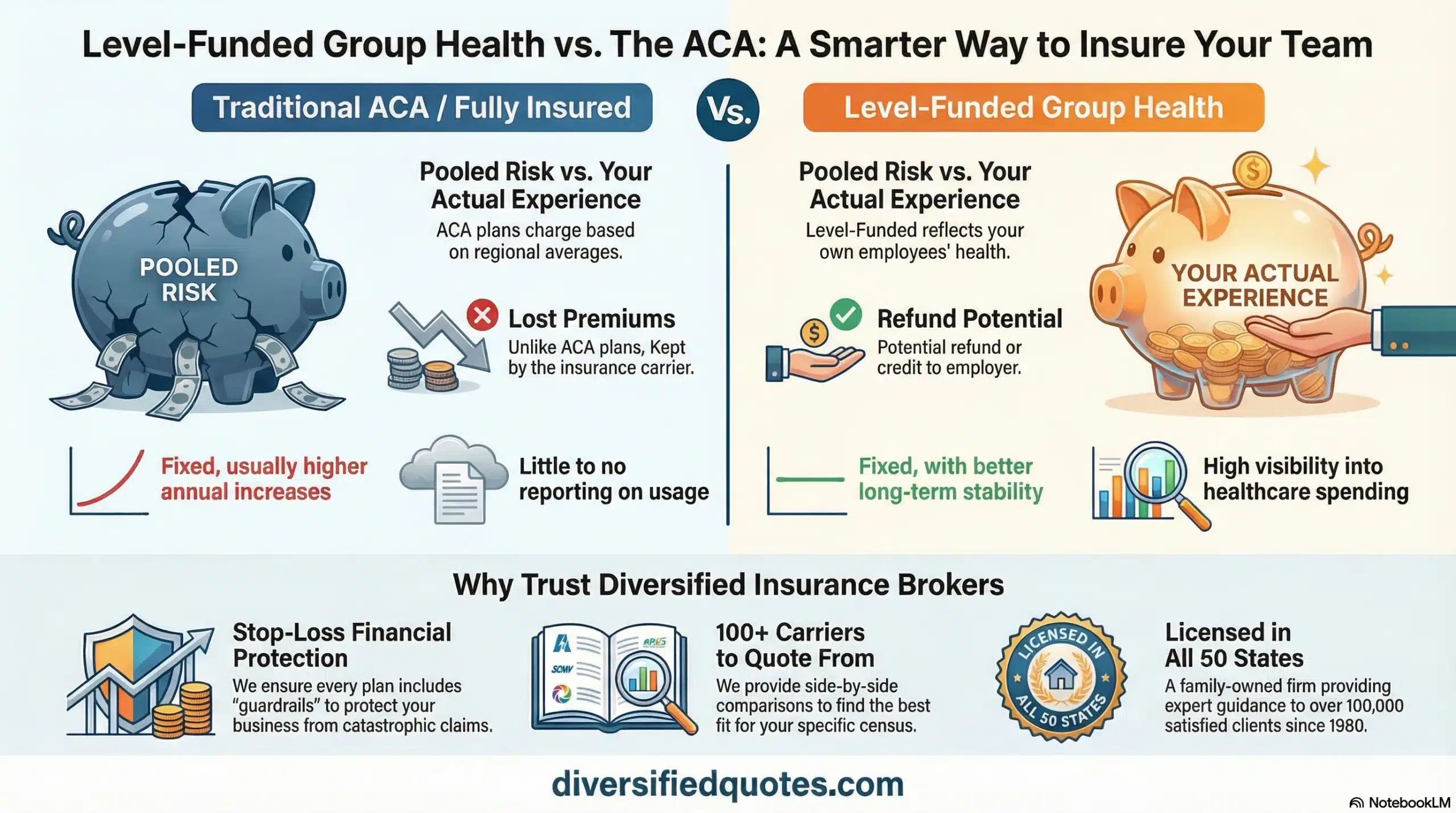
For the majority of small and midsize employers with a reasonably healthy, stable workforce, level-funded coverage wins on the dimensions that matter most day to day: predictable cash flow, a real shot at getting money back, catastrophic protection that’s already built into the structure, and visibility into what’s actually driving costs. It isn’t the right answer for every group, and we’ll cover exactly where it isn’t further down this page — but it’s the structure worth evaluating first for most of the businesses we work with, and the rest of this page explains precisely why, and it should be noted that United Healthcare released a study showing that this type of plan saves employers an average of 22% on company healthcare costs.
Why the Funding Structure Matters More Than the Carrier Logo
Group health costs have been climbing steadily enough that most employers already feel it without needing a statistic to confirm it — but the numbers put real weight behind that feeling. Average employer-sponsored coverage cost roughly $17,500 per employee in 2025, and that figure is expected to climb past $18,500 in 2026. Small-group premium increases have been running in the double digits in many states heading into this year. Against that backdrop, the question of how your coverage is funded — not just which carrier’s name is on the card — has become one of the more consequential decisions a growing business makes, because the funding structure determines whether rising costs get smoothed across a broad pool or reflect your specific group’s actual experience, and whether a good year ever puts money back in your pocket.
What Level-Funded Coverage Actually Is
Level-funded health insurance is a hybrid structure, and understanding exactly how the hybrid is built is what makes the rest of this page make sense. Legally, a level-funded plan is a self-funded plan under ERISA — your business, not an insurance carrier, is technically responsible for paying your employees’ medical claims. But instead of experiencing that responsibility as unpredictable monthly bills the way traditional self-funding does, you pay one fixed amount every month, just like a traditional insurance premium.
That fixed monthly payment is actually three things bundled together: a funded account sized to cover your group’s projected claims for the year, an administrative fee covering plan management and network access, and a stop-loss insurance premium. The stop-loss insurance is what makes the whole arrangement work for a business too small to comfortably absorb a catastrophic claim on its own — it caps your exposure in two directions at once. Specific stop-loss caps how much any single employee’s claims can cost your plan before insurance takes over. Aggregate stop-loss caps your total claims exposure across the whole group for the year. Between the two, a level-funded employer gets most of the predictability of fully insured coverage with almost none of the catastrophic downside of true self-funding.
Then comes the part that makes this structure genuinely attractive rather than merely defensible: if your group’s actual claims come in under what was projected for the year, you generally get some or all of that unused claims fund back. A fully insured plan never does this — every dollar of premium you paid stays with the carrier regardless of how little your employees used the plan. Under a level-funded arrangement, a healthy year is a year you can actually see reflected in your bottom line, not just in your employees’ well-being. Our deeper look at whether small groups can actually get health insurance refunds and our full explanation of how stop-loss insurance works inside a level-funded plan cover both of these mechanics in more depth.
The Real Reason Level-Funded Can Cost Less: The ACA Rating Exemption
This is the single most important thing to understand about why level-funded coverage exists and why it’s grown so quickly, and it comes down to one structural fact most employers have never had explained to them clearly.
Fully insured small-group plans are governed by ACA community rating rules. In practice, that means a carrier pricing a fully insured small-group plan generally cannot use your specific employees’ health history to set your rate — pricing is based on broad factors like age, location, and group size, with every group in a similar profile paying roughly the same amount within that community pool. That’s a genuinely valuable protection for a group with significant health needs, because it means your rate isn’t determined by your own claims experience. But it also means a young, healthy workforce is, in effect, subsidizing less healthy groups within the same rated pool — you’re paying a rate calculated for the average of your risk category, not for your specific group’s actual, lower-than-average risk.
Level-funded plans sit outside those community rating rules, because legally they’re a form of self-funded coverage rather than fully insured coverage. That means a carrier evaluating a level-funded quote can, and typically does, medically underwrite the group — reviewing health questionnaires, prescription drug utilization, and prior claims experience before pricing the plan. For a healthy group, this is exactly the mechanism that produces real savings: you’re being priced on your own group’s actual risk instead of a broader community average that includes less healthy groups. Reported industry results reflect this directly — one major national carrier has reported that employers moving from fully insured to level-funded coverage paid meaningfully less on average, with figures in the range of twenty percent lower premium reported in some analyses. Results vary considerably by group, and any specific number should be treated as illustrative rather than a promise — but the directional advantage for a healthy group is well documented and consistent across the market.
Where Level-Funded Isn’t the Right Answer
Being straightforward about the limits of level-funded coverage is exactly what separates a genuine recommendation from a sales pitch, and there are real situations where a different structure serves a business better.
Level-funded plans are not guaranteed issue. Because the carrier is underwriting your group’s actual health, a workforce with several employees managing expensive chronic conditions — ongoing cancer treatment, dialysis, certain specialty medications — may receive a quote that’s less favorable than the community-rated fully insured alternative, or in some cases may not be offered coverage at all. For a group in that position, fully insured coverage’s community-rating protection is doing exactly the job it’s designed to do, and it may genuinely be the better and even the only workable option.
Renewal can be more volatile. Because a level-funded renewal is priced off your own group’s prior-year claims rather than smoothed across a carrier’s entire community pool, a single difficult claims year — an unexpected major diagnosis, a high-cost NICU stay — can produce a substantially higher renewal than a comparable fully insured plan would see in the same situation. This is the trade-off working exactly as designed, not a flaw, but it’s worth anticipating rather than discovering for the first time at renewal.
Availability varies by state. A handful of states restrict or effectively prohibit level-funded arrangements for small groups through their stop-loss insurance regulations, which means employers in those states remain in the community-rated fully insured market by default. Confirming availability in your specific state before assuming this option is on the table is a necessary first step.
Very small groups can lose access to state continuation coverage. Many state continuation laws — sometimes called mini-COBRA — apply only to fully insured plans. If your business is small enough to fall outside federal COBRA requirements and you move to a level-funded plan, departing employees may lose access to continuation coverage they would otherwise have had. This is a genuinely easy detail to miss, and it’s exactly the kind of thing worth confirming before making the switch rather than after.
Not sure which side of this your business falls on? We’ll tell you honestly, before you commit to either structure.
Get an Honest Funding Assessment
Level-Funded vs. Traditional Self-Funding
It’s worth distinguishing level-funded from full traditional self-funding as well, since the two are related but genuinely different commitments. Traditional self-funding — where a large employer pays actual claims as they occur through a third-party administrator, arranging its own stop-loss coverage separately — generally makes the most sense once a business has enough employees, typically upward of a hundred, to statistically smooth out claims volatility on its own. Below that scale, the built-in, carrier-packaged stop-loss protection inside a level-funded structure does the same essential job without requiring the business to design and manage that protection itself. Our overview of what self-funded group health insurance actually means and our honest look at the pros and cons of self-funding cover this comparison directly, including where the crossover point tends to fall.
The Tax Picture Doesn’t Change — And That’s a Good Thing
One question we hear regularly: does switching to level-funded coverage put any of the standard tax advantages of employer-sponsored health coverage at risk? It doesn’t. Employer contributions toward group health coverage remain deductible as a business expense, and employees continue to receive the coverage on a pre-tax basis, regardless of which funding structure sits underneath the plan. The tax treatment follows the fact that you’re offering group health coverage at all, not the specific mechanism funding it. Our detailed breakdown of level-funded health insurance tax benefits covers this in full, including how it interacts with contribution requirements — our overview of minimum employer contribution requirements is worth reading alongside it if you’re setting up a plan for the first time.
Why This Decision Deserves an Independent Broker, Not a Single Carrier’s Pitch
Here’s something worth understanding about how this decision typically gets made badly: a captive agent or a single carrier’s sales representative can only show you what that one carrier sells. If their company’s strength is fully insured plans, that’s what you’ll be shown, regardless of whether your group would actually be better served by a level-funded structure. If their company pushes level-funded aggressively because the commission structure favors it, that’s what you’ll hear pitched — even for a group whose health profile makes fully insured community rating the smarter, safer choice.
The only way to actually know which structure wins for your specific group is to run both quotes side by side — a genuine fully insured, community-rated quote and a genuine level-funded, medically underwritten quote — and compare the real numbers rather than a generic argument for either one. That comparison is exactly what an independent broker who represents both fully insured and level-funded carriers can do, and it’s precisely why this decision shouldn’t be made based on a single carrier’s presentation. Our overview of why an independent group health broker matters covers this principle in more depth, and it’s the entire premise behind how we approach every group health case we take on.
How We Help
We start every group health conversation the same way: by understanding your workforce’s actual profile — size, general health picture, turnover, and what you’re currently paying — before recommending any specific structure. For groups that look like strong candidates for level-funded coverage, we run real medical underwriting alongside a genuine fully insured quote so you can see the actual dollar difference, not a theoretical one. For groups where the health profile suggests fully insured community rating is the safer, more cost-effective path, we’ll tell you that plainly, even though it’s the less exciting recommendation.
Because we represent carriers across both funding structures rather than being tied to one company’s product line, our recommendation reflects what actually fits your group — not which structure happens to be easiest for us to sell. Our guidance on choosing the right group health plan and getting the best group health rates reflects that same approach, and if you already have coverage in place and want an honest second look at whether it’s still the right structure for your current workforce, our second-opinion review is exactly built for that conversation.
Ready to see the real numbers for your business — fully insured and level-funded, side by side?
Get Your Group Health Comparison
Financial Protection Essentials
Explore group health options by workforce size and industry.
Pick Your Company Size
Not the right headcount? Use the buttons below to jump to the group health page that matches your workforce.
Group Health Insurance for 10 Employees
Small-team pricing, participation strategy, and easy rollout.
Group Health Insurance for 20 Employees
Plan design choices that improve cost control and retention.
Group Health Insurance for 30 Employees
Reduce renewal spikes and address pharmacy cost drivers.
Group Health Insurance for 40 Employees
Better plan efficiency as your claims credibility improves.
Group Health Insurance for 50 Employees
Cost containment strategies and scalable benefit design.
Group Health Insurance for 60 Employees
Improve predictability and reduce waste without cutting benefits.
Group Health Insurance for 70 Employees
Funding choices that reduce renewal volatility as you grow.
Group Health Insurance for 80 Employees
Plan design and vendor strategy to control cost trends.
Group Health Insurance for 90 Employees
Prepare for 100+ pricing leverage and stabilize renewals.
Group Health Insurance for 100 Employees
A major transition point: funding options expand and plan design matters more.
Group Health Insurance for 150 Employees
More claims credibility means more leverage — optimize funding and reduce overpaying.
Group Health Insurance for 250 Employees
Advanced funding and transparency strategies for stronger cost control.
Group Health Insurance for 500 Employees
Enterprise approach: analytics, vendor oversight, and smarter funding strategy.
Group Health Insurance for 750 Employees
Scaled cost-control with deeper data visibility and targeted interventions.
Group Health Insurance for Over 1,000 Employees
Enterprise governance, advanced funding, and high-impact cost management.
Talk With an Advisor Today
Choose how you’d like to connect—call or message us, then book a time that works for you.
Schedule here:
calendly.com/jason-dibcompanies/diversified-quotes
Licensed in all 50 states • Fiduciary, family-owned since 1980
Is offering group health insurance actually worth it for a small business?
For most employers, yes — group health coverage remains one of the most tax-efficient forms of compensation available, and it’s frequently a deciding factor for candidates comparing job offers. The more consequential question, though, isn’t whether to offer coverage but how to fund it, since the funding structure has a much bigger effect on your actual cost and flexibility than most employers realize. For a large share of small and midsize employers with a reasonably healthy, stable workforce, level-funded coverage is worth serious consideration specifically because of how it’s structured — fixed, predictable monthly costs like a fully insured plan, but with the potential to get money back if your group’s claims run lower than expected, something a traditional fully insured plan never offers. Our overview of why employers buy group health coverage covers the broader case in more depth.
What exactly is a level-funded health plan?
A level-funded plan is a hybrid between fully insured and self-funded coverage. Legally, it’s a self-funded plan under ERISA, meaning your business is technically responsible for paying employee medical claims — but instead of unpredictable monthly bills, you pay one fixed amount every month, just like a traditional premium. That fixed payment bundles together a funded account sized to your group’s projected claims for the year, an administrative fee, and a stop-loss insurance premium. The stop-loss coverage caps your exposure — both per individual employee and in total across the group — which is what makes self-funded-style coverage viable for a business too small to comfortably absorb a catastrophic claim on its own. If your group’s actual claims come in under the projection, you generally get some or all of the unused claims fund back at year-end.
Why can level-funded plans be cheaper than fully insured coverage?
Because of a specific structural fact: fully insured small-group plans are governed by ACA community rating rules, meaning a carrier generally can’t price your plan based on your specific employees’ health — pricing is based on broad factors like age, location, and group size, with your group paying a rate calculated for the average of your risk category. Level-funded plans sit outside those rules because they’re legally self-funded, so a carrier can medically underwrite your specific group before pricing it. For a healthy workforce, this means being priced on your own group’s actual, lower-than-average risk rather than a broader community average. Reported industry results show this producing meaningful savings for healthy groups moving from fully insured to level-funded coverage, though the exact figure varies considerably by group and should always be confirmed with real numbers for your specific workforce rather than assumed from an industry average.
When is level-funded coverage NOT the right choice?
A few situations genuinely favor staying with fully insured, community-rated coverage instead. If your workforce includes several employees managing expensive ongoing conditions, level-funded underwriting may produce a less favorable quote than the community-rated alternative, or coverage may not be offered at all, since level-funded plans are not guaranteed issue the way ACA small-group coverage is. Renewal pricing on a level-funded plan is also tied to your own group’s prior-year claims rather than smoothed across a carrier’s full community pool, so a single difficult claims year can produce a meaningfully higher renewal than a comparable fully insured plan would see. A handful of states restrict level-funded arrangements for small groups through their stop-loss regulations, so availability should always be confirmed for your specific state. And very small employers who fall outside federal COBRA requirements can lose access to state continuation coverage when moving to a level-funded plan, since many state continuation laws apply only to fully insured coverage.
How is level-funded different from traditional self-funded health insurance?
Traditional self-funding, where a large employer pays actual claims as they occur through a third-party administrator and arranges its own stop-loss coverage separately, generally makes sense once a business has enough employees, typically upward of a hundred, to statistically smooth out claims volatility on its own. Level-funded coverage packages the same essential protection — a funded claims account plus stop-loss insurance — into a fixed, carrier-managed monthly payment that doesn’t require a smaller employer to design and manage that protection itself. In practice, level-funded is the version of self-funding built specifically to work for businesses too small to comfortably take on traditional self-funded risk directly. Our overview of what self-funded group health insurance means covers the full comparison.
Does switching to level-funded coverage change the tax treatment of our health benefits?
No. Employer contributions toward group health coverage remain deductible as a business expense, and employees continue to receive the coverage on a pre-tax basis, regardless of which funding structure sits underneath the plan. The tax treatment follows the fact that you’re offering group health coverage at all, not the specific mechanism funding it. Our detailed breakdown of level-funded health insurance tax benefits covers this in full.
How small can a group be and still qualify for level-funded coverage?
Smaller than most employers assume. Carriers have moved level-funded designs steadily down-market, and groups as small as five to ten employees can often access this coverage in many states, though the exact minimum group size, and whether it’s offered at all, varies by carrier and by state. Very small groups do face somewhat more underwriting scrutiny, since there’s less claims data and less statistical predictability to work with at that scale — but it’s worth checking directly rather than assuming your business is too small, since the eligibility threshold has dropped considerably as this coverage type has grown more common.
Why should I use an independent broker instead of going straight to a carrier?
Because a single carrier’s representative can only show you what that one company sells, regardless of whether it’s actually the best structure for your group. If their company’s strength is fully insured plans, that’s what you’ll be shown; if their commission structure favors level-funded, that’s what gets pitched — even to a group whose health profile makes community-rated fully insured coverage the smarter, safer choice. The only way to actually know which structure wins for your specific group is to run a genuine fully insured quote and a genuine level-funded quote side by side and compare the real numbers, which is exactly what an independent broker representing both types of carriers can do. Our overview of why an independent group health broker matters covers this in more depth.
About the Author:
Jason Stolz, CLTC, CRPC, DIA, CAA and Chief Underwriter at Diversified Insurance Brokers (NPN 20471358), is a senior insurance and retirement professional with more than 25 years of real-world experience helping individuals, families, and business owners protect their income, assets, and long-term financial stability. As a long-time partner of the nationally licensed independent agency Diversified Insurance Brokers, Jason provides trusted guidance across multiple specialties—including fixed and indexed annuities, long-term care planning, personal and business disability insurance, life insurance solutions, Group Health, Travel Medical and Evacuation Insurance, and short-term health coverage. Diversified Insurance Brokers maintains active contracts with over 100 highly rated insurance carriers, ensuring clients have access to a broad and competitive marketplace.
His practical, education-first approach has earned recognition in publications such as VoyageATL, and contributions from his agency featured in Kiplinger and GoBankingRates— highlighting his commitment to financial clarity and client-focused planning. Drawing on deep product knowledge and years of hands-on field experience, Jason helps clients evaluate carriers, compare strategies, and build retirement and protection plans that are both secure and cost-efficient. Visitors who want to explore current annuity rates and compare options across multiple insurers can also use this annuity quote and comparison tool.
Explore More Group Health Insurance Options: Browse our complete guide to Level Funding, Self-Funded & ACA Alternatives — covering stop-loss coverage, tax benefits, 1099 options & ACA alternatives from 100+ carriers.
Last Reviewed: August 26, 2026 |
Reviewed by: Jason Stolz, CLTC, CRPC, DIA, CAA
Chief Underwriter, Diversified Insurance Brokers, Inc. | NPN: 20471358 | Diversified Insurance Brokers, Inc. — Licensed in all 50 states
Fact Checked by: Tonia Pettitt, CMIP©
Medicare Specialist, Diversified Insurance Brokers, Inc. | NPN: 14374308 | Diversified Insurance Brokers, Inc. — Licensed in all 50 states
Did you find this content helpful? Leave us a Google review — it helps others find trustworthy guidance too.
Editorial Standards: Diversified Insurance Brokers maintains rigorous editorial standards to ensure accuracy, clarity, and independence in all content. Learn more about our editorial standards and commitment to transparency.
